

I made my second visit to the ancient Silk Road City of Bukhara on October 20-21. We were with old friends Claudiu, Vesna, Mark, and Tudor who were visiting from Romania. Bukhara is 5,000 years old and is a designated UNESCO World Heritage Site with 140 architectural monuments. It is an absolutely magnificent and exotic citadel that gives modern people a glimpse of what it was like on the Silk Road. October is a nice time to visit as the heat of summer has abated. We had a bit more time to explore the city on this visit as I was not in charge of a large delegation. Claudiu and Vesna are history buffs like I am so it was great to listen to our guide and she answered all of my questions.

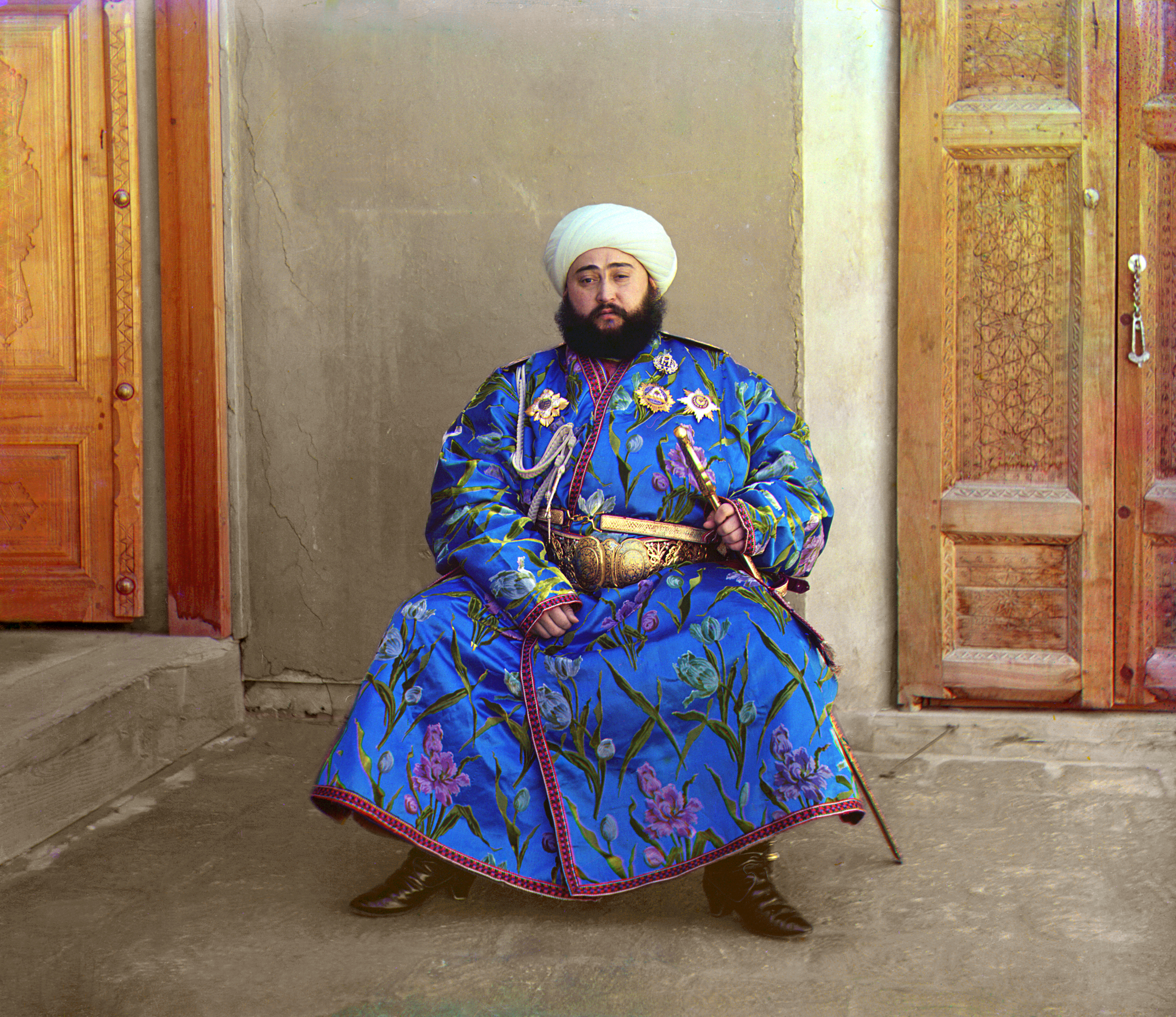
On this visit, I was particularly interested in visiting sites related to the last Emir of Bukhara, Alim Khan. I recently read a biography of Ghengis Khan, and Alim Khan was the last descendent of Ghengis to rule something, over 700 years after his death. Poor Alim had to flee Bukhara in September of 1920 as Red Army troops stormed the Ark and raised their flag on top of Kalyan Minaret. He eventually found exile in Kabul and died in 1940. I found a couple of photos of him posted at some of the sites and he has a madrassa/museum named after him. The Russian chemist/pioneer photographer Sergey Prokudin took the color photo below of the Emir in 1911. I wonder what kind of person he was and what kind of life he lived. I find it amazing that a khanate would last into the 20th century, but then we have the Sultanate of Brunei still existing today as well as Saudi Arabia and the Gulf Region monarchies. Amazing color photography for 1911! I have to look up other Uzbekistan photographs taken by Prokudin.
One of my favorite parts of the tour was visiting the old Jewish Quarter. Sadly, almost all of the Bukharan Jews are gone today. They originally came to the region in the 6th century (500s) coming out of Persia. They more or less were OK for 1000 years and spread out through Iran, Afghanistan, and Central Asia. Due to persecution from Muslims, eventually, they were isolated in the Khanate of Bukhara. In the mid-1800s, they started moving to Palestine and there is still a Bukharan Quarter in Jerusalem today named after the section where they originally settled. They also suffered under the Soviets, an atheist government. Over the years, they moved on to Israel and the United States. Today, some of their homes have been converted into hotels and are preserved like museums. We visited a couple of them and it really was awesome to get a sense of how they lived.
The walking tour of Bukhara included learning about the famous ornate, wood, carved doors. The doors had two brass knockers, one for men and one for women. If a man knocked using the male knocker and a woman was the only one home, she would go to the door and use the inside female brass knocker to tell the man that she couldn’t open the door.

We toured The Ark or Fortress. When Nadia and I were here in May, much of it was under construction. This time, it was open and it afforded us breathtaking views of the old city. We finished the day having a cup of tea overlooking the plaza inside the old city. Bukhara was truly awesome as it gives one a sense of what it was like so many years ago. I can imagine traveling through the Kyzl Kym (Red Sands) Desert for weeks to come up to the oasis of Bukhara. Seeing the Kaylan Tower in the distance must have been comforting for travelers.

 Bill's Blog