
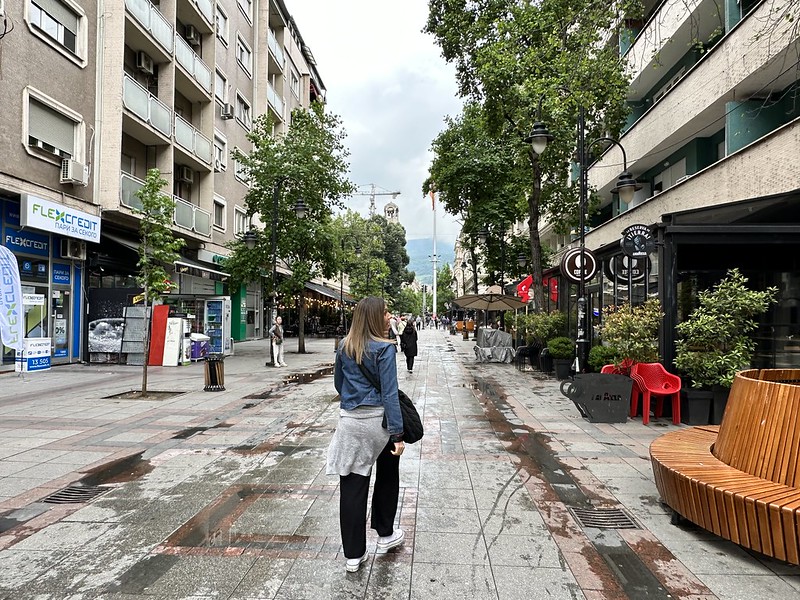
This is my third visit to the capital city of Skopje. The last time I was here was about 10 years ago, however, it was then capital of The Former Yugoslav Republic of Macedonia. Today it is the Republic of North Macedonia due to a compromise made by Greece and North Macedonia. Greece has a problem with the country using “Macedonia” because it is a region in Greece and historically associated with Greek culture. Greece was blocking Macedonia’s application to the European Union and NATO. The two countries signed an agreement on the shores of Lake Prespa in 2018 for Macedonia to change the name of the country in exchange for Greece allowing Macedonia to join NATO and the EU. North Macedonia has been a member of NATO since 2020 and has been in negotiations with the EU since July 2022. In my research, I learned the origin of the word Μακεδόνες may come from the Greek adjective “tall” which is appropriate for the Balkans. The South Slavs are a tall people!
North Macedonia is a tiny country of 1.8 million people. The Macedonians are a Slavic people. Their language uses a Cyrillic script and is mutually intelligible with Bulgarian. In reading a bit about the history of the Macedonians, they were usually under the control of a larger, outside empire, most recently the Bulgarians, Serbs, and Ottomans. All of the people of the Balkans are related linguistically and genetically to varying degrees. The Macedonians are probably closest to the Bulgarians and are sometimes called “Western Bulgarians”. The country first became independent in 1991, escaping peacefully from the breakup of Yugoslavia. I worry about the 25% Albanian minority population of the country. The relationship was destabilized with Kosovo’s breakaway from Serbia. The Slavic Macedonian group composes about 2/3 of North Macedonia. The two groups signed an agreement in 2001 preserving the minority Albanian rights and giving them some autonomy within the country. One of the big challenges is the economic disparity and the cultural differences between ethnic Albanians and ethnic Macedonians. I can see the lighted Christian cross shining over the city from the nearby mountains, similar to the cross in Bethlehem, Pennsylvania. I sense it is there to remind everyone that is a Christian nation.

Nadia and I flew to Skopje overnight through Istanbul. We had a quiet day exploring the city in the morning and sleeping in the afternoon. I am here for school leadership meetings of our regional association of international schools. The spring meetings coincided with our Victory and Remembrance Day holidays that are taking place today throughout the former Soviet Union Republics. The Russians mark May 9 as the anniversary of the World War II victory over Nazi Germany. We took advantage of the school holidays for Nadia to come with me. Often, school directors are accompanied by their partners, but Nadia is usually teaching and not able to attend. I hope to blog more about our experiences in North Macedonia this weekend.
* Part of the Prespa agreement was to not to proclaim Alexander the Great as Macedonian so the name of the statue was changed from “Alexander” to “Man or Soldier”.
 Bill's Blog