

I absolutely loved Erik Larson’s “The Demon of Unrest: A Saga of Hubris, Heartbreak, and Heroism at the Dawn of the Civil War“. I was always curious about the start of the Civil War and Larson’s research is fascinating. He always puts together a compelling narrative and this story is a page-turner.
It is fascinating to the point where a dispute or conflict becomes an all-out war. What is the trigger that pushes incidents and skirmishes to everyone on both sides deciding to go to war. It reminds me of the outbreak of the Balkan Wars in the 1990s and the attack on the Holiday Inn in Sarajevo. Larson uses Fort Sumter, a federal fort protecting the Charleson, South Carolina harbor as the Holiday Inn of the American Civil War. The book is also wide-ranging and follows many characters and settings, including Lincoln taking office in DC, the various secession conventions in the southern states, etc.
The book also left no doubt in my mind that the American Civil War was mostly about the question of slavery. Most people and more importantly, most leaders in the northern states were abolitionists and could not live in a country that permitted slavery. I can’t believe slavery lasted so long in the United States. This was 1860, which was only 164 years ago. The society and culture that grew around the cotton plantations and slavery was so different from the rest of the Union. I now see why we had to go to war to keep the country together. I am glad they sorted it out 100 years before my birth and today, the United States of America has the largest economy in the world and is a beacon of individual rights and rule of law for the world. We would have been a lesser nation split into two.
History does not look favorably on President James Buchanon (1857-1861). He did not take strong measures to reign in the South and support keeping the Union together. I learned of the Ghost/Shadow or Corwin Amendment, that he tried to push through that would have tolerated slavery within the Union. It never was ratified by the states due to the outbreak of the war, despite being passed by both houses of Congress. The amendment was a product of a “Peace Convention” where 133 delegates from 14 free states and 7 slave states gathered to try to reach a compromise to keep the Union together.
The saying that history repeats itself is a cliche, but the book describes the certification of the electoral vote of 1861. There was concern that Buchanon’s Vice President, the Southern Democrat John Breckinridge, would stage a mutiny or suppress the session of Congress to ratify the results of the election. This is part of what sparked the January 6, 2020 riots in the Capital building. It is a quirk of the Consitution needing Congress to officially certify of the results the election that took place several months before. I would abolish it. If this year’s vote is close and the Republicans lose, there will once again be tumult in January. It is also interesting that the Vice President was often an opposing party member back then, unlike today where it is the same party.
Through the book, I was noting the order of the Southern states that were seceding. South Carolina was the first state, followed by Mississippi, Alabama, and Louisiana. In the official declaration of Mississippi after the 84-15 vote in favor of leaving the Union, they wrote,
“Our position is thoroughly identified with the institution of slavery – the greatest material interest of the world…Its labor supplies the product which constitutes by far the largest and most important portions of commerce of the earth. These products are peculiar to the climate verging on the tropical regions, and by an imperious law of nature, none but the black race can bear exposure to the tropical sun. These products have become necessities of the world, and a blow at slavery is a blow at commerce and civilization.”
With a mindset like that, I see why the Civil War started. Mississippi’s leaders viewed Lincoln and the northern Republicans as a threat to their livelihood and way of life. Other deep south slave states felt the same and many of them broke away from the Union even before Lincoln started his term. Slavery is abhorrent and I see Lincoln and the north really had no choice. The wife of Buchanon’s Secretary of State Henry Seward, Frances Adeline Seward criticizing her husband’s compromise of allowing slavery within the Union wrote the following.
“Compromises based on the idea that the preservation of the Union is more important than the Liberty of nearly 4 million human beings cannot be right – The alteration of the Constitution to perpetuate slavery – the enforcement of a Law to recapture a poor, suffering fugitive – giving half of the Frontier of a free Country to the curse of Slavery – these compromises cannot be approved by God or supported by good men.”
- The Montgomery Daily Post newspaper advertised “Negro Dogs” for rent at $5 per day and $10 for each slave that they caught. Absolutely disgusting.
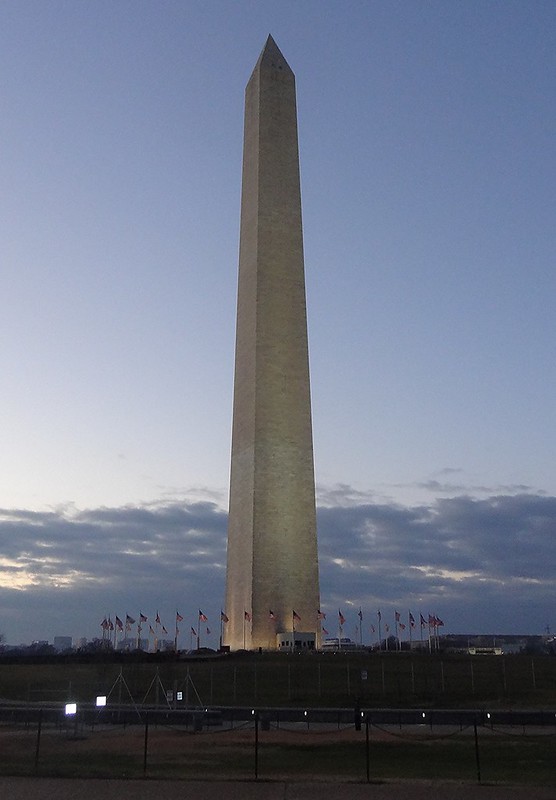
- I never noticed it, but I learned that the Washington Monument has two tones of marble. Construction started in 1848 with enslaved labor but stopped in 1858 due to the secession crisis. It did not resume until after the Civil War with paid labor using a different color of marble.
- Transportation and technology were so slow back then. There was no electricity and no microphones so many people relied on newspapers to learn what President Lincoln said in a speech, even events they attended but couldn’t get close enough to the stage. Transport was by train and horse and Lincoln’s journey from Illinois to Washington DC, took a long time!
- Like today, the president was surrounded by lots of people with opinions, often many of them with wrong opinions. A skillful leader needs to know when to take advice and when not to. Lincoln’s security advisor was a self-centered, pompous, idiot.
In reflecting on the Civil War, I can see why the Confederacy was so devastated by its defeat. They had built their society, culture, and lifestyle around cotton plantations and the use of slave labor. From a broader perspective, it’s difficult to understand how they could have expected to win. Perhaps they believed the Union would not be united or determined enough to mount a full-scale national effort to defeat the South. The odds were stacked against them: the Confederacy had only around 5.5 million free citizens (plus 3.5 million enslaved people) compared to a population of 22 million in the industrialized North, including the four border slave states (Maryland, Delaware, Kentucky, and Missouri) that remained in the Union. The human cost of the war was staggering – about 2% of Americans died, which today would be equivalent to about 7 million people.
I feel pride in Michigan and the North for standing up for human rights and fighting against the abhorrent practice of enslaving fellow humans. Abraham Lincoln is rightly enshrined as one of our great presidents for his leadership during this pivotal time. However, even though slavery was abolished, a cultural divide between “North” and “South” persists, though it has shifted to more of a coastal versus interior split. My Great Lakes region is still considered “Northern,” but faces its own internal cultural challenges. The divide is no longer between cotton plantations and industrial centers, but more between urban, highly educated, diverse communities and rural areas with more hands-on jobs and homogeneous populations. Racism continues to be a factor, partly due to demographic changes as white Americans become a minority and some resist this change.
 Bill's Blog