Latest Reading: The Heat Will Kill You First

I savored reading Jeff Goodell’s “The Heat Will Kill You First: Life and Death on a Scorched Planet.” He gives the reader a complete picture of global warming through the stories of individuals. The chapters cover all aspects of the impact on our lives and the environment of rising global temperatures. This includes the following chapters:

  • how humans evolved to handle the heat
  • increased deaths due to heat stroke
  • cities becoming urban heat islands
  • animals moving north and south toward cooler temperatures
  • heat waves and the basic physics of heat and temperatures
  • declining agricultural production
  • hotter oceans
  • outdoor workers’ deaths
  • the melting West Antarctic ice shelf
  • mosquitos spreading disease
  • impact of air conditioning
  • the value of trees and white streets

This might be the story of my lifetime. I’ve been ahead of the curve regarding awareness of what a warming planet will have on our lives. I finally feel the majority of people are realizing how much our lives will possibly be diminished. One of the challenges of humanity getting its act together and reducing the amount of CO2 we are putting into the environment is that it is a slow-moving phenomenon and it doesn’t sound drastic enough. A rise in the average global temperature of 1 to 4 degrees Celcius doesn’t sound all that menacing. However, the impact of that, although not existential for humanity, will make our lives less pleasurable and rich. Society has been putting CO2 in the atmosphere since before I was born and global warming started when I was a child. However, in my over 50 years on the planet, I’ve seen how there is less snow, less precipitation, warmer winters, and summers, and more natural disasters (hurricanes, drought, flooding, etc.) over my lifetime. I wonder if this process will speed up in my later years if I am still alive. Currently, humanity is more than halfway to 3.6 degrees C increase, at 2 degrees C increase. And that temperature is locked in for years until CO2 dissipates.

Goodell’s chapter on tree planting to combat climate change really helped my thinking on the power of trees. As a school leader, I’ve always planted trees on campus and made a big deal about it with the students. I liked the symbolism of delayed gratification, future thinking, schools planting the seed, and the fruits being the student’s path to adulthood, etc. I am now adding that the planting of trees is important for cooling the planet. Cities can be urban heat islands and trees can reduce temperatures greatly. They also provide shade for plants and wildlife. I also think trees calm children and adults, improving mental health. Goodell refers to a study in the city of Portland. Rich neighborhoods with trees are 25 degrees F cooler than poorer neighborhoods without trees.

Heat waves will be more common in the years to come and I want to understand them better. The military developed a more accurate measure of heat stress than heat index. The wet bulb globe temperature (WBGT). It takes into account temperature, humidity, wind speed, and solar radiation. Goodell used the example of a day in his residence in Austin, Texas. Air temperature of 95 degrees, humidity of 40%, and a light wind. The heat index would be 99, but due to the light cloud cover and relatively low humidity, the WBGT is only 86.4.

UK climate scientist Friederike Otto advises during a heat wave, close windows and draw curtains early in the day to keep out both the sun and heat. Below are some other points that were interesting to me. Overall, a great book that gives a complete and emotional picture of climate change.

  • The mathematician and scholar Al-Bīrunī was the first person to divide hours into minutes and seconds. I am amazed at the innovative thinking of ancient Islamic scientists and mathematicians. I wonder why they still are not at the cutting edge of science, mathematics, and technology.
  • Heat is the vibration of molecules. Temperature is the average speed of a collection of molecules.
  • NASA scientist James Hansen testified before US Congress in 1988 detecting a global warming of 0.4C. He is considered the grandfather of climate science.
  • Exxon Mobil is responsible for 3% of historical global CO2 emissions.
  • I didn’t know that Anders Celcius originally designed the scale in the opposite order from today, 0C was the boiling point of water and 100C was the freezing point.
  • By 2050, the world’s population will be nearly 10 billion. I wonder if that will be the peak of the global population?
  • A Cornell University study found global crop production is 21 percent less today due to climate change. I immediately thought of Interstellar.
  • If the West Antarctic deglaciates, there will be a 5-meter rise in sea level.
  • Mosquito-borne diseases are going to be on the rise as Aedes aegypti spreads north. The ordinary mosquito is from the Culex genus.
  • Some tick species are moving as much as 30 miles north each year. Crimean Congo Hemorrhagic Fever (CCHF) is spread by the Hyalomma genus ticks. They are predators, not like deer or wood ticks that wait on grass to be picked up by a passerby.

Latest Reading: Talking To Strangers

I read Malcolm Gladwell’s 2019 book, Talking to Strangers: What We Should Know About the People We Don’t Know. I read through the book through my professional lens. As an international school leader, annually a significant portion of the school community are “strangers”. Around 20% of the school community changes every year, including 100 new students and their families and approximately 15 new employees. Sizing up and quickly connecting to new people is a valuable skill. Gladwell’s premise of the book is that humans are not very good at it! We evolved to automatically trust people as a survival mechanism. It is easier to live one’s life not having the constant worry of strangers. I believe that most people are not out to hurt others or are not deceiving others.

This really comes into play in recruiting. Recruiters need to be open to signals or red flags of candidates. This is a change to our every day, trusting mindset. Gladwell goes through many examples of how even people trained in deception, ie spies and judges, get it wrong often. Gladwell is a genius at weaving history and news stories into a coherent narrative. He uses British politicians trying to figure out Hitler’s motives just before World War II, to the example of Amanda Knox, the American student wrongly accused of murder during her year abroad in Italy. Below is a list of my takeaways from the book.

  • Amanda Knox’s facial expressions and emotional responses didn’t match the stereotypical responses we think people should exhibit with grief, guilt, remorse, etc. Studies show that it is impossible to discern the truth based on a person’s body or facial language consistently. I see this most often with teenage boys. They do not have the emotional maturity to respond to events “appropriately” or express their feelings, both physically and verbally. It made it difficult for me as a principal while I was investigating behavior issues.
  • There was a fascinating chapter on university drinking culture and consensus. It is difficult to evaluate the truth between young men and women when they have been drinking and there are accusations of sexual misconduct. “Drinking puts you at the mercy of your environment. It crowds out everything except the most immediate experiences.” In other words, being inebriated clouds your perception and judgment. It also impacts your memory as alcohol inhibits the hippocampus from forming memories. Scientists now think that alcohol doesn’t lower your inhibitions but instead, impacts your brain to think in the short-term (alcoholic myopia).
  • “Having a meal in your stomach when you drink reduces your peak BAC (blood alcohol content) by a third.”
  • “How can we expect students to respect boundaries when no consensus exists as to what they are?” Lori Shaw, legal scholar
  • The idea of “coupling” means a behavior is linked to the circumstances and conditions available. The key example was more women committed suicide in the UK when it was easy to do so by using the cooking gas in British homes. Once a cleaner gas was used by municipalities, the suicide rate dropped. The same today with guns and men in America. About 40,000 Americans commit suicide every year, half of whom do so by shooting themselves. Banning handguns would conservatively save 10,000 lives a year.

My major takeaway from the book is to force myself to question my perceptions during recruiting. Use data, references, past work history instead of totally relying on my gut instinct.

Orthodox Christmas

Christmas Mass – January 7, 2024

Last Sunday, January 7 I attended the Russian Orthodox Christmas mass at the Cathedral of the Assumption of the Virgin in Tashkent. Orthodox churches are designed to be inspire awe and people to reflect on the majesty of God. It worked on me as I was a bit swept away as I listened to the hymns while the priest was giving communion. It is a beautiful setting as you can see above with the lighted dome, the colorful Orthodox icons and the lighted birth scene of Jesus. An Orthodox mass is much different to the Catholic mass I am used to. There are no pews and people seem to be doing their own thing often, paying respects to the various icon stations are the cathedral and lighting candles while people were receiving communion.

On special occasions like Easter and Christmas, Tashkent police and military provide security in front of the church. Although there has not been a terrorist attack in Uzbekistan in many years, this is a predominately Islamic country. There have been a number of new mosques constructed throughout the city over my 4 years living here and the practice of Islam is growing. The government has a huge police force that monitors for any signs of religious violence. It is nice that there is religious diversity here and a thriving Russian Orthodox parish in the city. In many Islamic countries, other religions are driven out. There are a couple of other Orthodox churches and monasteries in Tashkent. Sadly, the Bukharan Jews have mostly left Central Asia. The old Jewish Quarter is a fascinating area preserved in Bukhara which I visited in October. The former synagogue is preserved here in Tashkent, but there are no longer any Jews in Tashkent. There are also several Korean Christian Churches in Tashkent as well.

I was curious about the percentage of ethnic Russians that live in Tashkent. I often see many people who look Russian with fair skin and hair and light eyes. A friend referred me to this August 2021 article that reports population figures from the State Committee on Statistics. In the census published on January 1, 2021, you can see the national composition below. At the time, the total population of Uzbekistan was counted as 34.6 million.

  • 84% Uzbek
  • 3% Tajik
  • 1.4% Kazakh
  • 750,000 Karakalpaks (an ethnic group mostly living in the far west of Uzbekistan near the Aral Sea)
  • 720,000 “Russians” – The Uzbek government used to list the “nationality” of a person in passports, but this is no longer practiced.
  • 174,000 Koreans

The article goes on to say that the number of Russians has halved since the country became independent in 1991. Most left in the early days for economic reasons and the uncertainty of what would become of the new country. Most of the Russians lived in Tashkent when it was Uzbek SSR with 37% (850,000) of the city being Russians. Today it dropped to 105,000 (2.6%). This is less than I expected and the Causcasian people I see may be Tatars (south central Russian region), ethnic Ukrainians, or ethnic Greeks. I live on the more Russian side of the city in Mirabad so that may have influenced my perception.

I find it endearing that Eastern Orthodox Christians still use the Julian Calendar, even though it has been replaced by the rest of the world with the more accurate Gregorian Calendar. I think they do this because the development of Gregorian Calendar was commisioned by Pope Gregory III, and it looked like the Roman Catholic Church was dictating when to celebrate Easter and other important holidays. Even though the Gregorian Calendar is more accurate than the Julian Calendar, it is still not 100% accurate. It takes the Earth 365.2422 days to complete an orbit around the sun.

Chat GPT mentioned the International Fixed Calendar developed by Moses Cotsworth in 1902. It aligns with the Gregorian calendar but divides the year into 13 months of four weeks and 28 days each. The days of the Gregorian calendar cut off from the 28 days limit are pooled together between June and July and the month is called Sol. The leap day is inserted every 4 years as June 29, the day before Sol 1 begins. The only famous person who used the Cotsworth calendar was George Eastman, who insisted Kodak adhere to it. I would love to live through a Cotsworth year to see if I like it better than the Gregorian year.

Layover in Seoul, South Korea

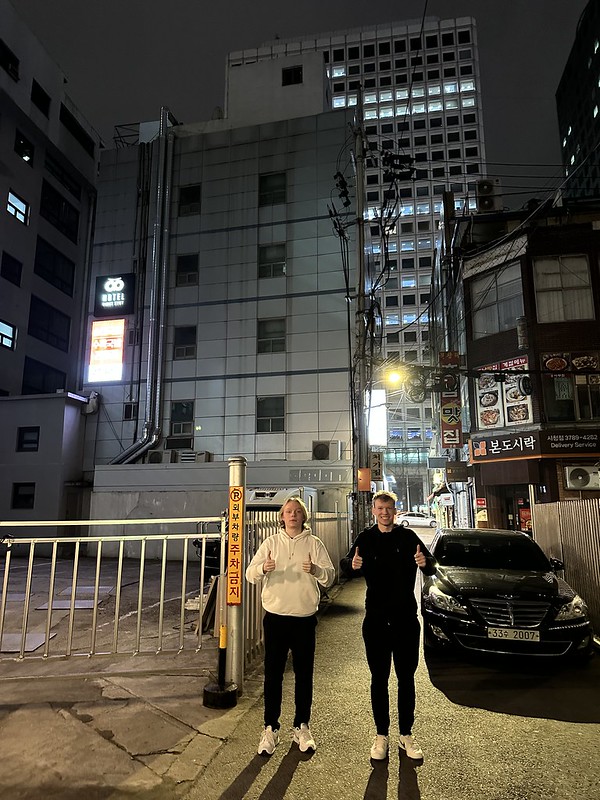
I really love it when we have flights with overnight layovers. It gives me and my travel companions an opportunity to visit places without having to pay for additional flights. The only expense is accommodation and transportation to and from the airport. In the past couple of years, we had overnight layovers in Almaty, Kazakhstan, and Riga, Latvia. On our way back from Japan, we had an overnight layover in Seoul, South Korea. We landed around 7:00 PM in the evening and flew out the next day at 3:40 PM. Upon arrival, we took a taxi to the Hotel FirstStay in the heart of the city. It was a perfect hotel, a great location, comfortable beds, hot showers, and for me, a reasonable price ($120 for 5 people).

The hotel is situated between the Namdaemun Market and Myeong-dong (“bright tunnel – neighborhood” in English) the most famous tourist and shopping districts of the city. I convinced Owen and Oliver to go with me for a craft beer and chicken in the cafe/bar/restaurant district located just outside our hotel lobby. I discovered the popular Korean alcoholic beverage Soju, a distilled, clear drink from rice or other grain with an alcohol content of around 15%. I liked the Andong Lager I tried. Andong is a city in northern South Korea that is famous for Soju. My sons are adults now and it is so pleasurable for me to go out with them and have conversations. They are developing into fine young men and it makes me think of the cycle of life. The food was so-so and we were tired from travel and headed back to the hotel early.

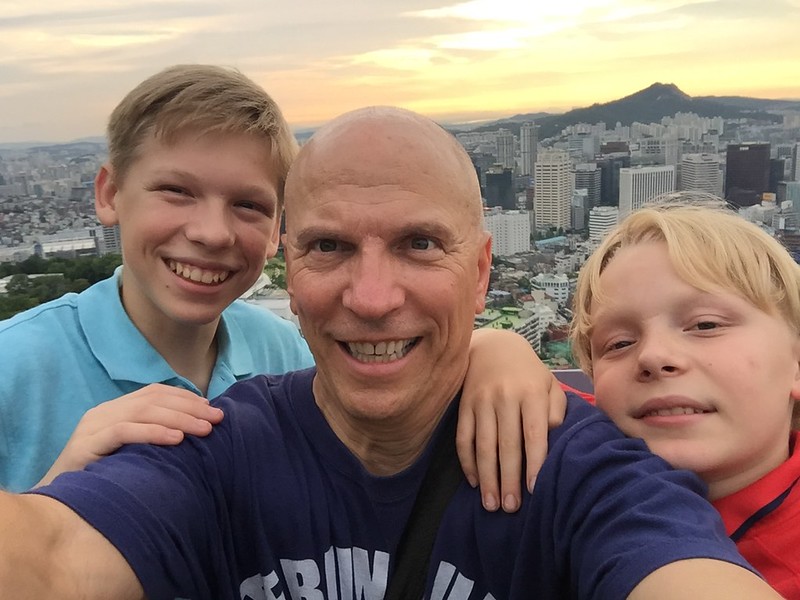
This was my third visit to Seoul and my fourth visit to South Korea. The last time I came with my family was in July of 2016 and you can see how much the kids have changed since. I remember it being a hot day and we climbed the park overlooking the city to the Seoul Tower. I came a couple of times as the head of school in Japan as we were part of an athletics conference with schools in Korea. Seoul is the capital of South Korea and a mega metropolitan city of over 26 million people. My big impression this time is that it felt more Western and Chinese than Osaka. The hustle and bustle of Sejong Street reminded me of New York.

Gyeongbokgung Palace

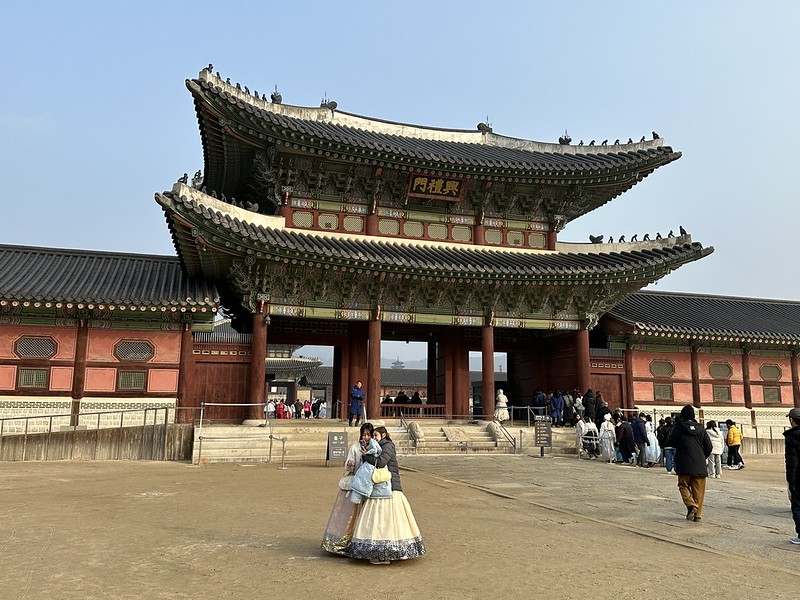
I got up early as usual and went for a walk. I was fortunate to catch the changing of the guard ceremony at the Gyeongbokgung Palace. This was the palace of the Joseon Dynasty that ruled the Korean peninsula from 1392 to 1897. It looks like the Forbidden City in Beijing and reinforces my impression that Koreans are more like Chinese than Japanese culturally. It makes sense that they share a border with China and although I have not read extensively on Korean history, China must have had a large impact on the Koreans. It is nice that they were not assimilated into the Han Chinese nation-state. The Japanese systematically dismantled the palace but in the 1960s until today, it has been restored. The Palace is huge and appropriately portrays the power of the Joseon Dynasty. It is worth seeing the ceremony which takes place four times a day. I saw the 10:00 AM performance.

In front of the Seoul Financial Center, there was a display thanking the US military for its efforts in the Korean War (1950 – 1953). A policeman asked me if I was an American and thanked me personally. My father didn’t serve in the Korean War but was stationed in Stuttgart, West Germany from 1954-1955. I am glad that South Korea and the USA are strong allies.

Several activist groups were also promoting political causes on Seoul Square alongside Sejong Street, some I never heard of. The first was a sign asking for “fairness” and using “common sense” in the investigation of Korean First Lady Kim Keon-Hee. She is under investigation of taking kickbacks and not paying taxes. She also embellished her relationship with NYU’s Stern Business School on her resume. Two pro-Israeli banners were encouraging the destruction of Hamas and another stand was a memorial for victims of the COVID-19 epidemic. There was also a wall of photos of the 159 people who were killed in the Halloween Crowd Crush in 2022. I like seeing free speech in action!

Nadia and I explored the Namdaemun Market before the taxi came to take us to the airport. It is a huge, sprawling market with stalls lining the streets. It has been a market since 1414 so a lot has gone on there. We bought some knock-off hoodies for the kids and I had a delicious soup, Korean noodle empanada, and of course, bibimbap.

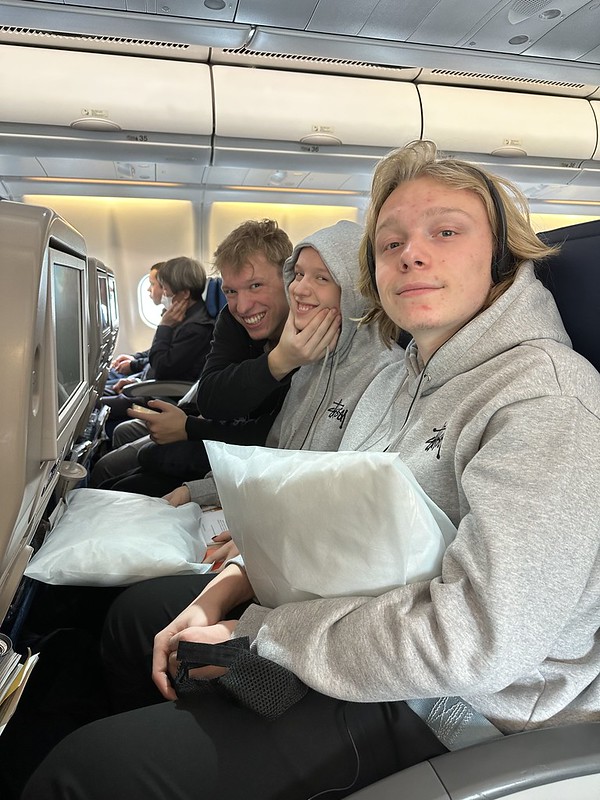
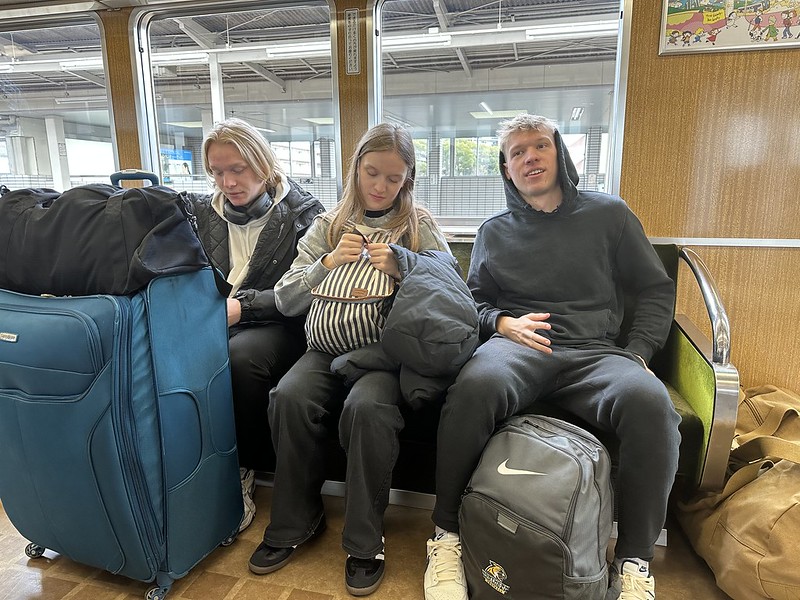
We snapped a few photos on the plane as this might be the last time all five of us fly together! We have had so many good times traveling together over the past 16 years (from the birth of Ocean until yesterday). Hopefully, we can have more opportunities to travel together.

Final Days in Japan

Winter Break is coming to an end as we head back to Tashkent and school starts on Monday. We finished our time in Japan visiting a few more friends (Mike and Ana), tidying up the house, packing, shopping, and eating. While the girls were shopping in Daiso, the dollar store of Japan, I went for a walk in Kita Senri Park. There is a nice trail that winds through a bamboo forest, similar to the famous UNESCO World Heritage site in Kyoto. It is right behind our former school and the path leads to our neighborhood in Onohara-Nishi. We also had so much shopping that we needed to go to a second hand store and buy three carry-ons to make sure we could take everything back with us to Tashkent.

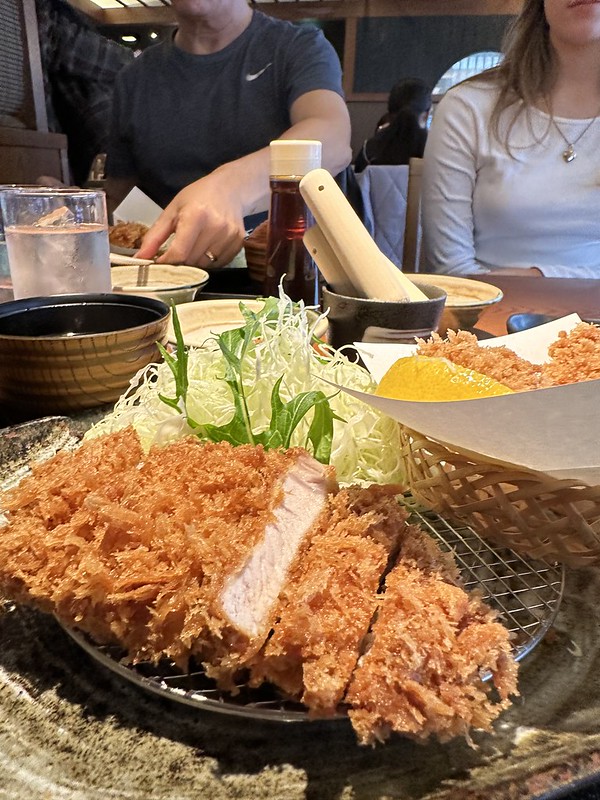
Nadia, Ocean, and I then ate tonkatsu (breaded pork cutlets, cabbage, rice, and miso soup) which on this visit was my favorite meal. Of course I had the deep-fried oysters as well because they are in season. Hiroshima is famous for its oysters and I saw them on menus all over the city. Ocean needed to do some last-minute clothes shopping. We discovered Gu the sister brand of Uniqlo. It is a cheaper version and I really couldn’t tell the difference between the clothes.

We then went on the La La Port Expo City Mall Ferris wheel. These are big in Japan and other East Asian countries. The symbol of the 1970 Expo, the iconic Tower of the Sun was lit up. It was created by Japanese artist Tako Okamoto and it is such an unusual building. I don’t know if the tower gets built in 2023, but in 1970, it was a centerpiece of the Expo and today it is a museum and still visited. We used to take students to Expo Park on field trips. The Osaka metropolitan area has a population of just under 20 million people and you could see the long spread of lights leading to the city center.

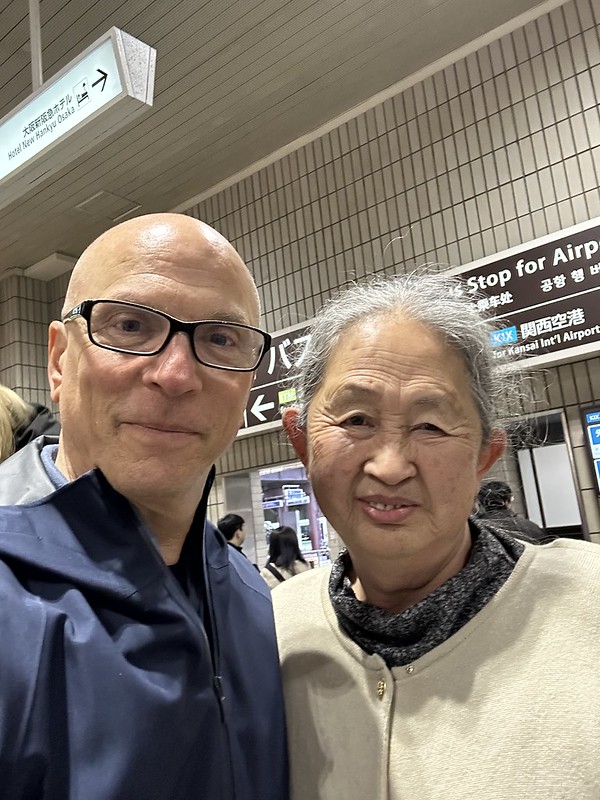
Bill and Yumiko

Our good friends Yumiko and Wakaba helped us get to the train station and on the limousine bus to the airport. The Osaka International School community always treated us with so much kindness! It is a process to get to Kansai International Airport as it is an artificial island in the south of Osaka Bay. We first traveled from the end of the Hankyu train line into the city center. From the Hankyu Umeda station, we then took an airport shuttle bus to the airport. The airport has been renovated since we lived here.

Chinese tourists were spending money like crazy not only at the airport duty-free shops but downtown as well. With a weak Yen, goods are very affordable. My friend reports that 30% of admissions at the international school are from Chinese applicants. Families are investing in Japan and receiving 10-year visas from the Japanese government. This includes buying hotels, apartment blocks, etc., and raising their children in Japan. I think this is a sign that upper-class Chinese people are hedging their bets on the future of the country. I would guess the Japanese government appreciates the influx of capital into their economy but does not want to be overwhelmed by a much louder and brash Chinese culture.

I love travel days because our adolescent kids are trapped with us and have to talk to us! I had a great day with them and we laughed a lot! I don’t know how many more full family travel days we will have as Owen is already in his third year of university, Oliver is off to college in August, and Ocean will be graduating in two years. As I wrote earlier in the school year, I am savoring my time with the kids!

The sun was setting in the Land of the Rising Sun as we hopped on the shuttle train to our departure gate. I hope Japan stays strong and preserves its unique culture as it struggles economically with a rapidly aging population. I think the social cohesion and trust will get them through the next 20 to 50 years and they will come out the other side in good shape.

Latest Reading: Essex Dogs by Dan Jones

The setting of the novel is the Hundred Years War, which was fought between England and France and various allies between 1337 and 1453. I didn’t know much about the war except that Joan of Arc played a role in rallying the French. This novel and inquiries to Chat GPT helped me learn a lot about this conflict. England’s King Edward III started the war by laying claim to the French throne because of his mom’s lineage. 

The Essex Dogs are a military unit of 10 soldiers in Edward’s army. Essex is a region in England where the main character, FitzTalbot Loveday is from. The novel follows them as the English army is invading Normandy in the summer of 1346. It is like a Band of Brothers but set in medieval times, ala Game of Thrones with longbows, knights, sword fighting, cavalry, etc. The English marauded through Norman towns which reflects early English victories in the real 100 Years War. I won’t spoil the ending for you, but by the end of the book, you are hoping the guys can survive the many battles against the French and their German allies. It is not a deep, life-changing novel, but it is entertaining and I like learning history through historical fiction.

What changed for me with this book was using Chat GPT to provide background on the historical figures and events mentioned in the book. In the actual 100 Years War, the French eventually won. The use of the long bow was a game-changer in warfare and the conflicts ushered in the first ideas of nationalism and the nation-state. Joan of Arc was a real person, a French military hero, and a Catholic Saint. There is a mysterious woman character in the book, but the story takes place before she was born. 

The story reminded me that if I had an opportunity to time travel, I would prefer to travel to the future. Life was difficult back then for the vast majority of people. In the novel, the descriptions of the lives of peasants in the fortified towns and villages and the English soldiers on a campaign are miserable. The novel helped me fall back to sleep this week and I enjoyed going into their medieval world. I also would love to visit Normandy someday. It seems like an interesting part of the world with D-Day, the sea, and the countryside.

I always pick up new vocabulary words when I read and below is a list.

  • flitches – slabs of bacon (old English) or a piece of timber
  • chevauchée – Medieval military technique of burning and pillaging enemy territory to reduce productivity (ex. burn fields, kill horses)
  • squire – attendant to a knight before becoming a knight
  • feckless – good for nothing; weak

My Thoughts on Japan

Japan will always have a special place in our hearts as we lived in Osaka from 2014 to 2019. I reflected on my time here shortly after departing in the summer of 2019. (Farewell Japan) We decided to come back for our Winter Break mostly for the kids so they could reflect on their time here. Nostalgia has a way of romanticizing a place and they were here during their formative years, so I think it was good to have all of us visit it again. We had a great holiday here, although, as I always say, as long as I am with family and friends, it does not matter where I am, I will enjoy vacation time! We stayed close to our former neighborhood and relived many of the streets, and trails and visited with old friends.

Last month, Ian Bremmer in his excellent PBS program G Zero World, interviewed the current US ambassador to Japan on his podcast “Unpacking the Complicated US-Japan Relationship“. My father regarded Japan as a mortal enemy after the bombing of Pearl Harbor in his childhood. Today Japan is one of our strongest allies, especially against China. In one generation there was a complete reversal of the relationship between the USA and Japan. Japan is a stable democracy that values human rights and is on the American side in the global division between the Americas/Europe vs. China/Russia/Iran. I think it is special that the two countries have turned from enemies to friends.

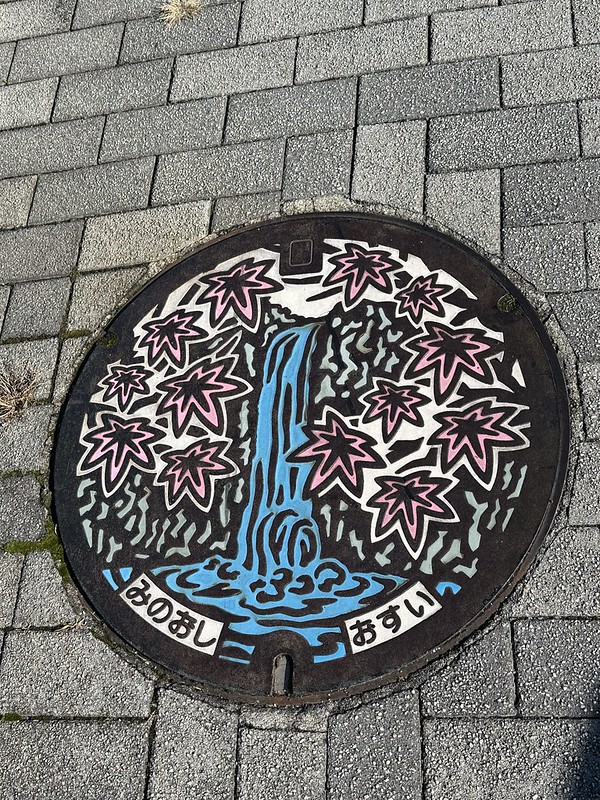
The visit reminded me of the distinctiveness of Japan. There is no other place like it and even its closest equivalent, South Korea, is much more like the rest of East Asia than Japan. I appreciate differences and it is good to have a place like Japan in the world. What other country designs sewer covers based on what suburb they are located in or if the firefighters use them? The attention to detail and focus on their surroundings truly astounds me.

One aspect I don’t miss is the small size of the Japanese homes. The entire ground floor of the house we are renting these two weeks is slightly smaller than our living room/dining room in Uzbekistan. There is a lack of privacy within the home and I understand why there are so many hotels people can rent by the hour. Coming down the steep, narrow stairs in the morning to turn on the heaters in a very cold house. I always said it is like living on the seasonal porch in an American home. The idea of “feeling the seasons” sounds great, but living it is not.

Ina River

I love the fresh air and blue skies of Japan. In the winter especially, the skies are so blue. I also used an electric bicycle for the first time and think that it could convince Americans to use a bicycle more for their daily errands and activities. The winter fresh air was invigorating as I cycled often through my old routes I loved when I lived here. Not much has changed. I also loved the juxtaposition between our suburban nature town of Minoh and the megacity of Osaka downtown.

Osaka Tower

Earthquakes will always be prevalent. We were reminded of the Osaka Earthquake of June 2018 that we lived through when there was an equivalent earthquake on New Year’s Day afternoon in the Noto Peninsula. Fortunately, the epicenter was over 400 kilometers away from us instead of 10 kilometers like in 2018. Our house swayed back and forth gently for over a minute while we were having lunch. 57 people died and there was a lot of destruction on the other side of main island of Honshu. There is no way of getting away from earthquakes as Japan is directly on the Pacific Ring of Fire.

I am not sure when I will get back to Japan again. Sayyonara!

Family Journal: January 1, 2024 – Hike to Katsuoji Temple

The Kralovec Family Daruma

We kicked off the New Year with a hike to Katsuoji Temple. It is our favorite temple in Japan! The temple is located in the hills of Minoh Park, a huge forested set of hills and valleys just on the outskirts of the urban sprawl of Osaka. We all spent a lot of time in Minoh Park, cycling and hiking through the beautiful Sugi forests. In certain areas in the park, one can see deer and monkeys and it is nice to have nature so close to the metropolis of Osaka. It is a perfect hike starting from our old house, it is about a 4-kilometer walk (2.5 miles) up the mountain on a clearly marked trail. Japanese people in the early days of the New Year, visit their local temple to pray for good fortune in the upcoming year and pay respects to their ancestors. This is called hatsumode. It is a befitting way to start a year. I loved getting the family together to exercise and to reflect on what is coming up in 2024.

Nadia and Ocean with their luck charms

We purchased lucky charms to bring us money, safety while driving, luck on school exams, and one lucky wish. We attached the charms to the complimentary bamboo branch we received upon entrance to the temple. We lit a candle and incense for our ancestors, both dead and alive. We skipped the prayers at the shrines because the lines were too long. Rain interspersed stretches of sunshine throughout the day but it was not heavy and the walking warmed us up.

I love Katsuoji because, unlike many temples in Japan, it is located in a wilderness area and not overcrowded like many temples during New Year’s celebrations. The Emperor Seiwa erected the Buddhist temple 1,260 years ago and named it katsu, which means “winning” in Japanese. For centuries, warlords and common people have come to Katsuoji to buy the famous Daruma dolls to see if they get the winner’s luck. If the wish is fulfilled, the daruma dolls are supposed to be left on the grounds. We bought six Daruma dolls to represent our five family members and our dog Obi.

It was a perfect way to start the new year. I love exercising in the wilderness followed by a cultural experience. We don’t know what 2024 will bring us but we will do our best and stick together as a family. Happy New Year and best wishes for health, happiness, success, and fulfillment in the upcoming year.

Family Journal: December 31, 2023 – Happy New Year!

We spent New Year’s Eve in downtown Osaka to celebrate the end of 2023. Our eldest son Owen went with his friends so it was Oliver, Ocean, Nadia, and me who left our house around 6:00 PM. We ate at One Karubi, a Korean Barbeque Beef restaurant. They only offer a 2-hour, all-you-can-eat menu option. We were pretty much done after the first hour but continued to order drinks and some desserts in the second hour. We used to go to the restaurant for special occasions when we lived here and it was nice to go back.

After dinner, we drove 30 minutes to one of the most popular tourist areas of Osaka, Dotonbori. “Bori” means canal and “Doton” refers to Nariyasu Doton, an entrepreneur who built the canal way back in 1612. Doton built it to increase trade in Osaka, but in 1621, the Tokugawa Shogunate designated it an entertainment district. 403 years later, it is still an entertainment district with lots of bars, restaurants, karaoke, pachinko, etc. Sadly, there is only one theatre left, as originally it was full of kabuki and bunraku theatres. I wonder if a world-class theatre district like Broadway or London’s West End could be built here and survive? Japanese really don’t celebrate New Year’s Eve by going out to places like Times Square. It was mostly tourists. We were surprised by the large numbers of men from the Philippines who were congregating along the canal, drinking and smoking. They must be guest workers here, as they didn’t look like typical tourists. We noticed piles of rubbish everywhere which is rare in Japan. Public garbage bins are not common here and with so many tourists, I can see why this happened.

Kuidaore (食い倒れ) is a Japanese word that means to “ruin oneself financially by extravagant spending on food” or in Western terms, “eat until you drop”. Osaka is the food capital of Japan and prides itself on having the most and best restaurants in the country. Of course, we needed to stop to try some takoyaki or fried balls of a doughy batter with octopus inside. It was nice to watch the preparations of the takoyaki and okonomiyaki (pancakes) in front of the hot grills in the cold weather and slight rain.

Ocean, Oliver, and Nadia in Shinsekai

We left Dotonbori and headed over to ShinSekai district, about 4 kilometers away from Dotonbori. “Shin” means new and “Sekai” means world. The area was first developed in 1912 and being typical of Japanese culture, it was modeled after Coney Island (north side) and Paris (south side). The Japanese often replicate outside cultures and with their attention to detail and hard work, often improve them! 🙂 The amusement park is long gone but the Eifel Tower, Tsūtenkaku (tower reaching heaven) is still there. The tower burned down in 1943 and the steel was used in Japan’s war efforts. Residents lobbied the government to rebuild the tower. The tower reopened in 1956 and featured a Billiken. Art teacher Florence Pretz of Kansas City, Missouri created the Billiken charm doll in the early 1900s. The figure came to her in a dream and she found the name in an 1896 poem. She sold the patent to the Billiken Company of Chicago. To purchase one, or even better, to receive a Billiken doll brings you good luck. The Billiken is also known as the “God of Things as They Ought to Be”. It was a big fad in the early 20th century but faded into obscurity over the past 100 years. Today it is still a symbol of American culture in the shinsekai district and we noticed many billikens around the neighborhood. I am glad they kept the idea alive. We will probably head back to the district once more before we leave to enjoy the cozy kushi-kastsu (deep fried meat on skewers) restaurants and I’ll blog more about one of my favorite districts of the city.

We also paid our respects to the kami inari a Buddhist/Shinto god associated with “with foxes, rice, household wellbeing, business prosperity, and general prosperity”. We all send positive vibes in honor of Oliver so he can pass his IB Diploma in May. You can find the shrines all over Japan, in both cities and the countryside. You wash your hands to leave the secular world and enter the sacred world. You go through a ritual of ringing the bell and clapping to “wake-up” the kami (ancestral spirits) and bow to show respect. We are all hoping it works!

We finished the evening by celebrating the countdown at our house together. My first New Year’s kiss was of course with my beautiful wife Nadia. It was so nice to spend the evening together with Oliver and Ocean. They will soon become adults and leave us, and it felt like a nice way to be together as a family to welcome 2024.

The Sacred Deer of Nara Park

“I’ve had enough…”

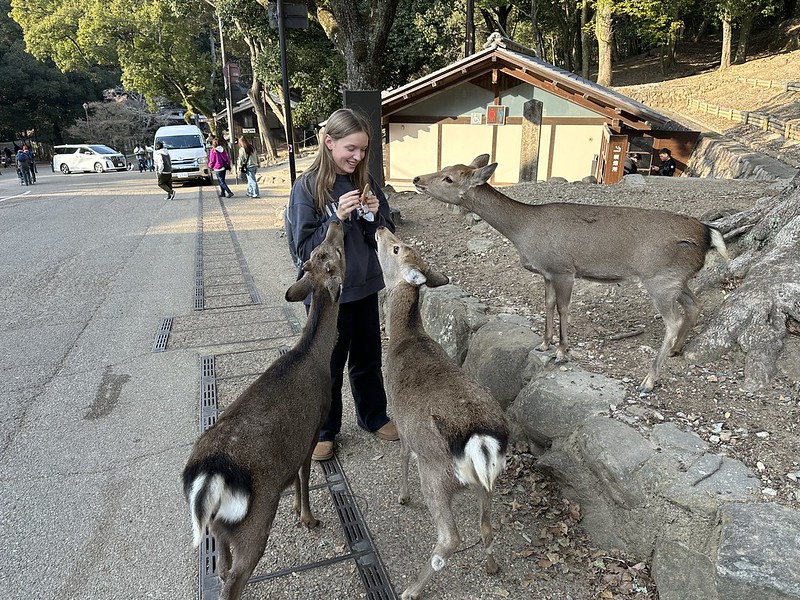
As you can see by this bloated deer, the tourists are back! I was reading that during COVID, the deer were starving without the daily influx of tourists feeding the deer rice cookies. By the time we arrived in the afternoon, the deer looked like they were full and tired of having tourists stick cookies in their faces. We had to walk away from the central park area up to Wakakusayama Hill to find deer that were eager to crunch the cookies.

Hungry Deer

This is the fourth time that I’ve visited Nara Park and the famous Sika or Northern Spotted or Japanese Deer (Cervus nippon). My daughter Ocean wanted to post photographs of feeding the deer on her Instagram so we drove from Osaka to Nara (55 minutes). Besides the deer, there are some beautiful Buddhist Temples including one of the world’s largest wooden temples housing a huge statue of Buddha. The manicured grounds are full of trees, ponds, and open grass areas.

Oliver feeds the deer

The deer are considered to be sacred messengers of the gods and have been protected for over a thousand years. They have been isolated for so long from other deer herds in Japan that they are genetically different and they behave differently. The Nara Deer are famous for bowing while approaching tourists for rice. This is not a behavior Sika Deer exhibits in nature and they think it may have developed as a form of communication between the deer and the humans.

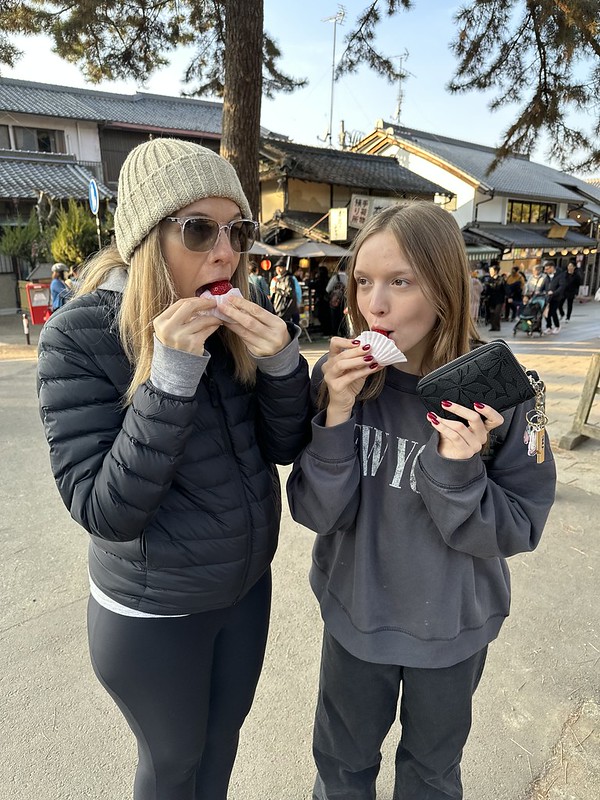
Red Bean Paste and Strawberry Mochi

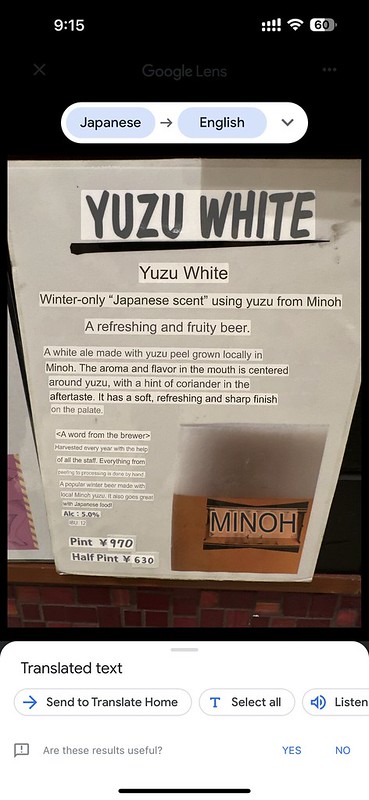
In the evening, Nadia and I rode our bicycles to meet with my friend Kurt at the Minoh Brewery. They make in my opinion, the world’s finest craft beers. I tried the Yuzu White one of their winter beers. I love seasonal things and like all of their beers, absolutely delicious. I don’t drink a lot of beer or alcohol in general for health reasons especially now I am in my 50s, but I do love an occasional good craft beer. I also keep being impressed with Google Translate. It is so much faster and more accurate than 5 years ago and makes travel in Japan easier. I also sense the Japanese are opening to the English-speaking world. With such a weak yen, the island is receiving many more tourists who are coming specifically for shopping.