(SPOILER ALERTS in this post – do not read if you want to read this novel!)
Summer holidays mean more reading time for me, and yesterday, I couldn’t put down Blake Crouch’s Dark Matter (2016). It combines thriller and science fiction story, similar to Michael Crichton’s books. The main character is an award-winning physicist named Dr. Jason Desson who has created a technology that allows a person to enter any personal alternative universe. The idea is that we make hundreds of decisions every day, some very consequential, that define the outcome of our lives. Desson’s machine gives access to the alternate outcomes. The big decision in this story is his choice not to marry his pregnant girlfriend and instead pursue his career in science. The result is that the career-focused Jason (Jason2) violently switches places with family-focused Jason (Jason1), and the action begins there. Eventually, dozens of Jasons converge on Jason1’s universe in a battle to become the husband of his beautiful wife and father to their son.
On a broad, simple level, the story is about the choice between career and family. Dr. Desson in one universe gets married and becomes a professor at a small college. In another universe, he wins the “Pavia” prize for his quantum physics discoveries and becomes a giant in the field of physics. Most of the time, life is not that simple and more nuanced. Crouch touches on this as there are an infinite number of universes because we make so many choices in a typical day, month, year, and life. It made me think about the decisions I made an overall I am quite happy that I was able to balance an engaging career (international education) and marriage and fatherhood.
The book is set in Chicago and near the end of the book, Jason1 escapes with his wife and son to northern Wisconsin. They take refuge from the multiple Jasons chasing him in a seasonal cabin by a lake. It is probably pretty close to my house as he drove around 6-7 hours north from Chicago.
In doing a bit of research of Crouch, he is most famous for his Wayward Pines trilogy that was made into a Netflix television series. I may want to watch it as well as this book, that was developed as a television series on Apple TV. He is a prolific author and if his other books are like this one, they make for a thrilling read.
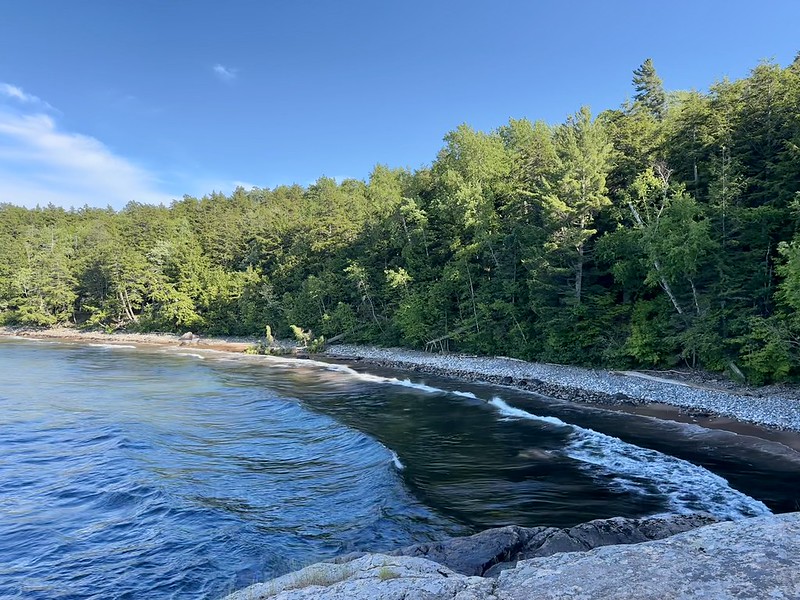
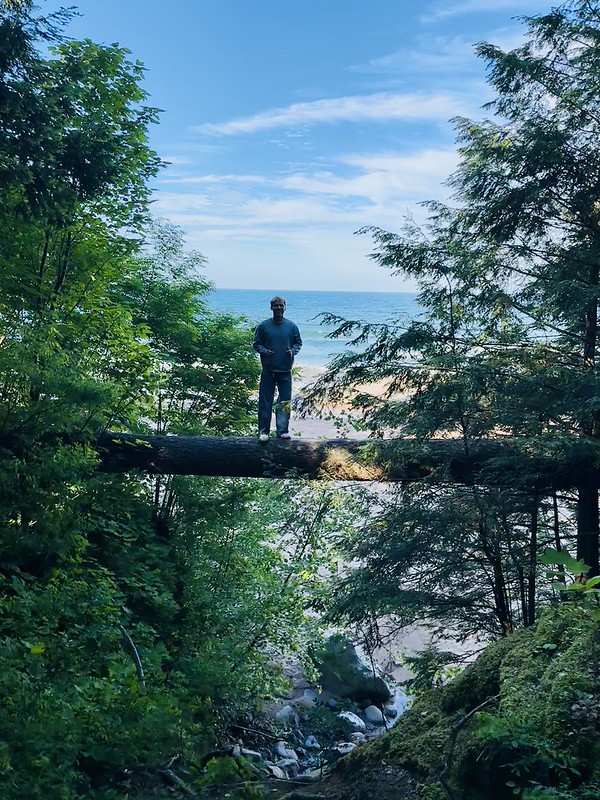
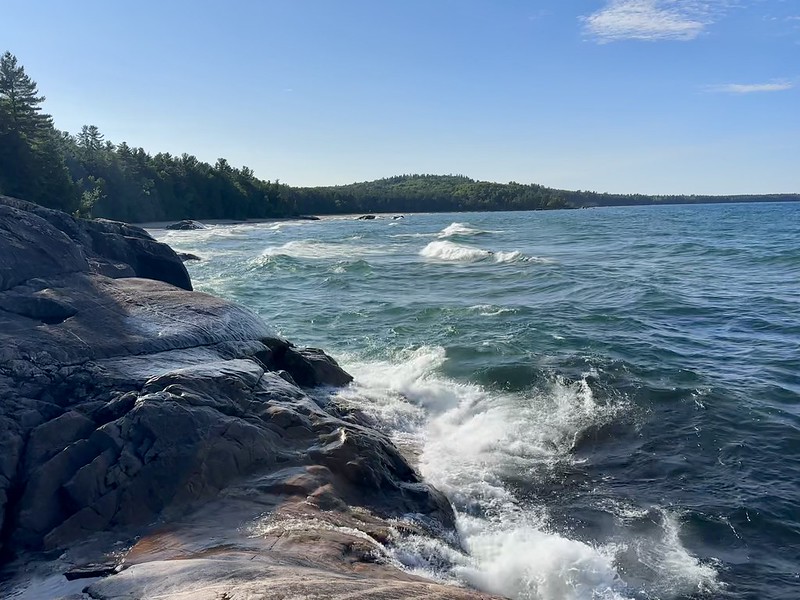
We spent a delightful Sunday exploring the shore of Lake Superior just north of Marquette, Michigan. Owen showed us a nice spot where he watched the Northern Lights (Aurora Borealis) when he was at Northern Michigan University. Little Presque Isle is a stretch of the Lake Superior shoreline that has a combination of sandy beaches, old-growth trees, and 2.3 billion-year-old granite outcrops/ledges/cliffs. There is a nice trail that runs along the shore and many trailheads in the area.
Owen 2 billion year old granite
The term “Presque” comes from the French, meaning “almost,” which refers to a peninsula that is connected to the mainland by a narrow strip of land. Early explorers and the Ojibwe tribe members used this location as a landing area to access the mainland. It was also an area where lumberjacks could bring logs to float down to Marquette. William Wetmore was a 19th-century businessman who owned slate and iron mining companies and other business interests, including logging. He founded the company town of Arvon, which we visited earlier in our holidays.
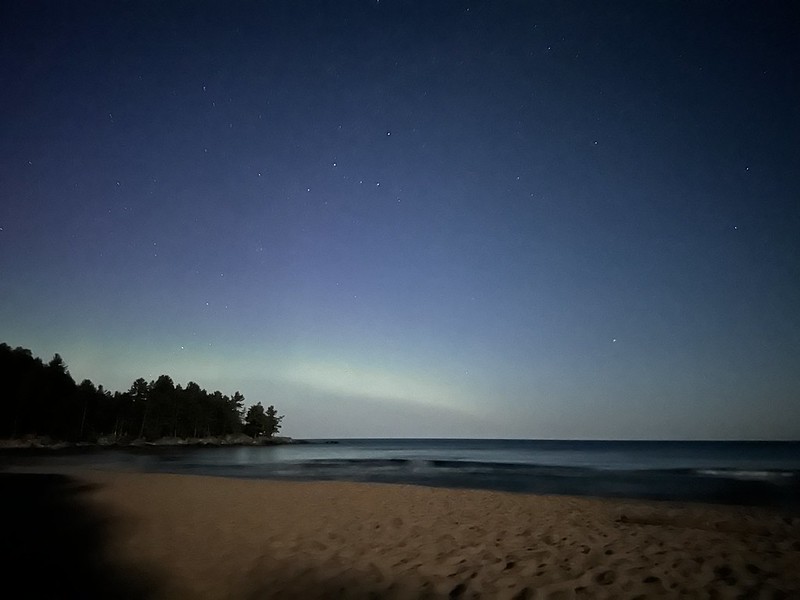
Our son noticed that the KP Index which measures geomagnetic activity on a scale from 0-9 was measuring a 5 for that particular Sunday evening. A “5” indicates a moderate level of geomagnetic storms and the Aurora Borealis might be visible in northern US states like Minnesota, Michigan, Wisconsin, and Maine. The National Oceanic and Atmospheric Administration’s Space Weather Prediction Center has an informative visual map that I didn’t learn about until after we spent a couple of hours on the beach that evening. It didn’t matter because
No Aurora Borealis, but a beautiful evening nonetheless
Nadia, Bill, Owen at the Rhinelander- Oneida County Airport – 6:00 AM July 12, 2025
I write this post with a heavy heart as Nadia and I drove our son Owen to the Rhinelander-Oneida County Airport. He departed for a two-year mission with the United States Peace Corps in Costa Rica. It is a bittersweet morning for us as we are so proud of the young man Owen has become and heartbroken that we will not be seeing him in person for quite a while. He brings joy and positive energy to our family when he is with us.
The flight left at 6:30 AM to Minneapolis, where he will connect to Miami for two days of orientation and training. My village of Caspian is a 1-hour and 20-minute drive from Rhinelander, so we left early this morning at 4:05 AM. It is a standard small-town regional airport. It was raining this morning, but it cleared up on our way back to Caspian.
Owen and DadMoon Set in the Wisconsin Northwoods
We celebrated our final day with Owen by playing tennis, helping him pack, and then we all went to see the new Superman movie in Quinnesec. It was an OK movie, giving us the typical DC movie experience.
I wish the best of luck to Owen and hope you have a formative life experience and do some good in the world! It is funny that both Nadia and I shared a Costa Rican experience and now our son will be having his time in the land of “Pura Vida”. Our family believes in service to others, and we are so proud that Owen will be representing the USA and making a difference in the lives of “Ticos”.
Oliver, Nadia, Owen, Ocean, and Bill (Section 225 – Row 7, American Family Field, Milwaukee, Wisconsin)
My favorite professional baseball team is the Detroit Tigers. My mother was a huge fan and watched or listened to every Tigers’ game, and the radio broadcast was the soundtrack of my summers in the 1970s and 80s. The Tigers in 2025 have the best record in Major League Baseball (MLB), and we were looking to go to a game during our visit to the USA. Unfortunately, Michigan is a big state, and Comerica Park, where the Tigers play, is an 8-hour drive from Caspian. The Milwaukee Brewers (4 hours) and Minnesota Twins (5 hours) are actually closer to my hometown than Detroit (8 hours). When I saw the glamorous Los Angeles Dodgers playing the Milwaukee Brewers this week, I decided to see the final game of a 3-game series yesterday. It was an afternoon game, so we could drive down in the morning and return in the evening.
Otani SanConcourseOur View
The Los Angeles Dodgers are “glamorous” because their principal owner, Mark Walter, is a very wealthy man (estimated $12 billion in personal wealth). The team is part of the Guggenheim Partners portfolio, a global financial firm controlling $335 billion in investments. The Dodgers have the MLB’s highest annual payroll at $338 million. The average MLB payroll is $171 million. Being able to spend twice as much as the other teams gets you players like Shohei Otani ($70 million/year) and yesterday’s pitcher, Tyler Glasnow ($33 million/year). The Milwaukee Brewers, as a small-market team, have a payroll of $115 million.
We had a great family day at the American Family Field stadium in Milwaukee. The Brewers came from behind to tie the game in the bottom of the ninth inning and win it in the 10th inning 3-2 on Venezuelan centerfielder Jackson Chourio’s single.
The main attraction in the game was to see Shohei Otani. He didn’t have a particularly good game with 2 strikeouts, two walks, and a fly out to center field in his 5 plate appearances. His size (6 feet 4 inches tall) and speed on the bases were impressive! We got to see a close game and some outstanding, athletic plays by world-class athletes. American professional sports really know how to provide a comfortable and entertaining fan experience. There was free WiFi, bars, restaurants, food stalls, shops, etc., on the concourses around the stadium. Our seats were in the sun so the girls spent much of the game walking around the stadium and enjoying the atmosphere of the game. Oliver, Owen, and I focused on the game.
I remembered during the game the last time I attended a Milwaukee Brewers game, exactly 40 years ago this summer. In 1985, my godfather, Bill Leonoff, who was working for the local radio station, WIKB, aired Brewers games on the radio then, and so he took me up into the press box for a two games against the then-Oakland Athletics. I remember getting all the free food I wanted, and it was cool to receive the media packet of statistics for both teams.
Overall, it was a great experience. My one complaint is the cost of attending a game. We paid $30 per ticket (5x=$150) plus $40 for parking, $12 beers, and a tank of gas to drive there ($60). A day at the ball park costs between $300 and $400 for a family of five. That is OK for a one-off experience, but I don’t see how people can afford to attend a lot of games. The attendance was over 33,000 people for a Wednesday afternoon game, so it has not hit the point of being too expensive, obviously. It would be nice if everyone involved in MLB would take less money to provide a more affordable experience for fans. I don’t think this will happen, though.
Ernest Scheyder, a senior correspondent for Reuters, has written a fascinating book about mining for the critical minerals that are the foundation of green and renewable energy technologies. Copper, Lithium, Antimony, rare earth metals, etc. are components of electric vehicle batteries, solar panels, LED lighting systems, iPhones and high-end electronics, computer processors, magnets used in wind turbines, etc. Sourcing these is driving humanity’s move away from fossil fuels and possibly saving future generations to the ravages of climate change. There is a cost however to this as mining for minerals is complex, costly, and damages the environment. Often these mines are huge open pits, requiring transportation links to the outside world, have toxic tailings ponds or evaporation pools, that may damage the local ecosystems. One of the challenges of trace minerals huge amounts of rocks need to be dug out, crushed, chemically treated to extract the desired mineral. Scheyder goes around the country and into South America to interview the key players in this story. He gives the views of all sides, mining company executives and engineers, government officials, environmental activists, etc. to tell the historical and modern story
My life has been greatly influenced by the mining industry. I grew up on Iron County in Michigan’s Upper Peninsula. In the 20th century, there were approximately 70 iron ore mines but many ended post World War II as higher percentage iron ore mines developed around the world. A few mines hung on into the 1960s and 1970s when I was a child, the last mine, the Sherwood Mine closed in 1978. In my village of Caspian, there were six iron mines with the Voroner Mining Company operated three mines:
Baltic (1900) – It by the way is the name of my street.
Young’s (1904)
Fogarty (1907)
Other mines included the Caspian (1903), Berkshire (1908), and Dober (year unknown). The population of Caspian has dropped from 1,912 in 1920 to 800 in 2020 and declining at a rate of an average of 8% per decade. When I was a kid, the entire woods around Caspian and Iron River was covered in red dust/rock, and the Iron River going through the town was known to us kids as the “Red River”. 50 years later nature has healed itself. The open pits are now filled with water and create wetlands for wildlife and recreation, there are iron ore waste piles that have been mostly covered up by trees, and the Iron County museum preserves the Caspian Mine Headframe and tells the story of the mining industry here. There is a spider web of underground shafts and tunnels in the county. Back in the 1950s the road between Caspian and the neighboring village of Gaastra caved-in, killing a young man driving home in the middle of the night. I’ll do a blog post someday of that incident. Caspian was part of the greater Iron Range, an area in the Upper Great Lakes from Minnesota, through Wisconsin, to Michigan. Scheyder reports from Ely, Minnesota in the book about the attempt to develop mining in the Boundary Waters National Wilderness area just north of the town. It would be nice to have mining companies come back through the Iron Range, looking for these critical minerals in the remnants of the iron mines.
Bike Path (headframe)Iron Ore MoundHeadframe – Caspian Mine
I got my first teaching job in Nevada thanks to the need for schools because of the gold mines in Elko County. They mined microscopic gold and along within came a booming economy but also cyanide-laced, leaching ponds and huge mountains of waste rock. Scheyder spends a lot of time out in the American west, in Nevada, Idaho, and Arizona, detailing the challenges of developing mines in the face of environmental concerns and indigenous people’s rights.
The book gives an overview of the global critical metals mining industry, with of course, China leading the way. It is a strategic need for governments around the world and Scheyder contrasts the policies of Trump and Biden, as well as spending a lot of time in our other home of Bolivia. The Salar de Uyuni is the biggest salt flat in the world and underneath it is a brine of dissolved lithium and salt, the largest lithium resources in the world. Due to its elevation, distance from markets, difficulty of extracting lithium, and poor governance, it just has not been developed yet. Nadia and I spent a summer break touring the Salar de Uyuni in the late 1990s, one of the most striking landscapes on Earth. I should try to find the photos from that trip and digitize them.
I also found it interesting that the mining industry will eventually end when recycling takes over. The lithium and copper in batteries can be recycled over and over again without degradation. Scheyder interviews a couple of companies trying to start recycling businesses. I highly recommend this book for anyone wanting to learn more about mining. I think it would be a good career to get into and I will encourage my students to consider a career in mining engineering.
Other facts I learned:
A 55.4 kWh Tesla car battery has around 6 kilograms of lithium. A typical Tesla car needs 10 pounds of cobalt. The conditions of “artisanal miners” in Congo supplying the cobalt is appalling.
The USA is moving its petroleum dependence on OPEC to mineral dependence on China, Congo, and others. The geopolitics around OPEC countries and the West is moving towards nickel, magnesium, graphite, cobalt, lithium, and rare earths.
USA holds 24% of world’s lithium reserves but only produces 3% of annual lithium ready for use.
Mining has a big impact on the environment. Chile is the world’s largest copper producer and #2 in lithium and 65% of the country’s water is used by the mining sector alone.
The average 747 Boeing jetliner has 135 miles of copper wiring, and the average American house has 400 pounds of copper wiring and piping.
If I have time, I should read the Standard for Responsible Mining (June 2108) IRMA – Initiative for Responsible Mining Assurance
Parking your car backwards is a mining industry safety standard because backing up a vehicle in an emergency is considered a safety hazard.
EV (Electric vehicles) generate 500,000 tons of battery waste in 2019, will rise to 8 million tons by 2040.
I would like to visit the Salton Sea in California, which is similar to the Salar de Uyuni in regards to the potential of filtering the salty brine could produce a lot of lithium for the USA.
Lithium is the lightest metal on the Periodic Table of Elements, so great for batteries.
“Despite attempts to find alternative ways to produce metals for the green energy transition, there was no way around the fact that mining is loud, dangerous, and disruptive and will remain so for the foreseeable future, a reality that continued to fuel the global battle over our collective future”
I like the quote, “Here was a corporate leader encouraging dissent, asking for free thought, and demanding frank dialogue.”
On Wednesday, we went to the FireBrick Bar & Grill for Trivia Night at the beautiful George Young Resort right here in Iron County. We had a lot of fun and scored 30 of 40 correct in the quiz. The winners had 33 correct, so we were not that far off the lead. The best part was spending time with the family and laughing over our general knowledge skills. It was full, and the kitchen and wait staff were struggling with getting orders out on time. I am noticing that while I am in the Upper Peninsula is there is a lack of younger people wanting or needing to work. Bars, restaurants, gas stations, contractors, plumbers, electricians, etc,. They are all complaining about a lack of workforce. I’ll blog more about that later this month. My daughter Ocean is looking more and more beautiful every day. What an angel.
We had a quiet Independence Day Celebration. I worked in the morning online, taking care of school business, and then did some banking/organizing our finances for most of the day. I did get out for a bike ride (36 kilometers). Iron County is great for cycling with almost no traffic and lots of country roads. The Western Upper Peninsula is not mountainous but has many hills that are the perfect slope for giving you a workout, but not killing you. Uzbekistan is like the Alps or the Pyrenees in the Tour De France. Michigan has the rolling hills of the French countryside. I am trying to ride my bike and do a yoga workout daily this break. In the late afternoon, Oliver, Ocean, Nadia, and I swam at Hagerman Lake. I love summer in the UP with the cold water lakes, the pure blue skies, the massive walls of green trees, and having time to talk with family. We skipped last night’s fireworks and had a Mexican dinner at home.
I managed to get the girls out for a 4-mile hike on the Lauterman Lake Trail System, just south of the Michigan/Wisconsin border, earlier this week. I am familiar with the trails only in winter, as the Department of Natural Resources keeps the trails groomed for cross-country skiers. It is much different in the summer, and we got a little lost trying to hurry up to get back home for Trivia Night. As you can see from the video, Nadia and Ocean survived the experience.
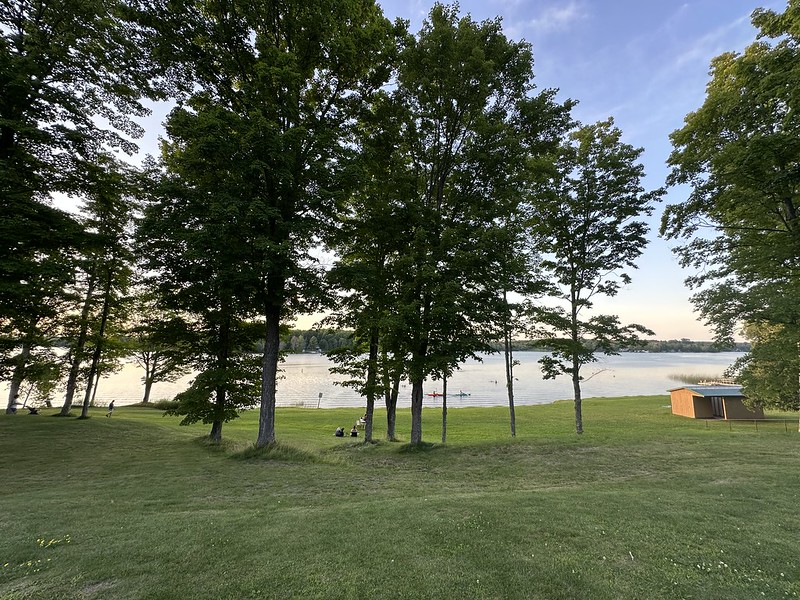
One of the most popular public beaches on an Iron County lake is Pentoga Park. The public beach, playground, and camping site are located on a former indigenous Ojibwe (Anishinaabe) settlement. The village was on the southeast shore of Gichi-zaaga’igan, meaning “big lake”, today known as Chicagon Lake, a corrupted form of the original Ojibwe name. When European settlers came to the area and set up mining towns, the local Ojibwe had peaceful trading relations with them. I think it was because there were never a lot of Ojibwe in the area, one account I read estimated 5,000 in the entire Upper Peninsula. Ojibwe Headman Meshkawaanagonebi, known as Chief John Edwards to area residents, abandoned the land in 1891 and left with his wife, Pentoga, to the Lac Vieux Desert reservation across the border in Wisconsin. The county purchased the land in 1924 and set up the park to preserve the burial grounds.
Indian Burial GroundOwen and Uncle JimPentoga Park Playground
All that is left of the Ojibwe village is the graveyard. Ojibwe culture buried their dead and placed a wooden shelter over the grave to protect from the elements and keep animals out. The bodies were wrapped in birch bark along with their most prized possessions. The shelter had a small door and a family totem. They placed the door towards the west, the direction the Ojibwe thought Bangishimog, or heaven, was located. I like that idea of heaven being towards the setting sun!
Oliver, Ocean, and Owen Reach the Summit of Mount Arvon!
It was a momentous day for the Kralovec family yesterday as we “scaled” Mount Arvon (1,979 feet or 603 meters) and reached the state of Michigan’s highest point. “Mount” Arvon is located in neighboring Baraga County in the Huron Mountain Range. The name comes from the township it is located. Early settlers named the area after the Arvon region in Wales. It was recognized as Michigan’s highest point in 1982. It is located in a remote part of the western Upper Peninsula, 27 miles southeast of the town of L’anse, on Lake Superior.
Oliver and Dad at the PeakWetlandsViews to Huron Bay
It was easy to find as there were several descriptions online about how to reach the spot. The road is much improved since many reviews on the internet were posted. We drove to the top parking lot, although I recommend stopping short of this and walking up on a trail that is off to the side of the road. We didn’t see it on the way up as it is not well-marked. Officials have cleared the lookout a bit down from the peak that offers views all the way to Huron Bay, a part of Lake Superior. It was a cold, grey day and we could feel the cool winds coming from the lake. Michigan is not known for its mountains, so 603 meters above sea level is not that impressive, but it was a fun day out trying to find it.
Owen, Ocean, Uncle Jimmer, Oliver
We stopped along the way to visit Michigan’s “Grand Canyon”, Canyon Falls Gorge on the Sturgeon River. The Sturgeon River has cut through the rocks, creating a beautiful gorge. We walked several miles along the river trail, which is part of the North Country Trail. It was a very peaceful spot and I wanted to keep going, but the kids started complaining. I was grateful they were spending time with us.
Canyon Falls GorgeLichens on the Gorge WallsOwen
I love the vast amounts of forests we have in the Upper Peninsula. So much beauty to explore!
Ocean and Nadia head into the plane at Hamad International Airport
We landed at Hamad International Airport at approximately 6:00 AM on Monday, June 23 to catch our connecting flight to the USA. Our two-hour layover went by quickly as we stopped for a coffee and cheesecake at an Ili Cafe on our way to our departure gate. The flight departed on time around 8:30 AM. Less than 12 hours later, Iran launched 14 missiles toward Al Udeid Air Force base in Qatar (40 kilometers away from the airport). Qatar officials closed Qatar airspace, stranding passengers. Hamad processes around 10,000 passengers daily, and clearing the backlog will take a few days. I reckon the airspace closed sometime in the late afternoon on Monday, with the bombing around 8:00 PM. Officials reopened the airspace early Tuesday morning. Thankfully, we were off the ground and out of Qatar airspace before the closure took place. In March this year, we just missed the earthquake in Bangkok, flying 4 hours before it hit the city, and the airport was closed. Fortunately for the soldiers at the base, 13 of the missiles were intercepted, and 1 missile flew off course into the water.
Nadia’s Photo of the Red Sea from the planeCNN Video CNN Video
As you can see above, we left in the morning. Nadia took a beautiful photo of the Red Sea as we were leaving Saudi Arabia’s airspace. A few hours later, missiles were seen over Doha. We landed in Chicago’s O’Hare International Airport and made our way through the crowds from the international terminal #5 to the domestic terminal #3. I had a window seat on the flight to Marquette, Michigan, the largest city in Michigan’s Upper Peninsula. The pilot warned of upcoming turbulence due to a storm on Lake Michigan. During the summer months, the relatively cool lake water interact with warm, humid air masses moving over the region causing turbulence in atmosphere. The series of photographs below show our plane approaching the massive cloud system.
The flight however was quite smooth and the anticipated turbulence and instructions to stay in our seats for the 30-minute flight were never needed. I slept through the grey clouds and didn’t wake up until we touched down on the runway of the former K.I. Sawyer International Airport. It used to be an Air Force Base that was developed in the 1950s during the height of the Cold War. It served as the home to nuclear-armed bombers and a strategic refueling station. It is appropriate that our final destination leaving Doha, Qatar on June 23 was a former nuclear bomber base. K.I. Sawyer was closed in 1995 when the collapse of the Soviet Union ended the need for such a remote and expensive air base. Over 4,500 jobs were lost and it was another blow to the economy of the Upper Peninsula. The local high school, the Gwinn “Modeltowners” had a large and diverse student population thanks to the base. Today, the school is just another shrinking school system in rural Michigan. The Stealth Bombers that delivered the strike to the nuclear sites in Iran departed from an Air Force Base in Missouri that probably replaced K.I. Sawyer.
We arrived at 10:00 PM Monday evening and our family was waiting for us at the small airport. It was so nice to see our two sons, my nephew, my brother and his wife. They were kind to greet us and drive the 90 minutes to our home in Iron County, Michigan.
Olver, Beau, Ocean, and Owen at KI Sawyer International Airport
Yuval Noah Harari’s “Sapiens” was a brilliant read! His thinking shows the world in a totally different light from other writers and changed how I view our species. Like Jared Diamond, he takes vast time periods and puts them into a fascinating paradigm. He broke down human evolution into several revolutions:
Cognitive Revolution – 70,000 – 30,000 years ago Accidental genetic mutations rewire Homo sapiens brains to think, communicate, and collaborate in unprecedented ways. Money, Empire and Religion are the three great unifiers of humankind.
Agricultural Revolution – 12,000 years ago – Our ancestors domesticate a handful of plants (wheat, rice, corn, barley, potatoes) between 9,500 and 3,500 BC and still today it provides 90% of our calories. Allowed much greater population numbers.
Scientific Revolution – 500 years ago
There are too many interesting ideas to explore, but below are a few of the ones that I have time to think about.
“It is doubtful where Homo sapiens will still be around a thousand years from now, so 2 million years is really out of our league” – Harari is referring to Homo erectus, an early species of human. He thinks that technology and genetic engineering will so utterly change us that we will no longer be the same species.
“And if you spend hours praying to non-existent guardian spirits, aren’t you wasting precious time, time better spent foraging, fighting, and fornicating?” Sapiens is the only animal that can tell imaginary stories, share abstract concepts such as future possibilities, etc. Sometimes these are beneficial, such as, don’t go to the waterhole at sunset, many predators visit there during the dry season. Some are not, if you become a suicide bomber, you will have access to a thousand virgins in the afterlife.
My major insight from him is the idea of common myths unify human beings. These can be religious, patriotic, cultural, etc. An example is of a Limited Liability Company (Peugeot) is fiction. It only exists if we all agree in the founding documents of company. Our superpower is to allow millions of strangers to cooperate and work towards common goals.
The dog was the first animal domesticated by Homo sapiens, at least 15,000 years ago. “This 15,000-year bond has yielded a much deeper understanding and affection between humans and dogs than between humans and any other animal.”
“A typical forager 30,000 years ago had access to only one type of sweet food – ripe fruit.”
“The forager economy provided most people with more interesting lives than agriculture or industry.” They also had less infectious diseases because of population density and no domesticated animals.
“A diet based on cereals is poor in minerals and vitamins, hard to digest, and really bad for your teeth and gums.
Humans evolved for millions of years in small bands of a few dozen individuals. The Ag Revolution was “not enough time to allow an instinct for mass cooperation to evolve.”
An expensive trip to Paris by a millionaire and his wife wanting a vacation “is not a reflection of some independent desire, but rather of an ardent belief in the myths of romantic consumerism.
cognitive dissonance – The uncomfortable feeling that comes when you hold two conflicting beliefs, attitudes, or ideas at the same time.
“The truth is that empire has been the world’s most common form of political organization for the last 2500 years.
Beliefs in social order come from practicalities. Why were Africans regarded as sub-human to justify slavery? Because of their genetic superiority, they could survive in warm climates with malaria, etc.. This translated into cultural inferiority and the European plantation owners told themselves the myth to justify enslaving fellow human beings.
“The Romans killed no more than a few thousand Christians in 300 years.” “By contrast, over the course of 1,500 years, Christians slaughtered Christians by the millions.”
“Money is the only trust system created by humans that can bridge almost any cultural gap, and that does not discriminate on the basis of religion, gender, race, age, or sexual orientation.”
“The Christian saints did not merely resemble the old polytheistic gods. Often they were the same gods in disguise”
“Zoroastrianism saw the world as a cosmic battle between the good god Ahura Mazda and the evil god Angra Mainyu.