
Final Days in Japan

Winter Break is coming to an end as we head back to Tashkent and school starts on Monday. We finished our time in Japan visiting a few more friends (Mike and Ana), tidying up the house, packing, shopping, and eating. While the girls were shopping in Daiso, the dollar store of Japan, I went for a walk in Kita Senri Park. There is a nice trail that winds through a bamboo forest, similar to the famous UNESCO World Heritage site in Kyoto. It is right behind our former school and the path leads to our neighborhood in Onohara-Nishi. We also had so much shopping that we needed to go to a second hand store and buy three carry-ons to make sure we could take everything back with us to Tashkent.

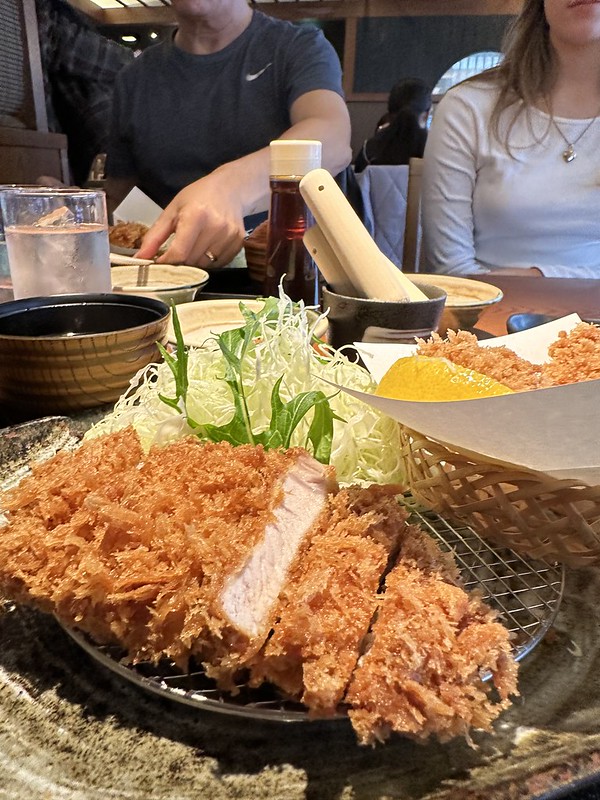
Nadia, Ocean, and I then ate tonkatsu (breaded pork cutlets, cabbage, rice, and miso soup) which on this visit was my favorite meal. Of course I had the deep-fried oysters as well because they are in season. Hiroshima is famous for its oysters and I saw them on menus all over the city. Ocean needed to do some last-minute clothes shopping. We discovered Gu the sister brand of Uniqlo. It is a cheaper version and I really couldn’t tell the difference between the clothes.

We then went on the La La Port Expo City Mall Ferris wheel. These are big in Japan and other East Asian countries. The symbol of the 1970 Expo, the iconic Tower of the Sun was lit up. It was created by Japanese artist Tako Okamoto and it is such an unusual building. I don’t know if the tower gets built in 2023, but in 1970, it was a centerpiece of the Expo and today it is a museum and still visited. We used to take students to Expo Park on field trips. The Osaka metropolitan area has a population of just under 20 million people and you could see the long spread of lights leading to the city center.
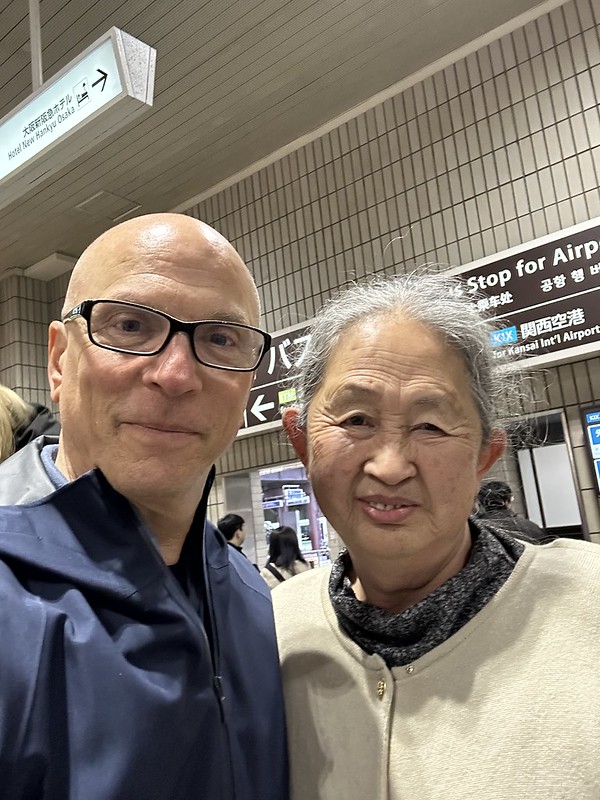
Bill and Yumiko

Our good friends Yumiko and Wakaba helped us get to the train station and on the limousine bus to the airport. The Osaka International School community always treated us with so much kindness! It is a process to get to Kansai International Airport as it is an artificial island in the south of Osaka Bay. We first traveled from the end of the Hankyu train line into the city center. From the Hankyu Umeda station, we then took an airport shuttle bus to the airport. The airport has been renovated since we lived here.

Chinese tourists were spending money like crazy not only at the airport duty-free shops but downtown as well. With a weak Yen, goods are very affordable. My friend reports that 30% of admissions at the international school are from Chinese applicants. Families are investing in Japan and receiving 10-year visas from the Japanese government. This includes buying hotels, apartment blocks, etc., and raising their children in Japan. I think this is a sign that upper-class Chinese people are hedging their bets on the future of the country. I would guess the Japanese government appreciates the influx of capital into their economy but does not want to be overwhelmed by a much louder and brash Chinese culture.

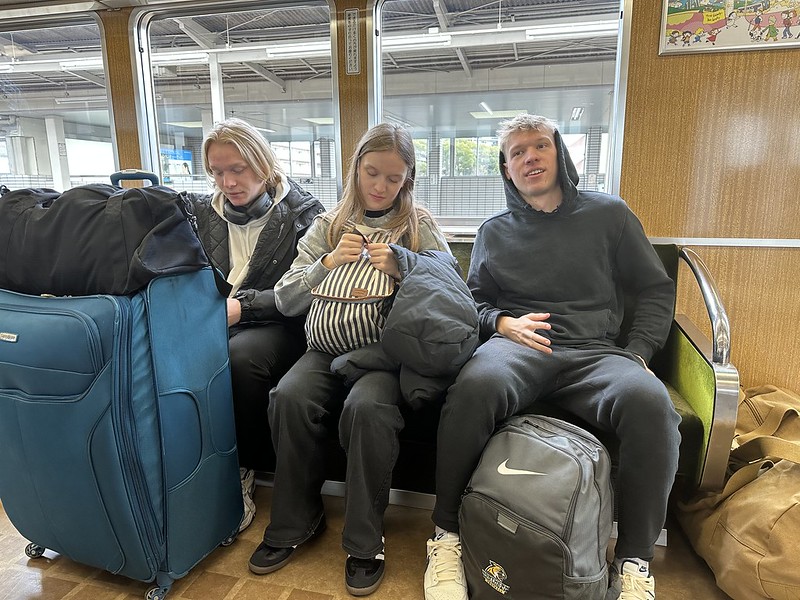
I love travel days because our adolescent kids are trapped with us and have to talk to us! I had a great day with them and we laughed a lot! I don’t know how many more full family travel days we will have as Owen is already in his third year of university, Oliver is off to college in August, and Ocean will be graduating in two years. As I wrote earlier in the school year, I am savoring my time with the kids!

The sun was setting in the Land of the Rising Sun as we hopped on the shuttle train to our departure gate. I hope Japan stays strong and preserves its unique culture as it struggles economically with a rapidly aging population. I think the social cohesion and trust will get them through the next 20 to 50 years and they will come out the other side in good shape.

Family Journal: December 31, 2023 – Happy New Year!

We spent New Year’s Eve in downtown Osaka to celebrate the end of 2023. Our eldest son Owen went with his friends so it was Oliver, Ocean, Nadia, and me who left our house around 6:00 PM. We ate at One Karubi, a Korean Barbeque Beef restaurant. They only offer a 2-hour, all-you-can-eat menu option. We were pretty much done after the first hour but continued to order drinks and some desserts in the second hour. We used to go to the restaurant for special occasions when we lived here and it was nice to go back.

After dinner, we drove 30 minutes to one of the most popular tourist areas of Osaka, Dotonbori. “Bori” means canal and “Doton” refers to Nariyasu Doton, an entrepreneur who built the canal way back in 1612. Doton built it to increase trade in Osaka, but in 1621, the Tokugawa Shogunate designated it an entertainment district. 403 years later, it is still an entertainment district with lots of bars, restaurants, karaoke, pachinko, etc. Sadly, there is only one theatre left, as originally it was full of kabuki and bunraku theatres. I wonder if a world-class theatre district like Broadway or London’s West End could be built here and survive? Japanese really don’t celebrate New Year’s Eve by going out to places like Times Square. It was mostly tourists. We were surprised by the large numbers of men from the Philippines who were congregating along the canal, drinking and smoking. They must be guest workers here, as they didn’t look like typical tourists. We noticed piles of rubbish everywhere which is rare in Japan. Public garbage bins are not common here and with so many tourists, I can see why this happened.

Kuidaore (食い倒れ) is a Japanese word that means to “ruin oneself financially by extravagant spending on food” or in Western terms, “eat until you drop”. Osaka is the food capital of Japan and prides itself on having the most and best restaurants in the country. Of course, we needed to stop to try some takoyaki or fried balls of a doughy batter with octopus inside. It was nice to watch the preparations of the takoyaki and okonomiyaki (pancakes) in front of the hot grills in the cold weather and slight rain.

Ocean, Oliver, and Nadia in Shinsekai

We left Dotonbori and headed over to ShinSekai district, about 4 kilometers away from Dotonbori. “Shin” means new and “Sekai” means world. The area was first developed in 1912 and being typical of Japanese culture, it was modeled after Coney Island (north side) and Paris (south side). The Japanese often replicate outside cultures and with their attention to detail and hard work, often improve them! 🙂 The amusement park is long gone but the Eifel Tower, Tsūtenkaku (tower reaching heaven) is still there. The tower burned down in 1943 and the steel was used in Japan’s war efforts. Residents lobbied the government to rebuild the tower. The tower reopened in 1956 and featured a Billiken. Art teacher Florence Pretz of Kansas City, Missouri created the Billiken charm doll in the early 1900s. The figure came to her in a dream and she found the name in an 1896 poem. She sold the patent to the Billiken Company of Chicago. To purchase one, or even better, to receive a Billiken doll brings you good luck. The Billiken is also known as the “God of Things as They Ought to Be”. It was a big fad in the early 20th century but faded into obscurity over the past 100 years. Today it is still a symbol of American culture in the shinsekai district and we noticed many billikens around the neighborhood. I am glad they kept the idea alive. We will probably head back to the district once more before we leave to enjoy the cozy kushi-kastsu (deep fried meat on skewers) restaurants and I’ll blog more about one of my favorite districts of the city.

We also paid our respects to the kami inari a Buddhist/Shinto god associated with “with foxes, rice, household wellbeing, business prosperity, and general prosperity”. We all send positive vibes in honor of Oliver so he can pass his IB Diploma in May. You can find the shrines all over Japan, in both cities and the countryside. You wash your hands to leave the secular world and enter the sacred world. You go through a ritual of ringing the bell and clapping to “wake-up” the kami (ancestral spirits) and bow to show respect. We are all hoping it works!

We finished the evening by celebrating the countdown at our house together. My first New Year’s kiss was of course with my beautiful wife Nadia. It was so nice to spend the evening together with Oliver and Ocean. They will soon become adults and leave us, and it felt like a nice way to be together as a family to welcome 2024.

Latest Reading: Michael Schuman’s “The Miracle”

I just finished reading Michael Schuman’s “The Miracle: The Epic Story of Asia’s Quest for Wealth” and I really enjoyed it. Schuman is a journalist with Time magazine and the Wall Street Journal and has covered Asian economics and news for ten years. Asia is a part of the world that I don’t know much about and I have never been there (Australia excluded), and so the book is a good primer on the recent history of the region. He covers China, India, South Korea, Indonesia, Malaysia, and Taiwan.

 Schuman gives a brief recent history of each country and chooses an important political figure and businessman for each country to tell his story. Asia since WWII has passed other regions since then in standard of living. He goes into the many reasons. I understand the biggest reason was tapping into the global economy through encouraging foreign investment and increasing the quality of businesses in the country. He also writes that all of the countries put politics and history aside and concentrated on the generating of wealth. That is a good lesson for the Balkans! 

I particularly liked the chapter on China. It is an example of one person’s efforts and opinion changing a countries destiny. That is what great leaders can do for a country. He profiles Deng Xiaoping and his reforms of the communist party. It also gave another perspective on Tiananmen Square protests. Deng had the view that China is too large for a democracy and without a single party suppressing it, China would be chaotic. I wonder as Chinese grow richer and better educated, how that will play out. 

I also am realizing that India and China have 1/3 the world’s population and their rise will change the current international political and cultural structures. He argues that the USA started this globalization of economies after WWII and when Asia gets richer, it is good for the US. I hope it spurs our schools and our young people to improve as there are a lot of children and teens coming from homes that don’t value learning and a strong work ethic in the USA. We have to compete with Asians for jobs and business.

I recommend reading the book. I think eventually our international careers will take us to Asia. I would like to see for myself what it is like, although I am not a fan of big cities. One thought is to have our children attend Australian universities while we work in international schools in Asia. 


The Washington Post Review of the Book