
After the CEESA meetings on Friday, we spent the weekend up at Lake Ohrid to sightsee, unwind, and continue having conversations about our schools. Lake Ohrid is stunningly beautiful with a delightful, Mediterranean-like atmosphere with picturesque villages, steep green mountains, and clear, blue waters. It is one of the oldest and deepest freshwater lakes in Europe. It is a poorly developed Rift Valley lake (technically a graben) which is a tectonic fault. It is similar to Lake Titicaca in Bolivia. The water comes from underground springs, seeping through the limestone sediments. The lake has over 200 endemic species that can thrive in the unique alpine environment.

We took a boat tour leaving the main harbor in front of the town of Ohrid. We traveled south and stopped at an archaeological site (Bay of Bones) and visited a recreation of an ancient fishing village based on Roman descriptions of the area. The lake is shared with neighboring Albania which has 36% of the shoreline and Macedonia which has 64% of the shoreline. The water in very clear and with the sun coming through the clouds, it was a beautiful sky backdrop while on the water.
The view from the church dedicated to John of Patmos (top photo), the writer of the Book of Revelation, was stunning. I love history and the Orthodox Church was probably constructed in the 1200s, before the Ottomans took over the area. The theatre dates back to the Hellenistic Period (200 BC) which was the time from the death of Alexander Great to the emergence of the Roman Empire. The theatre was only discovered in the 1980s. The Romans used it for the execution of Christians and the locals hated the place and avoided it. This preserved it until during the construction of homes, the workers were uncovering Roman-era stone slabs. Today it hosts a summer music festival.


Ohrid village is picturesque, with over 300 churches for a population of 42,000 people. There were lots of tour groups and we completed a walking tour along the waterfront up to the fortress and back through the town by a Roman-era amphitheater. The quaint homes reminded me of many of the Mediterranean villages like Valledamosa in Mallorca, Trogir in Croatia, etc. I would definitely come back and stay for a week, hiking in the mountains around the lake and kayaking/diving in different sections of the lake, including exploring the Albanian side.
We had a lively dinner with Macedonian folk music and dancing. America lacks rousing folk songs that everyone can sing by heart and use an accordion to play. Slavic Eastern Europe has many of them and it makes for a community feeling of strangers in a restaurant. We were trying to think of an equivalent and only could come up with YMCA, or some pop music hits. The restaurant band tried, playing “Oh Sussanah” and “When the Saints Come Marching In”. I could only think of “This is My Land, This is Your Land”.

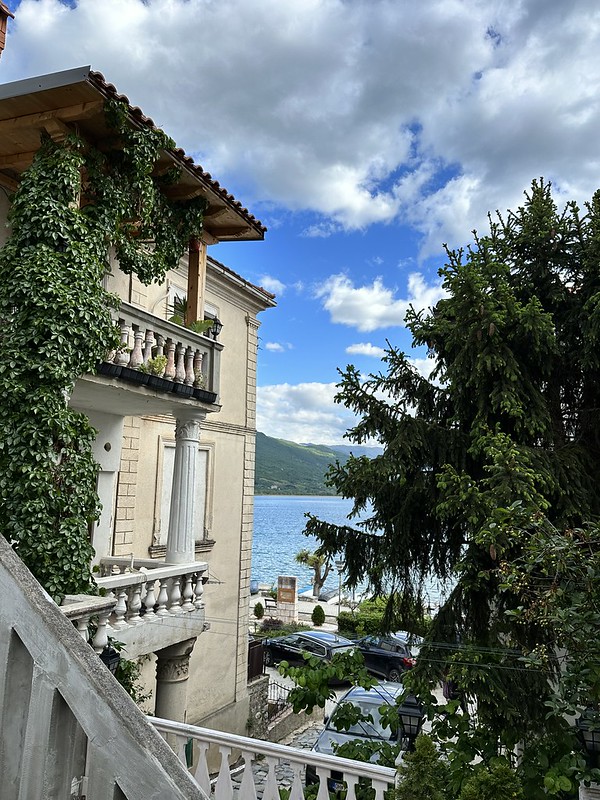
The next day I went for a run along the bike path on the shore outside of the town of Ohrid. We took a bus back to Skopje (3-hour drive) and flew through Istanbul back to Tashkent in the evening. Of course, our flight was delayed by 3 hours, so it was a long night in the Istanbul airport and a later arrival at school on Monday.
Overall it was a relaxing and insightful trip. It was great that Nadia was able to come and we reconnected with each other, spending a lot of time together. Often during a busy week, we do not see each other a lot. North Macedonia is an overlooked country because it is small and landlocked. It is north of Greece and it was the far south of Yugoslavia. Skopje is similar in many ways to Belgrade, just a lot smaller and less developed. We love the Balkans and the ex-Yugoslavia and perhaps will be back next spring in Zagreb or Split Croatia. I would like to thank our host, Ivan for his gracious hospitality and joie de vivre!
 Bill's Blog