Hiking the Sturgeon River Gorge Wilderness – June 23, 2024

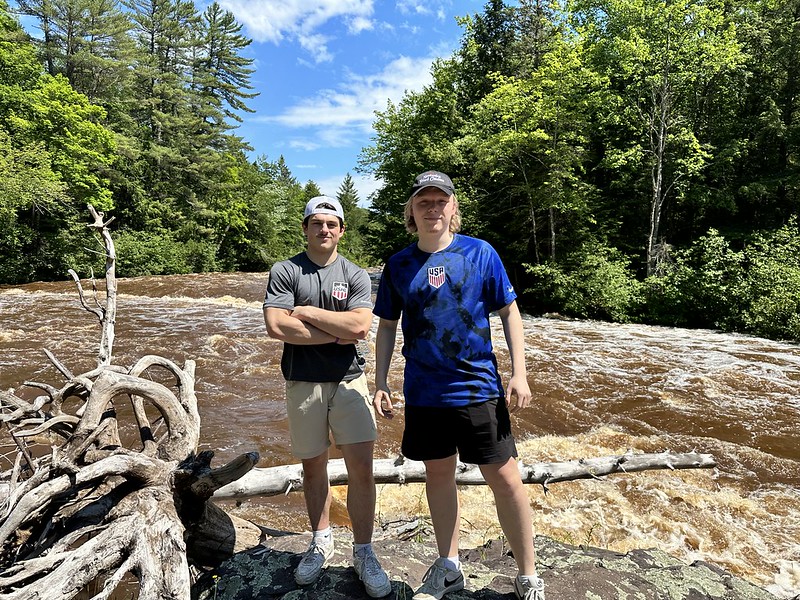
Beau and Oliver on the Sturgeon River

The United States Forest Service oversees the National Wilderness Preservation System. The program protects 803 designated Wilderness Areas that cover 111.7 million acres of land (larger than the state of California). American President Lyndon B. Johnson signed the 1964 Wilderness Act to preserve “an enduring resource of wilderness” for future generations. Americans have greatly altered nature and I am heartened that at least a small portion of the land is preserved.

On Sunday I took my son Oliver and my two nephews, Beau and Tony, to visit one of the 803 wilderness areas, the Sturgeon River Gorge Wilderness Area. It is only an hour’s drive from my home and I can’t believe I’ve never been there. It is stunningly beautiful! The interior of the Upper Peninsula of Michigan is rarely visited by tourists. It is not the easiest place to get to with two-track ATV trails and narrow gravel roads being the only access. We had the place to ourselves on a sunny Sunday June afternoon! It is located almost directly north of my village of Caspian in southern Houghton C0unty. In looking at the map, I could easily ride my bicycle to the campground, taking all forest roads.

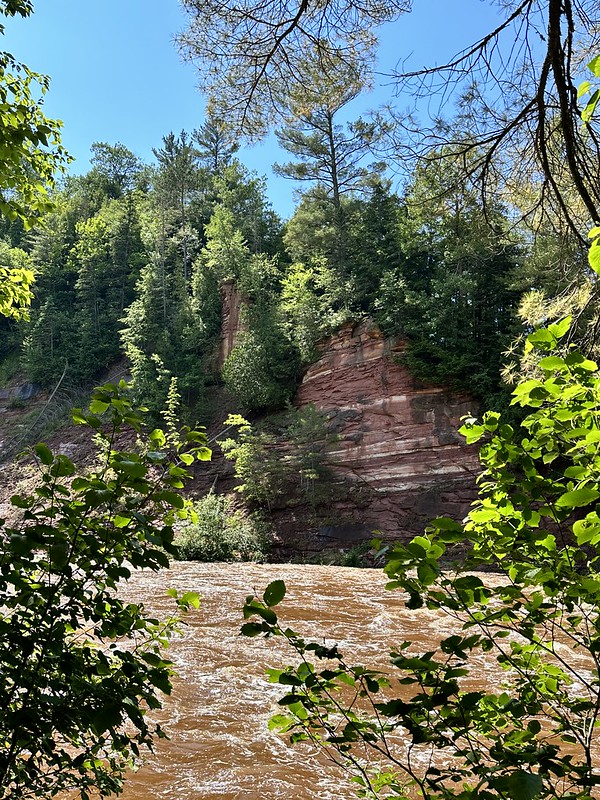
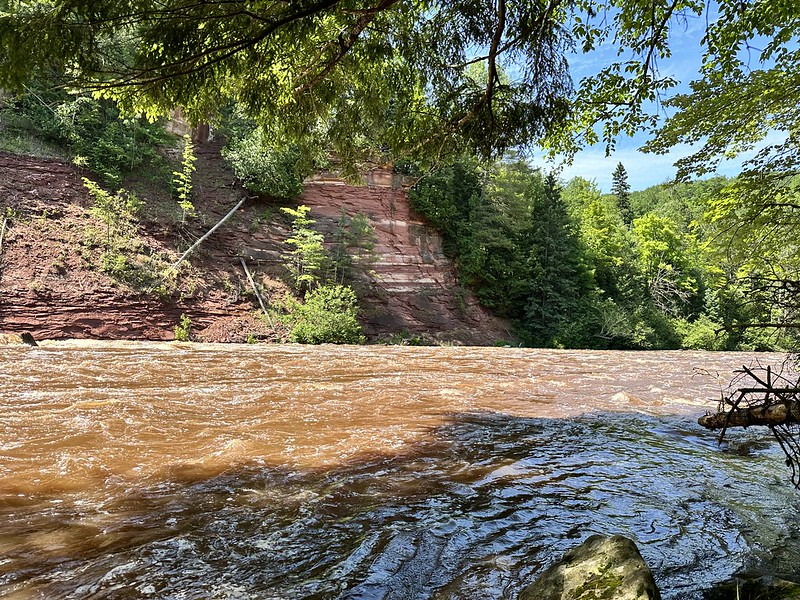
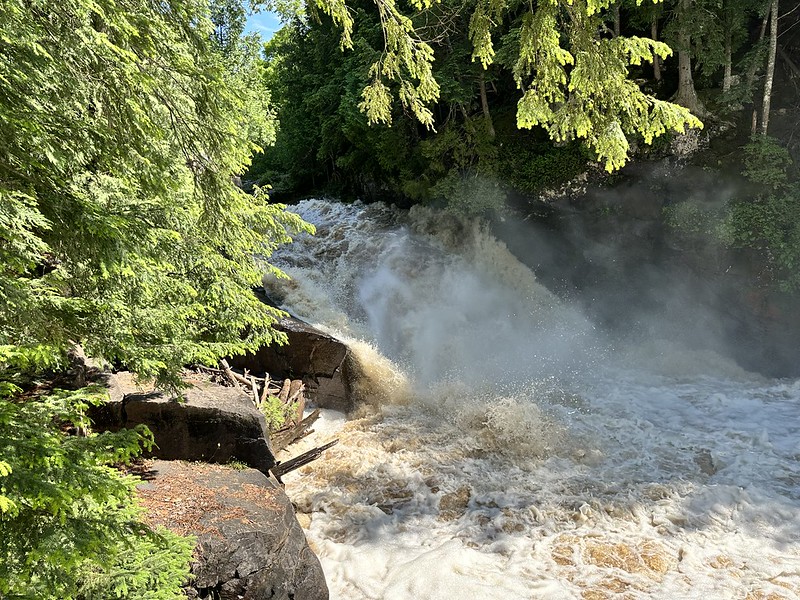
We started at the Sturgeon River Falls trail head. The 1-mile trail is well-marked and runs along the top of the gorge for a short distance before a series of switchback trails leads hikers to the river bank. The wide gorge is approximately 300 feet deep and covered with beautiful trees. It had rained the day before the river was roaring. It looked like a wild version of Willy Wonka’s Chocolate River. The rivers of the Upper Peninsula are brown-colored from the tannins (plant chemicals) from the surrounding forests, especially cedar marshland. The water was not muddy or silty and looked like chocolate in the UP sunshine. The power of rapids exploding through the narrow bedrock was breathtaking. I don’t think one could kayak through it.

The Boys at the Bears Den Overlook

On the way back home we stopped at the Bears Den Overlook, another short trail. With so many trees in the UP it is rare to get long views over the forests. The view over the gorge was awesome and worth the stop. We worked our way about halfway down along a narrow ridge to the right of the overlook before returning to the car. You can see the chocolate ribbon of the river at the bottom of the gorge from the top. I will definitely come back and explore more of the area. The next time I come I will set up a camp at the Sturgeon River Campground, hike the Sidnaw Trail, and ride bicycles up to the falls and overlook and explore a bit more of the area.

Travel Journal May : Lake Ohrid, North Macedonia – May 9-12, 2024

Church of St. John at Kaneo

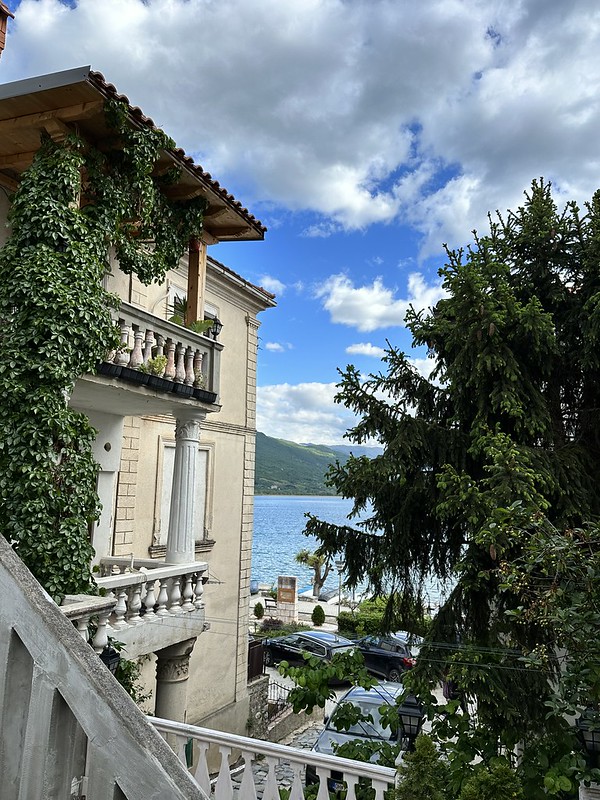
After the CEESA meetings on Friday, we spent the weekend up at Lake Ohrid to sightsee, unwind, and continue having conversations about our schools. Lake Ohrid is stunningly beautiful with a delightful, Mediterranean-like atmosphere with picturesque villages, steep green mountains, and clear, blue waters. It is one of the oldest and deepest freshwater lakes in Europe. It is a poorly developed Rift Valley lake (technically a graben) which is a tectonic fault. It is similar to Lake Titicaca in Bolivia. The water comes from underground springs, seeping through the limestone sediments. The lake has over 200 endemic species that can thrive in the unique alpine environment.

Ancient Theatre of Ohrid

We took a boat tour leaving the main harbor in front of the town of Ohrid. We traveled south and stopped at an archaeological site (Bay of Bones) and visited a recreation of an ancient fishing village based on Roman descriptions of the area. The lake is shared with neighboring Albania which has 36% of the shoreline and Macedonia which has 64% of the shoreline. The water in very clear and with the sun coming through the clouds, it was a beautiful sky backdrop while on the water.

The view from the church dedicated to John of Patmos (top photo), the writer of the Book of Revelation, was stunning. I love history and the Orthodox Church was probably constructed in the 1200s, before the Ottomans took over the area. The theatre dates back to the Hellenistic Period (200 BC) which was the time from the death of Alexander Great to the emergence of the Roman Empire. The theatre was only discovered in the 1980s. The Romans used it for the execution of Christians and the locals hated the place and avoided it. This preserved it until during the construction of homes, the workers were uncovering Roman-era stone slabs. Today it hosts a summer music festival.

Ohrid village is picturesque, with over 300 churches for a population of 42,000 people. There were lots of tour groups and we completed a walking tour along the waterfront up to the fortress and back through the town by a Roman-era amphitheater. The quaint homes reminded me of many of the Mediterranean villages like Valledamosa in Mallorca, Trogir in Croatia, etc. I would definitely come back and stay for a week, hiking in the mountains around the lake and kayaking/diving in different sections of the lake, including exploring the Albanian side.

We had a lively dinner with Macedonian folk music and dancing. America lacks rousing folk songs that everyone can sing by heart and use an accordion to play. Slavic Eastern Europe has many of them and it makes for a community feeling of strangers in a restaurant. We were trying to think of an equivalent and only could come up with YMCA, or some pop music hits. The restaurant band tried, playing “Oh Sussanah” and “When the Saints Come Marching In”. I could only think of “This is My Land, This is Your Land”.

The next day I went for a run along the bike path on the shore outside of the town of Ohrid. We took a bus back to Skopje (3-hour drive) and flew through Istanbul back to Tashkent in the evening. Of course, our flight was delayed by 3 hours, so it was a long night in the Istanbul airport and a later arrival at school on Monday.

Overall it was a relaxing and insightful trip. It was great that Nadia was able to come and we reconnected with each other, spending a lot of time together. Often during a busy week, we do not see each other a lot. North Macedonia is an overlooked country because it is small and landlocked. It is north of Greece and it was the far south of Yugoslavia. Skopje is similar in many ways to Belgrade, just a lot smaller and less developed. We love the Balkans and the ex-Yugoslavia and perhaps will be back next spring in Zagreb or Split Croatia. I would like to thank our host, Ivan for his gracious hospitality and joie de vivre!
Final Days in Japan

Winter Break is coming to an end as we head back to Tashkent and school starts on Monday. We finished our time in Japan visiting a few more friends (Mike and Ana), tidying up the house, packing, shopping, and eating. While the girls were shopping in Daiso, the dollar store of Japan, I went for a walk in Kita Senri Park. There is a nice trail that winds through a bamboo forest, similar to the famous UNESCO World Heritage site in Kyoto. It is right behind our former school and the path leads to our neighborhood in Onohara-Nishi. We also had so much shopping that we needed to go to a second hand store and buy three carry-ons to make sure we could take everything back with us to Tashkent.

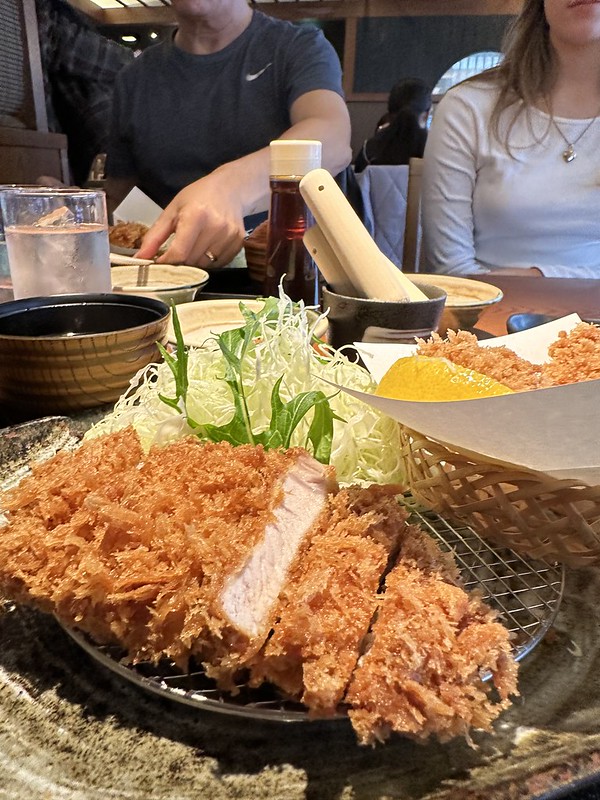
Nadia, Ocean, and I then ate tonkatsu (breaded pork cutlets, cabbage, rice, and miso soup) which on this visit was my favorite meal. Of course I had the deep-fried oysters as well because they are in season. Hiroshima is famous for its oysters and I saw them on menus all over the city. Ocean needed to do some last-minute clothes shopping. We discovered Gu the sister brand of Uniqlo. It is a cheaper version and I really couldn’t tell the difference between the clothes.

We then went on the La La Port Expo City Mall Ferris wheel. These are big in Japan and other East Asian countries. The symbol of the 1970 Expo, the iconic Tower of the Sun was lit up. It was created by Japanese artist Tako Okamoto and it is such an unusual building. I don’t know if the tower gets built in 2023, but in 1970, it was a centerpiece of the Expo and today it is a museum and still visited. We used to take students to Expo Park on field trips. The Osaka metropolitan area has a population of just under 20 million people and you could see the long spread of lights leading to the city center.

Bill and Yumiko

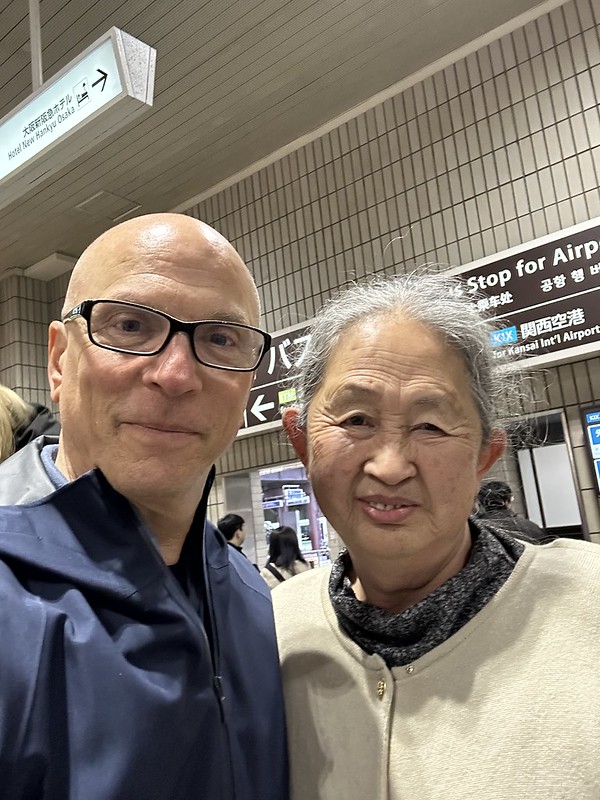
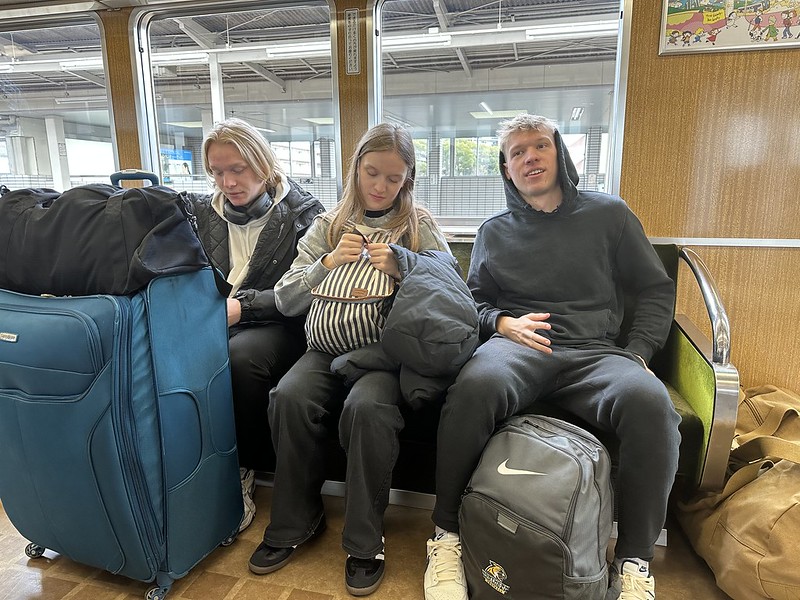
Our good friends Yumiko and Wakaba helped us get to the train station and on the limousine bus to the airport. The Osaka International School community always treated us with so much kindness! It is a process to get to Kansai International Airport as it is an artificial island in the south of Osaka Bay. We first traveled from the end of the Hankyu train line into the city center. From the Hankyu Umeda station, we then took an airport shuttle bus to the airport. The airport has been renovated since we lived here.

Chinese tourists were spending money like crazy not only at the airport duty-free shops but downtown as well. With a weak Yen, goods are very affordable. My friend reports that 30% of admissions at the international school are from Chinese applicants. Families are investing in Japan and receiving 10-year visas from the Japanese government. This includes buying hotels, apartment blocks, etc., and raising their children in Japan. I think this is a sign that upper-class Chinese people are hedging their bets on the future of the country. I would guess the Japanese government appreciates the influx of capital into their economy but does not want to be overwhelmed by a much louder and brash Chinese culture.

I love travel days because our adolescent kids are trapped with us and have to talk to us! I had a great day with them and we laughed a lot! I don’t know how many more full family travel days we will have as Owen is already in his third year of university, Oliver is off to college in August, and Ocean will be graduating in two years. As I wrote earlier in the school year, I am savoring my time with the kids!

The sun was setting in the Land of the Rising Sun as we hopped on the shuttle train to our departure gate. I hope Japan stays strong and preserves its unique culture as it struggles economically with a rapidly aging population. I think the social cohesion and trust will get them through the next 20 to 50 years and they will come out the other side in good shape.

Family Journal: January 1, 2024 – Hike to Katsuoji Temple

The Kralovec Family Daruma

We kicked off the New Year with a hike to Katsuoji Temple. It is our favorite temple in Japan! The temple is located in the hills of Minoh Park, a huge forested set of hills and valleys just on the outskirts of the urban sprawl of Osaka. We all spent a lot of time in Minoh Park, cycling and hiking through the beautiful Sugi forests. In certain areas in the park, one can see deer and monkeys and it is nice to have nature so close to the metropolis of Osaka. It is a perfect hike starting from our old house, it is about a 4-kilometer walk (2.5 miles) up the mountain on a clearly marked trail. Japanese people in the early days of the New Year, visit their local temple to pray for good fortune in the upcoming year and pay respects to their ancestors. This is called hatsumode. It is a befitting way to start a year. I loved getting the family together to exercise and to reflect on what is coming up in 2024.

Nadia and Ocean with their luck charms

We purchased lucky charms to bring us money, safety while driving, luck on school exams, and one lucky wish. We attached the charms to the complimentary bamboo branch we received upon entrance to the temple. We lit a candle and incense for our ancestors, both dead and alive. We skipped the prayers at the shrines because the lines were too long. Rain interspersed stretches of sunshine throughout the day but it was not heavy and the walking warmed us up.

I love Katsuoji because, unlike many temples in Japan, it is located in a wilderness area and not overcrowded like many temples during New Year’s celebrations. The Emperor Seiwa erected the Buddhist temple 1,260 years ago and named it katsu, which means “winning” in Japanese. For centuries, warlords and common people have come to Katsuoji to buy the famous Daruma dolls to see if they get the winner’s luck. If the wish is fulfilled, the daruma dolls are supposed to be left on the grounds. We bought six Daruma dolls to represent our five family members and our dog Obi.

It was a perfect way to start the new year. I love exercising in the wilderness followed by a cultural experience. We don’t know what 2024 will bring us but we will do our best and stick together as a family. Happy New Year and best wishes for health, happiness, success, and fulfillment in the upcoming year.

Family Journal: December 31, 2023 – Happy New Year!

We spent New Year’s Eve in downtown Osaka to celebrate the end of 2023. Our eldest son Owen went with his friends so it was Oliver, Ocean, Nadia, and me who left our house around 6:00 PM. We ate at One Karubi, a Korean Barbeque Beef restaurant. They only offer a 2-hour, all-you-can-eat menu option. We were pretty much done after the first hour but continued to order drinks and some desserts in the second hour. We used to go to the restaurant for special occasions when we lived here and it was nice to go back.

After dinner, we drove 30 minutes to one of the most popular tourist areas of Osaka, Dotonbori. “Bori” means canal and “Doton” refers to Nariyasu Doton, an entrepreneur who built the canal way back in 1612. Doton built it to increase trade in Osaka, but in 1621, the Tokugawa Shogunate designated it an entertainment district. 403 years later, it is still an entertainment district with lots of bars, restaurants, karaoke, pachinko, etc. Sadly, there is only one theatre left, as originally it was full of kabuki and bunraku theatres. I wonder if a world-class theatre district like Broadway or London’s West End could be built here and survive? Japanese really don’t celebrate New Year’s Eve by going out to places like Times Square. It was mostly tourists. We were surprised by the large numbers of men from the Philippines who were congregating along the canal, drinking and smoking. They must be guest workers here, as they didn’t look like typical tourists. We noticed piles of rubbish everywhere which is rare in Japan. Public garbage bins are not common here and with so many tourists, I can see why this happened.

Kuidaore (食い倒れ) is a Japanese word that means to “ruin oneself financially by extravagant spending on food” or in Western terms, “eat until you drop”. Osaka is the food capital of Japan and prides itself on having the most and best restaurants in the country. Of course, we needed to stop to try some takoyaki or fried balls of a doughy batter with octopus inside. It was nice to watch the preparations of the takoyaki and okonomiyaki (pancakes) in front of the hot grills in the cold weather and slight rain.

Ocean, Oliver, and Nadia in Shinsekai

We left Dotonbori and headed over to ShinSekai district, about 4 kilometers away from Dotonbori. “Shin” means new and “Sekai” means world. The area was first developed in 1912 and being typical of Japanese culture, it was modeled after Coney Island (north side) and Paris (south side). The Japanese often replicate outside cultures and with their attention to detail and hard work, often improve them! 🙂 The amusement park is long gone but the Eifel Tower, Tsūtenkaku (tower reaching heaven) is still there. The tower burned down in 1943 and the steel was used in Japan’s war efforts. Residents lobbied the government to rebuild the tower. The tower reopened in 1956 and featured a Billiken. Art teacher Florence Pretz of Kansas City, Missouri created the Billiken charm doll in the early 1900s. The figure came to her in a dream and she found the name in an 1896 poem. She sold the patent to the Billiken Company of Chicago. To purchase one, or even better, to receive a Billiken doll brings you good luck. The Billiken is also known as the “God of Things as They Ought to Be”. It was a big fad in the early 20th century but faded into obscurity over the past 100 years. Today it is still a symbol of American culture in the shinsekai district and we noticed many billikens around the neighborhood. I am glad they kept the idea alive. We will probably head back to the district once more before we leave to enjoy the cozy kushi-kastsu (deep fried meat on skewers) restaurants and I’ll blog more about one of my favorite districts of the city.

We also paid our respects to the kami inari a Buddhist/Shinto god associated with “with foxes, rice, household wellbeing, business prosperity, and general prosperity”. We all send positive vibes in honor of Oliver so he can pass his IB Diploma in May. You can find the shrines all over Japan, in both cities and the countryside. You wash your hands to leave the secular world and enter the sacred world. You go through a ritual of ringing the bell and clapping to “wake-up” the kami (ancestral spirits) and bow to show respect. We are all hoping it works!

We finished the evening by celebrating the countdown at our house together. My first New Year’s kiss was of course with my beautiful wife Nadia. It was so nice to spend the evening together with Oliver and Ocean. They will soon become adults and leave us, and it felt like a nice way to be together as a family to welcome 2024.

The Sacred Deer of Nara Park

“I’ve had enough…”

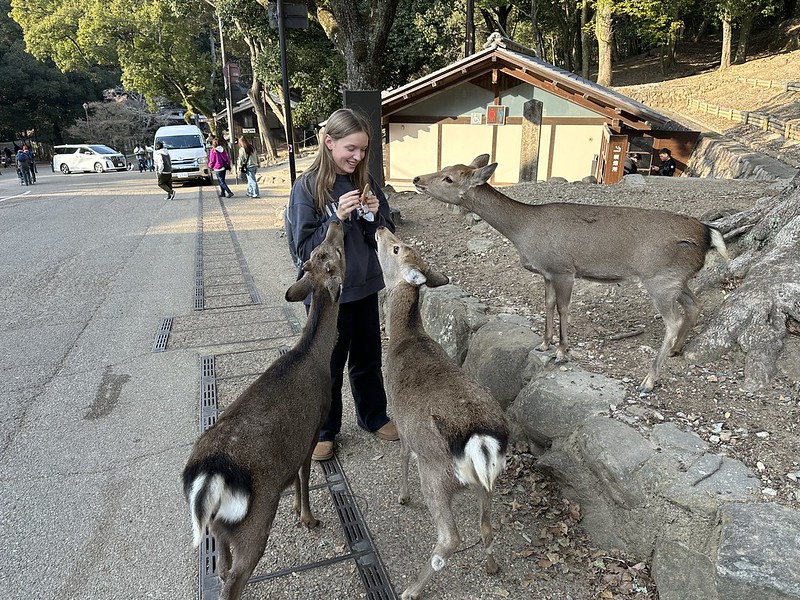
As you can see by this bloated deer, the tourists are back! I was reading that during COVID, the deer were starving without the daily influx of tourists feeding the deer rice cookies. By the time we arrived in the afternoon, the deer looked like they were full and tired of having tourists stick cookies in their faces. We had to walk away from the central park area up to Wakakusayama Hill to find deer that were eager to crunch the cookies.

Hungry Deer

This is the fourth time that I’ve visited Nara Park and the famous Sika or Northern Spotted or Japanese Deer (Cervus nippon). My daughter Ocean wanted to post photographs of feeding the deer on her Instagram so we drove from Osaka to Nara (55 minutes). Besides the deer, there are some beautiful Buddhist Temples including one of the world’s largest wooden temples housing a huge statue of Buddha. The manicured grounds are full of trees, ponds, and open grass areas.

Oliver feeds the deer

The deer are considered to be sacred messengers of the gods and have been protected for over a thousand years. They have been isolated for so long from other deer herds in Japan that they are genetically different and they behave differently. The Nara Deer are famous for bowing while approaching tourists for rice. This is not a behavior Sika Deer exhibits in nature and they think it may have developed as a form of communication between the deer and the humans.

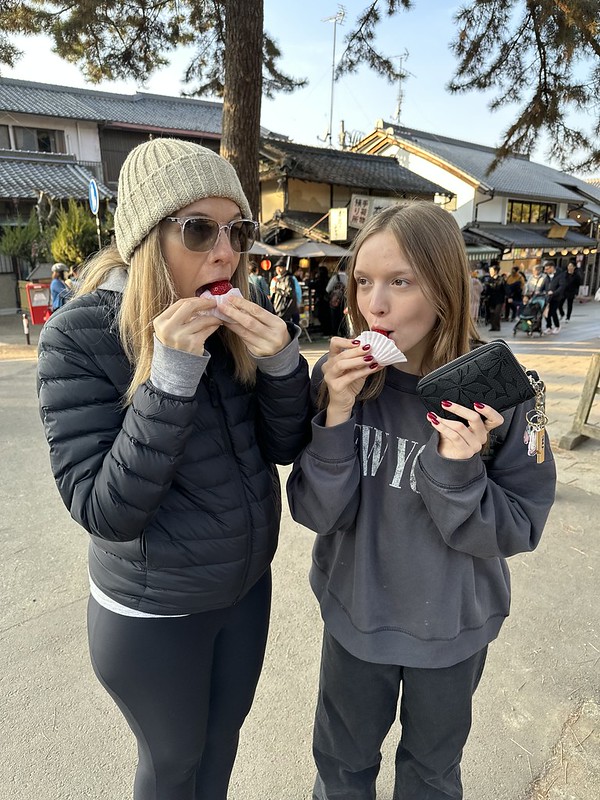
Red Bean Paste and Strawberry Mochi

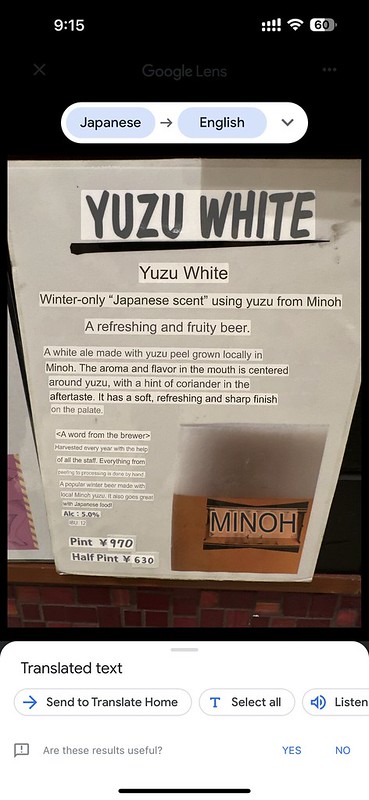
In the evening, Nadia and I rode our bicycles to meet with my friend Kurt at the Minoh Brewery. They make in my opinion, the world’s finest craft beers. I tried the Yuzu White one of their winter beers. I love seasonal things and like all of their beers, absolutely delicious. I don’t drink a lot of beer or alcohol in general for health reasons especially now I am in my 50s, but I do love an occasional good craft beer. I also keep being impressed with Google Translate. It is so much faster and more accurate than 5 years ago and makes travel in Japan easier. I also sense the Japanese are opening to the English-speaking world. With such a weak yen, the island is receiving many more tourists who are coming specifically for shopping.

Ocean Becomes a Certified Scuba Diver

Dad and Ocean – Indian Ocean

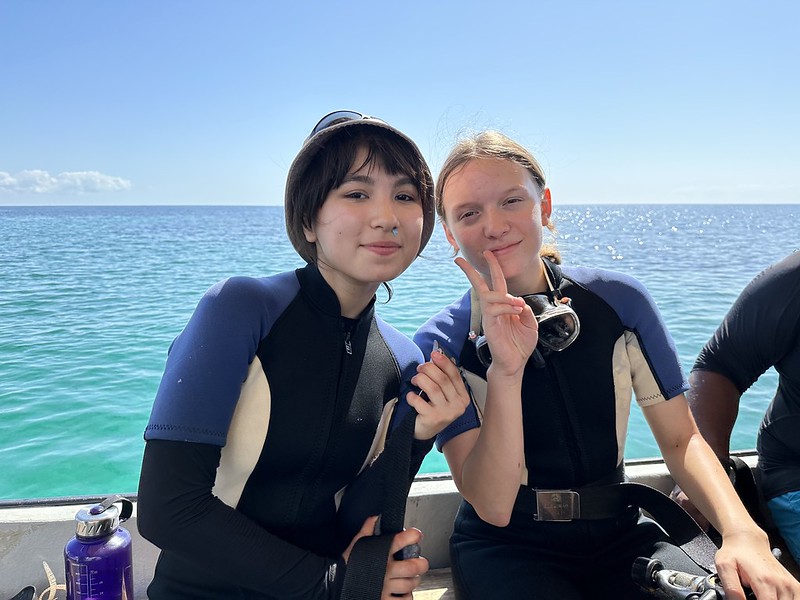
The last time I went scuba diving was in 2001 in the Western Australian Aquarium shark tank in Perth. My daughter Ocean completed her PADI open-water certification diving course and it was awesome for me to go on her first dive together as a certified diver! I did a refresher dive practicing all of the skills of diving and the safety precautions. Ocean is a natural in the water, it might have to do something with her name.

Ocean and her friend Oygul

I earned my certification in 1991 with Dawn’s High Desert Divers in northern Nevada. I remember my first dive was in a geothermal hot pond in the Great Salt Desert. I continued diving on the Caribbean coast of Colombia, earning an advanced diving certification. Since then I’ve done quite a bit of snorkeling and swimming, but not much diving. Part of it was in Colombia I suffered from seasickness and hated all of the preparation to dive. My motion sickness has diminished as I am getting older, one of the only nice things about being in my 50s. I am not crazy about diving, but I think everyone should do it in their lives. The earth is 2/3 ocean and for those people who do not dive, they are missing out on a wonderful part of the planet.

I did six dives during the week, some with the students, some service dives, and others, just with the other teachers. The coral reefs of the Indian Ocean Tanzanian coast are making a comeback. Efforts of conservation and restoration of the reefs are taking place all up and down the coast. Country officials are realizing the economic value of ocean biodiversity. We helped the restoration of the reefs by planting cement shells that serve as a medium for coral growth. Local fishermen use dynamite to fish which destroys the coral. This is not prohibited, although it still occasionally occurs. Our school is establishing a relationship with Fish Eagle Point and others in the region to support their conservation and rehabilitation of the Tanzanian coral reefs.

I am proud of Ocean! She found time to complete the online course before leaving for the trip. She has a busy academic schedule and Ocean was not entirely enthusiastic about going. She had a little trouble equalizing her sinuses on the first couple of dives, but after that, excelled as a diver. She is now a certified PADI diver. I would love to get Owen and Oliver as divers as well so we could all do a Lake Superior dive this summer. We’ll see.

Placing the sound recording device anchor in the boat

Mkomazi National Park – Tanzanian Majesty

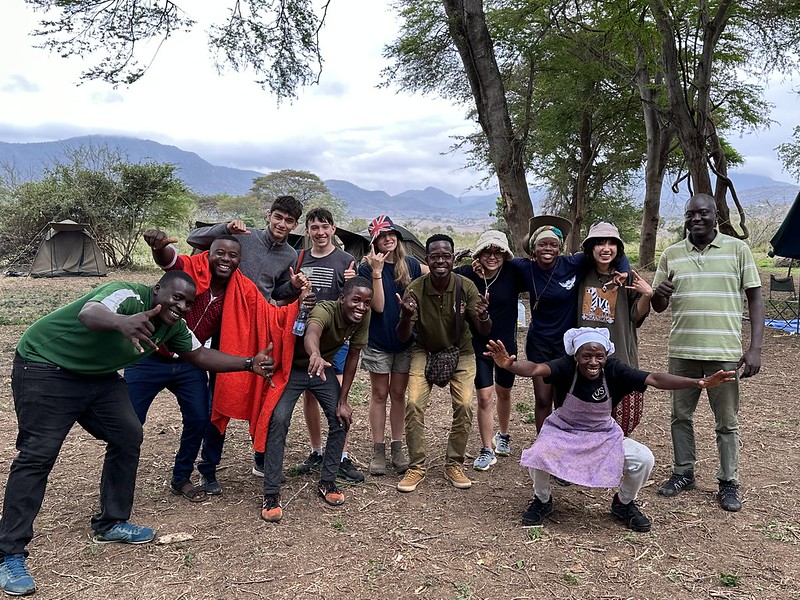
Our friendly crew at the Mkomazi Campsite

I completed a lifelong dream of going on a safari in Africa. My daughter Ocean and I visited the Mkomazi National Park located on the border of Tanzania and Kenya. It is adjacent to the Tsavo West National Park on the Kenyan side. Mkomazi is little visited compared to the more famous Tanzanian parks in the Serengeti region. However, I was swept away by the majesty of the African savannah and Acacia-dry woodlands all the same. The park features breeding programs for Black Rhinos and the African Wild Dog. It was patched together through combining reserves and somewhat controversially, evicting pastoralists and local villagers without giving adequate compensation. During the long drive from Fish Eagle Point to the park, we saw many poor villages all the way up to almost the border of the park. We also saw the occasional Maasai herders, walking along the side of the road. I have mixed emotions as a rich foreigner able to visit the rhinos and celebrate the success of conserving a big piece of land.

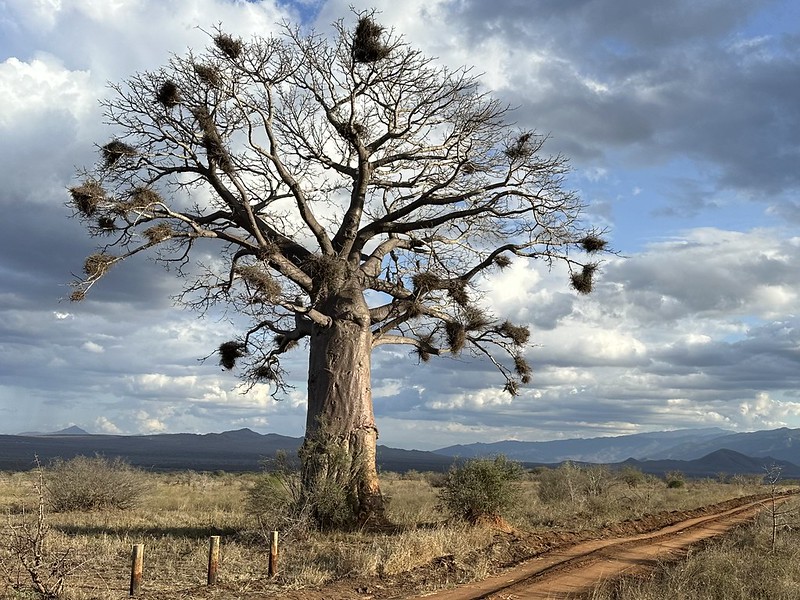
The majestic African Baobab Tree Adansonia digitata

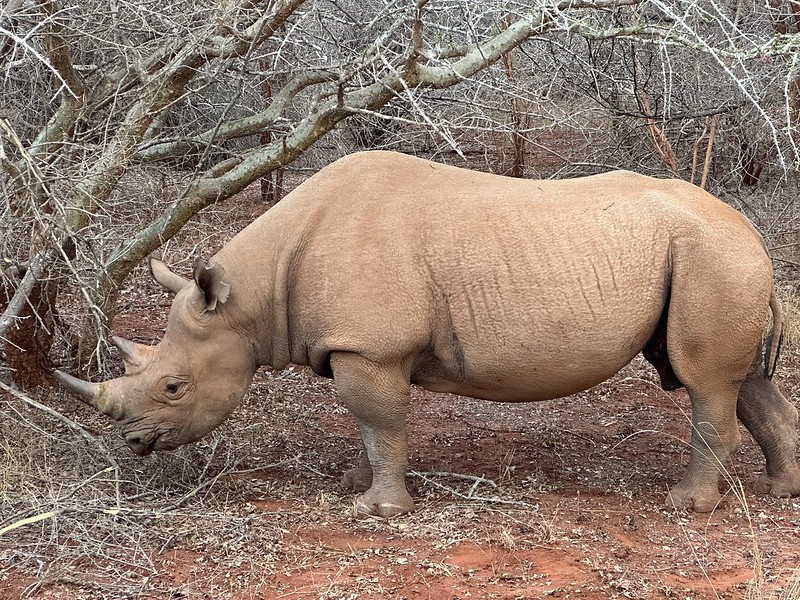
I was pleasantly surprised by the size of the park. It is slightly larger than my home of Iron County in Michigan’s Upper Peninsula (over 3,000 square kilometers). We didn’t start seeing large concentrations of animals until the interior of the park. It is the end of the dry season and many of the animals concentrate near watering holes. The Black Rhinos were used to tourists which was good that we got to see them, but bad in that it was a bit more of a zoo than a park.

The Black Rhinocerus

Our campsite was beautiful. The views of the mountains in the background, the immense Boab trees, and the clear night skies were dreamy. We were definitely not “glamping” as it was a school trip. We all had basic tents with sleeping bags and mats. We had a delicious dinner on picnic tables. We paid extra to visit the rhinos and wild dogs’ breeding areas. I was disappointed that you just can’t go on an unaccompanied hike through the park. Part of it is for safety and part of it is not to disturb the wildlife.

Dad and Ocean

I see the economics of tourism and national parks in Tanzania. I am glad my tourist dollars go to the local employees and government to give them a good life and conserve the incredible wilderness of Africa. The trip really opened my eyes to the beauty of Africa. It is similar to South America in many ways. It is a bit poorer with less infrastructure, but the nature of the tropics is on par with the Amazon, Pantonal, Andes, etc. I feel so fortunate to experience a safari. I remember Mutual of Omaha’s Wild Kingdom with Marlin Perkins as a kid (1963-1988). Growing up in a little town in northern Michigan, I always wanted to visit the exotic locales and see the wilderness that they featured on the show. I hope to go back and experience more of African wilderness.

Countries I Have Visited

My rule for counting countries is that I have to be on the land outside of the airport grounds for it to count, regardless of how long I am in the country. I also get to determine what is a country and what is not. Sometimes it is not obvious. The following are the countries I have been to in no particular order:

  1. United States of America
  2. Canada
  3. Mexico
  4. El Salvador
  5. Costa Rica
  6. Panama
  7. Colombia
  8. Venezuela
  9. Ecuador
  10. Peru
  11. Bolivia
  12. Chile
  13. Brazil
  14. Argentina
  15. Paraguay
  16. Uruguay
  17. Jamaica
  18. Trinidad & Tobago
  19. Grenada
  20. Barbados
  21. Saint Lucia
  22. Martinique (insular region of France)
  23. Antigua & Barbuda
  24. British Virgin Islands (UK overseas territory)
  25. New Zealand
  26. Australia
  27. Spain
  28. Germany
  29. Lithuania
  30. Serbia
  31. Bulgaria
  32. Hungary
  33. Croatia
  34. Slovenia
  35. Austria
  36. The Netherlands
  37. Finland
  38. Romania
  39. Bosnia i Hercegovina
  40. Estonia
  41. Montenegro
  42. Italy
  43. Bahrain
  44. Latvia
  45. Slovakia
  46. England
  47. Macedonia
  48. Greece
  49. Cyprus
  50. Sweden
  51. Denmark
  52. Japan
  53. Poland
  54. Czech Republic
  55. Turkey
  56. Malta
  57. Malaysia
  58. China
  59. Thailand
  60. Macau (special administrative region of China) – 2015
  61. Guam (unincorporated US territory)
  62. South Korea
  63. Singapore
  64. United Arab Emirates (Dubai)
  65. Uzbekistan
  66. Hong Kong (special administrative region of China) – 2019
  67. Turkmenistan
  68. Kazakhstan
  69. Tanzania
  70. Egypt

Nadia’s List

  1. Australia
  2. Fiji
  3. New Zealand
  4. Bolivia
  5. USA
  6. Canada
  7. Lithuania
  8. Germany
  9. Chile
  10. Peru
  11. Brazil
  12. Argentina
  13. Venezuela
  14. Costa Rica
  15. Panama
  16. Serbia
  17. Hungary
  18. Croatia
  19. Slovenia
  20. Austria
  21. Romania
  22. Bosnia i Hercegovina
  23. Montenegro
  24. United Arab Emirates (Dubai)
  25. Turkey
  26. Italy
  27. Slovakia
  28. Macedonia
  29. Greece
  30. Cyprus
  31. Sweden
  32. Denmark
  33. Bulgaria
  34. Poland
  35. Czech Republic
  36. Japan
  37. China
  38. Malaysia
  39. South Korea
  40. Guam (unincorporated US territory)
  41. Singapore
  42. Uzbekistan

Owen’s and Oliver’s List

  1. Bolivia
  2. Venezuela
  3. USA
  4. Serbia
  5. Bulgaria
  6. Hungary
  7. Croatia
  8. Slovenia
  9. Austria
  10. Romania
  11. Bosnia i Hercegovina
  12. Montenegro
  13. Italy
  14. Slovakia
  15. Macedonia
  16. Greece
  17. Cyprus
  18. Sweden
  19. Denmark
  20. Poland
  21. Czech Republic
  22. Turkey
  23. Japan
  24. Australia
  25. China
  26. Guam
  27. South Korea
  28. Thailand (Owen only)
  29. Singapore
  30. Kazakhstan
  31. Uzbekistan
  32. Kyrgyzstan (Oliver only)
  33. Netherlands (Owen only)
  34. United Arab Emirates (Oliver only)
  35. Italy (Oliver only)

Ocean’s List

  1. Bolivia
  2. USA
  3. Venezuela
  4. Germany
  5. Lithuania
  6. Serbia
  7. Hungary
  8. Croatia
  9. Slovenia
  10. Austria
  11. Romania
  12. Bosnia i Hercegovina
  13. Montenegro
  14. Italy
  15. Slovakia
  16. Macedonia
  17. Greece
  18. Cyprus
  19. Sweden
  20. Denmark
  21. Bulgaria
  22. Poland
  23. Czech Republic
  24. Turkey
  25. Japan
  26. Australia
  27. China
  28. Guam
  29. South Korea
  30. Singapore
  31. Uzbekistan
  32. Kazakhstan
  33. Kyrgyzstan
  34. France
  35. Monaco
  36. Tanzania
  37. Italy

Sebastian

  1. Bolivia
  2. Canada
  3. Venezuela
  4. Indonesia
  5. Singapore
  6. Thailand
  7. Philippines
  8. Vietnam
  9. Serbia
  10. Slovenia
  11. Bahrain
  12. Hungary
  13. Croatia
  14. Laos
  15. Argentina
  16. USA
  17. Romania
  18. Dubai
  19. France
  20. Austria
  21. Singapore