
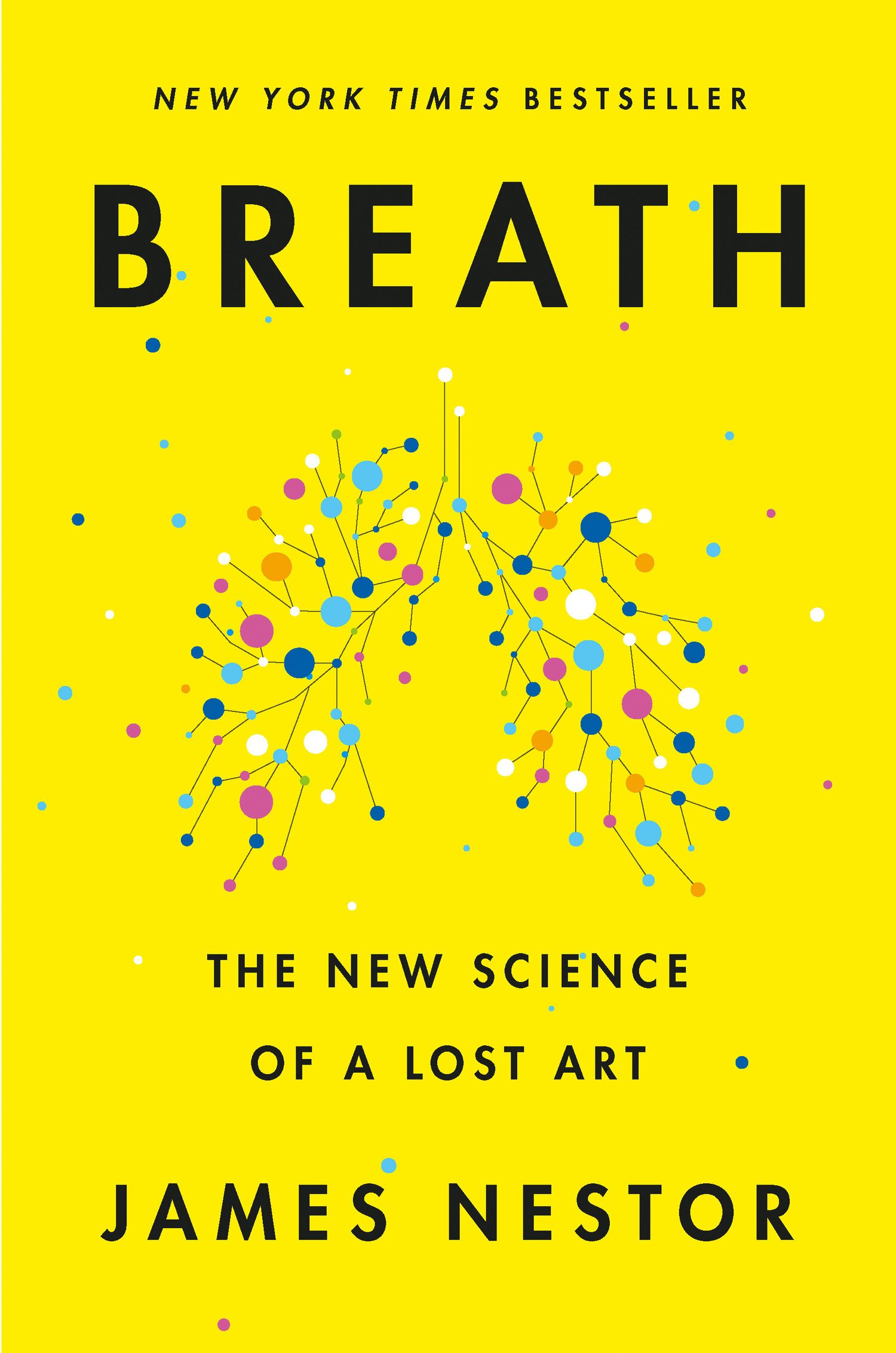
I llistened to this audio book during the long day of travel. I discovered the importance of breathing over the past couple of years through my practice of Power Yoga (Vinyasa). Travis Elliot, the founder of Inner Dimension Yoga and many of the instructors include breathing techniques in their practices. The Indian Embassy Cultural Center instructor who did a session at TIS in June also focused on breath. This led me to find this book.
Most health advice focuses on food and exercise. Nestor’s argument is that the thing we do 25,000 times a day, breathing, gets almost no attention, and that how we do it shapes nervous system function, heart rate, blood flow and blood pressure, and sleep quality more than we realize. Some of the “pulmonauts” he met claim it also prevents tooth decay, promotes weight loss, decreases chronic diseases and increases longevity. I do it now to clear my mind and relax my nervous system (slow breathing) and forced deep exhales to energize my brain (pranayama) during some yoga workouts. I took several pages of notes while listening and asked Claude to convert them to text and summarize some of the chapters.
Nose Breathing – The physiology backs this up. Mucus in the nasal passage captures debris and transports it down the throat, and the nose warms, humidifies, and filters air before it hits the lungs. That is a lot of unseen work the mouth simply cannot do. I want to look up George Catlin, an 1800s painter who did anthropological studies of Plains Indian Tribes. This connects to a modern practice that sounds strange until you understand the logic, mouth taping at night. A dentist named Mark Burhenn and a Stanford researcher named Ann Kearney both back the idea that taping the mouth shut during sleep keeps you nasal breathing, which is linked to higher nitric oxide levels and better sleep quality. The practical version is surgical tape placed at the center of the lips, not sealing the whole mouth.
Chewing Built Our Faces: A section I found genuinely surprising traced how our jaws and airways changed with agriculture, starting roughly 8,000 years ago. Softer, processed food meant less chewing, which meant smaller jaws, crowded teeth, and more breathing problems over generations. Compare that to accounts of people eating rougher, unprocessed diets who reportedly kept strong, straight teeth without any dental care. Nestor compared ancient skulls to today’s skulls. The culprits named were the modern staples, white flour, white rice, juices, jams, canned vegetables, milled and softened foods generally. The fix isn’t exotic, it’s chewing tougher food more.
Exhale and the Case for Breathing Less: Lung capacity and size are tied to longevity, and things like walking and cycling build that capacity over time. But the more counterintuitive idea in this section is about carbon dioxide. CO2 builds up in confined spaces. An eight hour day in a closed office, a classroom, or a gym all showed meaningfully different CO2 concentrations, with the classroom sitting somewhere around 800 to 1500 parts per million and higher levels linked to fatigue, headaches, and reduced cognitive performance. Flights are worse, CO2 levels on planes can run three to six times higher than fresh outdoor air, especially while boarding with the engines running. Airports themselves are not as bad, generally around 1000 ppm, but hotels recycling air instead of pulling in fresh air to save money was called out specifically.The takeaway that stuck with me is to open a window, and consider getting a CO2 monitor for spaces you spend a lot of time in.
There is also a nice mental model here, the body as a branching set of tubes, from the large ones (the throat) down to the smallest (alveoli), which act like docking stations where oxygen crosses into red blood cells (hemoglobin) and CO2 comes back out to be exhaled. The notes even mention that a meaningful portion of fat loss happens through exhaled CO2 rather than sweat or urine, which reframes exhaling as something with real physiological weight, not just a passive afterthought. Oxygen alone “does nothing for a person” without that whole exchange system working properly.The practical exercise from this section was slow, paced breathing, something like six seconds in, six seconds held, six seconds out, working toward roughly five and a half breaths per minute. That rhythm apparently echoes the pace of ocean waves and resting blood flow, and it’s the same cadence some meditative practices, like reciting the rosary, land on almost by accident.
Less is More: This section pushes the CO2 idea further. Most of us over breathe, and simply limiting inhales to around three seconds while stretching exhales to four to six seconds raises CO2 levels in the body, which in turn allows more oxygen to actually be released into tissues. Two examples anchored this for me. Emil Zatopek, the Czech distance runner, trained by running fast while holding his breath, a form of hypoventilation training that mimics high altitude conditions. And John Councilman used a version of this with the US swim team ahead of the 1976 Montreal Olympics.
Hypoventilation training works by teaching the body to do more with less, and one drill mentioned was inhaling for two steps while walking and exhaling for five, described as painful. On the other end of the spectrum, asthma rates are up roughly four times since 1980, at around 8% of the population, which the book frames as connected to this broader story of breathing too much, too fast, through the mouth. A detail I keep coming back to, animals with the slowest resting breathing rates tend to live the longest.
Reading this alongside noticing my own habits, a few things feel worth testing for myself.
- Nasal breathing as the default, during the day and especially at night.
- Getting a CO2 monitor for my office or bedroom, and just opening a window more.
- Practicing slower paced breathing, aiming toward that five and a half breaths per minute rhythm.
- Being more deliberate about chewing tougher, less processed food.
- Looking into mouth taping at night, cautiously and after reading more on how to do it safely
There is a chapter about yogis and the remarkable things they can do with their breathing, body temperature, heart rate, etc. Yoga developed in the ancient Indus Valley along the border with Afghanistan and northwest India. It started as motionless postures, breathing and meditation.
In the summary, Nestor goes over his findings.
- Close your mouth and breathe through your nose. – Humans were not designed to take in air through the mouth for long periods of time. It should be used only as a backup, for example, when you have a cold or are exercising heavily. Sleep tape is good for controlling snoring and sleep apnea.
- Fully exhale. – Clearing your system of CO2
- Eat food that requires chewing. A strong mouth and jaw improve breathing. Modern diets of soft, processed foods are not good.
- Breathe more on occasion.
- Hold your breath. – Steady breathing calms the amygdala and controls anxiety.
- How we breathe matters. – The perfect breath is 5.5 seconds inhale, 5.5 seconds exhale – 5 full cycles per minute. Practice this daily.
Below are links to videos demonstrating breathing techniques described in the book.
Buteyko breathing is a method developed in the 1950s by Ukrainian physician Konstantin Buteyko, built on the idea that many people chronically over-breathe (take in more air than the body needs) and that this contributes to problems like asthma, anxiety, and poor sleep. When you chronically over-breathe, you exhale too much CO2, which can actually make it harder for oxygen to reach your cells and can trigger airway constriction.
Other videos can be found on James Nestor’s website.

