I think I am done for a while with Hiassen crime novels, but I did enjoy another of his “only in Florida” intricate plots with a host of colorful characters. The title refers to a woman who was thrown overboard on a cruise ship by her husband. She survives by clinging to a bale of Jamaican marijuana at sea. I’ve noticed Hiassen with some of the same themes, beautiful women, down-on-their-luck former detectives, crooked businessmen, mobsters, etc. This book featured the Everglades as a setting. I am disappointed I did not spend any time in the Everglades while I was in Florida. It seems to be the most interesting part of the state. I’ll try to get there the next time I am in the state.
Terms I want to add to my vocabulary: sinewy – muscled palisade – fence
I am turning to non-fiction with my next book, Jeffrey Toobin’s “Homegrown: Timothy McVeigh and the rise of Right-Wing Extremism”. So far it is excellent!
Last week we toured the Silk Road City of Samarkand with my fellow CEESA directors and made a stop at Mirzo Ulugbek Observatory. He is the 15th-century ruler of Samarkand and the grandson of the great Tamerlane. His true passion was astronomy, mathematics, and learning. This was not good for his reign, he eventually was defeated in battle by his son and on his way to exile in Mecca, was beheaded by traitors. His lack of focus on military campaigns and setting religious leaders against him was his downfall. There is a statue of Ulugbek at the archeological site that reminded my wife, Nadia of her mathematics book, from her high school days in Bolivia (above and below).
One of the founders of algebra (Al-Gabr) was Muḥammad ibn Mūsā al-Khwārizmī who is featured on the cover of the Bolivian textbook. He was not Arabic, but Persian and was from the region that is around present-day Khiva. It is still called “Khwarazm” and good old Muhammad had the region in his name (Al-Juarismi – The Khivan). We had a big laugh that Nadia, who struggled with algebra and mathematics as a student, ended up moving to the land of the founders of algebra and higher mathematics, Uzbekistan! I think this is good therapy for her!
Nadia at the Amir Temur Mausoleum
We also visited the mausoleum of Tamerlane (Amir Temur). Samarkand was his capital and the guy had an eye for architectural design. The restored madrassas, mosques and other public buildings are stunning with their geometric blue tiles. We finished our day in Samarkand with our friend, Abdullahad who took us out for plov and gave us a tour of his carpet factory.
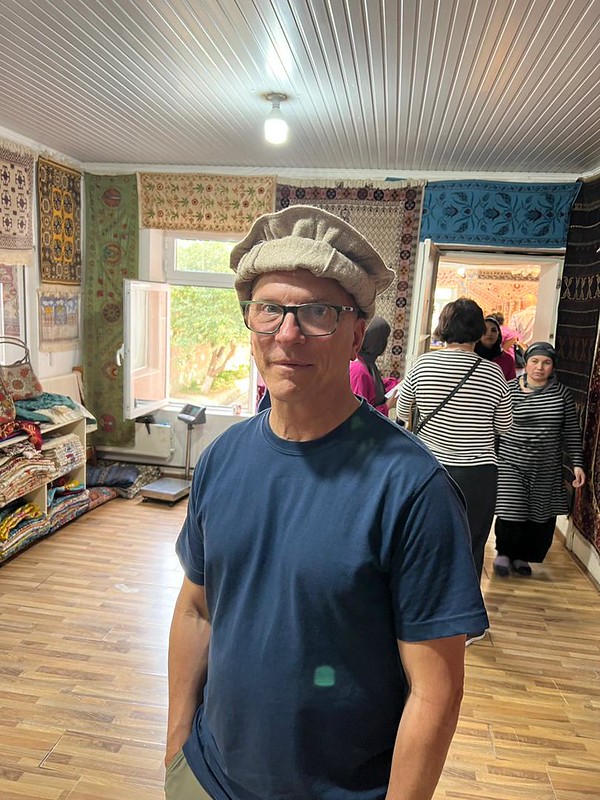
Sheep on the streets of SamarkandOur Tour Guide I purchased an Afghan/Pakistan “pakol” hat
There are three ancient Silk Road cities in Uzbekistan that are UNESCO World Heritage Sites, Samarkand, Bukhara, and Khiva. I finally got to the middle of the three, Bukhara last weekend. I led a retreat of CEESA directors to both Samarkand and Bukhara. I was awed by the vast history and architecture of Bukhara. The city was a center of trade, scholarship, culture, and religion for over 2,500 years. Today it is a medium-sized city of 280,000 citizens with a thriving tourist industry. Many of the mosques, madrassas, markets, and mausoleums are preserved and we saw numerous tour groups learning about the history of the city.
Bukhara’s “heyday” was between 850 and 1500 when it was an important center of Persian (Samanoid) culture. The majority of residents today still speak Tajik, a Persian (Iranian) language. Our tour guide said most people she knows are bilingual, Tajik and Uzbek, with the study of English and Russian quite popular in schools. The Uzbeks eventually took over the city and it was a city-state, ruled by the Emirs of Bukhara all the way up until the arrival of Russian armies. The city fell under Red Army control in 1920 and was incorporated into the Uzbek SSR. The long history means much has taken place in Bukhara. I was reading Ghengis Khan sacked the city in 1220.
We stayed at the new Mercure Hotel, about a kilometer from the old city. It was an elegant and comfortable choice and the group enjoyed the rooftop bar and spa. The bus took us to the major sites, including the following:
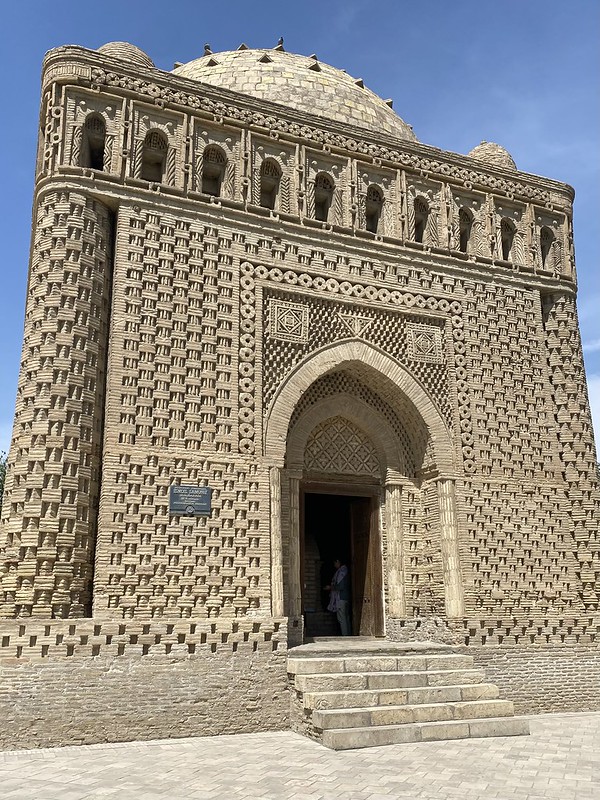
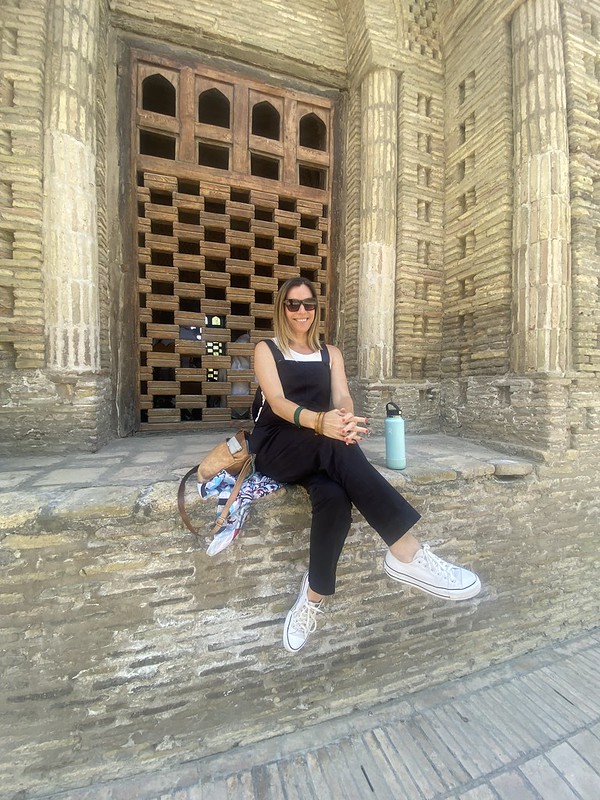
Ismail Samani mausoleum: This is the final resting place of the founder of the Saminoid (Persian) dynasty and it was built around 900 AD. The intricate brickwork has a Zoroastrian motif. It was saved from Mongol destruction by being buried in mud due to a flood when Ghengis Khan destroyed much of the city. Nadia loved the textures and shapes. The Soviets built parks on the site of cemeteries, hence today, there is a Ferris wheel, games, and rides surrounding the mausoleum.
Ark Fortress of Bukhara: The fort was built around 400 AD and city leaders and citizens lived inside it for thousands of years. It is restored today and we toured the museums and a mosque inside. A cool fact is that it was designed after the constellation Ursa Major (The Big Dipper). Nadia bought some artwork and we took a group photo on a recreated throne of the Emir.
Kalyan Minaret: This was my favorite! The massive tower is known as the “Tower of Death” because city officials executed criminals by tossing them from the top. When we visited, technicians were setting up for a classical music concert. I am always amazed that it just takes a lot of time to change the reputation from a site of gruesome atrocities to a UNESCO heritage site. The gorgeous blue domes, pillars and religious buildings surrounding the tower are truly awesome from an architectural perspective.
Lab-i Hauz complex: Bukhara was founded near the Zeravshan River, a tributary of the Amu Darya, and is surrounded by desert. Water was crucial for survival and the city once has many artificial ponds or pools. The Lab-i-Hauz complex is a preserved area of madrassas, mosques, and markets surrounding one of the last remaining pools. The Russians filled most of the pools because the mosquitos that bred on the water carried infectious diseases. I read in the Lonely Planet Guidebook that the city was known for illnesses and the life expectancy for Bukharans was 32. I found it to be quite pleasant with cafes lining the pool. Walking through the narrow alleyways and coming upon ancient and beautiful buildings was a lovely way to spend a sunny afternoon.
You definitely need a couple of days to really see the entire city and I am sure I’ll be back with my family sometime before I leave Uzbekistan. I also have the third Silk Road City, Khiva on my bucket list.
One of my favorite traditions in Uzbekistan is going out to the choyhana (teahouse) with friends for dinner. Choyhonas used to be shaded tables near a river in the summer where friends gather to share the national dish of plov (rice pilaf). Today, there are many restaurants that recreate the scene with private rooms and big tables for large groups. They still serve endless cups of Uzbek tea. I’ve grown to like the unsweetened, light tea that is always served when people gather in Uzbekistan.
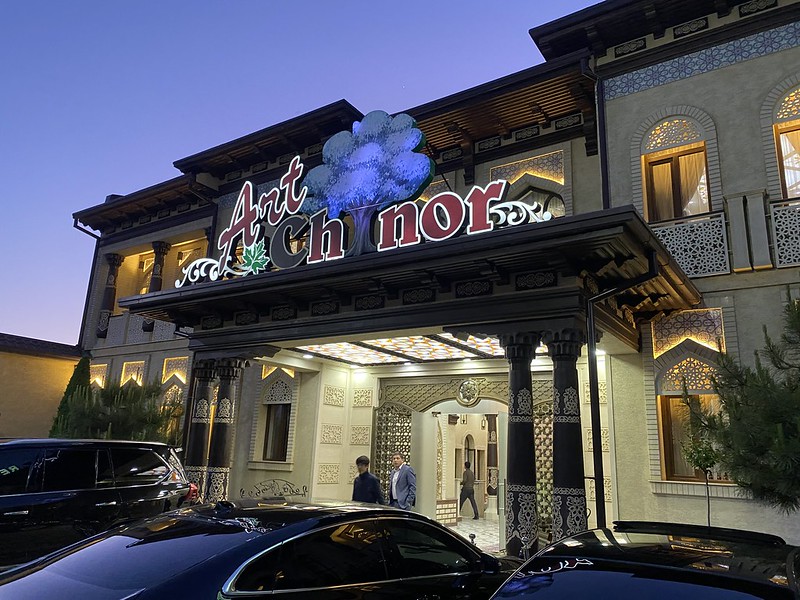
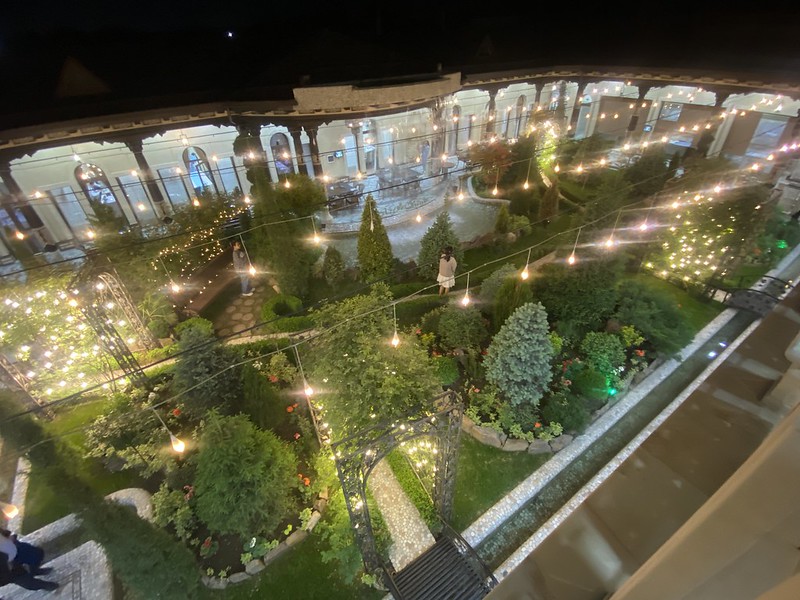
Last night Mukhtor chose a choyhona located in the far northeast of the city, Art Chinor restaurant. 20 of us gathered to eat, talk, laugh, and generally enjoy each other’s company. In Uzbekistan, the teahouses are segregated by sex, and so it is only men or only women in the private dining rooms. The meal starts with salads and bread followed by heaping plates of plov. Plov is usually cooked in huge wide pots over a fire. This plov had rice, garlic, peppers, horse, lamb, “jiz” (sheep fat), carrots, etc. It is quite filling and maybe not the best for my cholesterol. It is delicious and we had a great time.
PlovNisholda dessert
I learned about a traditional Uzbek dessert called nisholda.It is egg white, with sugar and herbs whipped for a long period of time. You can spread it on bread or crackers like Nutella or peanut butter. It is usually prepared and served around the holidays. With the end of Ramadam taking place tomorrow, it was served last night.
During Ramadan, traffic around sunset gets a bit hectic. Many people go out for their iftar (evening dinner) after fasting all day long. What normally should be a 20-minute drive, took me 40 minutes to go from my house to the restaurant. I like the festive atmosphere of the city in the evenings during Ramadan. I would like to thank Mukhtor for organizing the evening. It is always nice to connect and unwind with my Uzbek and foreign colleagues in a convivial setting.
Last weekend we camped with friends near the Tavaksay Canyon, which is in the foothills overlooking the town of Chirchiq, about an hour and 15 minutes-drive from our home in Tashkent. We had a lot of laughs and it was a beautiful evening under the half moon. The temperature was perfect and I slept very comfortably in our tent.
A windy set-up
It was my wife’s and Ocean’s favorite type of camping. It involved no hiking and backpacks. We just drove to the spot, parked, and set the tent next to the car. It was quite windy in the late afternoon Saturday when we set up the tents so we used our vehicles as a windblock. Thankfully, the wind abated and it was a glorious evening. It is so relaxing to be out in nature. We went for a walk up a ridge in the evening and I discovered the iPhone with it’s 3-second button, takes really nice night photos (see below).
The cliffs and lights of Chirchiq in the distance
It was a quiet evening as we were alone with the sheep and cow herds that ranchers take up to graze. The grasses are green at this time of the year. As spring turns into summer, the shepherds take their herds further up the mountains. I am interested in their lives and watched with interest as they guided the sheep to different grazing areas over the weekend. The Central Asian sheepdogs faithfully follow the herds and the herders are either on horseback or foot, corraling wayward sheep and cows. I think I might enjoy being a herder for a summer. It would be fun and relaxing to be outdoors all the time, but I think after a few weeks, it might get a bit boring. Once again, I must state, however, that I would like to see these hills without livestock grazing it all the time. The views are beautiful but there are not many plants, birds, and wildlife and it is mostly a sterile environment, thanks to our habit of eating a lot of meat.
It was cool to hear the call to prayer in the distance. I also got to ride my gravel bike a lot on Sunday morning. I will definitely head back up there during our upcoming Eid break to cycle more of the areas I didn’t get to. There were also a surprising number of cars driving around the hills in the evening. Uzbeks like to go up into the mountains for picnics or drinking. They are not big campers, however, as we foreigners stood out with our brightly colored tents. The mountains are my favorite aspect of living in Tashkent and I can’t wait to explore other areas this spring.
The Shape of Water is a crime novel featuring police chief detective Salvo Montalbano. It is a classic detective procedural and is the first in a series featuring the fictional detective. RAI, the national public broadcasting company of Italy turned The Shape of Water and the later other novels into the series into a television series. Kirkus Reviews calls Montalbano the Latin version of Phillip Marlowe. Marlowe is a character by Raymond Chandler, the most famous author in the “hardboiled crime fiction” genre that started in the 1920s.
I chose the book because Camilleri’s Montalbano stories are set on the island of Sicily. We are visiting the island in June and I am reading about Sicily to enhance my visit. It was another book I borrowed from the Great Lakes Digital Library and it took me 4 hours and 31 minutes to complete. I don’t know how I feel about digital books providing usage data. It is interesting to learn how long it takes to read a novel and I don’t think I would have guessed that it takes that much time.
I like crime stories and the book is a page-turner. It is set in the fictional south coast town of Vigata. Two municipal garbage collectors find an important politician dead in his car at an abandoned factory on the outskirts of the town. The factory site has turned into an outdoor brothel of sorts with immigrant women plying their trade. Powerful political players try to cover up the crime behind the death and Montalbano sets out to uncover what happened. It is an entertaining, light read and would be good on an airplane.
Ideas I am taking away from the book and things I learned about Sicily are as follows:
I knew southern Italy is different from northern Italy and that some Italians feel it could not be part of the country. I didn’t realize that there was a Sicilian dialect that is so different from Italian that it is considered a separate language. Sicily to me seems to be poor, a bit rough-edged (the mafia originated there), hot, dry and having seen better days. I know hundreds of thousands of Sicilians immigrated and their culture is a big part of New York culture today.
The carabinieri are the military police of Italy. I guess they would be the equivalent of the Michigan’s State Police but with stronger ties to the military. Officers are assigned regionally and are usually not from the districts they are patrolling.
tambasiare – Sicilian verb similar to English to dawdle and specifically refers to poking about from room-to-room without a precise goal.
accuttufarsi – Sicilian verb meaning to get beaten up and to withdraw from human society
pied-à-terre – a French term literally mean “foot on the ground” and it refers to a small apartment or residence used as a secondary accommodation by a rich person. It is not a vacation home but just as an occasional residence. In the book, the deceased victim had a cottage on an isolated cape that he used for illicit romantic encounters. In the Upper Peninsula of Michigan, we used our friends family hunting camps or lake cabins to take girls or drink alcohol. I guess those would have been our pied-a-terres. Cities like New York and Paris have been trying to reduce the number of apartments purchased in this manner because for most of the year they are empty and they drive up the cost of real estate.
tufa is a variety of limestone and I imagine I’ll be seeing a lot of it on our visit. It also has the name travertine and we are using it as the facade of our school buildings.
cália e simenza – a Sicilian streetfood mixture of roasted chick peas and salted pumpkin seeds
Carl Hiaasen’s book always relax me and keep me turning pages. This book is set in Key West, Florida and it made me miss my time living in the tropics. I lived in the tropics from 1992 to 1999 and then again from 2002 to 2008. Hiaasen’s crime novels always have colorful characters and are set in the crazy state of Florida. Hiaasen was a reporter for the Miami Herald for many years and weaves in the stories he probably covered of con men, gangsters, and eccentric people to color his novels. One time on a layover in Miami I did drive about halfway down the keys and I want to get back there someday to stay awhile and see what life is like at the southernmost part of the continental USA.
My favorite character in this particular thriller/crime novel is the down-on-his-luck health inspector, Andrew Yancy. He was demoted from the police as a detective and is trying to get back into the good graces of the sheriff so he can get back on the force. He is tall and handsome and Hiaasen always includes beautiful, crazy women in his novels, so despite his low salary, Yancy is able to attract women. Every character is going to for something and their interactions are hilarious. Hiaasen mixes in news stories so reality television, the New Jersey mafia, corrupt lawyers, Florida real estate, and ecology are all featured in the plot. The eponymous Razor Girl is a con artist that helps thugs catch people who have somehow ran foul of gangsters. It is an enjoyable read and I recommend the book.
I checked out the book from the Great Lakes Digital Library which I access through my home library in West Iron County, Michigan. The software, Libby, gives user statistics. I picked up “the book” 16 times and it took me 9 hours and 41 minutes to read it. Interesting insight about reading. Although the library does not have all the books I want, I am finding enough to save me several hundred dollars over the course of a year.
I set a goal to explore and map hiking areas of the Ugam-Chatkal National Park. Yesterday, my son Oliver, my wife Nadia, and I took our dog Obi for a walk through the foothills of Tavaksay. It was my first time in the area and I was careful to give a good experience to Nadia, who enjoys walking in nature but does not like steep terrain. This area is perfect for beginners and in the spring, the hills are green and the bushes and plants are just starting to come into flower.
We walked to the west of the Tavaksay River where the waterfalls were located. Often, walking up a canyon can be difficult. We instead took a trail just to the west of the river and chose the peak, Dostarkaz, which may be a Turkic word that in Central Asia refers to a table cloth or place where to eat a meal. At 1,180 meters in elevation, the flat-topped mountain would be a nice place for a picnic. We discovered that we could have driven closer to the famous canyon and waterfalls along the road we hiked and we’ll try that the next time we are up there. For the first time, it was a delightful 10.56-kilometer walk in the foothills. We saw many herds of sheep and horses taking advantage of the new green growth of grasses after a winter of snow.
I completed Travis Elliot’s 30 for 30 Yoga Program. It is a series of power yoga sessions of 30 minutes for 30 days. I took more than 30 days because during the week I often don’t find the time to do the workouts. Starting in January, I completed the 30 workouts in mid-March.
My body is tighter since I’ve been in my 50s and I finally reached the point where I love doing yoga. I tried yoga several times years ago but didn’t see the point of it. Now as I am older, the benefits of flexibility to my aging body are tremendous. I don’t want to be a stiff, creaky, old man. At least not for a while. I was beginning to feel like an old man, stiff, sore, etc. The yoga workouts have improved my flexibility and strength and I feel younger! Compared to the practitioners in his studio in the videos, I have a long way to go, but importantly, it is helping me improve my health. Not only physically, but it is also a great stress reliever. After a workout, I feel refreshed and the tension headache that may have been starting or nagging thoughts in my mind, disappear and I feel calmer. I am taking to heart Elliot’s advice that my breathing is my fortress of strength. Deep breathing does relax me. I am moving on to his 45 for 45 and I’ll see how I do with the extra 15 minutes of workouts.
Another source of pleasure and exercise for me is tennis. Nadia and I found an open court at the Olympic Tennis School yesterday. They don’t have the clay courts going yet, but we rented a hard court (60,000 UZS). It was awesome and I am glad to see my wife back into exercise.
Nadia and I enjoyed a couple sets of tennis at the Olympic Tennis Club
It was a special week for me and my family as we hosted the Hamburg Girls Choir. Jacob Spears, a friend and a music teacher at our school connected with the choir director, Gesa, and our school hosted the 50+ female choir on the Tashkent leg of the Central Asian tour. They performed at the State Conservatory of Uzbekistan with a local choir. You can watch that concert here. TIS faculty billeted choir members and the choir held workshops and a concert at our school. We hosted six delightful young women and our family enjoyed our time with them. The choir performed at a reception we hosted at our house on Sunday. I’ll upload the 360-degree video when it is ready. The TIS marketing person, Lindemann specializes in 360-degree recordings and you can see them on his YouTube page.
The power and beauty of the human voice are amazing. The choir encircled the audience during the performance in our home. I could hear the different parts of the choir coming from different sections of the circle. I had goosebumps and was carried away by the music. That for me is one of the peak experiences of being human. Despite all of our faults, humans can reach a sublime level sometimes and the choir reminded me of that. Their passion for music is infectious. It was truly an awe-inspiring (awesome) experience. I was also impressed with their technical expertise and I imagine all of the time and effort that goes into getting to that level of performance. My appreciation for music and musicians increased because of my close interactions with the girls.
We enjoyed hosting six choir members
I couldn’t help thinking about the long tradition of music from Germany. Gesa Werhahn comes from a long line of choral and music directors throughout history. Bach, Beethoven, Haydn, etc. Seeing young people carry on the tradition of making music gives me hope for the future.
I would like to thank the choir for coming to our school and trusting us to host the girls. The visit meant a lot to my family and our community.

















 Bill's Blog