The staples aisle (rice, flour) was a bit bawre in our local supermarket on March 19.
It was a hectic morning assisting some of our staff members and their parents purchasing tickets on the last flight, for awhile, out of Uzbekistan. They were relieved they could go to the USA and I was glad to help. The departure of American embassy personnel and their families caused a bit of anxiety in those that remained, including my family as they lost friends.
I spent the rest of the day sheltering-in-place at home and preparing for the possibly long time we will be stuck at home. I organized our basement storeroom, cooked with Nadia, who is spending a lot of time with new recipes, inspired by Barefoot Contessa, setting up a treadmill we recently purchased, etc. Our pool cleaner came over and vacuumed the sand from the bottom that was in system when we opened the pump. We still have to wait a few more days because of the high chlorine content. It is raining and in the mid-50s F this morning as I write this so it is easy to wait.
I started the University of Cornell’s online Bird Ornithology Course. I love birds and being outdoors and as a former biology teacher, I want to bring more conservation and outdoor education to the school. My other project is to improve my investing knowledge and diversify my family financial portfolio. With university looming for our three children, I also want to be able to retire someday, so this will help.
Things are pretty much normal in Tashkent. The government has taken steps like closing schools, cancelling major events (Tashkent Marathon, Navruz Celebrations) and closing the border for the next 40 days. However, people are not really social distancing although I am seeing people wearing more masks. I expect stronger measures will be coming soon.
It has been an unusual Spring Break for me and my family. We finished school on Friday with a faculty meeting to update everyone in case Covid-19 cases were confirmed in Tashkent. On Sunday, March 15 the first case was confirmed, a woman arriving from Paris. Since then, it has been many crisis management team meetings and communication. Expatriates have to make the difficult decision to stay or leave. There is so much uncertainty to what is the best course of action and it has been stressful for everyone. I am trying my best as the director of the school to help all employees, students and parents. Time has slowed way down, and that Sunday feels like a month ago.
Part of the uneasiness is the fast nature of the pandemic. When we were making travel plans during the winter to visit Japan, we never thought that spring break would be filled with contingency plans and preparing for an extended social distancing anti-viral campaign. Everyone has been sorting through different emotions and with the huge amount of information we now receive via the internet, it is overwhelming. The Uzbek government, like many around the world has stopped outgoing and incoming flights.
Apricot Tree in flower on my street
Another source of uneasiness is how long this pandemic will last. In looking at the early hot spots of China, South Korea, Italy and Japan, it could take a while, even until this summer. I also do not know how the virus will spread here in Uzbekistan. There are limited testing kits and medical facilities will not be able to handle a large number of patients. It is a young population here, but there is also a lot of poverty and I worry about the disadvantaged population here, the poor and elderly. I hope our school and my family can help.
Owen making breakfast in the kitchen
I now want to prepare for the worst and make sure that our family is ready to the challenge ahead. We will stock our pantry with non-perishable food to carry us over in case we are homebound.
One thing I am doing to relax is to cycle and on my rides I take some pictures of Tashkent.
It was a busy day yesterday with all three children playing basketball games. The day started with breakfast for Ollie and Ocean and taking them over to the gymnasium. Ocean’s team lost 5-11 in a game with a running clock and slow-acting referees where most of the game was spent arranging players on free throws or inbounds plays. The referees did not recognize the importance of swift play to give the students the most amount of actual play.
Nadia counsels Owen during the conferences
Oliver’s team defeated a local school 53-18. They were much younger than our school and that happens occasionally when arranging games with local teams. I love the way Oliver attacks every moment on the floor with gusto! He is always hustling and supportive of his teammates.
Owen’s team also faced an inferior, younger opponent and won 78-9. It was a workout and the team did run through its sets in a full gym, but it was almost not worth the game.
It was a gorgeous spring-like day along the canals yesterday.
It was a beautiful day, more spring-like than winter with temperatures going up to 20C (68F) in the afternoon. I took advantage of the delightful day and went for a 10 kilometer run along the Ankhor Canal. Nadia and I had fun at the Tashkent Women International Group ball at the newly opened Hilton. All proceeds went to a children’s hospital . The theme was Hollywood and the organizers did a good job with the entertainment, including arranging for paparazzi to welcome us on the red carpet. We had some laughs and danced for a long time. Nadia looked beautiful in her Aunt Silvia-designed dress. I am lucky to have married such a mujerona.
Selfie at the Ball last night
I really enjoyed Parent-Teacher-Student conferences on Friday. With our kids growing up so quickly, these occasions will be coming to an end. It was funny to see Owen’s face as he was getting it from both me and Nadia. All of them are good kids, just not ambitious or studious at this point in their lives. All of them are well-adjusted and happy, and I guess I should be happy for that.
This is my second visit to the Netherlands. I attended an IB conference in March of 2009 in Amsterdam. This week I was in Den Hague (The Hague) the third city of the Netherlands. The city is much smaller than Amsterdam, which I like. It has been awhile since I’ve been in an European city. I forgot how nice it is to have good public transport and most importantly, a strong cycling infrastructure.
The Netherlands is probably number one nation for cycling and in thinking back to my first trip over 10 years ago, I have developed into an avid cyclist. My five years in Japan gave me the opportunity to road cycle daily and I continue to find opportunities to cross-cycle in Tashkent. I rented a bicycle from the hotel and daily rode the 7 kilometers towards the coast to the International School of the Hague. Besides having protected cycle trails on both sides of the road, the drivers are hyper aware of bicycles. One of the employees of the hotel said he saw a television program that Americans were questioning why the Dutch do not have mandatory helmet laws. Research shows that often people do not bike because of the helmet laws and the Dutch government even went as far as to say helmet laws are bad for overall health of a population. I would say that the Dutch are probably more healthy than Americans because of high number of people with the bicycle as their main form of transport. 27% of all trips in the Netherlands are by bicycle! There are more bicycles (22 million) than citizens (17 million).
A classic Netherlands scene – residential canals in the Hague
I rode onto the dunes and visited the North Sea beaches two afternoons after the workshops finished for the day. The Hague is at 52 north latitude and darkness in late January comes around 5:30 PM (8:30 AM sunrise), so I had limited time. As in the city, there were clearly marked and protected cycle paths through the dunes with views to the beaches and the coastal towns inland. From the town of Kijkduin near the school, one day I went north, riding through Westduin Park and the second day, I rode south to the town of Monster.
My morning commute – kilometers of protected bike lanes in the city!
We are considering sending our children to the Netherlands to university. There are many English language programs and sadly, it is less expensive for non-EU citizens than in-state tuition for American universities. The Netherlands is smart to attract foreigners to come and study in the country. I think that may result in more business in the future for Dutch companies as smart people with strong ties to the country develop their careers. I would be OK with my children eventually living here. The one drawback to life here is the population density, which is slightly higher than India. However, they have such a great infrastructure (housing, roads) that it doesn’t feel crowded as other places I’ve been to.
The walking street in downtown Den Hague
The Hague is also known as the International City of Peace and Justice. I know it for being the site of the UN International Court of Justice and remember while living in Belgrade the many Bosnian Serbs that were captured and faced trials in the Hague. I visited the Peace Palace on a rainy Sunday morning and was pleasantly surprised that American Andrew Carnegie donated the funds to build the beautiful cathedral like building. Since the 1300s, the city has hosted peace conferences and meetings. Today, it is the seat of the Netherlands government, one of the most progressive governments in the world, and also international peace organizations.
I love this colorful Soviet mosaic on Taras Shevchenko Street in Tashkent. The mosaic is on the wall of School #110, which also bears the name of the Ukrainian poet, Taras Shevchenko. The large mosaic panel was made by artist V. Kutkin and was dedicated on June 1, 1970. Many Ukrainians settled this part of the Tashkent and the mosaic and park was part of the rebuild after the 1966 earthquake. A statue of Shevchenko in front of the mosaic was dedicated in 2002 and the then Ukrainian president attended the ceremony.
You can see Shevchenko in the left center of the panel, playing a kobzar, a traditional Ukrainian guitar. I am not sure what is taking place on the left side. I see a muscled worker with a newly forged sword and some fellow workers saluting his work. To the left looks like some people suffering, but I am not sure what is the cause of their suffering. As one moves past Shevchenko, spear-carrying soldiers appear to be marching by a muscled women holding both arms up. On the far right, Uzbekistan is celebrated by its rivers, cotton production and golden sunshine
Who was Taras Shevchenko? He was a artist and author who lived in the 1800s. He is regarded as the “father” of the Ukrainian literature and the modern Ukrainian language and had strong views of Ukrainian independence and often ridiculed the Russian royal house.
The art of the Soviet Union is fascinating and I hope city officials preserve them. In the late Soviet times, all building projects had 5% of the budget dedicated to “artistic elements”. It is part of the history of the city and as we get further away from the Uzbek SSR times, there will be pressure to modernize and demolish Soviet art and architecture. I feel it is one of the charms of the former Soviet sphere for foreigners. I understand not all people would agree, but I also think that all periods of history of a country should be preserved in part. This is a good website that gives a more in depth history of Soviet mosaic panels.
This is another 1970s Soviet building. It was completed in 1970 to celebrated the centennial of Lenin and was a museum dedicated to him. For 20 years, middle and high schools in the city led mandatory field trips to the museum. After independence, it was changed to a museum of Uzbekistan.
In 2001, the Japanese Embassy and the Uzbek Ministry of Foreign Economic Relations built a park near the Tashkent Tower. There were quite a few water fowl in the large pond.
UPDATE – My friend Mark H. sent me a photo of the original mosaic on the Pravda building. I am not sure why the current building owners would block out the Russian Cyrillic script. I think it would be a loss of the city’s historical heritage if Soviet architecture is slowly being lost. However, considering the Russians invaded and suppressed the Uzbeks for such a long time, I can see why government officials and citizens would want to get rid of this part of their history.
The original Soviet mosaic (photo courtesy of Mark H.) Mosaic on the Pravda Vostok Building
I have not been feeling well recently with a strong chest cold and sinus inflammation. I went for a long walk Sunday afternoon to clear my head. On my explorations of Tashkent, I always discover an interesting facet of the city. On this walk, I noticed this Soviet era mosaic (above) of a newspaper delivery person. In going around to the front of the building, I saw that it was the offices of Pravda Vostok (Truth of the East) the official Russian language newspaper of record of the Uzbek S.S.R. I was surprised that it still functioning as a media outlet. I believe it is still owned by the government.
The Pravda Vostok Building is a classic Soviet architecture
Further on I stopped at the Crying Mother Monument and the eternal flame. The site commemorates the 400,000 Uzbeks who died in World War II. The Germans never reached Tashkent, but many Uzbeks were conscripted into the Soviet army. I need to read more about Uzbekistan’s role in World War II.
The eternal flame commemorating WWII victims
Finally, after my walk in the late afternoon, Nadia, Alejandra and I went for a cup of tea. It was another gray, wet day and the hot jasmine tea made me feel a bit better. Breadly is a really nice coffee place with gourmet-level food and sour dough and multi-grain breads. I highly recommend a visit.
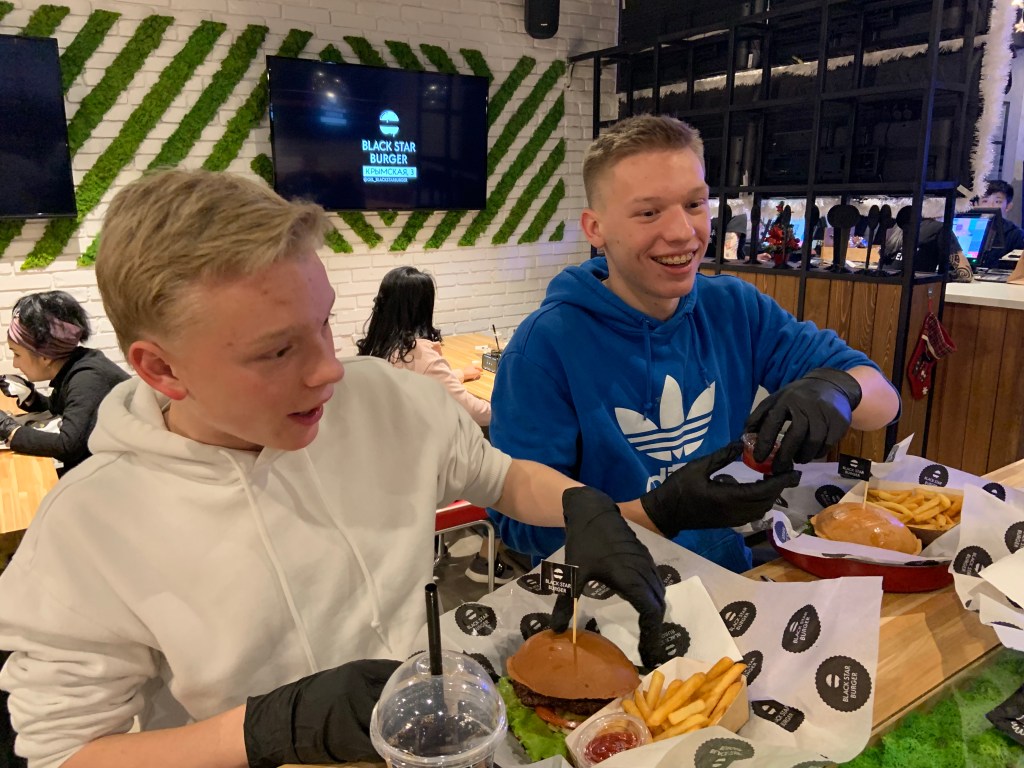
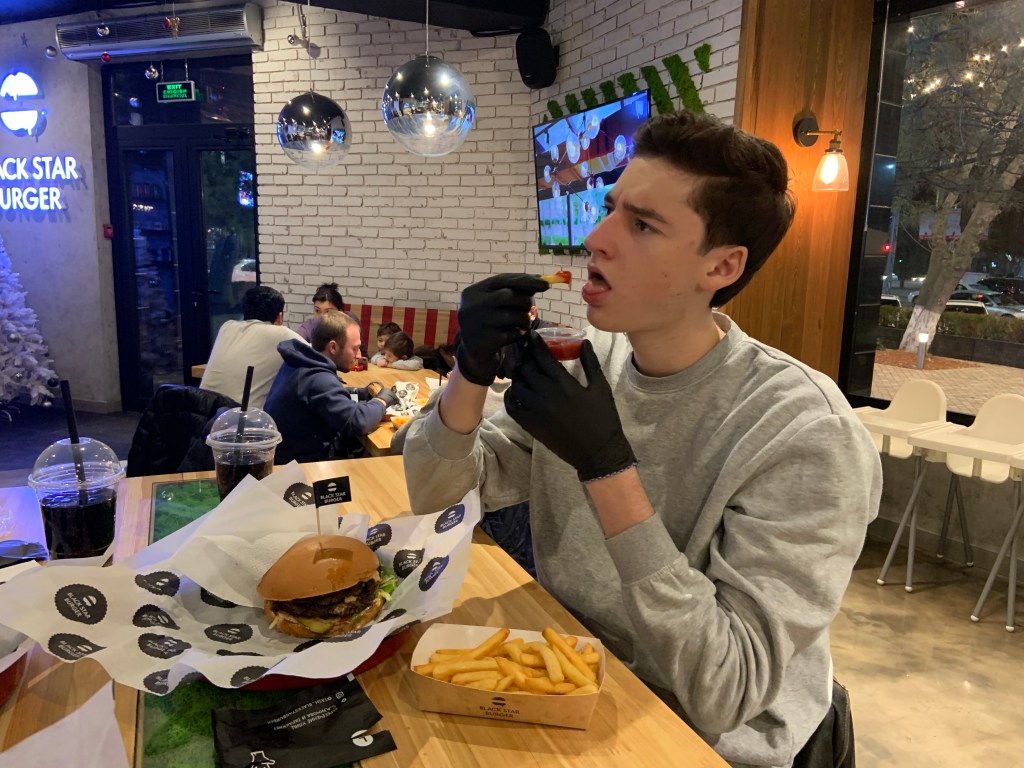
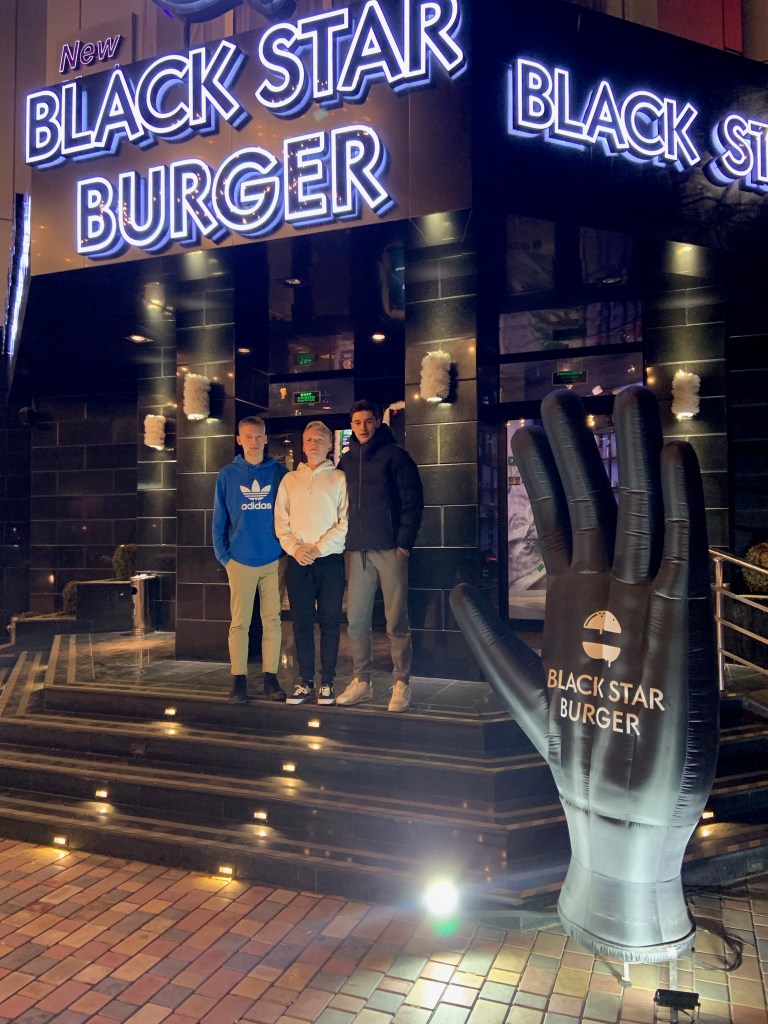
The boys love to go to Black Star Burger, an American-style hamburger chain owned by Russian Hip-Hop artist, Timati and businessman Yuri Levitas. It has a cool vibe and some distinctive features that make it worth a night out. With every meal comes a pair of disposable black rubber gloves. The burgers are very juicy and it is convenient at the end of the meal to peel off the gloves and leave the table with dry hands.
The decor is similar to Shake Shack, with an attractive font for the signs. Another interesting feature are the tattoo-sleeves servers wear under their black t-shirts. Timati looks like Drake, but he is not African. His parents ar Tartar (Turkish ethnic group) and Jewish and he grew up in Moscow. Politically, he supported Vladimir Putin in two elections and came under some criticism for the pro-Putin music video he starred in. I’ve listened to his music and definitely not my style. The restaurant market in Russia has room for different kinds of food and they seem to be successful. I see they are selling franchises in other parts of Russia besides Moscow.
Fresh Haircuts
It was a quiet day. I dropped the kids off at Ice City. Nadia made carrot-cake cream cookies, pan de jamon and a beef stir fry. She was busy in the kitchen. It is nice to have family here for Christmas! The boys got a haircut from Oleg, who comes to the house. He always does a nice job.
We hosted 22 people for Thanksgiving dinner on Thursday and it was such a delightful evening. Our school gave scheduled only a half-day of classes so we (I mean, Nadia and Deliya) could start cooking the turkey. We had an extremely large Butterball turkey delivered from Ramstein Air Base in Germany (thanks US Embassy commissary!) Nadia had a masterful performance and after 20 years of cooking turkeys, she has become a top chef and the turkey is always moist and delicious!
Ocean is getting into the Thanksgiving spirit!
Thanksgiving is an uniquely American holiday and we are lucky to be able to share it with friends from all over the world. It was funny that our Israeli friends reflected on their first Thanksgiving that it was the opposite of Yon Kippur, a day of fasting and saying sorry, while Thanksgiving is a day to eat until you are uncomfortably full and be thankful for all the good things in your life.
Both my father and grandfather died of heart disease. My grandfather had rheumatic fever as a child which weakened his valves. He died in his 40s, peacefully while taking a nap after lunch. My father told me he had an argument at work, a factory where he was the foreman. He came home for lunch and my father thinks that the stress from work, may have been what pushed his heart over the brink. My father, Charles Kralovec, survived his first heart attack. He had bypass surgery and a surgical stent placed in one of his arteries. He lived for another 10 years and passed away from a heart attack while serving as a lector at a funeral at St. Cecilia’s Church in my hometown of Caspian, Michigan at the age of 78. Even though I am not biologically related to them (I am adopted) I’ve always been aware of heart disease.
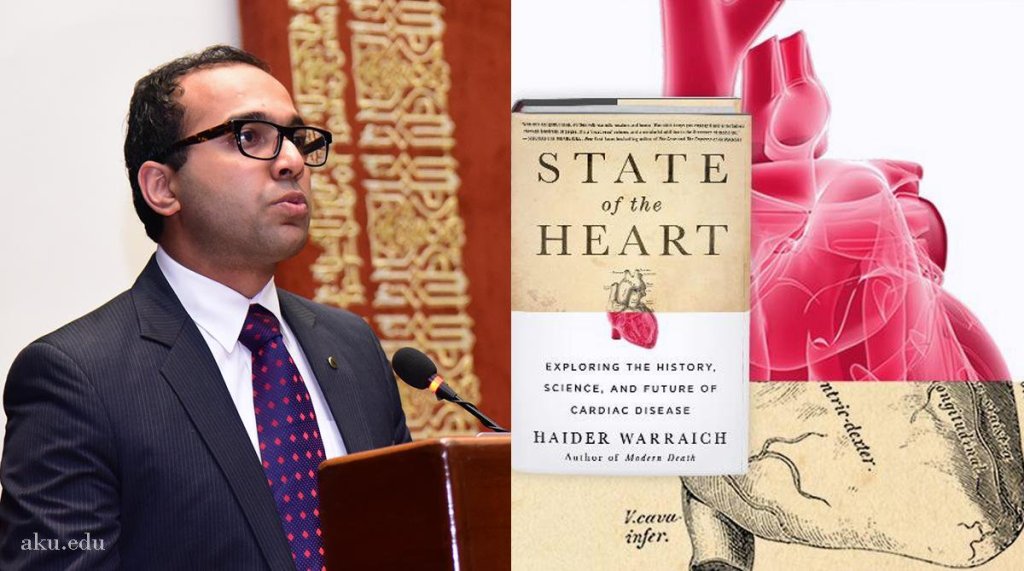
I really enjoyed reading Dr. Haider Warraich’s State of the Heart: Exploring the History, Science and Future of Cardiac Disease. Dr. Warraich is a Harvard Medical School cardiologist and Pakistani immigrant to the USA. He uses his patients to introduce all aspects of heart disease. It is amazing the medical advances that have prolonged the lives of millions of people. Cardiovascular diseases are the leading cause of death in the USA and worldwide. Heart disease is almost double the rate of cancer as a cause of death worldwide and slightly higher than the rate of cancer in the USA.
Heart disease has been on my mind lately because my doctor and I decided for me to start taking statins after my yearly physical this summer. I always score “borderline” risk when it comes to total cholesterol with a 14-year average score of 225. Warraich made me feel much better about this choice as he is very enthusiastic about the wonders of this class of lipid-lowering medications. It is the most commonly prescribed medication in America with soon, 1/3 of all Americans older than 40 will be taking a statin. Atorvastatin, Lipitor is the bestselling drug of all time. I liked that a Japanese doctor, Akira Endo, was one of the key researchers to discover statins. Warraich ranks Endo’s discovery with Fleming’s discovery of penicillin.
“…the most important means to improve and prolong life we have ever developed as a species”
I hope my daily 10mg tablet will lower my LDL cholesterol, which commonly leads to atherosclerotic plaques lining blood vessels. I was glad to see that Warriach’s research showed raising HDL likely doesn’t change risk for heart disease. My average score of 38 for HDL is just below the at-risk range (>40). I will continue to watch my weight, exercise and not smoke to see if my HDL can stay above 40. Some other aspects from the book I would like to remember are as follows:
Heart disease is just as common in women as men. Estrogen does offer protection to women, so they experience more heart disease post-menopause.
High blood pressure is the real threat for heart attacks, more so than cholesterol as a risk factor.
Work stress is linked to higher rates of heart disease.
The coronary arteries, the vessels that feed oxygenated blood to the heart are the most common vessels for heart attacks.
Cardiology is the most competitive field among internal medicine specialties.
Often medical research is just as flawed as educational research. I think it is for the same reason. It is difficult to treat humans like lab rats and conduct unbiased experiments.
Chest pain is the most common symptom of a heart attack. Doctors also can do an EKG or check for troponin levels in the blood.
“Patients older than 65 with heart failure in the USA admitted to the hospital live for only an average of 2 years.”
The book helped me realize the amazing structure and role of the heart. It is amazing that the heart can generate electricity. The pacemaker section in the lining of the heart is controlled by a small electrical charge that is transported cell-to-cell. It is such a small amount that it would take 70 hours of heart operation to collect enough energy to charge an iPhone. The heart is also one of the few organs that you can see working. Most organs do their business on the microscopic level.
The future of treating heart disease will be very interesting. Warraich predicts we will eventually have a 100% artificial heart that distributes blood through the body. Doctors are advancing in this area, with Left Ventricular Assist Devices (LVADs) a battery-powered implant that pumps a damaged heart.
Ashgabat was such an interesting and distinct place. The topography and climate reminded me of Nevada and Utah. It felt much drier than Tashkent and the hills and ravines at sunset and sunrise were quite beautiful. It was just so odd to look over at the futuristic buildings on this landscape. The city is close to the Iranian border, which could be seen in the distant mountains
Lobby of the Yyldyz Hotel
The city was built to impress visitors. As you can see from the hotel lobby above, no expense is spared in these huge public monuments and facilities. For example, below the hotel on the road leading down the hill towards the city, was an 18-hole, Jack Nicholson-designed golf course. We never saw anyone play during our three days at the hotel. However, the grounds were immaculately maintained.
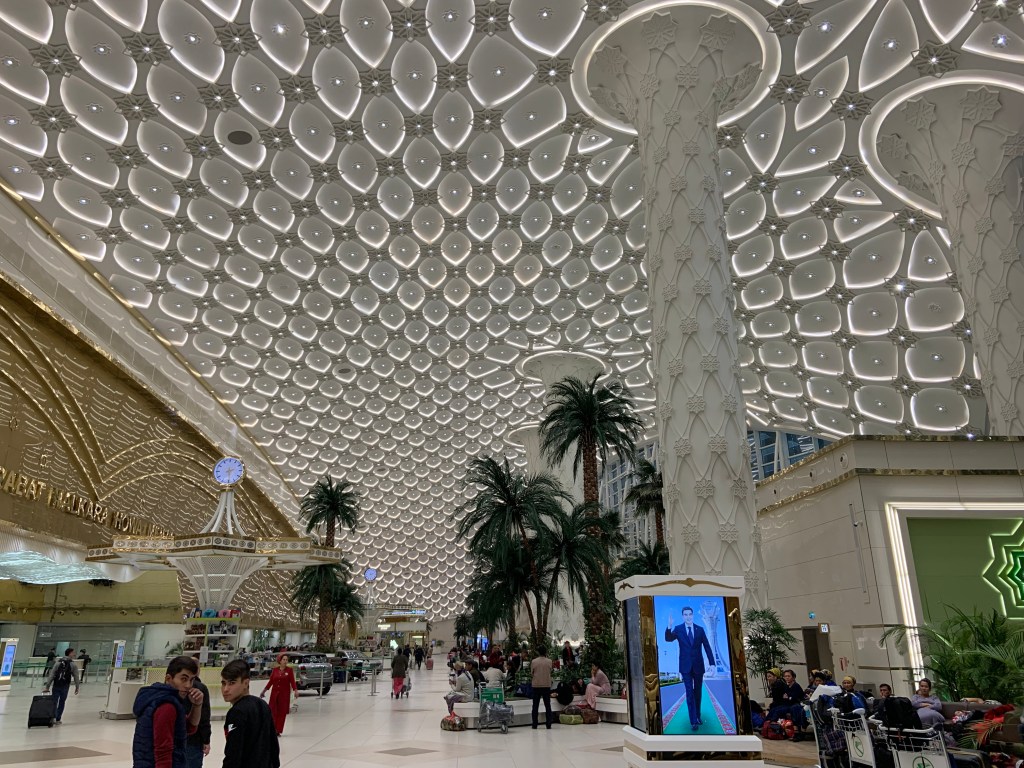
The international airport is shaped like a bird. Many of the buildings shape match their function. The national library looks like two books.
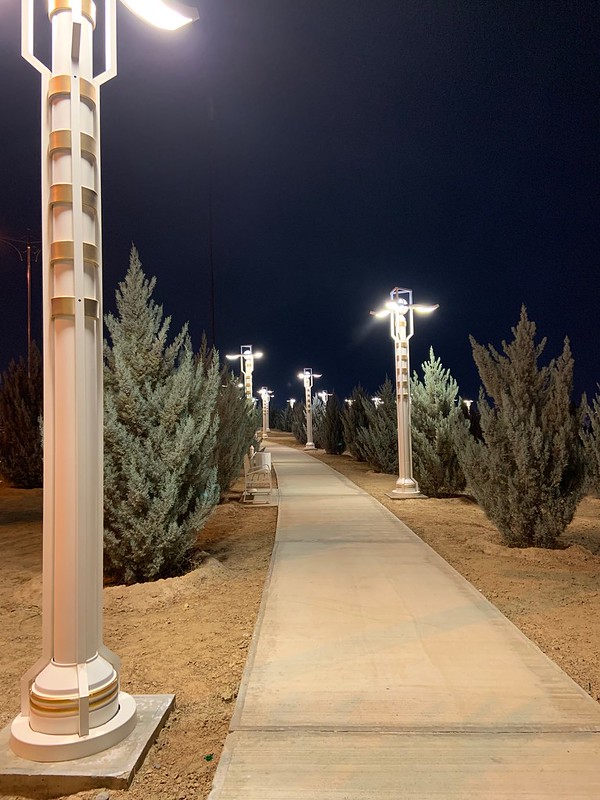
Walking Trail
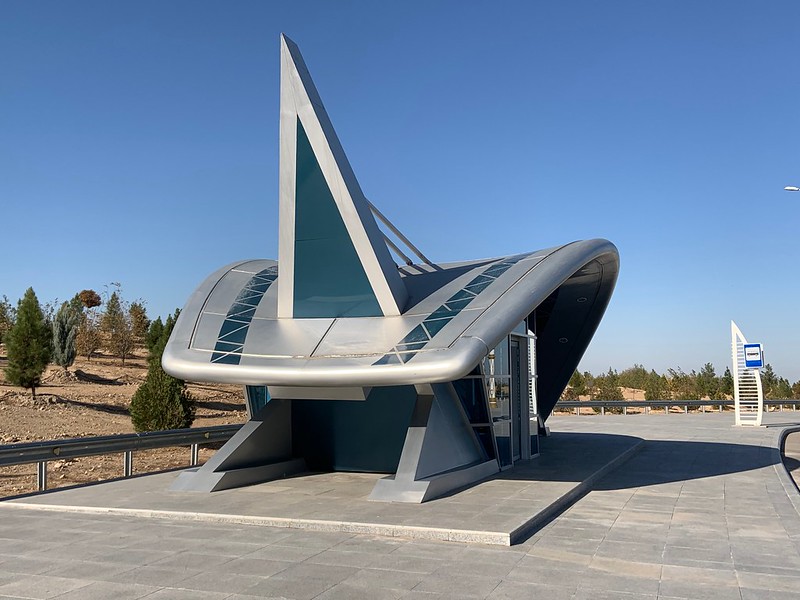
Bus Station
Even light posts match the gold and white theme
Ashgabat Airport
Scenes of Ashgabat
A sample of Turkmen TV
One of the negative aspects of Ashgabat that really struck me was the lack of outside influences. Most of the most popular internet sites are blocked. There is absolutely no advertising found in the city. I read where only about 10% of the population accesses the internet. The government actively controls internet access and even my Express VPN did not work there.
Panoramic View from the hotel restaurant balcony
I didn’t spend enough time exploring this fascinating city and country. I’ll never forget country #67 on my life list.









 Bill's Blog