Oliver Breaks His Arm

Oliver fell off his bike on Monday after school. He had a small break at the end of his radius, near his right wrist. I shot some video at the Minoh City Hospital. I am learning how to edit video using Final Cut Pro and this is one of my first attempts. 

He is doing OK and is in not any pain. He loved all the attention the cast garnered him at school. Ollie showed up early to school with his Sharpie® for his classmates to sign the cast. 

Berlin Trilogy: Remembering David Bowie

45660664852_b3eefc34de_z
Ollie poses in front of Hauptstraße 155, 10827 Berlin

Close to our Air BNB apartment in Berlin is the apartment where David Bowie lived in the late 1970s. This was a hard time for Bowie, he was fighting an addiction to cocaine while living in Los Angeles. He moved to Berlin to get away from the drugs and he was also seeking anonymity. Bowie was also going through a divorce from his wife Angela. In his four years living in Berlin, he beat his coke addiction, divorced his wife and recorded three albums. All were pretty good commercial successes and included Low (1977), Heroes (1977) and Lodger (1979). In 1980 he moved to New York to begin another stage in his life. That is one of the things I admire about Bowie is how he continually redefined his music and his stage characters.

His apartment building is marked by a plaque. Dedicated fans left flowers and candles and it has become somewhat of a shrine. When he died in early 2016, many people left flowers and mementos. He shared the apartment with Iggy Pop.

Bowie’s music is always on our Spotify rotation and one of our favorite musicians.

On our way back, we found a store selling American candy and bought some Hubba Bubba gum and the boys ate their first Twinkie.

44797243875_d5eb07703e_z


Touring Berlin

44797457445_a19d295fab_z
Climbing the Berlin Wall in Nordbahnhaf

I got to explore a bit of Berlin before my conference began and enjoyed getting to know this vibrant, global city. Berlin is the largest city in continental Europe and only London is larger in the wider region. The greater metropolitan area has a population of almost six million people.  It is the capital of Germany since it became unified in 1990 and is truly a world-class city, with a high standard of living, incredible fine arts and cultural opportunities and a huge service and IT and business sector.

The city started on the banks for the Spree River and has been an important part of the various German/Prussian kingdoms for over 1000 years. In reading a bit of the city’s history, I learned that the Germanic tribes ousted Slavic tribes in the 7th century AD. 20th-century history is more on display in the city of course, with Berlin serving as the capital of Hitler’s Third Reich. Berlin was destroyed in World War II and not much is left, thankfully, of the Nazis here. Germany does acknowledge publicly the horrors of WWII, much more than in Japan.

45711454291_13998f66a9_z
Oliver in Pariser Platz in front of the Brandenburg Gate

My biggest interest in the city was considering the Berlin Wall, which divided the city during the Cold War. It started being built suddenly in 1961 to stop the flow of defectors leaving East Germany and didn’t come down until 1989.

43893821790_bb4c19d092_z
Checkpoint Charlie

Two of the major icons of Berlin, the Brandenburg Gate and the Reichstag were not used during this era because they were in the “no-man’s land” near the border between east and west. The path of the former wall is marked on the sidewalks near the area. Today it is a really well done public space along the river and huge parks and plazas surrounding them. The Reichstag was renovated in the 90s and a glass dome was added to the roof and is a huge tourist draw. The tour was fully booked during the time we were in the city.

44797383115_c9e8dc7050_z
A classic Berlin “currywurst” (pork sausage, ketchup, curry powder, Worschester sauce

The highlight for me was seeing the remnants of the wall near the train station of Nordbahnhof station and Checkpoint Charlie. We read many poignant stories of people successfully escaping the Iron Curtain and also, tragically, stories of many lives lost because of the wall. People were so desperate to get out that they tried all sorts of risky methods of leaving including homemade hot air balloon, makeshift zip lines, and hidden compartments in cars. It was so sad to hear how families were separated from each other in the division of the city.  I highly recommend spending time in the Mauer Museum at Checkpoint Charlie.

30771025007_9324567e81_c
The Bundestag on the banks of the Spree River

I have not been in Europe since leaving Belgrade in 2014 and it was so nice to feel the vibes of life in a European city. It is so different from life in Japan. The wide streets lined with thousands of huge trees and the old, but well-kempt, solid apartment blocks, make it a very different cityscape than Japan. I sampled the famous Berlin currywurst on the Pariser Platz. I noticed thousands of tourists from all over the world, not as diverse as New York City, but still, tourism is a big business here and the city receives more tourists than Rome.

31839536138_5d602133aa_z
The Reichstag

This was the most time I’ve spent in Germany, with my previous visits to Frankfurt and Munich, were either short business trips or overnight stays during transport. The Germans certainly are big, both men and women, and it was in stark contrast to the diminutive Japanese I am used to. I didn’t notice a large immigrant population here. Our taxi driver was from Somalia and there were Middle Eastern commuters on the trains. I was curious to see the impact of immigration. I read articles that the right was growing in strength in German politics, somewhat based on the fears of large immigration.


Cycling Between Osaka and Kyoto

32065691218_d775ed7b04_c
Owen and Ocean pose for a photo. There are hundreds of small side roads going through farmers’ fields and forests in the hills north of Minoh.

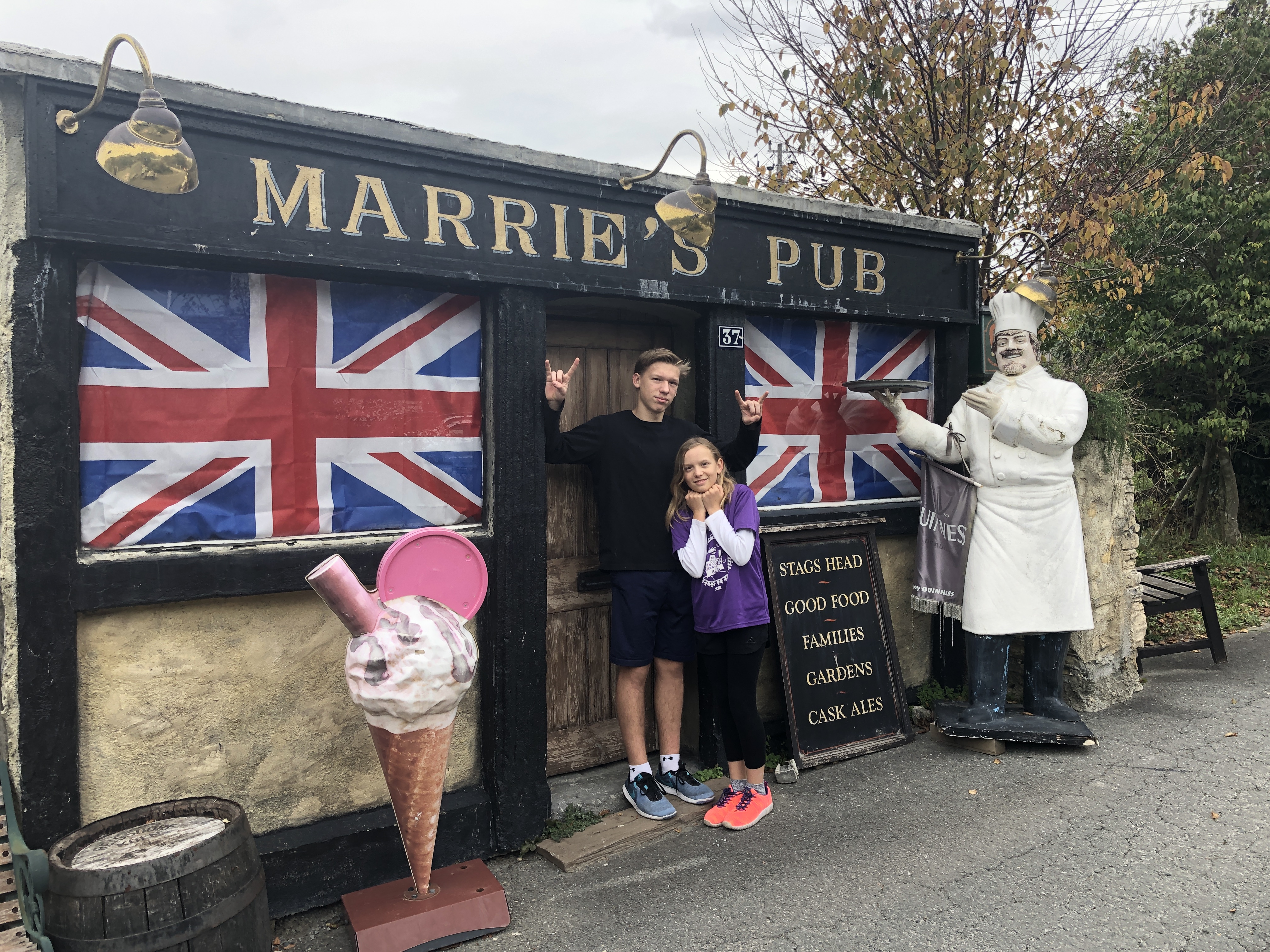
I just love cycling, especially with my children. It is so nice to get them out of the house, off personal digital devices and into the countryside. When you are out cycling, you always see interesting things. We saw a small field of the famous “cosmos” flowers, the autumn “cherry blossoms” of Japan. We also found the British restaurant that is a replica of an old village in England that serves a decent fish’n’chips. Nadia and I went there a couple of years ago but could not find it again. The splashes of orange, yellow and red gave some color to the autumn scenes of rice fields already harvested and gray skies. 

Riding with Ocean 

I took Owen and Ocean with me on a bike ride this afternoon. We started in the small town of Toyono and did a decent sized loop through the forests and fields straddling the border of Osaka and Kyoto prefectures. Ocean’s biking ability and stamina impressed me and she did not complain during the ride. 

Latest Reading and Watching: Macbeth & Bohemian Rhapsody

91cb9yelw4l

On the long flights to and from Germany, I read Jo Nesbo’s Macbeth. It is the latest book of the Hogarth Project, which publishes Shakespeare’s works as interpreted by best selling and acclaimed novelists of the today. Nesbo is a Norweigan thriller writer and so his Macbeth is set a dreary city in Scotland in probably the 1980s. It is still a story of how ambition for power can corrupt and lead to madness and death. Instead of Macbeth as a king of Inverness, he is going for the chief police commissioner and the office of mayor. There is a lot of murder, action, drugs and eventually insanity. I have not read any of Nesbo’s detective novels.

 https://www.youtube.com/watch?time_continue=17&v=uh5zUIKnmI8

The book was definitely a page-turner, although some of the plot points were really far-fetched for me. I would recommend the book as it made me reflect on what the drive for power can do to people. I often gain some vocabulary words or ideas from books and they are below:

  • Tithonos – This is a character from Greek mythology. He was the human lover of the goddess of the dawn, Eos. She asks Zeus to grant him immortality, which he does. However, she forgets to ask for eternal youth as well and poor Tithonos ends up a bag of bones as an old man in bed, but he cannot die.
  • blond plaits – an older term for braids
  • pillion rider – a British term for a seat on the back of a motorcycle
  • quay – pronounced like “key”, a stone or metal platform projecting into a body of water and used for the loading and unloading of ships
  • a ruddy, porcine face – pronounced “poor sign” and means resembling a pig
  • bollard – post on a ship or quay where a boat can be secured; also posts to block motorized transport
  • casino croupier – another word for dealer

gn-gift_guide_variable_c
Actor Rami Malek plays Freddie Mercury in Bohemian Rhapsody

The British rock band Queen has always been pretty high on the Kralovec family playlist. We were excited to see the new movie, Bohemian Rhapsody last night. We went to the IMAX theatre and were not disappointed. A very entertaining movie with the best part being, of course, the music! My takeaway was a simple one, Queen used the idea of audience participation to gain popularity. A simple, but brilliant idea. Audiences need something to do during a concert, more than marveling at the technical skill of the musicians and Queen were masters of getting people to participate in the music. The culmination of this idea and of the movie was Queen’s set during Live Aid back in 1985. I remember the day, a hot July summer afternoon before I went off to college. I rode my bicycle back from cutting lawns with my dad for our 30+ clients that summer and watched the concert on television. I highly recommend going to see the movie in a theatre with great sound!


Impressions of Dubai

43310057520_a9536ce94b_c
The ski hill inside the Dubai Mall

I am catching up on blog posts. I visited Dubai last spring.

It was my first time to the global city of Dubai. The largest city of the United Arab Emirates marked country number 64 on my life list. I was here on business so only had 23 and 1/2 hours on the ground. The trip was special because I got the opportunity to fly business class on Emirates, rated by many, the best business class airline experience in the world. Being in education and having a large family, I usually fly economy so it was a nice change. Probably the best thing about it besides the obvious fully-reclining seat/bed and space is the lack of waiting in lines. Before my flight, I went to the business class lounge with the extra time I save with skipping the lines through immigration and at the gate. Who cares what section A-B-C-D is boarding when one can leisurely stroll through the first and business class entry and board the plane without worrying about people coming behind you. It is a bit of a different world. Of course in my opinion, not worth the amount extra one pays, but it is nice.

31249688448_598961b4c9_c
A typical daytime view in Dubai

Although I wasn’t in the country long, I did have most of the afternoon and evening to go to the famous Mall of the Emirates and Dubai Mall. People in the Gulf region love to shop and the malls were absolutely massive. It felt like the economy is booming here, with thousands of shoppers with lots of bags, tens of booths advertising investing in apartments, including one offer that gave free access to the Trump International Golf Course. I can’t get away from hearing that man’s name. Lots of ostentatious wealth displayed with Ferraris, BMW, etc. Walking around the hotel in the morning just after my arrival, I saw several very drunk or stoned people laughing and shouting coming out of the nightclub. This was at around 5:00 AM.

31249688718_55acedc716_c
Civic life centers around the many shopping malls in the city

It truly is a global city with so many nationalities represented in the tourists and workers. I talked to Russians, Filipinos, Pakistanis, Moroccans, South Africans, Jordanians, etc. who were working retail in the stores, serving as tour guides or working at the hotels as chefs, porters, etc. The captain announced the pilots and flight attendants were from 9 different countries. The language of the city is English, which is a refreshing change from Japan. I was able to talk to people.

The Burj Khalifa is the tallest building in the world and so I decided to take the tour. I went to the 148th floor, over 800 meters high. It was a spectacular view, similar to experiences I’ve had at the Tokyo Tower, CN Tower Toronto and the Umeda Sky Building here in Osaka. Huge skyscrapers next to it looked tiny. It was quite crowded and I paid extra to avoid a 3-hour wait. I bought my ticket online in the morning and was disappointed to see the long wait times.

44402902134_486a4c4652_c
Shopping is King! This was in the luxury section of the Dubai Mall with a higher % of locals

General Observations

  • Dubai was much more modern and larger than Bahrain, the only other time I’ve been in the Gulf region. I saw more Western influence in Dubai, with lots of tourists and expatriates.
  • The contrast between women covered completely in black, Arab clothing to women walking around in tight shorts and tank tops is always striking. Japanese women generally carry themselves meekly and it was nice to see confident women strutting brashly around the mall.
  • The high during the day was 39 Celsius which is normal for spring here. Between the extremely high temperatures and lack of sidewalks or bike paths, you rarely see people walking.
  • A haze covered the blue skies and I was reading about Saudi Arabia having high levels of air pollution.
  • I think most Arab men have beards because they can. I noticed both Arab men and women are hirsute. If I tried growing a beard, it would be patchy for a long time, but Arab men have full, uniform facial hair.

43310056200_53feab6b76_c
The view from the top of the Burj Khalif

I always ask myself, could I live in the place that I visited? I really didn’t spend enough time here to give a definitive answer. Wilderness and nature are important to me and I would have to see if the  Arabian/Persian Gulf and the Red Sea and flat desert landscapes could satisfy me.

31249689838_4dd3acda95_z
More people are active at night due to the daily heat. 

The amount of wealth that has come to the Arabian peninsula with the discovery of oil is astounding. You can see much of the consequences of this in a small area like Dubai. I wonder what the long-term consequences will be on the people of the Emirates.

Tachi Nomi – The Japanese Standing Bar

44498429442_1e70a5bdf3_c
A classic Tachinomi near the Osaka train station

Every year we take the new teachers to a traditional “tachi” – stand “nomi” – drink or in English, Standing Bar. Standing Bars are unsophisticated, cheap places aimed at salarymen on their way home after work. They are usually located near train stations and offer simple cold beer, sake, ume (plum wine)  and the Japanese version of bar food, izakaya, or deep-fried meats and seafood with edamame. 

I took the photo above of a standing bar near Osaka train station. You come in and find a table and in this one, a boss lady takes your order, making you order food with your drinks. As you can see, the decor is spartan, although I saw this retro beer sign that I would have loved to have in university in my apartment or if I had a bar in my home, it would be a great conversational piece.

43829792224_4e7a7ef1db_c
Asahi Beer Promotional Poster

As you can see in the photo standing bars have a predominately male clientele, although there were a couple of women and even a mother with her baby in a stroller when we first arrived. I do feel that men here spend too much time at work or socializing with their colleagues after work and not enough time with their families, however, it is nice occasionally to check these places out. They only open from around 5:00 PM and close early in the evening.


Latest Reading: The Big Seven by Jim Harrison

01henderson-articlelarge
Harrison hunting in Montana (courtesy of the New York Times)

Jim Harrison is one of my favorite authors, partly because many of his novels are set in my birthplace of the Upper Peninsula (UP) of Michigan. The UP is a sparsely populated area the size of Maryland that forms the southern shore of Lake Superior. It is in my mind, a distinctive place in homogenized suburban America and has a culture of its own. He is from the northern part of lower Michigan and a graduate of Michigan State University. He is most known for the novella that became a movie, Legends of the Fall.

The Big Seven is one of his last books, written in 2015, a year before he died of a heart attack. It is not one of his best, but it was an enjoyable read. He goes back to a recurring character, Detective Sunderson, a retired state policeman and the detective that lives in Marquette, Michigan. It is a crime novel dealing with a violent, poor family living in the western Upper Peninsula. I love his references to life in the UP, like pasties, and his description of the people, places and lifestyle there. You can tell he knows the area. The detective story is a page turner, not for the crimes itself, but for what was going on with Sunderson.

I do have problems with the book. The main character Sunderson is in his late sixties, eats too much and drinks a lot, but is picking up women constantly. I just don’t believe so many beautiful young women are into retired, out-of-shape, alcoholics. He also constantly describes Sunderson’s drinking habits. Some of it felt like filler and a good editor would have helped him.

The title comes from the Seven Deadly Sins. Sunderson is trying to write an essay or novel on his “eighth sin” of violence but is slowed by his drinking and laziness.

Jim Harrison was a literary figure like one of my favorite authors when I was young, Ernest Hemmingway. An adventurer with a zest for the good life whose writing set in places like the American west and northern Michigan. The book made me consider going back to Hemmingway now as a middle-aged man to see how my perceptions of his writing have changed in the last 25 years.


Latest reading – Shoe Dog: A memoir by Nike Creator Phil Knight

shoe-dog-9781471146725_hr

Besides getting a lot of exercise this summer, I also found some time to read more. Using the Great Lakes Digital Library and access through the wonderful West Iron County District Library in my hometown of Iron River, Michigan, I can download digital books and audible books. I still like a paper copy, but living abroad, digital gives me access to books I would have to order and ship.

I didn’t realize how long of a struggle it was for  Phil Knight to build Nike into the global behemoth that it is today. He started in 1962 and for many years was on the verge of bankruptcy and fighting legal and financial battles with suppliers, US customs, banks, etc. I took it for granted that people always ran long distances for physical and mental health. However, in the 1960s and most of the 1970s, running was a something very few people did.

Phil ran track at the University of Oregon and many of the early employees of Nike either coached or ran track and field there. The “hippie” or “alternative lifestyle” of Oregon and dedication to track and field carried his company through hard times. For a long time they were a private company and on the verge of bankruptcy many times due to cash flow problems. They went public in 1980 and Knight and the founding employees became super wealthy. The term “shoe dog”, refers to a person who is obsessed with shoes and spend many hours designing and constructing better shoes. Thanks to the University of Oregon and Nike, running shoes today are much better than a generation ago. The recent attempt to run a sub 2: 00-hour marathon shows Nike continues to try to improve human performance and athletic shoes.

Knight has strong ties to Japan. He started the Blue Ribbon Sports company by importing Onitsuka “Tiger” shoes. Today Onitsuka is still based in Kobe and is known as ASICS. ASICS is an acronym for the Latin phrase, “healthy soul in a healthy body”. Onitsuka in the 1960s made some of the best shoes around and combined with the expertise and passion Knight and his friends from University of Oregon athletics program, they pushed ADIDAS and Converse, the two giants in the shoe industry of the 1970s. Knight eventually manufactured his own shoes and clothing, etc. and with powerful marketing, they are almost more of a lifestyle and sports/celebrity agency than just a shoe company.

It was sad to hear his regrets regarding his son and his regret of not spending enough time with his wife and children while building Nike. His eldest son tragically drowned in a diving accident in El Salvador in his 20s while working for an NGO.

I highly recommend the book. It gave me a new appreciation for the athletic shoe market, finding a balance between work and family and it was interesting to hear how long and hard Knight and his early partners worked on building Nike.

“How to Change Your Mind” Michael Pollan

41yw3jt4kal-_sx327_bo1204203200_

Michael Pollan, the Harvard and California-Berkeley professor is one of my favorite thinkers and writers. I have read all of his books and his horticulture and healthy eating books have deeply influenced how I live my life. His latest book, “How to Change Your Mind: What the New Science of Psychedelics Teaches Us About Consciousness, Dying, Addiction, Depression and Transcendence” discusses the history of and current research of using psilocybin and LSD to treat mental illness and for people with healthy minds, a way of bringing meaning to one’s life. I’ve listened to him as he made the rounds of the podcasts I listen to, New York Times Book Review, Slate, Fresh Air, etc. His ideas are engrossing and I am thoroughly enjoying the book.

Pollan illustrates the growth of how psychedelics are being used in conjunction with therapy, to cure people with mental illnesses like depression and addiction and help terminal illness patients deal with death. Doctors and therapists use psilocybin (the active ingredient in “magic mushrooms”) LSD (Lysergic acid diethylamide) and other drugs to break the mind out of obsessive thought patterns of people in these situations. Like many, when I think of “acid” or “magic mushrooms” I think of former Harvard professor Timothy Leary and the 1960s counterculture movement. Pollan shows how medical research into psychedelics started decades before Leary and before the “turn on, tune in and drop out” mantra became popular, scientists were conducting research on how the compounds could be used to help humanity. The current trials of using psychedelics by New York University, John Hopkins, and Imperial College of London are quite promising and it is a shame that reckless recreational use and bad publicity caused governments to make them illegal so long ago.

The most interesting part of the book for me, especially as an educator, was Chapter 5, the section explaining the neuroscience of the human brain on psychedelics. These compounds quiet the DMN (Default Mode Network) of the brain. Discovered in 2001, this network links the cerebral cortex to the deeper, older inner networks of the brain, which control one’s emotions and memories. The DMN controls all of the different networks of the brain, keeping them separate and using the brain’s energy most efficiently to survive and solve problems. The DMN is our “self” or “ego”, or in other words and it is the story we tell ourselves about who we are. This “sense of self” was a great evolutionary achievement and other animals lack such a developed cerebral cortex. However, having a conscience separates us from nature and others. Buddhists and other ancient civilizations have said this for a long time. Even Albert Einstein saw this when he said:

“A human being is a part of the whole called by us universe, a part limited in time and space. He experiences himself, his thoughts and feeling as something separated from the rest, a kind of optical delusion of his consciousness. This delusion is a kind of prison for us, restricting us to our personal desires and to affection for a few persons nearest to us. Our task must be to free ourselves from this prison by widening our circle of compassion to embrace all living creatures and the whole of nature in its beauty.”

Pollan also interestingly talks with researchers working with children. Young children do not have the ingrained patterns of thought of adults and this section of the book reminded me that often novel or “out-of-the-box” solutions to problems come easier to younger people who do not have such a highly developed DSM and entrenched thinking patterns as adults.

Psilocybin and other methods like meditation, fasting, etc. quiet DMN activity and the ego dissolves. This allows the other brain networks to connect with each other and you get all sorts of crazy ideas, visions, feelings, memories, etc. The DMN also filters what input we take in. This helps us get things done and not staring at the clouds or sunlight filtering in through the window. However, something is lost. When the networks are able to connect and take in stimulus from the environment that is usually filtered, sometimes profound insights and new ways of thought take place. That is why people often say they have been profoundly changed after an acid trip.

Pollan describes his experiences in trying psilocybin, LSD, toad venom and ayahuasca. He is a California Berkeley and Harvard professor and celebrated author so he is not going into these like a hippie from the 60s. Pollan is also in his 60s and entered it with fear of heart failure and the impact the experience would have on his health. He experiences these “trips” with a trained therapist who guides him through taking the drugs and then making sense of it afterward. Pollan is enthusiastic about “healthy normals”, people without mental or a terminal illness using psychedelics to reinvigorate their minds and see life through the filters of a range of their brain networks. It is like a brain “shake-up” and it changes how one interprets the world.

Pollan makes a compelling case for trying psychedelics, especially older people in controlled situations. In his detailed history of psychedelic research and use, he discusses the risks and rewards. I do not want to sound like former Harvard researcher and doctor, Richard Alpert, now Ram Dass, and do not think it is for everyone. However, as I enter late middle age, it may be a good way to refresh my thinking and redefine meaning in my life. I never would have considered trying it, but after reading this book, I see the potential benefits. The book also reinforced the practice of meditation and how good it is for the mind and I should be doing more of it. Currently, most psychedelics are illegal and there is still a negative view on their use in our society, but more government agencies and universities and hospitals are changing their thinking about this. After reading about the research taking place at New York University, Johns Hopkins, London, etc., it seems like they should be used more in therapy.

I highly recommend the book. It is a long, detailed read but worth the time investment. Below are some other notes I picked up from the book.

  • Albert Hofmann, a Swiss chemist, identified, synthesized, and named both LSD and psilocybin. LSD was originally derived from the ergot, the fungus that infects rye and other grains. Psilocybin is a blue chemical compound found in species of  the mushroom genus Psilocybe that has profound effects on the brain. There are approximately 180 species of “magic mushrooms” containing psilocybin found on all continents. Most are in the Psilocybe genus, but some are found in several genera. All are considered LBM (little brown mushrooms) and are difficult to find and identify.
  • The top expert in Psilocybe mushrooms is former Evergreen State College professor Paul Stamets. The love his TED Talk linked here and his description of the millions of mushroom threads (mycelium) weaving through the soils of forests allows trees to communicate with each other.
  • Aldous Huxley the British author of Brave New World was a fascinating thinker and I should read some of his work. He comes up time and again in the book.