Tashkent Journal: Mosaics, Lenin and a Japanese Pond

I love this colorful Soviet mosaic on Taras Shevchenko Street in Tashkent. The mosaic is on the wall of School #110, which also bears the name of the Ukrainian poet, Taras Shevchenko. The large mosaic panel was made by artist V. Kutkin and was dedicated on June 1, 1970. Many Ukrainians settled this part of the Tashkent and the mosaic and park was part of the rebuild after the 1966 earthquake. A statue of Shevchenko in front of the mosaic was dedicated in 2002 and the then Ukrainian president attended the ceremony.

You can see Shevchenko in the left center of the panel, playing a kobzar, a traditional Ukrainian guitar. I am not sure what is taking place on the left side. I see a muscled worker with a newly forged sword and some fellow workers saluting his work. To the left looks like some people suffering, but I am not sure what is the cause of their suffering. As one moves past Shevchenko, spear-carrying soldiers appear to be marching by a muscled women holding both arms up. On the far right, Uzbekistan is celebrated by its rivers, cotton production and golden sunshine

Who was Taras Shevchenko? He was a artist and author who lived in the 1800s. He is regarded as the “father” of the Ukrainian literature and the modern Ukrainian language and had strong views of Ukrainian independence and often ridiculed the Russian royal house.

The art of the Soviet Union is fascinating and I hope city officials preserve them. In the late Soviet times, all building projects had 5% of the budget dedicated to “artistic elements”. It is part of the history of the city and as we get further away from the Uzbek SSR times, there will be pressure to modernize and demolish Soviet art and architecture. I feel it is one of the charms of the former Soviet sphere for foreigners. I understand not all people would agree, but I also think that all periods of history of a country should be preserved in part. This is a good website that gives a more in depth history of Soviet mosaic panels.

This is another 1970s Soviet building. It was completed in 1970 to celebrated the centennial of Lenin and was a museum dedicated to him. For 20 years, middle and high schools in the city led mandatory field trips to the museum. After independence, it was changed to a museum of Uzbekistan.

In 2001, the Japanese Embassy and the Uzbek Ministry of Foreign Economic Relations built a park near the Tashkent Tower. There were quite a few water fowl in the large pond.
Professional Hockey in Tashkent

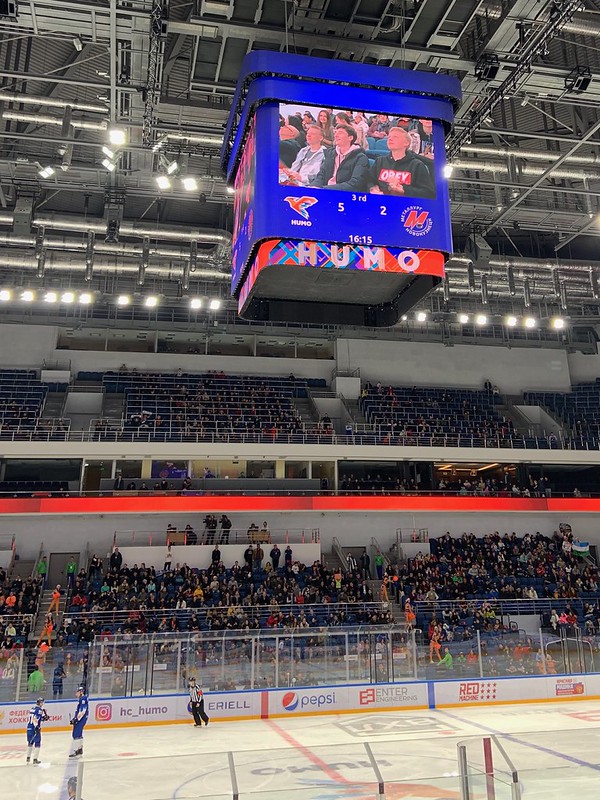
Owen, Sebey and Oliver make the big screen

I was pleasantly surprised attending the Humo Tashkent hockey game last night. The boys and I watched the game between Humo and Metallurg Novokuznetsk. The home team, Humo, won an exciting game 7 goals to 5! The two teams are part of the Supreme Hockey League (VHL). The VHL is the second highest level of professional hockey in Russia. There are 34 teams in the league, with teams joining from Kazakhstan, China and Uzbekistan this year.

The boys pose with the Humo Cheerleaders!

Novokuznetsk is a small city north of Kazakshstan in central Siberia. They are currently in 10th place and Humo is in 16th place. (now 15th place after the victory) “Humo” is a mythical bird from Persian mythology and part of the Uzbekistan emblem. Humo Arena seats 12,500 and is the largest stadium in the league. It is new and modern with a great sound system, comfortable seats, cheerleaders, etc. It was a very entertaining evening. We had great seats for $7.

It is definitely a good night out and I am sure we’ll be going to a few more games this season.

Amirsoy Skiing

Ocean Ready To Go!

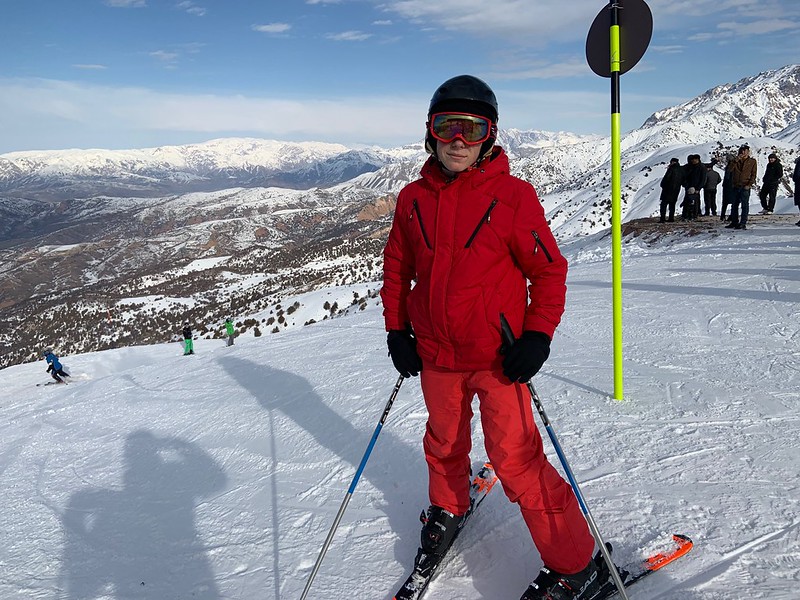
I took the kids yesterday to the new ski resort near Tashkent, Amirsoy. An international ski management company from Andorra, Pas Grau International (PGI), is managing the facility. It opened with great fanfare last month. There were many people at the resort due to January 2 being a national holiday here in Uzbekistan. However, most of the crowds were non-skiers, which was really strange. Hundreds of locals bought a ticket for a ride up the gondola to the top of the mountain. It was surreal for skiers, which thankfully had a different line, to get off the gondola and weave their way through sightseers at the top of the run. Skiing is new here and most Uzbeks do not know how to ski. It is also expensive, considering the average monthly salary here is around $300. I hope with the economy improving here, more locals will be able to use the resort.

Owen is getting better on the snowboard

During the day, several English-speaking Uzbeks saw that I was a foreigner and pulled me aside to talk about the resort. I sensed the disbelief and pride in their voices that an international standard ski resort was now operating in the Chimgan Mountains of Uzbekistan. Here is a video introducing Amirsoy (link).

Oliver made it with ease down the slopes

We had a really nice day, despite some confusion in getting our ski passes and equipment rental in the morning. As with most things here, it is inexpensive with an all-day ski pass costing $26 and rental equipment around $15. It is an affordable day out for me and three children. It is not a big resort, with six major routes. From the top, one can ski over 3,500 meters to the bottom which is really enjoyable and tiring. There were a couple of patches dirt lower down the mountain. PGI is building more snow-making machines to cover those areas. However, on the top, the snow was fine, although some of the runs are a bit narrow for beginners. There are three red routes (Europe classification suitable for intermediates) and one blue route. They have the main gondola for 8 people with two stops and a side chair lift for 4 people on a good intermediate run.

My nephew Sebey is enjoying a break

They have chalets for rent and it would be nice to stay for a couple of days. There are not enough slopes to make it worth a full week, but 3 days of skiing would be perfect. It is about a 1 hour and 20-minute drive from our home. We left at 7:45 AM to arrive when it opened at 9:00 AM. Due to the large crowds, they ran out of food at the restaurant near the chair lift. This is part of the growing pains of a new resort.

The Chimgan Mountains are high enough to attract and keep enough snow, even in this time of global warming. With the addition of some snow-making equipment, they could extend the season and make it work. I hope PGI will make it work with Amirsoy.

Tashkent Journal: December 29, 2019

UPDATE – My friend Mark H. sent me a photo of the original mosaic on the Pravda building. I am not sure why the current building owners would block out the Russian Cyrillic script. I think it would be a loss of the city’s historical heritage if Soviet architecture is slowly being lost. However, considering the Russians invaded and suppressed the Uzbeks for such a long time, I can see why government officials and citizens would want to get rid of this part of their history.

The original Soviet mosaic (photo courtesy of Mark H.)
Mosaic on the Pravda Vostok Building

I have not been feeling well recently with a strong chest cold and sinus inflammation. I went for a long walk Sunday afternoon to clear my head. On my explorations of Tashkent, I always discover an interesting facet of the city. On this walk, I noticed this Soviet era mosaic (above) of a newspaper delivery person. In going around to the front of the building, I saw that it was the offices of Pravda Vostok (Truth of the East) the official Russian language newspaper of record of the Uzbek S.S.R. I was surprised that it still functioning as a media outlet. I believe it is still owned by the government.

The Pravda Vostok Building is a classic Soviet architecture

Further on I stopped at the Crying Mother Monument and the eternal flame. The site commemorates the 400,000 Uzbeks who died in World War II. The Germans never reached Tashkent, but many Uzbeks were conscripted into the Soviet army. I need to read more about Uzbekistan’s role in World War II.

The eternal flame commemorating WWII victims

Finally, after my walk in the late afternoon, Nadia, Alejandra and I went for a cup of tea. It was another gray, wet day and the hot jasmine tea made me feel a bit better. Breadly is a really nice coffee place with gourmet-level food and sour dough and multi-grain breads. I highly recommend a visit.

Midnight in Chernobyl: The Untold Story of the Worlds Greatest Nuclear Disaster (Latest Reading)

Over the holiday break I finished Adam Higginbotham’s book on the Chernobyl accident of 1986. Higginbotham is a journalist who writes for prestigious publications such as the Telegraph, New York Times, etc. The book made the New York Times Top 10 Books of 2019 list. His writing is clear and he puts suspense into every chapter and so it was a difficult book to put down. I am now watching HBO’s Chernobyl series to compliment my understanding the accident.

I have been generally pro-nuclear energy, despite this accident, the Fukushima accident in Japan (where I lived for five years) and starting my teaching career in Nevada, where the US federal government was trying to put a nuclear waste storage facility under Yucca Mountain. I am fascinated with nuclear energy and always try to read about or visit nuclear energy plants when the opportunity arises. I like that it is a source of energy that does not contribute to global warming and is so far, the biggest alternative to traditional fossil fuels.

The cause of the accident at Chernobyl was the Soviet government. They did things as cheap as possible and had an unquestioning bureaucratic structure that did not promote a culture of excellence. I felt sorry for the plant workers having to deal with the flimsy and antique equipment and control systems. I am surprised more accidents didn’t happen in the ex-Soviet Union. Doing things on the cheap, especially when it comes to something as large and deadly as a nuclear reactor, is not a good idea.

The book and the HBO series vividly portray the invisible power of radiation. The tragic and horrible consequences of high dosages of radiation on humans and the environment are shocking. It is odd the delay in the effects of radiation and it would be more helpful to avoid it if one could see the deadly rays emitted by radioactive substances.

The delays in evacuation and stopping the exposed core are due to the Soviet system. There seemed to be a lot of fear, resignation and no challenging of authority. I see some of that living here in Uzbekistan, an ex-Soviet republic. It will take a long time for these countries to move past the effects of living under the Soviet system for such a long time. I read recently where with the help of Russia, Uzbekistan will be building a nuclear energy plant in the Navoi region (between Samarkand and Bukhara). I hope they have learned from the mistakes of Chernobyl.

Samarkand

Nadia and Alejandra are dwarfed by a madrassa on the Registan

It makes sense that before extensive maritime transportation that Eurasia, with its massive landmass, would be where the longest trade routes were located. Trade between China, Rome, Persia, India and others peaked before the start of ocean-going long haul ships. Samarkand, a two-hour high-speed train from Tashkent, was one of the most important trading cities in the silk road network.

I was in awe standing at night in the Registan and thinking of all of the great names in history who had come through Samarkand. Alexander the Great, Marco Polo, Genghis Khan, Timur (Tamerlane) all spent much time in the city. They would not have had the view we did that evening because of course at that time, there was not electricity. I wonder what they would have thought to stand there with us in 2019?

Courtyard

The Registan (Persian language meaning sandy place or desert) was the central plaza, the heart of the city and back in the day, probably a busy market. Today, the main bazaar moved down the street and the Soviets and Uzbeks have created a clear space on the Registan so people can admire the three madrassas that form the borders of the clearing. The architecture, colors, designs and size of the madrassas are truly breathtaking and I see why it was made a UNESCO World Heritage Site. The muqarnas, or vaulted arches with the tiled designs of different blues, made me want to paint them. The different hues of blue tiles with intricate designs blend perfectly with the beige bricks and brown sand and mountains that surround the city. I hope to learn more about Islamic architecture during my time in Uzbekistan.

Photo Opportunity at the Registan

Samarkand today is Uzbekistan’s second city with a population around 1 million people in the metro area. The little over 300 kilometer distance takes 2-hours on a high-speed train. It is quite convenient for us because the train station is close to our house. My only complaint was half of the seats in the train face backwards on every journey. I wish they had the reversible seats like or turn the trains around in the station. It is better than the 4-hour+ drive. Samarkand was originally a Persian city and the majority of the population speaks Tajik, which is an Iranian language. Many Iranians almost moved to Samarkand in the 1800s. Walking around the city, I noticed the the Tajiks/Iranians have a bit darker skin and have slighter builds than Uzbeks.

Taking a break on the ruins of Afrosiab

We spent the second day wandering around the hills and ruins of the ancient city of Marakanda. This was the original Samarkand, when it was controlled by the Sogdians, an Iranian/Persian tribe that had a huge empire starting around 500 BC. It is a huge archeological site (500 acres+) just north of the city and has been preserved by the Soviets and the current Uzbek government. It was an ancient walled city. The Sogdians survived Alexander the Great taking the city in 329 BC, the Arabs in 712 AD and finally, dwindled away after Ghengis Khan wrecked Marakanda in 1220. It wasn’t until Timur conquered the area and made his capital in present day Samarkand in the 1300s.

Walking Around the Renovated Tourist Area of Samarkand

It made for a nice afternoon for me and the boys. Much better than trailing my wife and her sister through the markets and tourist shops. The area is large and I wonder how much is still underneath. We visited the museum and learned there are three areas, including a citadel. It is called Afrasiyab settlement and can be reached on foot from the Registan. You can kind of make out where they are with faint foundations and hills. We found some cool earthen caves on the sides of hills, which are probably used by herders tending their sheep as they graze over the area. We looked for some ancient pottery and threw a lot of rocks. We did a big loop around the grounds and checked out the most interesting areas. It was nice to have free reign over the area and not signs or guides prohibiting exploration.

Black Star Burger

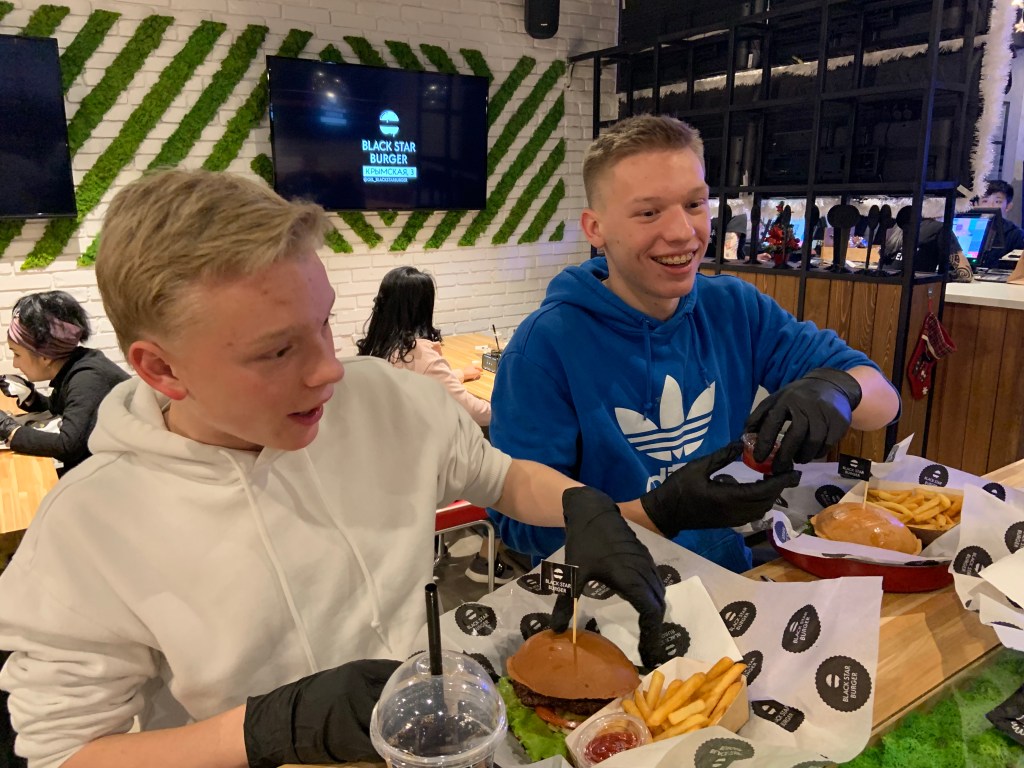
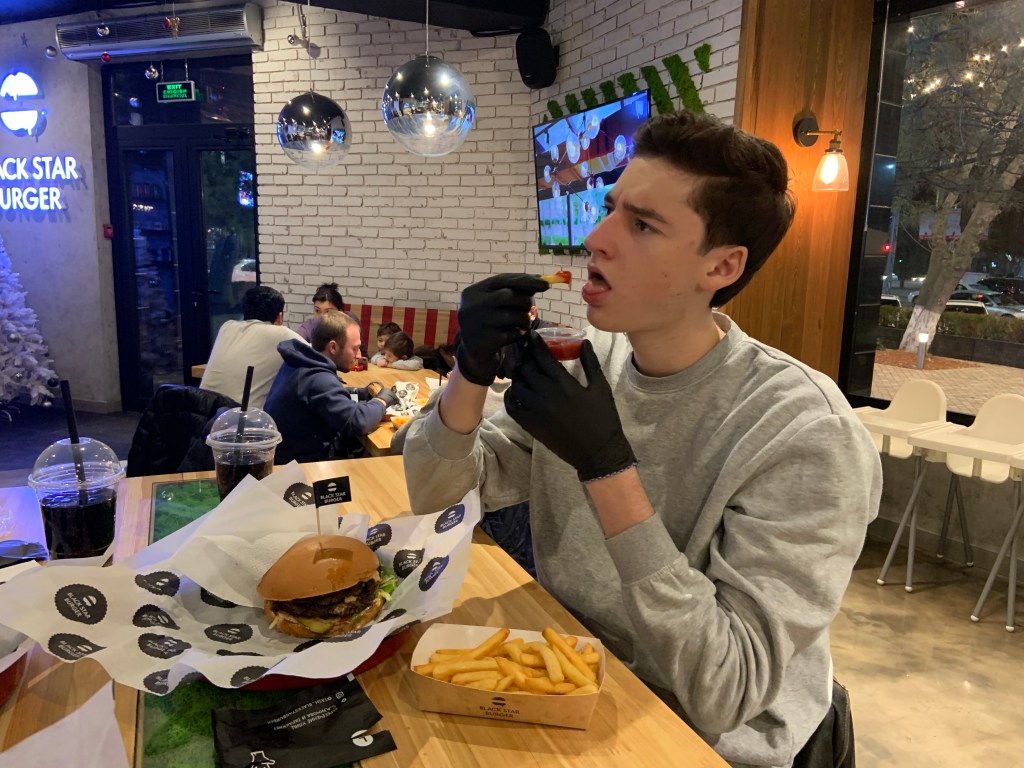
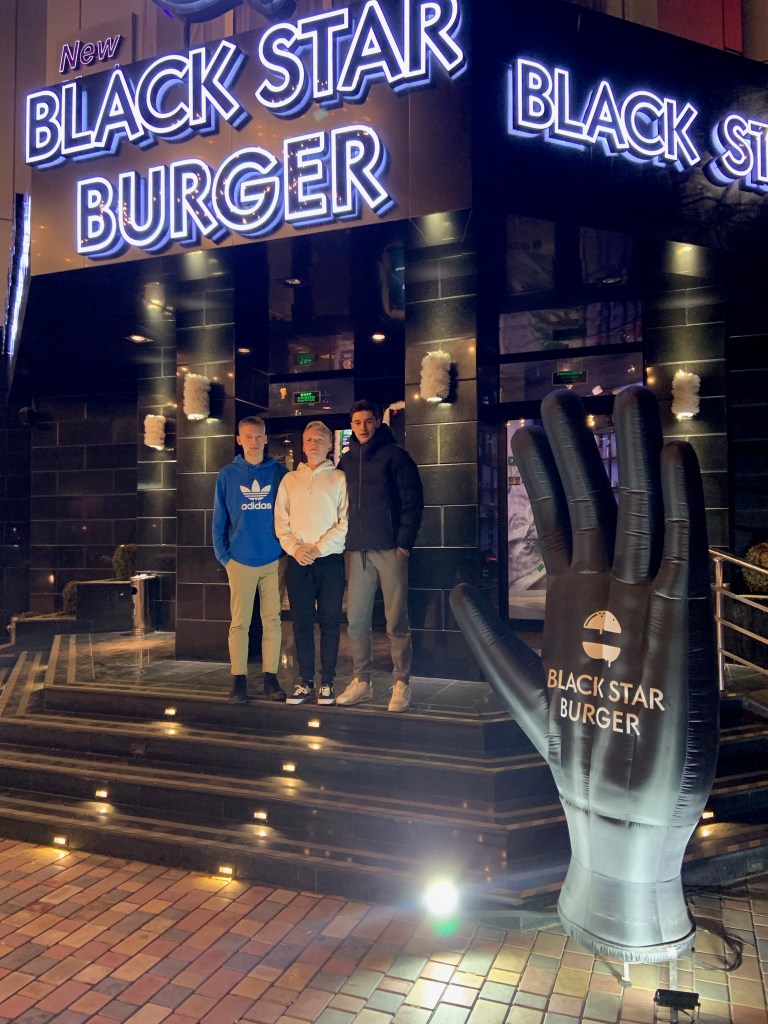
The boys love to go to Black Star Burger, an American-style hamburger chain owned by Russian Hip-Hop artist, Timati and businessman Yuri Levitas. It has a cool vibe and some distinctive features that make it worth a night out. With every meal comes a pair of disposable black rubber gloves. The burgers are very juicy and it is convenient at the end of the meal to peel off the gloves and leave the table with dry hands.

The decor is similar to Shake Shack, with an attractive font for the signs. Another interesting feature are the tattoo-sleeves servers wear under their black t-shirts. Timati looks like Drake, but he is not African. His parents ar Tartar (Turkish ethnic group) and Jewish and he grew up in Moscow. Politically, he supported Vladimir Putin in two elections and came under some criticism for the pro-Putin music video he starred in. I’ve listened to his music and definitely not my style. The restaurant market in Russia has room for different kinds of food and they seem to be successful. I see they are selling franchises in other parts of Russia besides Moscow.

Fresh Haircuts

It was a quiet day. I dropped the kids off at Ice City. Nadia made carrot-cake cream cookies, pan de jamon and a beef stir fry. She was busy in the kitchen. It is nice to have family here for Christmas! The boys got a haircut from Oleg, who comes to the house. He always does a nice job.

Winter Holidays in Tashkent Journal

Ocean asked me to go with her to Ice City, a new winter sports amusement center in Tashkent. We made Oliver go with us and we had a lot of laughs. I especially liked the speed skating ring. They even had an indoor bunny hill for skiers. I just love spending time with my family during the holidays.

A cold evening at the Tashkent International Airport

Last night and again this afternoon, we went to the airport to pick up Nadia’s father and her sister and nephew. The Tashkent International Airport is unusual in that people must wait outside the arrivals terminal and cannot enter the building. With temperatures hovering around zero, we were uncomfortable. I really enjoyed it however, just spending time with my family, joking around and waiting with anticipation for our relatives to exit the terminal.

Still cold during the day

I had a headache today and took it easy most of the day. Yesterday however, I did get out for a ride along the canals. It was quite refreshing and I hope to ride more often during the break.

Ankhor Canal

Tashkent Family Journal: Christmas Break Begins

The city is putting up Christmas trees in many parks in the city, including Odo Park.

I will be getting back to my regular blogging during the Christmas break. This weekend Nadia and I had a Hyatt Day, working out in the gym, taking a water aerobics class, hitting the sauna, culminating with a nice dinner in the rooftop Italian restaurant. I went for a walk while she was getting her nails done and noticed all of the Christmas decorations going up in the city. These were some massive artificial trees being lit up in Odo Park, near the hotel. This is new for Uzbekistan because the first president did not allow for Christmas decorations. I am looking forward to walking around the city at night this week to see all of the lights.

Nadia purchased several suzanis which are Central Asian embroidered, decorative textiles. The word suzan is Persian for “needle”. The Persians ruled most of Central Asia for a long time before the Turks and Mongolian tribes ousted them. They make beautiful tapestries or table covers. A lot of time and effort goes into making them. Nadia will be giving them as Christmas gifts.

Nadia and Brittany

We played tennis on Sunday morning at the indoor courts of the Olympic Tennis School. It is a great way to exercise during cold and wet weather we’ve been experiencing so far this break in Tashkent. I will try to play more tennis at NBU Yoshlik Center this week.

Owen works on this shooting

I’ve been working on recruiting as well this week and trying to balance family time with work. Owen and I went to the school gym to work out. I am trying to get the family out and about more and off their devices. We’ll see how that goes.

Uzbek Weddings

Lots of flowers, gold and of course, the wedding video and photo crew.

I was not enthused to attend a wedding on a Tuesday evening. My driver invited me and Nadia to one of the groundskeeper’s wedding last month. Weddings are big here in Uzbekistan! They are quite extravagant and the government even had to make a law limiting the size and cost of the parties. Families save up for years to spend lavishly on food, entertainment, decorations, etc. It is a big industry in Tashkent, with wedding halls located all over the city. I think there is cultural pressure to hold large weddings to show off one’s ability to do so. However, I haven’t been here long enough to definitely say this is true.

Little did I know what I was getting into. Nadia of course declined, so I went with my driver. Upon arrival, we were guided to a table with the rest of the TIS employees who were in attendance. The wedding couple invites family, friends, acquaintances, employers, friends of friends, etc. There were at least 250 – 300 people in attendance. Quickly, I was eating the national dish of plov and drinking tea, in between shots of vodka. Later in the evening, our table was invited into the center of the dance floor where a MC asked me to make a short speech. I wished the couple happiness on their marriage and praised the groom for his dedication to the school.

I was asked to dance with the groom in the center of the circle. Later, one of the aunts was giving 5,000 So’m bills to people to stuff in the groom’s coat pockets while dancing. I think this was for good luck. Uzbeks have a hybrid culture of Islam and influence from the Soviets. Women and men mostly danced separately, but there is often lots of alcohol consumed at weddings.

Uzbek music is growing on me. I like the rhythm and exotic, Turkish sound mixed with a danceable beat. It reminds me of Balkan pop music. The Uzbeks love a party and I actually ended up having a good time.