Travel Journal May : Lake Ohrid, North Macedonia – May 9-12, 2024

Church of St. John at Kaneo

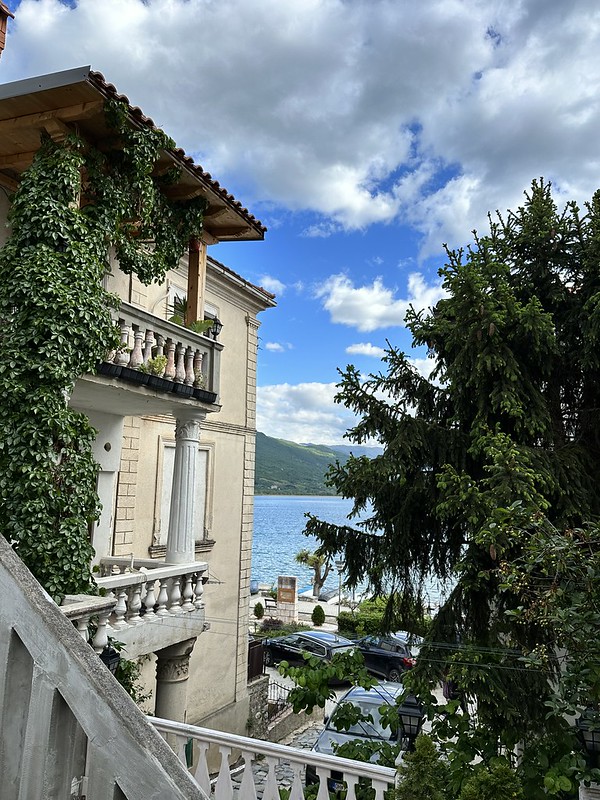
After the CEESA meetings on Friday, we spent the weekend up at Lake Ohrid to sightsee, unwind, and continue having conversations about our schools. Lake Ohrid is stunningly beautiful with a delightful, Mediterranean-like atmosphere with picturesque villages, steep green mountains, and clear, blue waters. It is one of the oldest and deepest freshwater lakes in Europe. It is a poorly developed Rift Valley lake (technically a graben) which is a tectonic fault. It is similar to Lake Titicaca in Bolivia. The water comes from underground springs, seeping through the limestone sediments. The lake has over 200 endemic species that can thrive in the unique alpine environment.

Ancient Theatre of Ohrid

We took a boat tour leaving the main harbor in front of the town of Ohrid. We traveled south and stopped at an archaeological site (Bay of Bones) and visited a recreation of an ancient fishing village based on Roman descriptions of the area. The lake is shared with neighboring Albania which has 36% of the shoreline and Macedonia which has 64% of the shoreline. The water in very clear and with the sun coming through the clouds, it was a beautiful sky backdrop while on the water.

The view from the church dedicated to John of Patmos (top photo), the writer of the Book of Revelation, was stunning. I love history and the Orthodox Church was probably constructed in the 1200s, before the Ottomans took over the area. The theatre dates back to the Hellenistic Period (200 BC) which was the time from the death of Alexander Great to the emergence of the Roman Empire. The theatre was only discovered in the 1980s. The Romans used it for the execution of Christians and the locals hated the place and avoided it. This preserved it until during the construction of homes, the workers were uncovering Roman-era stone slabs. Today it hosts a summer music festival.

Ohrid village is picturesque, with over 300 churches for a population of 42,000 people. There were lots of tour groups and we completed a walking tour along the waterfront up to the fortress and back through the town by a Roman-era amphitheater. The quaint homes reminded me of many of the Mediterranean villages like Valledamosa in Mallorca, Trogir in Croatia, etc. I would definitely come back and stay for a week, hiking in the mountains around the lake and kayaking/diving in different sections of the lake, including exploring the Albanian side.

We had a lively dinner with Macedonian folk music and dancing. America lacks rousing folk songs that everyone can sing by heart and use an accordion to play. Slavic Eastern Europe has many of them and it makes for a community feeling of strangers in a restaurant. We were trying to think of an equivalent and only could come up with YMCA, or some pop music hits. The restaurant band tried, playing “Oh Sussanah” and “When the Saints Come Marching In”. I could only think of “This is My Land, This is Your Land”.

The next day I went for a run along the bike path on the shore outside of the town of Ohrid. We took a bus back to Skopje (3-hour drive) and flew through Istanbul back to Tashkent in the evening. Of course, our flight was delayed by 3 hours, so it was a long night in the Istanbul airport and a later arrival at school on Monday.

Overall it was a relaxing and insightful trip. It was great that Nadia was able to come and we reconnected with each other, spending a lot of time together. Often during a busy week, we do not see each other a lot. North Macedonia is an overlooked country because it is small and landlocked. It is north of Greece and it was the far south of Yugoslavia. Skopje is similar in many ways to Belgrade, just a lot smaller and less developed. We love the Balkans and the ex-Yugoslavia and perhaps will be back next spring in Zagreb or Split Croatia. I would like to thank our host, Ivan for his gracious hospitality and joie de vivre!

Visit To Skopje, Macedonia

This is my second visit to Skopje, as I was here in September 2012, about 1 and 1/2 years ago, which I blogged about here. I am here this week for a basketball tourney so haven’t had much time to see the city.

We did a walking tour of downtown last night, and you can see above the Palace of Justice behind one of the many statues along the Vardar River. That is one thing I will miss about living in Europe is being able to see so many different countries in such a short time. The drive from Belgrade to Skopje is about 5 hours. Skopje was once part of Yugoslavia and one can still see the distinctive Socialist architecture here and there. The Macedonians are trying to re-do the city in their own image with many new buildings. There is also a Turkish/Albanian influence, as the country is about 25% ethnic Albanian. Our host Aleksandar said that the fortress is closed to the public due to a dispute between the muslim community and the Macedonian Orthodox community. City officials were to build or open an Orthodox Church there and the Albanian community opposed it.

Macedonia was a smaller part of the ex-Yugoslavia, with only about 2 million inhabitants. Beside Tito’s Partisans wanting the area, the Macedonians have also been sought after by the Greeks, Bulgarians, Serbians, Ottomans, etc. I am happy they have their independence, but feel if they wanted a larger country, they would best fit with the Bulgarians.

Boris Trajkovski Sports Center – Skopje, Macedonia

I am here for a basketball tournament with our High School Boys’ team. We are playing games at the Boris Trajkovski Sports Center, which is named after the former President of Macedonia. He died in an airplane crash while visiting Bosnia 10 years ago. He was a Methodist Minister and was known as a moderate who promoted inclusion of all ethnic groups in Macedonia. This is a quality still much needed today in the Balkans. He is regarded as a hero by the Macedonians and the government has built a beautiful center with a hockey rink, pool, arena, gymnasium, etc.

Skopje, Macedonia

Alexander The Great on Horse – Macedonia Square – Skopje

I am finishing my 3-day visit to the capital of Macedonia today. I was here on business but got the opportunity to explore Skopje a bit. I really enjoyed our stay mostly for two reasons. First, I stayed at the Alexander Palace Hotel, which had 6 tennis courts and a café/bar sponsored by the Skovin Winery. We played a lot of tennis and enjoyed the Macedonian wines. The second reason was the hospitality of our hosts, the Novakoski Family. Viktor Novakoski is the principal of the Nova International School in Skopje. They are fellow members of the Central and Eastern European Schools Association. Nova has become a valuable partner in developing our sports programs.  Viktor and his team were fabulous hosts and I was very impressed with their school and his mission of bringing international education to the young nation of Macedonia.

The city itself is smaller than I expected, with a population of around 700,000. The topography and climate is very Mediterranean, and it looked and felt like Spain, Greece, or the Croatian coast. Skopje is surrounded by green mountains and with the perfect sunshine and blue skies, it was a very enjoyable 3 days. I was happy my Serbian was useful in getting around the city and the Macedonians easily understood me. I didn’t notice any difference in the Cyrillic script as well.

View From My Hotel

I came with question of where the Macedonians fit in the Slavic spectrum. They are not as tall as the Serbs, and being the southern most Slavic people, the city had a lot of Turkish or Albanian ambiance. There are many mosques, however, the city seemed divided between the Macedonian part and the Albanian part. Walking through the old Turkish market today, I felt like I was in Sarajevo. We even heard the call to prayer one night at dinner. With a growing population of ethnic Albanian Macedonians, it will be interesting to see how the two groups interact in future years. Can the country hold together?

I also was interested in seeing the infamous Skopje 2014 project. City leaders have this plan to build these huge statues, huge Greek Revival buildings, and fountains, plazas, etc. It was a bit amusement park like to see a 50-foot bronze Alexander the Great on horseback on a towering pillar in the center of a fountain. The fountain shooting streams of water in synch with classical music, including lights. They are spending a lot of money developing buildings and statues along the river. I have not seen anything like it and it would be interesting to hear the opinions of Macedonians if this has improved the city. There was also a really nice running track along the Vardar river, going from our hotel to downtown. It was a great place to exercise and I hope they add to the network.

Another Statue – They love horses in Macedonia!

In reading about the history of the Macedonians, I asked the question, are they more like the Bulgarians or the Serbians. I would say that the city felt more like Sofia than Belgrade and they are definitely more Bulgarian, but slightly less central Asian. They truly are a people in between the Serbs and the Turks. Everyone was friendly and treated us well. I would recommend a visit to the country!

There are lots of Albanians in the city