Latest Reading: Norman Davies “No Simple Victory: WW II in Europe 1939-1945

fter our Christmas holiday trip to Poland, I wanted to learn a bit more about World War II. In Krakow we saw Schindler’s factory and the Jewish Ghetto, and this piqued the curiosity of our children. We explained the war and the Holocaust to them in the long car rides and watched Saving Private Ryan and Schindler’s List to reinforce their learning.

I chose the Davies book because it concentrated on Europe and it gave an outsider’s view to the war. I grew up with stories from my Dad, who was a boy during World War II and was fascinated with the war and what we were taught in school. I had an American-centric view of the war. Living in Eastern Europe has opened my eyes to a broader view of events.

Most of the war took place in Eastern Europe, specifically Poland, Belarus, and Ukraine. The two major combatants were the Fascist, Nazi Germans against the Communist Red Army of the Bolsheviks. It was a conflict of two great armies led by evil men, Hitler and Stalin, and the results were the deaths of millions of people, both soldiers and civilians, and the loss of opportunities for a good life for several generations of people.

I always thought that it was the Americans who came in and saved the day! I understood that the USA arrived to Europe to save the UK and France and landed on the beaches of Normandy and fought their way to Berlin. And then went on and defeated Japan as well. Davies however, shows with facts and his research and the research of others, that America only played a minor role in Europe. The Soviet Army did the hard work and won the war, not the USA. Most of the 16 million soldier deaths were suffered by the Soviets (9 million) and Germans (4 million). The biggest casualties were on the Eastern Front of the war with Barbarossa, Stalingrad, Leningrad, having over 10 times more deaths than say the Battle of the Bulge, the largest battle the Americans were involved in. The turning point of the war was not D-Day, but the huge tank battle at Kursk in the Ukraine. From that point on, the Germans were on a retreat that would not end until the Russians reached Hitler’s bunker in Berlin. America only contributed to 15 percent of Germany’s war deaths.

The reason most of the war was fought in Eastern Europe, is that the Germans wanted “room to live” and felt that the area east of Germany was meant for them and was filled with a “mix of subhuman and filthy” Slavs and Jews. Being of Slavic origin, I am glad Hitler and the Nazis got what they deserved. The Bolsheviks, the “74-year experiment that wasted tens of millions of lives” also wanted to expand into the area to take Communism to the world. The result were Poland being split into two by the Germans and Soviets, and Belarus suffering the most civilian deaths per capita and Ukraine most civilian deaths total of any country in the war. One example of the cruelty Poland faced was when the Nazis occupied Krakow, they immediately went in and executed the entire faculty of Jagiellonian University, because they felt Poles didn’t require universities, secondary schools, or educated leaders.

Stalin in my opinion was worse than Hitler. His internal purges and war tactics killed many more people than Hitler and the Nazis, even including the 6 million Jews in the Holocaust. In fact, the Stalinist Terror in the 1930s had roughly the same death toll rate (18 million estimated non-military deaths) as during the war in 1939-1945 (6 million non-military deaths). The Red Army used its numbers to win many battles, sacrificing millions of soldiers. Soldiers actually felt freer on the front lines in many cases, facing executions if caught of desertion or cowardice, or just being in the wrong place at the wrong time. Davies describes many atrocities and the disgusting conditions of the Red Army and Soviet policies with civilians. The GULag concentration camps in Russia and Siberia were much larger than Auschwitz or the other big Nazi camps.

I don’t want to downplay America’s contributions to the war too much however. They supply both Great Britain, the Western Allies and the Soviets. They also did keep Germany occupied on two fronts, although I think Russia could have defeated Germany on their own. The USA also defeated Japan in the Pacific theater, which had much less deaths than Europe, and used their superiority in the air and water. However, the US before 1941 did not have much of a military and it took a long time to build up their armed forces to match the Soviets or the Germans. It is ironic today that the US has the largest military in the world. It would be nice to spend the American GDP on something rather than maintaining the military.

I highly recommend No Small Effort. It gave me a better understanding of World War II and the impact of the war on Eastern Europe. I would like to read a similar book (s) on the Pacific Theatre of the war as well.

Istanbul: The Grand Bazaar


It was with mixed emotions that I ventured with my family to Istanbul’s famous Grand Bazaar. I really wanted to see one of the world’s famous places and learn about how it worked, but on the other hand, I detest shopping and I loathed the idea of a few hours of browsing and purchasing items. Would it be a glorified mall trip?

Upon reflecting the day, it was a mixed experience. The most positive aspect were the joy it brought to my wife and daughter, purchasing pillows (Nadia) and belly dancing outfit (Ocean). Ocean especially reminded me that I have a daughter and she loves shopping! She even came home and we watched belly dancing videos together for her to pick up some moves and then she performed for the family! I hope to post the video soon.

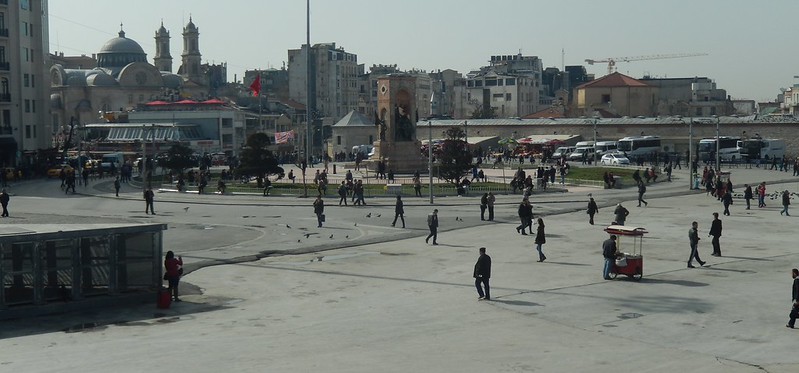
Taksim Square – Istanbul

The negative was the hassling we received as a family from vendors. I guess walking through the bazaar with an Indiana T-shirt on, three blond children, and carrying several large bags of stuff, would be a signal to vendors that they can make some money off of us! It is so foreign to me however, to sell and use a variety of offers to try to maximize the profits from an interaction with a visitor to my country, or anyone for that matter. For example on the way to the bazaar, we stopped at Taksim Square. The shoe shine men used a ploy on me to drop their brush and so I would pick it up and that would give them an opportunity to quickly start shining my shoes and asking for money. I did give him some Serbian money, but he was asking for 100 Lira $45. Another example was the taxi driver, wanting 50 Lira for a 20 Lira metered taxi ride. It gave me a very negative view of my trip because they try to get as much money from tourists as possible.

It was fascinating to watch the salesmen and their support people. I think it would be very boring to own a shop in the bazaar, attempting daily to sell the same wares to tourists. The vendors looked bored, playing solitaire on their phones, drinking tea, and talking with each other. This is the winter and off season, so business was slow, so I assume in the summer they are busier with sales. I wonder how much vacation time they get and how much do they make a year? Do they get insurance, pregnancy leave, and other benefits? Many were trying to avoid paying government and credit card fees and asked for cash so they don’t need to report their sales to the Turkish IRS. I wonder how many generations they have been working in the bazaar?


Istanbul: The Blue Mosque and Carpet Shopping


We are staying in Istanbul this week for our February Break. Our first day in the city yesterday was exciting, with a visit to the famous “Blue Mosque” and shopping for carpet. This is our third Islamic country for our family and it is nice to hear the call to prayer and the warm responses children receive from the locals.

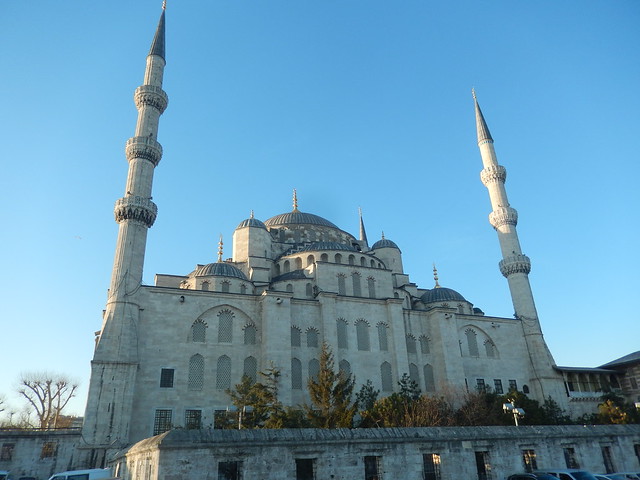
The back view of Sultan Ahmed’s Mosque

The city is breathtakingly huge and beautiful, with the minarets of mosques rising up from the hills and dramatic views to the blue Bosphorus. I can see why it is one of the world cities!

The Blue Mosque, was built by the Ottoman Sultan Ahmed 400 years ago. It is a huge example of classic Ottoman architecture. We had to remove our shoes and the girls put on head scarves. After touring the mosque, we went over to the Arasta Bazaar and bought a beautiful carpet from Murat Metin, in the Er Ne Hali Gallery. He was very helpful and we purchased a rug from his part of Turkey, the eastern Kurdish part.

Enjoying Tea While Contemplating Carpets

I will try to do a few more blog posts from Istanbul this week.

Oliver and Owen Star in Indoor Baseball Tournament

The Head of Serbian Little League Baseball, Nikola Vučević invited the International School of Belgrade to form a Team USA and participate in an Indoor Baseball Tourney yesterday. We headed up to the beautiful facilities of the Serbian Institute of Sport located in the Belgrade suburb of Banavo Brdo. There were six teams from Belgrade and Novi Sad participating. I never saw this type of baseball before, the rules are described here in Serbian. The ball is hit off a tee and there field is a triangle, with two bases and a home plate. Runs are scored by the team in the field by recording an out and by the offense by the batter going around the triangle to score. We played with seven people, one catcher and six in the field. All defensive players must be beyond the triangle. All seven batters bat every inning. The games were 25 minutes long and scores were in the high teens or low twenties. It took the team awhile to get going because we haven’t played in such a long time, and these were new rules to us. It seemed like a game we would make up as kids! It was especially exciting when a ball was hit off the wall and came bouncing back towards the bases. Owen played excellent at first base and Oliver played some outfield and some catcher. The team made it out of the group stage and finished fourth out of six teams. They were excited about the medals. Most importantly, the boys really enjoyed themselves.


I would like to thank Nikola for inviting us and my colleague, Brian Lettinga for organizing and coaching the team. It was my first time inside the Institute. Here is a video on Vimeo that describes their mission and it will give you a good idea of how the Serbian language sounds.

Oliver Appears in Mali Zabavnik Magazine

Earlier this month we were surprised when a friend pointed out that my son Oliver appeared in the Serbian children’s magazine, Mali Zabavnik. The parent magazine, Zabavnik (translation – Party / Amusing) is very famous in Yugoslavia. It was one of the only western style magazines dating back to 1950s published in the former Yugoslavia. It featured Disney and domestic comics and articles with a broad appeal. Its tagline was “For Everyone from 7 to 77”. All of my Serbian friends grew up with the magazine and it is still published today. I also read that when former Yugoslavian leader Tito was asked permission to publish the magazine, he said, “Why not, I like Donald Duck.”

The Serbian government is publishing a version called “Little Zabavnik” for schools and that is where Oliver’s photo appeared. They must have got the photo from my Flickr.com account. I took the photo years ago and it shows Ollie holding the “žito” standing in front of a badnjak , two Serbian Christmas traditions. The photo is used on page 26, in an article about the upcoming Serbian Christmas. I don’t mind the photo was used without my permission, but people usually ask me to use the photos on my Flickr account. Through the years, my photos have been used for the Egyptian Airlines in flight magazine, a solar eclipse photo, or in a web site banner for a conference on the Great Lakes.

It is another nice souvenir of our time in Serbia and I am honored that my son got to be a part of Yugoslavian tradition. The cover of the January 1, 2014 issue where Oliver is on page 26 of the magazine is pictured below.


Happy Birthday Nadia!

Last weekend we celebrated Nadia’s birthday. We invited friends to a nice meal on the Belgrade riverfront at the restaurant, Communale. From there we went to the Canadian Embassy where our good friend Kevin, opened the Canadian Club for us and we sang karaoke and had a lot of laughs. It was a good way to celebrate – with good food and good friends. As you can see below, we finally have some snow!

The next day we celebrated by going to Owen and Ollie’s basketball game. The Junior Dragons defeated KK Sava 33-31. Owen scored 10 points and Ollie had an amazing pass that fooled everyone. Ollie is pictured below with his best friend Jack, the only two third graders on the team.

It was a really nice weekend. Happy Birthday Baby!


The Hungarian Empire in Serbia


On Saturday we walked up to the top of Gardoš Hill in Zemun to check out the tower of the same name and the view. As you can see in the photo above, in the foreground is the now Belgrade suburb of Zemun, with the Danube (Dunav in Serbian) flowing by with the city of Belgrade in the distance.

The tower was built in 1896 to celebrate 1000 years of Hungarians presence on the Pannonian Plain. This is the large, flat, grasslands in the north of Serbia stretching into Hungary, that geologically, used to be a sea. Zemun was the southernmost city in the Hungarian Empire and towers were built in the four corners. It is common for nations to celebrate their largest historical empire. Listening to the radio commentator and historian Dan Carlin however, has me thinking a bit differently about this. He argues that people should think about the consequences of empire, that some other people were conquered and there was probably much death and destruction to build that empire.

The Gardoš Tower – January 18, 2014

In this case, the Gardoš Tower, which is also named after the 15th century Hungarian general, Jonas Hunyadi, is celebrated by both the Hungarians and the Serbs. Hunyadi’s armies repelled the Ottoman Turks, a common enemy of both the Hungarians and the Serbs.

Today in Zemun, one can immediately see and feel the architectural difference left by the Austo-Hungarian builders. Zemun, once a separate city, has a much different look than Belgrade. It was part of the Austro-Hungarian Empire, and the attack on Belgrade by the Hapsburg armies in retaliation for the assassination of ArchDuke Ferdinand was launched from here to start WW I.

I can see why people have gravitated to this spot over time. The Danube provided transport and the hill a defense against invaders. I could see the hill of Kalamegdan and Avala in the distance and understand the importance of the high ground in pre-industrial warfare.

Zemun today is quite pleasant to visit with a nice promenade and bike trail along the river. There are also quite a few restaurants and cafes along the waterfront, and the old buildings, cobblestone streets, and winding alleys make for a quaint atmosphere. My children love running up and down the levees on the banks of the Danube. Another nice thing about Belgrade is that the rich have not taken over the waterfront as in other places. One does not see private residences, luxury apartments or yacht clubs. In fact, most of the boats in Belgrade are like the one below, simple and for the common man.

I have a lot of nice memories of Zemun and will definitely miss it when I leave Serbia.

Tipsarevic Park – New Belgrade, Serbia


Last week on one of my bike rides I noticed the new fitness equipment in Friendship Park in New Belgrade. It was donated by Serbian tennis professional, Janko Tipsarević. He is still injured from last year and not competing in this week’s Australian Open. He missed the Davis Cup final in November, which caused Serbia to lose. Janko is currently ranked number 52 on the tour. There was a nice article about him in the New York Times last year.

Despite Tipsarevic being absent for the first Grand Slam of the year, Serbia is well represented with Novak Djokovic, going for the fifth consecutive title is into the third round already. The heat will not affect him as much as the other players due to his fitness and conditioning. Doubles specialist, Nenad Zimonjic, is through the first round and I see he is playing with Belgrade native, Daniel Nestor. On the women’s side, Ana Ivanovic won her first two matches, and is playing some of her best tennis in years after winning the Australian Open warm up tourney in Brisbane earlier this month. Jelena Jankovic is also through to the third round with two straight sets victories. I’ll post an update here next week on how the Serbs finish in the Open.

Belgrades Parks and a Balmy January

I took this photo on Saturday during a bike ride around Ada Ciganlija. The weather in January so far has been surprisingly warm. The historical mean high temperature for the month is 4C and this weekend, temperatures will go to 15C. So far this winter it only snowed once in late November. When one sits in the sun, it is almost warm! We did have several days of thick fog and cold, but mostly it has been sunny and warm. We biked around the lake at Ada, as always spending time at the exercise park and the excursion pictured above, exploring the woods on the island. The new bike path under the bridge project saves a lot of time and makes Ada much more accessible from Senjak.

In speaking with my friend over the holiday, I said life’s pleasures change for every age. As I am getting older, going for walks or bike rides in nature is just so refreshing and re-energizing. Belgrade is blessed with many parks and easy escapes from the city life. Ocean is shown below being silly in our walk on Sunday in Košutnjak Park. With no leaves in the trees, one can see across the valley from the park into the Royal Palace grounds in Dedinje. I can see why the Košutnjak started as the King’s hunting grounds. He could probably look across from the palace and see the wooded hills on the other side of the valley. We had a nice father-daughter outing talking about all kinds of things. She was really interested in moles after seeing the many piles of dirt made by them, and I ended up having to explain the natural history of the European Mole. We even went on line after we got back so she could see their tunnels, what they looked like, and the traps used to catch them. We finished the hike by collecting sticks for our fireplace. What a great day!


Serbian Christmas

The Serbian Orthodox Church is one of several Eastern Orthodox Churches that celebrates Christmas and New Year on the Julian Calendar instead of the more common Gregorian Calendar. Some of the Orthodox Churches celebrate on December 25 (Greek, Cypriot, Romania), but most like Macedonia, Russia, etc. have the holiday on January 7th, 13 days after the 25th of December. We attended the service at the largest Orthodox Cathedral in the world on January 6th, Saint Sava’s Cathedral in Belgrade. This is our final year in Serbia and it is a tradition of our family to go to the service and toss the badnjak (Oak Tree Branch) into the fire. Ocean did it this year as you see above. This ritual dates back to the Slavic pagan yule log and the tradition of fire of the family hearth and the winter solstice should all resonate with us. I am very curious what Europe would look like today if Christianity never spread out of the Levant. Would we be burning the oak in honor of Perun? 

Orthodox mass (I was raised Catholic) is much different than the Catholic services I grew up with. Most of the service is sung in A capella and as usual, people came and went during the mass in the huge St. Sava Cathedral. The video I took below will give you a little taste of a Serbian Orthodox church service. Last year I attended the Serbian New Year services, and hope to do so this year on January 14.

As they say in Serbia on Christmas, Христо се роди!