Osaka Soul Food: Okonomiyaki

The cool autumn weather has finally arrived here in Minoh. Last night the temperature dipped down into the 40s F (5-7 C) and so we wanted a hot meal. We rode our bikes to a restaurant in our neighborhood called Warai. They specialize in Okonomiyaki. The okonomi part of the word means “as you like it” and yaki means grilled or cooked. This style of food is associated with our Kansai region and a there is a slightly different version in Hiroshima. It is popular throughout the country. It is interesting that I have never seen it featured in Japanese restaurants outside of Japan.

The best thing about these types of restaurants is the hot stove that is seated in the table top and the little spatulas everyone is given. The kids love being able to do some “cooking” but one has to be careful with younger children that they do not burn themselves. The staff brings out various dishes half-cooked and lets patrons finish them on the hot stove. The stove also

The famous pancake of Osaka!

We ordered squid, corn and dumplings as the first course. The second course was the famous Osaka pancake. It is made of flour mixed with cabbage and yam, and either seafood or meat is added. It is topped with super thin fish flakes and you can add Japanese mayonnaise or the signature sauce of okonomiyaki, which is like  Worcestershire sauce. I love them and it is known as the soul food or signature dish of Osaka.

Delicious squid and corn

There are many restaurants that serve Okonomiyaki. Warai is a chain of family-style restaurants and there are over 20 in Osaka and Kobe. It is conveniently located for us and is kid friendly. I am looking forward to comparing the Hiroshima-style pancake.

Nadia and Oliver in front of the restaurant in Onohara.

A Small Town in a Big City

We live and work in the suburb of Minoh, which is about 15 kilometers north from downtown Osaka. It has a population of around 130,000 people and is famous for the forested park the city is nestled against. We are really enjoying living out here and one of the best things is the ability to ride bikes anywhere. We regularly go out as a family and explore the city on bike.

Last weekend we rode up into the hills and visited a Shinto shrine. We also walked along a small creek and the kids had fun running around and exploring the forest. One bad thing about Japan I am learning is there is almost no untouched wilderness. Even in the park, the hillsides have cement reinforcement walls and all of the rivers have dams so the water can be controlled for irrigating the rice paddies of the city.

Ollie being Ollie!

After the walk, we rode back down to the city and went for a late lunch at Q’s Mall, located on highway 171, which bisects the Kobe-Osaka-Kyoto metro area.

I am looking forward to my first fall in Japan. The peak colors will be coming up later this month. I can’t wait to see the famous red colors of the Japanese maples. Some of the bushes and trees are already starting to turn.


Walking in Meiji no Mori Park

Morning View of the Mino Q-National Park – typhoon coming

Yesterday afternoon Owen and I went for a walk in the Meiji no Mori Quasi National Park. The park provides the backdrop to the view from our house and consists of forested hills near our suburb. I needed to recharge my batteries and get out into some “wilderness” for awhile, and with the perfect autumn weather we are having this week, it was a refreshing afternoon with my son.

The park was set up in 1967 and is called “quasi” because it allows for some development, more so than proper national park. It is nice to have a forest next to a metro area of 17 million people (see last post) and surprisingly, not that many people go up there. That is probably because it takes some effort to go up the hill. There are plenty of marked trails in the park, however, the signs are not in English so we are still trying to figure it all out.

We have been in the park a couple of times and we still have not seen any of the famous monkeys. I thought we were lucky yesterday late in the afternoon, but it turned out to be a squirrel. We also heard a strange call from the forest. You can hear it in the video below right at the end. I will do some investigation to find out what it is. I think it might be a monk from a nearby temple.

(video coming soon…)

We made it to the further point in the park than we have gone so far. On the other side is pure countryside and will be nice to explore once we get a car. So far it is my favorite place in Osaka.

The view back to Osaka

Visualizing 17 Million People

Looking up at the Umeda Sky Building

One of the biggest adjustments for me in our move to Japan is living in a very large city. The metropolitan area of Osaka – Kobe – Kyoto has a population of over 18 million people. That is larger than Moscow, Cairo, Los Angeles, and Bangkok and ranks #14 in the world, just below Mumbai. The three cities are known as Keihanshin and the GDP of this area is roughly the same as London or Paris. There is a lot of people here and a lot of money. The most populous metro area in the world is Tokyo with almost 40 million people. It has a population density higher than Bangladesh. I will certainly be exploring Tokyo in future visits.

The view towards Osaka Bay from the top of the building

Although we live in a big metro area, we do not feel it on a daily basis. The school is located in the suburb of Minoh, which is 17 kilometers (10.5 miles) from the city center. By train it is about 20 minutes. We live only a few blocks away and it is about a 5-minute walk to school. Minoh is full of parks, wide sidewalks, bike paths, and is minutes away from the forested hills of a “quasi national park” so one gets the impression of living in the suburbs of any city. The only time we get a sense of the vastness of Keihanshin is when we take the train into the center or go over to Kobe. The apartments, houses, and businesses go on endlessly.

Our goal yesterday was to get to the top of the Umeda Sky Building. This is an Osaka landmark, built by Toshiba in 1993. During the heady real estate boom of the late 1980s they had originally wanted 4 interconnected towers, but only built two. In between the two towers at the top, there is an outdoor observatory, an escalator on one of the top floors leading across the open space, and modern sitting area with restaurants and cafes. The views are spectacular. They really helped me see how big Keihanshin really is. It goes on forever with hundreds of skyscrapers, all the way out to the Osaka Bay. Around the Sky Building, there are some parks, wide walkways filled with cafes, restaurants, and shops. It is very pleasant, except when one gets closer to the Umeda train station, as there are too many people for my taste in that station.

The garden next to the Umeda Sky building

We had dinner in the basement floor of restaurants. In Japan, it is common for entire floors of buildings or train stations to be devoted to restaurants and bars. There were probably 20 different restaurants to choose from. We chose an Indian restaurant and it was really good. I recommend a visit to the building. The architecture is interesting, it is a really nice area, and the views, especially at night or at sunset are beautiful. It gives one a good sense of the layout of the city.

Growing up in a small town of 900 people in a very rural and isolated part of northern MIchigan, living in a city that has twice as many people as the state of Michigan, is going to take some getting used to. In some of my previous postings overseas, I have lived in cities of around 2 million (Perth, Santa Cruz, Barranquilla, Belgrade) but never this big.

View looking towards our house – Yodo River in foreground

Kyoto: Where Japanese Come to Experience Japan

Kyoto was the capital of Japan for over a thousand years. The allies in World War II also avoided bombing the historic city, hence, it is a place full of old, beautiful temples, shrines, and traditional Japanese architecture. It is about an hour’s drive from Osaka, and makes up 1/3 of the tri-city metro area that includes Osaka and Kobe. We spent the weekend in a traditional ryokan near the Kiyomizu Temple and really enjoyed the experience. We were surprised to see so many Japanese people dressed in kimonos. They also come to Kyoto to experience their own culture. Japan is a very modern country and most of the cities look and feel like western suburbs. The hills of Kyoto are the exception and there are literally thousand of Buddhist and Shinto shrines and temples. We only scratched the surface of what Kyoto has to offer.

Owen in front of the soldier memorial

The girls, Nadia, Ale, and Ocean were a big hit with their kimonos. People were asking to get their picture taken with them, as you can see above. The Kiyomizu Temple is one of the biggest tourist attractions and was great for the kids. There is a lot to do and see in the compound, much of it a bit kitschy, like drinking the water of the waterfall to get your wish to come true, fortune telling, etc. I do need to read up on Buddhism to understand fully what is going on at the temples.

It got crowded in the afternoon and we were starting to feel a bit uncomfortable with the amount of hustle and bustle. The girls loved the shopping. We got away from the crowds and visited the unknown soldier memorial and watched a local music concert while they finished their shopping. I highly recommend seeing Kyoto and spending a few days. The temples vary quite a lot so there is something for everyone.

Our Stay at a Ryokan

The kids thought they were ninjas!

This week we have family and friends visiting us from China and Yemen. We wanted to give them, and us, a Japanese experience so we stayed last night at a traditional ryokan hotel in nearby Kyoto. You sleep on tatami mats, wear robes, use the public bath and eat Japanese cuisine. It was one of the most memorable nights I’ve had, and I highly recommend this different experience for everyone. It is a bit expensive, but worth it as a special treat or if you really want to experience old Japanese life.

The robes were hilarious and we were asked to change immediately by hotel staff. The kids thought they were ninjas or geishas and it was a bit like halloween. The bath was another interesting experience. Japanese bathe naked publicly, something that does not happen in the USA.  They are segregated between males and females. The boys wore their trunks because they were shy, but Jim and I went as the locals did. The bath had the squatting shower, three temperature pools, a sauna, and facilities for shaving, etc. It was really relaxing and reminded me of the European spas. The meal was traditional, with the tables near the floor and diners on the pillows. There were multiple courses and many of the dishes, we didn’t know what they were. At night we went for a walk in the old streets of Kyoto and saw the big temple nearby all lit up. When we came back to the room, the futon mats were laid out for us. The staff was superbly friendly and at our service, despite the language barrier.

There are many different kinds of ryokans and we will definitely stay again. We stayed at the Hotel Riozen, which was a mid-level price range in a great location.  A big thank you to Masago Sensei for the recommendation and to Jim for arranging the transport! Domo arigato!

MS Baseball Season Continues

The SOIS Sabers Middle School B Baseball Team travelled across the bay on Saturday to take on the Canadian Academy Falcons from Kobe. The Falcons started with an early 4-0, but going into the last inning, they were down 5-12. They scored 7 runs in the last inning to tie the game and it ended in a 12-12 draw. The Sabers pitching staff couldn’t find the strike zone in the last inning, and the CA batters were not swinging and going for walks, which was a good strategy for them. A controversial umpire’s call in that fateful last inning kept CA’s hopes alive, and they came through with the tying run. In the end, it was a grounder back to the pitcher, Owen Kralovec, who tagged the runner out at third to end the game.

Owen Playing First Base

Myong Jun Kim tripled and pitched well in the middle innings. Misishi homered in the game and was voted MVP by the coaches We enjoyed the sunny weather and camaraderie and I would like to thank Coach Fukushima for his help in getting us there and his cultural insights.


The Times Square of Osaka: Dotonbori

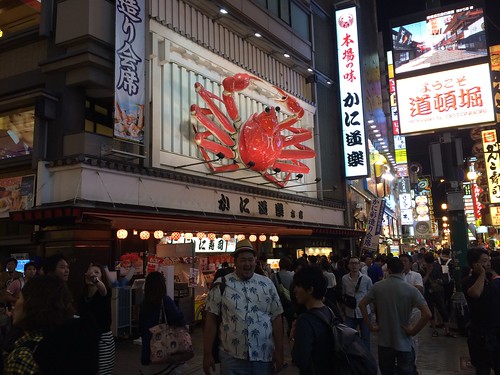
Last night we ventured to the heart of Osaka to the famous neighborhood of Dotonbori. This is the crazy stereotypical urban Japan at its finest, with huge neon billboards, throngs of people, deep-fried octopus dumplings, steaming ramen restaurants, crazy fashion and futuristic designed buildings.

Yasui Doton designed this area as an entertainment hub over 500 years ago. HeThe entrepreneur dredged a canal (bori comes from hori, to dig) of the tiny Umezu River. The area was always zoned for entertainment and originally was a theatre district, the last theaters being destroyed in WWII.

Dotonbori today reminded me of a nicer Times Square. The canal at night is surprisingly peaceful, despite the tour boats passing by and the thousands of shoppers and eaters passing overhead. The number of shops are restaurants must number in the thousands. As it was our first time, we were a bit overwhelmed and with the kids being a bit tired, we struggled in finding a suitable restaurant for a family of 5.

The canal of Dotonbori

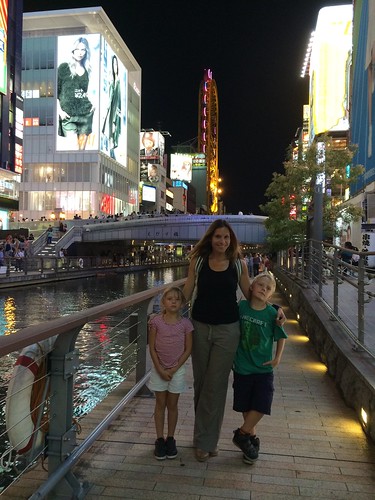
There are several icons of Osaka, which is the food capital of Japan. Above the restaurants there is a  giant mechanical crab, octopus, and fugu fish, all advertising the cuisine of Osaka. We stopped to take photos in front of  the Glica Running Man, which is a symbol of Osaka. The giant neon sign was taken down by the candy company Glica, and in its place is a regular billboard portraying a running girl. They did have a small version of the original for tourist. The buildings in Osaka are amazing. The designs and lighting are futuristic and sometimes you feel like you are in a sci fi movie like Blade Runner.

Ocean and Nadia in front of the Glica Running Man

Dotonbori is located just outside the Namba Station, one of the hubs of the Osaka train system. It is certainly exotic and if you are not bothered by crowds, it is a good night out. We will go back again now that we know the place a bit, and sample some more of the Osakan cuisine.

Moving In

Will all this stuff fit! (Yes it did)

We have been here for almost a month and finally starting to feel settled in. With the jet lag (14 hour time difference) and large language and cultural differences, Japan is a difficult place to get used to. I really enjoy experiencing new things and thought the process has been fun. Nadia, and to some degree Owen, have a different personality and have been more challenged with the culture shock and language barrier. Oliver and Ocean made an easy transition, much in part due to their younger age.

Japan is extremely organized and has a culture that values order, tidiness, and documentation. This made finding a house, setting up bank accounts, phones, internet, etc. all the more time consuming. One by one, however, we knocked down the list of errands we needed to do and we are at the point now, of almost settling in to a routine. A few advice points for newcomers to the OIS Community that we learned:

1) IKEA has the best prices for furniture and household goods. It is not too difficult to get to the store, as they have a free shuttle from the Namba Station, one of the major hubs of the Osaka Train Network.

2) Nitori is close by and good for futons (Japanese beds) and kitchen ware, although, is more expensive than IKEA.

3) Be careful with the internet from a wireless satellite provider like Wi Max. It depends on your apartment or house. If there are big buildings near by or you are on a lower floor, the connection speed will be slower. If you want a guaranteed connection, go with a cable version, although you will have to wait for 1-3 weeks.

Some Japanese furniture is low to the ground.


4) You need to get an address first, before being able to get a phone, bank account, etc, therefore your energies will be focused on finding a place to live.

5) Shinsei Bank is the best because they have English service and on line English service.

6) The Minoh local government is full of good resources for newcomers and you should visit the MAGFA Community Center early from your arrival if you live near the school. They have free Japanese lessons, cooking classes, a restaurant, and many other events.

7) The Kansai Scene is a great English-language resource for things to to in the Osaka/Kobe/Kyoto metro region.

8) Ask veteran expats and locals at the school lots of questions, from who is the best cell phone provider to where can you buy good cheap vegetables.

9) The Japanese want to be helpful and will try to do their best to assist you, language barriers aside. The percentage of English speakers is low, but we always found someone who speaks enough to get us through our predicament. Someone always comes to the rescue when sorting out trains, shopping, etc. People in Osaka are very empathetic to newcomers.

Nadia and Ocean at the steps to the promised land!

Thank god I brought my tool kit that my Dad and brother Andy, bought me five years ago. It really helped in assembling shelves and tables we bought from Nitori.


Owen Starts Middle School Baseball Career

Senri and Osaka International Schools Middle School Boys’ Baseball Team – August 29, 2014

I was a proud Dad to watch Owen play his first baseball game in Japan. He was a bit unsure of himself, being one of the youngest players and not speaking much Japanese, he over came his fears and had a great day of baseball. The two schools form one team and the “A” Team is for the older students and the “B” Team is for the younger students. In the first “B” Team game against the Canadian Academy of Kobe, Owen came into the game in the third inning to relieve his classmate, Jun, as a pitcher. After getting the first batter to strikeout, he then walked, beaned, and walked another batter to load the bases. He then cooly struck out the next guy to get the second out and then fielded a grounder and tagged the runner heading home from third to get out of a jam. He went on to pitch three more hitless innings to earn the win and him and Jun combined for a no-hitter and an 11-0 victory. Owen through 6 strikeouts and also made another good play in the seventh inning to throw out a runner at first.

Owen Pitching Against CA

He got into the second game against the Marist Brothers International School of Kobe, and in his only at bat, doubled with a line shot between the left and center fielder, to drive in two runs and eventually scoring in a 9-2 victory. He also walked with the bases loaded to drive in a third run. In the first game he scored twice.

Owen carried around his glove all weekend and is very enthusiastic to keep playing baseball! It was a rewarding start to his Sabers career.