First Snowfall in Osaka

24413152041_55f0124a69_z

Osaka’s climate is similar to Atlanta USA so it rarely snows here. Earlier this week, we awoke to a thin covering of snow! By noon it was melted and gone but the morning was fun for the kids and for me. Above is a tsubaki flower, known as the “rose of winter” which is an apt name. They are a common garden hedge in Osaka.

It was strange to see our street (below) with snow cover. I love snow and if it is going to be cold, one might as well have snow. The word for snow is Japanese is yuuki. This is the third occasion in my time here that it has snowed and I am hoping for more.

23867352724_1aed7d81f1_z

The cold weather finally arrived last week after a pretty warm December and early January. As I write this, it is -1C in our suburb of Minoo. It will stay around the zero mark all day today. The cold weather will stay until Wednesday when it will go back up to a high of 12 C (54F).  Nadia is pictured on the way to school on Tuesday morning during the snow.

24413150791_ced43504b9_z


The Largest City in the World: Tokyo

23706030599_7d2f23841e_z

We are spending a few days in Tokyo and are excited to experience the largest metropolitan area in the world. 2015 estimates put the total number of people at 38 million. Let me repeat, 38 million people! That is the entire population of Serbia six times over! They are spread out over a large area, but still has a population density twice that of Bangladesh at 2,642 people / square kilometer.

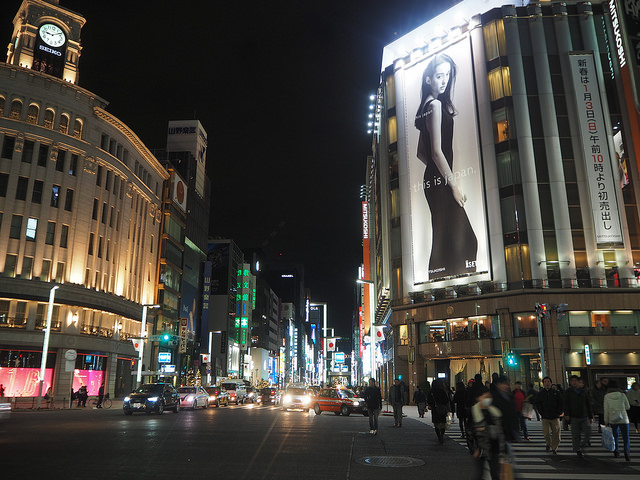
Our apartment is in Nishi (west) Asakusa which is on the northeastern fringe of city center. We arrived last night and took a 13-minute train ride to the famous Ginza area of Tokyo. I read a lot about Ginza in my Visualizing Japan course from Harvard X. It first developed during the Meiji restoration and was a symbol of cosmopolitanism that the government wanted to promote after centuries of isolation. The Shiseido company used Ginza as a central part of its successful marketing campaign in the interwar period. It was not popular with foreigners, as they wanted to see the more “authentic” Japan and the older neighborhoods. Most of the European architecture buildings were destroyed in World War II, but the famous Wako department store building survived. I am reading a lot about World War II lately and can’t imagine that the building was once the American GI RX. It has come a long way since then. The Wako building can be seen in the lead photo on the left.

23991273411_86a634913b_z

The Chanel store in Ginza.

Ginza reminds me of Manhattan with its glitzy window displays and lights. The architecture in Japan is more cutting edge than New York in my opinion and it is a delight for those interested in building design. It is also similar to the Shinsaibashi area on the Midosuji road in downtown Osaka. After a year and half in country, the train lines were not as daunting as before and with my Tokyo train app and our ICOCA cards that work around the country, it was quite easy to get around.

23991271551_a81607be42_z

Louis Vitton window display – Ginza

We found an excellent Mexican restaurant underneath a raised freeway. The Zest Cantina was located with several other restaurants in an underground tunnel of sorts. The homemade guava lemonade and guacamole were absolutely delicious! I recommend the hamburgers as well.

23965722562_d0fdaa8bce_z

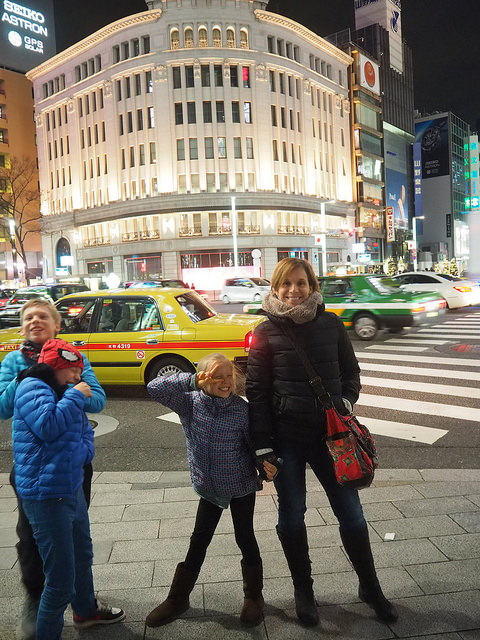
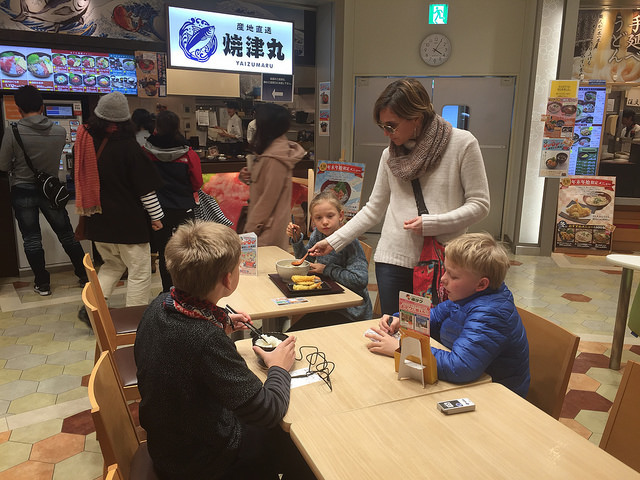
A typical Kralovec family photo – the boys wrestling and the girls posing!

Quirky Japan: Highway Rest Stops

23990519941_26fda9a757_z

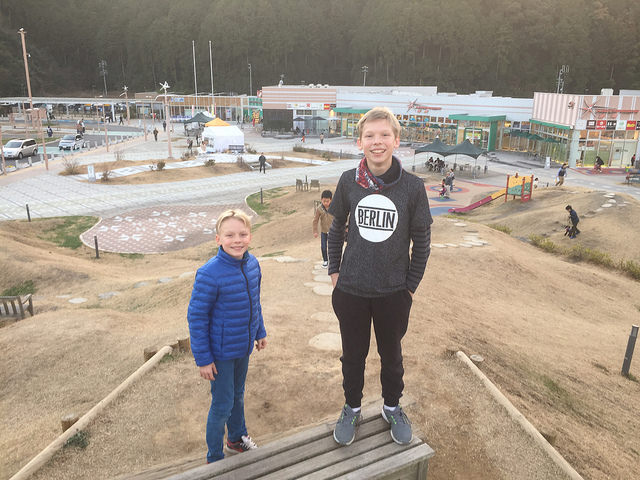
Oliver and Owen on top of the playground hill at a highway rest stop.

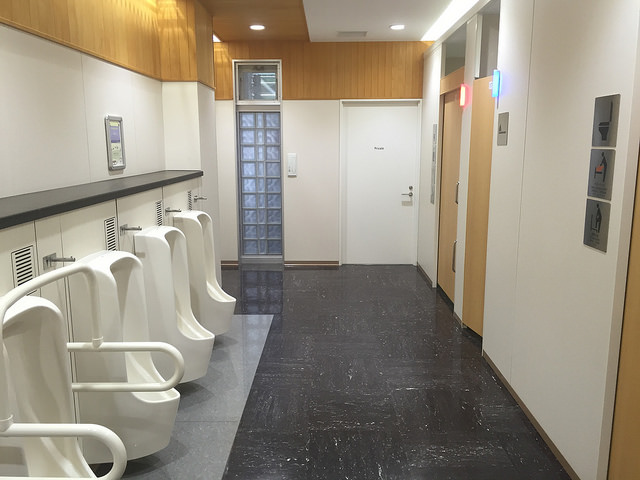
After visiting several highway rest stops in the country, I would say that Japan has the highest quality rest stops in the world. We took a break yesterday in our journey from Osaka to Tokyo. First, the bathrooms are 5-star hotel quality and always clean and modern, as you can see below. Lights indicate if a stall is occupied and there is a lack of odors. I usually look upon using a public bathroom as something to get through, but here, it is a pleasurable experience.

23777444860_f8cdb70e6a_z

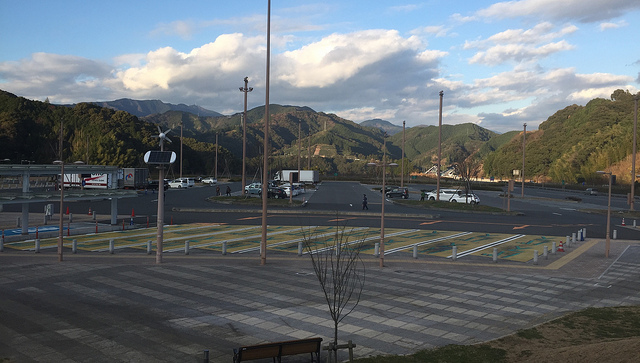
The photos in the post are from the “oasis” or rest stop near Shizuoka, on the Tomei expressway between Nagoya and Tokyo. The food court looked like a shopping mall. In Japan there are very few international or American franchises, so the choices were mostly Japanese cuisine. Lots of shopping also with souvenirs, local crafts and convenience items.

23990523271_6509226791_z

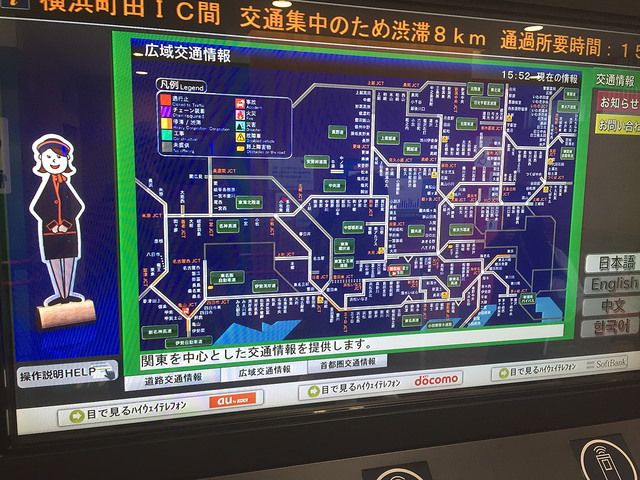
They also had lots of information regarding road conditions and tourist activities. The board below was a touch screen in Japanese and English.

23990525071_3944a38b83_z

The infrastructure for driving is world class in Japan. The expressway was in perfect condition. Because it is a mountainous country, a lesser infrastructure would mean winding, dangerous roads up and down the steep slopes, but here, the expressway goes through via tunnels. Although we didn’t count, there were probably 25-30 tunnels along the way, ranging in length from 100 meters to 5 kilometers. It is good to see my tax money at work. The toll was expensive, it cost us $85 US to travel from Osaka to the outskirts of Tokyo. However, as I get older, I appreciate more road safety and I think of the many lives are saved with better highways. The extra costs go towards protecting citizens. The entrance ramps were all lighted to provide extra visibility. Parking lot attendants direct tired drivers to the most convenient parking spots.

23444901614_ecb9511378_z

Traffic was not bad as I thought, this being a holiday. There were only 5 times where traffic slowed for a few minutes near exchanges. Japan is a densely populated nation with lots of cars, but they manage it smoothly.

Christmas in Japan

Japanese culture has embraced Christmas in a wide, superficial way. Stores are decorated with ornaments, cookies, etc. and Christmas music is played in most places. More than a few homes also have Christmas lights. I don’t think they celebrate exactly as we do. The day itself is not a national holiday which started this Saturday with the New Years celebrations. This is a big break for a hard working culture and most people are on vacation and traveling. As with Halloween, they enjoy the secular aspects of the holiday. I took the video above at a mall in Amerika-mura (American village) section of downtown Osaka on Christmas Eve.

23344927544_73475896ce_z

Christmas chicken at the Hankyu Oasis supermarket

A peculiar aspect of Christmas here is that it has become associated with eating chicken, especially KFC (Kentucky Fried Chicken). I read where it was a successful advertising campaign that started many people eating chicken on Christmas. It also has kind of a romantic feel about here as well, with couples going out for the evening.

23890622931_aaa3ef9fea_z

I saw quite a few santa outfits on people in the street downtown.

Merry Christmas from Japan!

Viewing the White Egret

23308468911_54dfb2e4a9_z

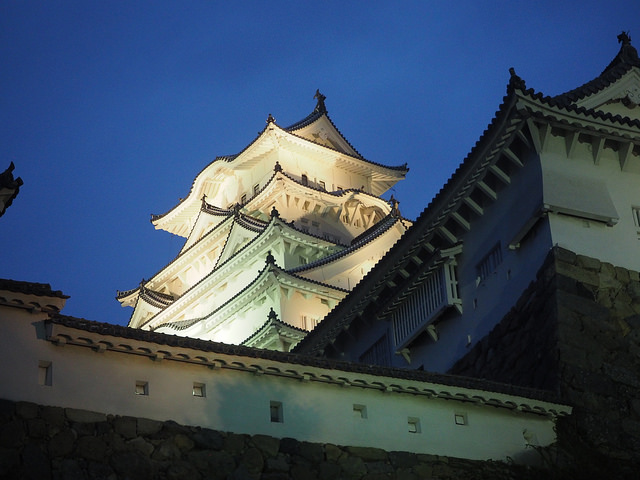
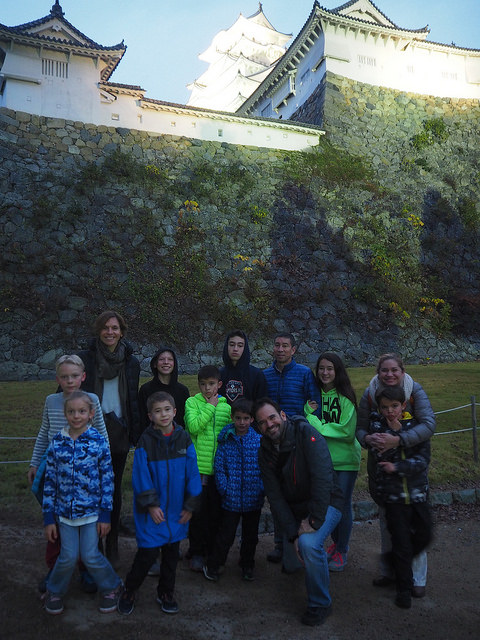
On the way home from Tottori we stopped at the famous Himeji Castle in the Hyogo prefecture. It is an UNESCO world heritage site and the finest example of the classic Japanese feudal period architecture. We arrived too late in the day to enter, but we did admire it from the substantial grounds surrounding it. It is called the “white heron” or “white egret” because with the roof gables give it the appearance of the white bird taking off in flight.

Castles are always funny to me in that people don’t realize all the awful things that took place on the site. They are usually the sites of great battles where men died and if the raid successful, the women and children enslaved. Because it happened so long ago however, people look at them for the architecture and history, but not the tragic human story. Himeji is no exception to this rule and since it was originally built in the 1300s, probably many people died fighting for control of the castle and the town. It is built on a hill and dominates the city.

It is remarkable that it is still standing. During World War II, a bomb landed on the roof but failed to detonate, meanwhile the entire city was destroyed by the allies. It survived the Great Hanshin earthquake of 1995, while once again, many buildings in the city were destroyed. Earlier, it was almost demolished and developed by the locals, but the expense of tearing it down, prevented various parties throughout history from doing so.

I am glad that it remained standing and perhaps if we are in the area, we will return to go inside. We found several geocaches around the castle and despite the rainy night, it was a good time. I want to thank the Tsubaki and Marce families for coming with us!

22762668424_9f5f861d13_z


Daisen National Park

During the fall break we took a few days to visit the prefecture of Tottori and the Daisen-Oki national park. It is my favorite place in Japan (so far) and it was our second visit to the area. We went with two other families from the school community. The kids had a blast, and the adults too!

22693870254_decf5955db_z

photo – Evan, Owen, Bill and Noah at Misen Peak

The highlight for me was the hike on Tuesday. We walked to the 1,709  (5,608 feet) meter high Misen Peak, in the Mount Daisen National Park. Despite fog, rain and cold winds, I had a wonderful day with my family and friends. Much of the pleasure of the hike was taken away by the clouds and fog obscuring the spectacular views to the nearby Sea of Japan. It was made up for me by spending the day outdoors and with my family. Highlights included walking through the gloomy beech forests near the town, with the falling leaves and then leaving the forest past the tree line to the summit. The winds whipping up the face of the mountain and going over at low points on the ridge were amazing to walk through! They were interspersed by quiet areas protected by rocks and bushes. It was a difficult hike with rocky steps mostly going straight up for the 6 miles up and down the trail. Nadia and the rest of the mothers and children made it to the turnaround point, close to the end of the beech forest. Owen and I and the three others went on from there to make the summit. The next day we saw snow on the mountain, so overnight, the icy winds and rain must have turned to snow, shortly after we left the summit. It was about 3 hours walk up and 2 hours walk back. The hot bath at our pension was just what the doctor ordered upon return, and a 2 hour nap!

23026434870_14ab41c14d_z

photo – Although it Daisen looks like Michigan, you don’t get Buddhist shrines in the forest like in Japan.

Daisen mountain has that classic volcano look from the west, but it has not erupted for the past 10,000 years. It has long been the center of worship, with the Daisen-ji temple founded almost 1,300 years ago. Shugendo, an ancient Japanese religion adapting shinto, taoism, buddhism and other beliefs, is practiced here. Adherents seek awakening through understanding the relationship between humans and nature and practitioners do this through denying themselves worldly pleasures and spending a lot of time on the mountain.

23322216625_435c24c609_z

photo – The kids heading up the stairs of the Daisen-ji temple.

It is pretty close to Osaka (2-4 hours) and is a relatively remote, unpopulated part of Japan. The area around the mountain reminds me of the Upper Peninsula of Michigan, so that might be one of the reasons why I love going there.
23322717156_0737827198_z

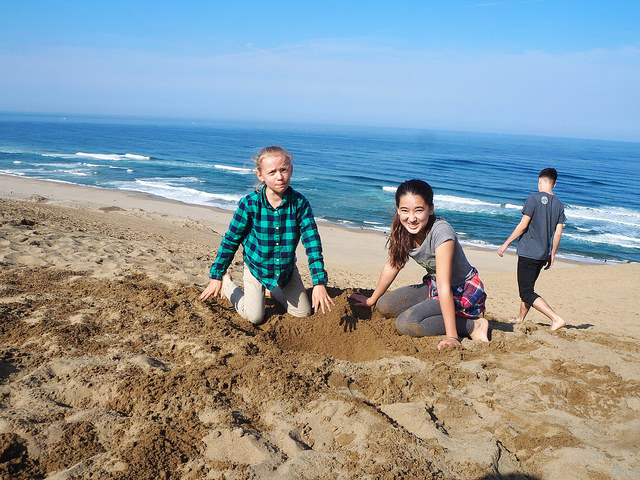
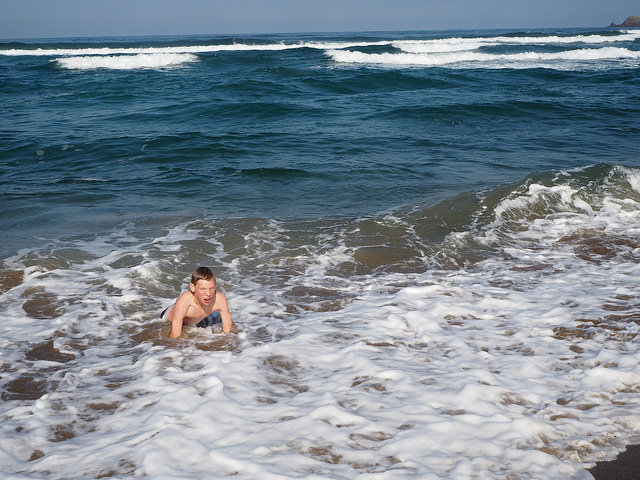
On the other side of the prefecture(state) are the Tottori sand dunes, which we visited the day before. Kids love them! It made for a perfect sunny afternoon. The weather was so nice that a couple of us even went for a swim. The huge dunes were a blast to climb up and sprint down. The crashing waves of the sea were relaxing. It might have been our last warm day of the season, as it is getting cold with the onset of winter.
23240496772_57610e118d_z

The dunes were shaped by winds bringing sand up from the sea. Over 100,000 years of this formed the only large dunes in Japan. Since World War II however, they have been shrinking due to a government reforestation program and tsunami walls further up the coast, changing wind patterns. Today they are 16 kilometers long and 2 kilometers wide.

A wonderful autumn break!

Quirky Japan: Children at Play Signs

22841528780_c4b59b907b_z

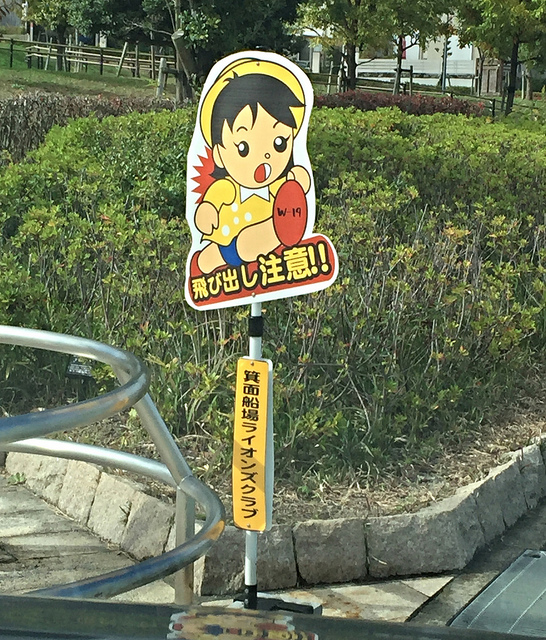
(photo – A sign at a nearby park cautions drivers that children are near)

This is another in my continuing series of “quirky Japan” which covers the little things about life in Japan that makes it distinct.

My brother and I used to joke about the “Slow Children at Play” (see below) that why are government authorities criticizing the speed of kids in a particular park. Did they take 40-yard dash times like in the NFL and deem them slow? I don’t think we consciously realized that they were meant as a warning for drivers to slow down because there is a high probability of children crossing streets or riding their bicycles in the vicinity. As a parent I am now very aware of the purpose of the signs.


ps16

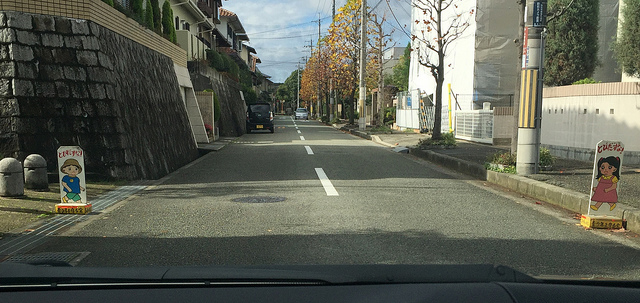
Japan takes these signs to a new level as you can see in the lead photo of this post. Mascots and cartoon figures are very popular here so it makes sense that they could be used instead of the traditional sign in the USA. I think it is much more effective that a street sign because it is so different. There are many different styles of these signs depending on the municipality or school. Below are warning signs at a pedestrian path in my neighborhood.

22841535050_284b34931b_z

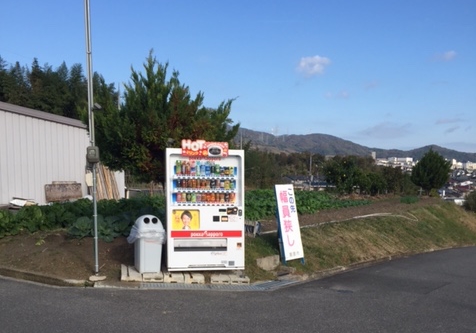
The other aspect I want to feature is the ubiquitousness of vending machines. They are everywhere! There must be thousands of beverage vending machines in the Osaka metropolitan area. I will pay more attention to them and later do a more in depth blog post. I am curious about the economics behind them. How much money do they make? How often do they need to be re-stocked? Do they malfunction often?

My children cannot pass one with out asking me for change. They feature both hot and cold drinks and there seems to be a vast number of different drinks to choose from ranging from teas and coffees, to water, sports drinks, energy drinks, etc. The machine below is on a corner across from the park in our neighborhood. On the other side are rice paddies. They can’t have that many people patronizing the machine. Where does it get electricity from? So many questions…

23173621841_e434be2c22_o


Temples of Japan

After our hike we drove across town just before closing time to walk the grounds of the Temple of the Golden Pavilion in Kyoto (photo above). This is another former villa of a rich shogun which upon his death, was turned into a Zen Buddhist temple. From the photos of the temple, it always looked like it is out in the countryside, but a busy street is in front of the grounds and property is in an urban zone. Arriving 5 minutes before the front gate to the complex closing was excellent timing for photos and lack of crowds. It is a thin coating of gold foil, not made of solid gold. The shoguns loved their ponds and gardens, which made for a stunning reflection in the setting sun.

Temples in Japan are similar to the monasteries in Serbia for me. They are usually located in bucolic settings, which is the attraction, as I don’t seek spiritual things. It is also an insight into the culture of a country and there is always a bit of history. They make for a good destination for a day out and a reason to get out of the house.

The biggest temple in Minoh is the Katsuo-ji  (in Japanese, “ji” means temple) which I’ve blogged about before. It is a nice hike we can do from our house and takes about 4 hours round trip. On my brother’s first day in Japan, we went up through the Minoh quasi national park forest to the temple. Despite the rain, it was a relaxing hike and as you can see from the photo above, the clouds made it even more mystical.

Temples also have attractions for kids. They love to feed the koi, or as I call them, colorful carp. There is also incense and candles to light and reflect on family members, both living and dead. Most have a gong or bell that can be rung and the kids can also get a fortune paper and tie it to the string. At katsuoji, you can also get the Japanese dolls, daruma. We have darumas representing our family under the biggest cedar tree on the property.

Daimon-Ji Mountain Hike

Above is the view from one of the fire platforms that make up the giant kanji symbol dai (great). Every August 16, the platforms are stocked with wood and ignited during the yaki – burning festival. A giant dai can be seen all over Kyoto. During the rest of the year, it makes for an beautiful hike and with my brother here, I took advantage of a gorgeous autumn day and went with him and his wife up the mountain. As you can see, the views over the city were breathtaking.

Taking a break at one of the many viewpoints over the city of Kyoto.

Kyoto has thousands of temples, shrines and historic homes. It was the the  capital of Japan for 1000 years, and unlike most of Japan, it was not destroyed in World War II (thanks to US Secretary of War Henry Stimson) and most of the history is preserved.

The hike starts at Ginkaku-ji or the temple of the Silver Pavilion. It dates back  over 500 years. It was originally the retirement villa of a shogun (hereditary military dictator) and it now is a Zen Buddhist temple. The Zen gardens of rock, trees and streams are serene and it would make a nice retirement pad. The main worship hall is not with silver anymore, but it is relaxing to visit if there are not too many tourists.

The trail is well-marked and we followed the description in the Lonely Planet’s “Hiking in Japan” which I highly recommend. The blue skies and autumn colors made it a glorious day that we will not soon forget.  We didn’t do the entire trail that leads to the “philosopher’s path” but made our way back to the starting point after getting a bit past the burning site.

Harvesting Rice

Owen operating the Mitsubishi VMS 11 rice harvester

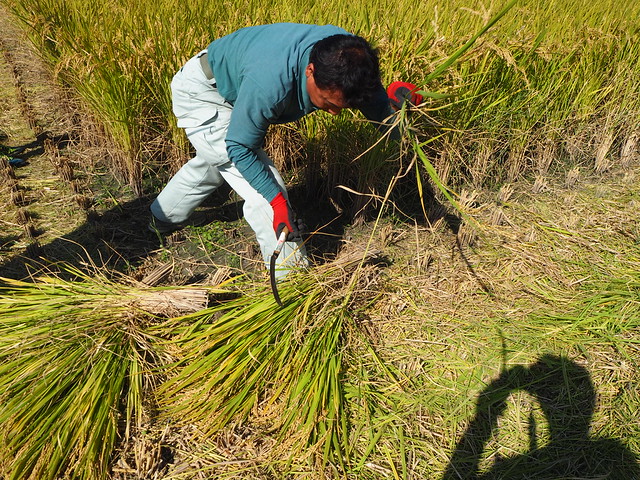
On a perfect autumn morning we got to harvest rice in the nearby Shukonoso neighborhood. Our suburb of Minoh is dotted with paddies and rice is such a central part to the Japanese culture and diet, I always wanted to help out in the harvest. Our CAS coordinator arranged the opportunity through one of her neighbors, Kubo-san. His family have been harvesting rice for the past 800 years, so to say it is a family tradition, is an understatement. Osaka, like many metropolitan areas through the world, has grown immensely to overtake what was once a quiet village, Shukonoso is now part of the city. The families of Shukonoso continue to harvest rice, although, it is not a necessity today. Kubo-san is an expert garden and landscape designer, and told me his family does not make much money from their paddies, but they do it more for tradition than anything. Japan is not a big exporter of rice and the government subsidizes its production. Japanese prefer the short grain, glutinous rice that is good for sushi and chopsticks. My children prefer the this short grain rice, especially when we add the rice vinegar. I prefer the long grain jasmine variety, produced in Thailand.

Kubo-san shows us how to cut the rice bundles.

Kubo was very kind to put up with us wanting to “help”. He showed us how to harvest in the traditional manner, with a sickle. Rice seedlings are planted in bundles and 3-5 bundles are cut and laid on the field at a time. They would then be hung and dried before the grains are pulled. Instead, we fed the rice stalks into the harvester. Kubo then allowed us to drive the harvester along the rows. It was like mowing lawns, slowly going down the rows.

Spending time in the field also gave me the chance to look at the irrigation system. There is an intricate system of reservoirs, damns and canals like a spider web going from the Minoh hills down through the city to the Osaka bay. It makes it easier for the rice seedlings to combat pests and weeds to have them grow in a few inches of water. That system must have been developed over the centuries. I am not sure how it works, but everyone must work together to get the water where it needs to go to at the proper time.

We counted between 44 to 62 seeds per stalk.

The experience gave me a better appreciation of rice and brought me closer to Japan. Thanks to Lyn and Kubo san for allowing Owen and I to participate.

It is funny to me that I eat so much rice now. Growing up in 1970s  rural Michigan in the pre-globalization era, my mother never served rice and we didn’t eat at ethnic restaurants. I really didn’t eat much rice until university and my first international posting in Colombia. Rice is as popular in South America as Asia. We were strictly a “meat and potato” family growing up. We eat rice on an almost daily basis and the staples of my youth, bread/butter and potatoes are rare at the dinner table for the Kralovecs.