Inner City Night Patrol

I got to see another side of Osaka last weekend when I accompanied the students from our school on a community service activity. We went to the Sanno Childrens Center in the poorest ward of Osaka, Nishinari-ku. The ward is infamous in Japan for its crime rates, red light district and homeless. Now this being Japan, a country with one of the lowest violent crime rates in the world, I felt quite safe and yes it did seem a bit run down and not as new and tidy as other parts of the city, but compared to disadvantaged districts in cities in other parts of the world, it is extremely safe.

The Childrens (Kodomo) Center was founded in the 1960s by German missionaries. To this day, it continues to provide after school care and other services for children from the ward. As you can see from the photo above, one of the children the center cares for was fascinated with my European, bald, head. One of the initiatives of the center is a monthly yomoguri or night patrol. Volunteers led by the pugnacious director of the center Mami, lead groups into the streets to deliver food (onigiri – spheres of rice wrapped in seaweed) and blankets to the homeless men sleeping in the streets of the shopping arcades in the district. I was filled with a sense of goodness seeing how grateful and kind the men were in talking with the students, including my 7 year old daughter.

Mami gives us instructions for the patrols and you can see Ocean leaning over the middle of the table.

Within Nishinari-ku is a neighborhood called Kamagasaki. This area is home to many male day laborers, who through a variety of circumstances (gambling, alcohol, mental illness) are homeless. The government forbids the official use of the name and they try to hide media from portraying issues in the area. A recent NHK documentary about the Sanno Childrens Center featured one of the orphans the center cares  for and it has brought increased donations to them. It was sad to see them laying on newspaper with cardboard boxes around them as their only protection against the elements. It gets cold at night in Osaka in November. There are several organizations helping them, including a center to organize them finding short-term manual labor, free or reduced price shelters, etc.

We also walked through Tobita Shinchi, another neighborhood within the ward. Tobita Shinchi is infamous for its red light district. As in Amsterdam, the women are displayed for street view, although here, it is open air and the architecture is old Japan style. They were only protected by an elderly woman minder that sat to the side of them. She yelled at me when I tried to take the photo (see below). The police tolerate prostitution, but again, I felt sorry for the girls, as it is a tough way to make a living.

I was so inspired to help and want to make it a regular part of our experience while we are here. I would like to thank Lyn and Hannah for assisting me and Ocean and introducing us to the center.


Osaka Soul Food: Okonomiyaki

The cool autumn weather has finally arrived here in Minoh. Last night the temperature dipped down into the 40s F (5-7 C) and so we wanted a hot meal. We rode our bikes to a restaurant in our neighborhood called Warai. They specialize in Okonomiyaki. The okonomi part of the word means “as you like it” and yaki means grilled or cooked. This style of food is associated with our Kansai region and a there is a slightly different version in Hiroshima. It is popular throughout the country. It is interesting that I have never seen it featured in Japanese restaurants outside of Japan.

The best thing about these types of restaurants is the hot stove that is seated in the table top and the little spatulas everyone is given. The kids love being able to do some “cooking” but one has to be careful with younger children that they do not burn themselves. The staff brings out various dishes half-cooked and lets patrons finish them on the hot stove. The stove also

The famous pancake of Osaka!

We ordered squid, corn and dumplings as the first course. The second course was the famous Osaka pancake. It is made of flour mixed with cabbage and yam, and either seafood or meat is added. It is topped with super thin fish flakes and you can add Japanese mayonnaise or the signature sauce of okonomiyaki, which is like  Worcestershire sauce. I love them and it is known as the soul food or signature dish of Osaka.

Delicious squid and corn

There are many restaurants that serve Okonomiyaki. Warai is a chain of family-style restaurants and there are over 20 in Osaka and Kobe. It is conveniently located for us and is kid friendly. I am looking forward to comparing the Hiroshima-style pancake.

Nadia and Oliver in front of the restaurant in Onohara.

Visualizing 17 Million People

Looking up at the Umeda Sky Building

One of the biggest adjustments for me in our move to Japan is living in a very large city. The metropolitan area of Osaka – Kobe – Kyoto has a population of over 18 million people. That is larger than Moscow, Cairo, Los Angeles, and Bangkok and ranks #14 in the world, just below Mumbai. The three cities are known as Keihanshin and the GDP of this area is roughly the same as London or Paris. There is a lot of people here and a lot of money. The most populous metro area in the world is Tokyo with almost 40 million people. It has a population density higher than Bangladesh. I will certainly be exploring Tokyo in future visits.

The view towards Osaka Bay from the top of the building

Although we live in a big metro area, we do not feel it on a daily basis. The school is located in the suburb of Minoh, which is 17 kilometers (10.5 miles) from the city center. By train it is about 20 minutes. We live only a few blocks away and it is about a 5-minute walk to school. Minoh is full of parks, wide sidewalks, bike paths, and is minutes away from the forested hills of a “quasi national park” so one gets the impression of living in the suburbs of any city. The only time we get a sense of the vastness of Keihanshin is when we take the train into the center or go over to Kobe. The apartments, houses, and businesses go on endlessly.

Our goal yesterday was to get to the top of the Umeda Sky Building. This is an Osaka landmark, built by Toshiba in 1993. During the heady real estate boom of the late 1980s they had originally wanted 4 interconnected towers, but only built two. In between the two towers at the top, there is an outdoor observatory, an escalator on one of the top floors leading across the open space, and modern sitting area with restaurants and cafes. The views are spectacular. They really helped me see how big Keihanshin really is. It goes on forever with hundreds of skyscrapers, all the way out to the Osaka Bay. Around the Sky Building, there are some parks, wide walkways filled with cafes, restaurants, and shops. It is very pleasant, except when one gets closer to the Umeda train station, as there are too many people for my taste in that station.

The garden next to the Umeda Sky building

We had dinner in the basement floor of restaurants. In Japan, it is common for entire floors of buildings or train stations to be devoted to restaurants and bars. There were probably 20 different restaurants to choose from. We chose an Indian restaurant and it was really good. I recommend a visit to the building. The architecture is interesting, it is a really nice area, and the views, especially at night or at sunset are beautiful. It gives one a good sense of the layout of the city.

Growing up in a small town of 900 people in a very rural and isolated part of northern MIchigan, living in a city that has twice as many people as the state of Michigan, is going to take some getting used to. In some of my previous postings overseas, I have lived in cities of around 2 million (Perth, Santa Cruz, Barranquilla, Belgrade) but never this big.

View looking towards our house – Yodo River in foreground

Our Stay at a Ryokan

The kids thought they were ninjas!

This week we have family and friends visiting us from China and Yemen. We wanted to give them, and us, a Japanese experience so we stayed last night at a traditional ryokan hotel in nearby Kyoto. You sleep on tatami mats, wear robes, use the public bath and eat Japanese cuisine. It was one of the most memorable nights I’ve had, and I highly recommend this different experience for everyone. It is a bit expensive, but worth it as a special treat or if you really want to experience old Japanese life.

The robes were hilarious and we were asked to change immediately by hotel staff. The kids thought they were ninjas or geishas and it was a bit like halloween. The bath was another interesting experience. Japanese bathe naked publicly, something that does not happen in the USA.  They are segregated between males and females. The boys wore their trunks because they were shy, but Jim and I went as the locals did. The bath had the squatting shower, three temperature pools, a sauna, and facilities for shaving, etc. It was really relaxing and reminded me of the European spas. The meal was traditional, with the tables near the floor and diners on the pillows. There were multiple courses and many of the dishes, we didn’t know what they were. At night we went for a walk in the old streets of Kyoto and saw the big temple nearby all lit up. When we came back to the room, the futon mats were laid out for us. The staff was superbly friendly and at our service, despite the language barrier.

There are many different kinds of ryokans and we will definitely stay again. We stayed at the Hotel Riozen, which was a mid-level price range in a great location.  A big thank you to Masago Sensei for the recommendation and to Jim for arranging the transport! Domo arigato!

Book Review: “South of the Border, West of the Sun” Murakami

Haruki Murakami is one of the most popular and best known Japanese contemporary authors. His books are best sellers in Japan and are regularly translated and sold around the world. He was born in Kyoto and now lives in Tokyo.

His short novel, “South of the Border, West of the Sun” is the story of the love life of Hajime, an average man born in 1951 in Tokyo. He grew up in nearby Kobe and his mother is from Osaka. The novel traces his life from grade school and his first love when he was 12, to middle age and his marriage and children, and the affairs in between. The narrator owns two jazz bars, like Murakami himself did, and is wrestling with his emotions when meeting his first girlfriend years later, when he is happily married, a successful career, and two healthy daughters. Does he throw all that away, divorce, to be with his old flame? I’ll let you read the book to find out what happens.

The title refers the song, “South of the Border” made famous by Frank Sinatra, and “West of the Sun” refers to Siberian farmers go stir crazy and start walking west on the steppe, and keep walking until they die of thirst and/or exhaustion.

It is a good story and hard to put down. Murakami has a very negative and fatalistic view of life in this book, and other short stories I have read by him. I also didn’t like how secretive the ex-girlfriend was and I don’t think anyone involved with her would tolerate not knowing if she was married and what she did for a living. It does give an accurate picture of life in Japan and after living here a month, I can relate to more of the references in the book. His latest book,Tsukuru Tazaki was a best seller in Japan and is now out in English and he talks about the book in this article in The Guardian.

I always read the local authors in the places I live and will read more of his work. I want to read some of his non fiction works about the sarin gas attacks. It gives me a better understanding of the culture of Japan.

The Times Square of Osaka: Dotonbori

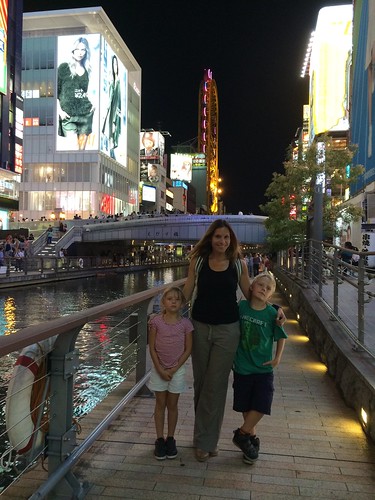
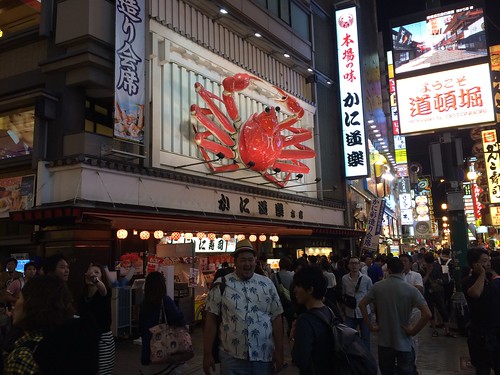
Last night we ventured to the heart of Osaka to the famous neighborhood of Dotonbori. This is the crazy stereotypical urban Japan at its finest, with huge neon billboards, throngs of people, deep-fried octopus dumplings, steaming ramen restaurants, crazy fashion and futuristic designed buildings.

Yasui Doton designed this area as an entertainment hub over 500 years ago. HeThe entrepreneur dredged a canal (bori comes from hori, to dig) of the tiny Umezu River. The area was always zoned for entertainment and originally was a theatre district, the last theaters being destroyed in WWII.

Dotonbori today reminded me of a nicer Times Square. The canal at night is surprisingly peaceful, despite the tour boats passing by and the thousands of shoppers and eaters passing overhead. The number of shops are restaurants must number in the thousands. As it was our first time, we were a bit overwhelmed and with the kids being a bit tired, we struggled in finding a suitable restaurant for a family of 5.

The canal of Dotonbori

There are several icons of Osaka, which is the food capital of Japan. Above the restaurants there is a  giant mechanical crab, octopus, and fugu fish, all advertising the cuisine of Osaka. We stopped to take photos in front of  the Glica Running Man, which is a symbol of Osaka. The giant neon sign was taken down by the candy company Glica, and in its place is a regular billboard portraying a running girl. They did have a small version of the original for tourist. The buildings in Osaka are amazing. The designs and lighting are futuristic and sometimes you feel like you are in a sci fi movie like Blade Runner.

Ocean and Nadia in front of the Glica Running Man

Dotonbori is located just outside the Namba Station, one of the hubs of the Osaka train system. It is certainly exotic and if you are not bothered by crowds, it is a good night out. We will go back again now that we know the place a bit, and sample some more of the Osakan cuisine.

Moving In

Will all this stuff fit! (Yes it did)

We have been here for almost a month and finally starting to feel settled in. With the jet lag (14 hour time difference) and large language and cultural differences, Japan is a difficult place to get used to. I really enjoy experiencing new things and thought the process has been fun. Nadia, and to some degree Owen, have a different personality and have been more challenged with the culture shock and language barrier. Oliver and Ocean made an easy transition, much in part due to their younger age.

Japan is extremely organized and has a culture that values order, tidiness, and documentation. This made finding a house, setting up bank accounts, phones, internet, etc. all the more time consuming. One by one, however, we knocked down the list of errands we needed to do and we are at the point now, of almost settling in to a routine. A few advice points for newcomers to the OIS Community that we learned:

1) IKEA has the best prices for furniture and household goods. It is not too difficult to get to the store, as they have a free shuttle from the Namba Station, one of the major hubs of the Osaka Train Network.

2) Nitori is close by and good for futons (Japanese beds) and kitchen ware, although, is more expensive than IKEA.

3) Be careful with the internet from a wireless satellite provider like Wi Max. It depends on your apartment or house. If there are big buildings near by or you are on a lower floor, the connection speed will be slower. If you want a guaranteed connection, go with a cable version, although you will have to wait for 1-3 weeks.

Some Japanese furniture is low to the ground.


4) You need to get an address first, before being able to get a phone, bank account, etc, therefore your energies will be focused on finding a place to live.

5) Shinsei Bank is the best because they have English service and on line English service.

6) The Minoh local government is full of good resources for newcomers and you should visit the MAGFA Community Center early from your arrival if you live near the school. They have free Japanese lessons, cooking classes, a restaurant, and many other events.

7) The Kansai Scene is a great English-language resource for things to to in the Osaka/Kobe/Kyoto metro region.

8) Ask veteran expats and locals at the school lots of questions, from who is the best cell phone provider to where can you buy good cheap vegetables.

9) The Japanese want to be helpful and will try to do their best to assist you, language barriers aside. The percentage of English speakers is low, but we always found someone who speaks enough to get us through our predicament. Someone always comes to the rescue when sorting out trains, shopping, etc. People in Osaka are very empathetic to newcomers.

Nadia and Ocean at the steps to the promised land!

Thank god I brought my tool kit that my Dad and brother Andy, bought me five years ago. It really helped in assembling shelves and tables we bought from Nitori.


A Samuri With a Tender Heart

Minoh City Icons

We are finally starting to settle into a rhythm of life here in Japan. This is our first time in Asia and it all has been so overwhelming different. Everything we see or experience I want to find out more about. Where do I start blogging?

We live in the suburb of Minoh which is about a 30-minute drive from downtown Osaka. It is on the edge of the huge metropolitan area that surrounds the flat plains ringing the Bay of Osaka. Kobe, Kyoto and Osaka form a distinct metro region with close to 19 million people. Here in Minoh however, it doesn’t feel like that at all. The suburb has a lot of parks and bike/running trains, and the Hokusetsu Mountains form a backdrop for our views. The forested mountain area is a national park and only a 10-minute bike ride away from our house. (more on that later)

On a visit to the Minoh City offices to register as a resident, I noticed this cartoon mascot figure that looks like a samuri orange in the courtyard of the office complex (below) He is the famous Takinomichi Yuzuru, and is a promotional mascot for Minoh City. A yuzu is a variety of citrus fruit (a cross between a sour mandarin and a lemon-like citrus fruit) that is grown from seed in Minoh. The process takes 15-18 years of careful tending, but the taste of the fruit of the mature tree from seed is much better than by grafting. The village of Todoromi in the north of Minoh is famous for growing yuzu. I really have to get up there to see it myself.

Yuzuru is everywhere in Minoh: on buses, flyers, signs, and on the plaque near the main street in the photo at the top of the blog post. The people of Minoh say he is the samuri with a tender heart and if you pat his eyebrows when you see him, it is supposed to bring you luck! I also notice he has a girlfriend mascot, a pinkish Hello Kitty figure. I need to figure out her name.

The Calm Before the Storm

Update: The typhoon passed quickly by Japan, crossing the island in few hours. Here is a short video of the peak winds and rain from the lobby of our hotel. There were a few branches down and everything got very soggy, but overall, it was just a bad storm and nothing exceptional. The family slept through most of it, battling jet lag. 


Courtesy of Japan Meteorological Agency

We arrived in Osaka a couple of hours ago and are cozy in our hotel. We got in just in time as many flights are being cancelled due to Typhoon Halang which will hit the Japanese mainland in a couple of hours. As you can see from the screen shot above, Osaka is located at the tip of the arrow. Halang, with winds gusting up to 180 km/hour is between a Category 2 and 3 on the Saffir-Simpson Hurricane Scale. That means there will be heavy rains and winds, and expect some trees and wires to fall. The weather was quite cool with a nice breeze upon our exit from the airport, which is one of the nice things – the heat and humidity of the Japanese summer has dissipated, at least for the weekend.

We are very tired after the 14-hour flight. I’ll try to take some video tomorrow if possible as it is almost 11:00 PM here in Osaka. The Japan Meteorological Agency has an excellent website in English which I will be checking often during my stay here. It also covers earthquakes, weather, and ocean data.

Good night and we’ll see what tomorrow will bring.


“How To Japan: A Tokyo Correspondent’s Take”

I am preparing for our move to Japan by reading as much as I can about the country. During the flights to South America, I read, “How to Japan: A Tokyo Correspondent’s Take” by Colin Joyce (2009 NHK Publishing) He is an English journalist and worked for the Daily Telegraph and Newsweek Japan Magazine and lived in Tokyo for over 15 years. The book is explaining Japan for Westerners, but was first published in Japanese for the local market in 2006. This is the English translation of the book.

The author’s love for Japan shines through and it gives insights into the culture from someone who has lived there for a long time. As with all foreign correspondents, his personality and personal tastes color the topics and views expressed. I liked him being touched by the politeness, empathy, pride, and sense of community most Japanese express in their daily lives. He was truly changed by his experience and I hope to be influenced as well.

There are some things I learned from his observations that I will definitely be thinking about when I live there. He loved going to the public baths (sento) and I recall the spas of the Baltics that I enjoyed, so I will be checking these out. Joyce also pointed out the well-thought out design of things, ranging from way people read a newspaper to the actual book, which is small to be portable and cheaply made, which is savings for the consumer, and not to have Western publishers “adding value” (greed) to books with fancy covers and hard covers that add to the price of books. I also learned that Japanese are “foodies” and appreciate and discuss food in detail and seriousness.

The two best chapters in the book are “Gaijin Dilemmas” and “Letter to an Incoming Correspondent”. The first applies to all expats, and the eternal question of how much of the new culture does one adapt to their own life. He suggests moderation and not to “go native” or to culturally isolate oneself, but to adapt some things and question others. He gives several examples of choices one has to make when put in a situation that the culture dictates one acts contrary to the home culture. In the last chapter, he gives some great advice to his replacement. These are as follows:

• buy slip-on shoes, which will save loads of time when entering/leaving Japanese homes.
• learn 20 words before you come, he suggests adjectives like oishii, atsui, natsukachii, sugoi, kirei, omoshiroi, – the people will appreciate it.
• honne and tatemae – the gap between what people actually think and what people actually tell you
• In England, you probably try to own as much stuff as possible, in Japan, this urge must be tempered by rigorous reference to how much space you have in your apartment.
• Japanese people in a Japanese company can’t leave without doing hours of overtime, you can.
• Don’t swim after mid-August, because the jellyfish stings last for months; walking and eating is considered rude

Basil Hall Chamberlain (19th century British Japanologist) “Do not fail to write down your first impressions as soon as possible. They are evanescent, you know; they will never come to you again, once they have faded out; and yet of all the strange sensations you may receive in this country you will feel none so charming as these”