Visualizing 17 Million People

Looking up at the Umeda Sky Building

One of the biggest adjustments for me in our move to Japan is living in a very large city. The metropolitan area of Osaka – Kobe – Kyoto has a population of over 18 million people. That is larger than Moscow, Cairo, Los Angeles, and Bangkok and ranks #14 in the world, just below Mumbai. The three cities are known as Keihanshin and the GDP of this area is roughly the same as London or Paris. There is a lot of people here and a lot of money. The most populous metro area in the world is Tokyo with almost 40 million people. It has a population density higher than Bangladesh. I will certainly be exploring Tokyo in future visits.

The view towards Osaka Bay from the top of the building

Although we live in a big metro area, we do not feel it on a daily basis. The school is located in the suburb of Minoh, which is 17 kilometers (10.5 miles) from the city center. By train it is about 20 minutes. We live only a few blocks away and it is about a 5-minute walk to school. Minoh is full of parks, wide sidewalks, bike paths, and is minutes away from the forested hills of a “quasi national park” so one gets the impression of living in the suburbs of any city. The only time we get a sense of the vastness of Keihanshin is when we take the train into the center or go over to Kobe. The apartments, houses, and businesses go on endlessly.

Our goal yesterday was to get to the top of the Umeda Sky Building. This is an Osaka landmark, built by Toshiba in 1993. During the heady real estate boom of the late 1980s they had originally wanted 4 interconnected towers, but only built two. In between the two towers at the top, there is an outdoor observatory, an escalator on one of the top floors leading across the open space, and modern sitting area with restaurants and cafes. The views are spectacular. They really helped me see how big Keihanshin really is. It goes on forever with hundreds of skyscrapers, all the way out to the Osaka Bay. Around the Sky Building, there are some parks, wide walkways filled with cafes, restaurants, and shops. It is very pleasant, except when one gets closer to the Umeda train station, as there are too many people for my taste in that station.

The garden next to the Umeda Sky building

We had dinner in the basement floor of restaurants. In Japan, it is common for entire floors of buildings or train stations to be devoted to restaurants and bars. There were probably 20 different restaurants to choose from. We chose an Indian restaurant and it was really good. I recommend a visit to the building. The architecture is interesting, it is a really nice area, and the views, especially at night or at sunset are beautiful. It gives one a good sense of the layout of the city.

Growing up in a small town of 900 people in a very rural and isolated part of northern MIchigan, living in a city that has twice as many people as the state of Michigan, is going to take some getting used to. In some of my previous postings overseas, I have lived in cities of around 2 million (Perth, Santa Cruz, Barranquilla, Belgrade) but never this big.

View looking towards our house – Yodo River in foreground

My First Ride on the “Bullet Train”

On Sunday I took my first ride on the Shinkansen or in English it is known as the bullet train, from Osaka to Tokyo and back. Shin means new in Japanese, although the high speed train is celebrating 50 years of service in Japan. It was very easy to get a ticket and get on the train. The train left from one of the major stations on the daily commuter train line, Shin-Osaka, and with 16-car trains leaving every 10 minutes, it was easy to buy a ticket moments before getting on the train. The return ticket was a bit expensive, around $250, but getting to Tokyo, a 5 and 1/2 hour car ride in 2 and 1/2 hours, is worth it. Especially with Tokyo traffic! The 3-hour mark is the cut-off for convenience over flights, and considering getting taxis, baggage, check-in, etc. it is the easiest method of going between Osaka and Tokyo.

The ride was comfortable, with much more leg room than a plane and my seat had a pull down table and electric charger. I struggled with reading or getting work done however, as the train did shake a bit and it made me a little motion sick. The outside scenes whir by and you can tell how fast the train is going. They can reach speeds of up to 150-200 miles per hour (320 km/hr).

The shinkansen has lines connecting the big cities on the two central islands of the Japan archipelago.  They had planned to expand it to Hokkaido and further south, but those have been postponed. Around 150 million passengers per year take the line between Osaka and Tokyo. The train uses only 16% of the carbon of a car, so it is good for the environment.

Kyoto: Where Japanese Come to Experience Japan

Kyoto was the capital of Japan for over a thousand years. The allies in World War II also avoided bombing the historic city, hence, it is a place full of old, beautiful temples, shrines, and traditional Japanese architecture. It is about an hour’s drive from Osaka, and makes up 1/3 of the tri-city metro area that includes Osaka and Kobe. We spent the weekend in a traditional ryokan near the Kiyomizu Temple and really enjoyed the experience. We were surprised to see so many Japanese people dressed in kimonos. They also come to Kyoto to experience their own culture. Japan is a very modern country and most of the cities look and feel like western suburbs. The hills of Kyoto are the exception and there are literally thousand of Buddhist and Shinto shrines and temples. We only scratched the surface of what Kyoto has to offer.

Owen in front of the soldier memorial

The girls, Nadia, Ale, and Ocean were a big hit with their kimonos. People were asking to get their picture taken with them, as you can see above. The Kiyomizu Temple is one of the biggest tourist attractions and was great for the kids. There is a lot to do and see in the compound, much of it a bit kitschy, like drinking the water of the waterfall to get your wish to come true, fortune telling, etc. I do need to read up on Buddhism to understand fully what is going on at the temples.

It got crowded in the afternoon and we were starting to feel a bit uncomfortable with the amount of hustle and bustle. The girls loved the shopping. We got away from the crowds and visited the unknown soldier memorial and watched a local music concert while they finished their shopping. I highly recommend seeing Kyoto and spending a few days. The temples vary quite a lot so there is something for everyone.

Our Stay at a Ryokan

The kids thought they were ninjas!

This week we have family and friends visiting us from China and Yemen. We wanted to give them, and us, a Japanese experience so we stayed last night at a traditional ryokan hotel in nearby Kyoto. You sleep on tatami mats, wear robes, use the public bath and eat Japanese cuisine. It was one of the most memorable nights I’ve had, and I highly recommend this different experience for everyone. It is a bit expensive, but worth it as a special treat or if you really want to experience old Japanese life.

The robes were hilarious and we were asked to change immediately by hotel staff. The kids thought they were ninjas or geishas and it was a bit like halloween. The bath was another interesting experience. Japanese bathe naked publicly, something that does not happen in the USA.  They are segregated between males and females. The boys wore their trunks because they were shy, but Jim and I went as the locals did. The bath had the squatting shower, three temperature pools, a sauna, and facilities for shaving, etc. It was really relaxing and reminded me of the European spas. The meal was traditional, with the tables near the floor and diners on the pillows. There were multiple courses and many of the dishes, we didn’t know what they were. At night we went for a walk in the old streets of Kyoto and saw the big temple nearby all lit up. When we came back to the room, the futon mats were laid out for us. The staff was superbly friendly and at our service, despite the language barrier.

There are many different kinds of ryokans and we will definitely stay again. We stayed at the Hotel Riozen, which was a mid-level price range in a great location.  A big thank you to Masago Sensei for the recommendation and to Jim for arranging the transport! Domo arigato!

Noh Theatre: Ancient Japanese Opera

Last weekend I got to see a short Noh play during the 125th celebration ceremony at Kwansei Gakuin University. They were opening the new auditorium and they had an Oscars like ceremony, with lots of music and lights between speeches.

The most unusual aspect of the ceremony was the ancient Japanese theatre form called Noh. This started over 800 years ago and is very traditional without innovation so it was like going back in time. It was strange to watch! The chorus sang in few tones and in character. The two women in the front row had solo parts and they sang in a deep voice, but forced. The music ensemble consisted of a primitive flute and these drummers making the oddest noises with their voices while occasionally beating on the drum.

This group wrote an original play, which is rare in the Noh art form as they have a traditional list of around 250 plays. The play was based on the founding of the university by American Methodist missionary, Charles Lambuth. 125 years ago he started a school in Kobe and it has now grown to over 24,000 students from K-12 schools to graduate university programs.

I am glad the university put Noh into the ceremony. It is a distinctly Japanese art form and those isolationists, the Tokugawas, had it be the official theatre form of the their court. I can’t say it was entertaining, but it was fascinating. I couldn’t understand the weird vocal grunts and what appeared to be random beats of the drum.

There must be something to it because it is still performed today and there are theatres in Tokyo and Osaka dedicated to Noh. I am not sure if I will give it another try, but it was an experience and gave me a better understanding of Japan.

Book Review: “South of the Border, West of the Sun” Murakami

Haruki Murakami is one of the most popular and best known Japanese contemporary authors. His books are best sellers in Japan and are regularly translated and sold around the world. He was born in Kyoto and now lives in Tokyo.

His short novel, “South of the Border, West of the Sun” is the story of the love life of Hajime, an average man born in 1951 in Tokyo. He grew up in nearby Kobe and his mother is from Osaka. The novel traces his life from grade school and his first love when he was 12, to middle age and his marriage and children, and the affairs in between. The narrator owns two jazz bars, like Murakami himself did, and is wrestling with his emotions when meeting his first girlfriend years later, when he is happily married, a successful career, and two healthy daughters. Does he throw all that away, divorce, to be with his old flame? I’ll let you read the book to find out what happens.

The title refers the song, “South of the Border” made famous by Frank Sinatra, and “West of the Sun” refers to Siberian farmers go stir crazy and start walking west on the steppe, and keep walking until they die of thirst and/or exhaustion.

It is a good story and hard to put down. Murakami has a very negative and fatalistic view of life in this book, and other short stories I have read by him. I also didn’t like how secretive the ex-girlfriend was and I don’t think anyone involved with her would tolerate not knowing if she was married and what she did for a living. It does give an accurate picture of life in Japan and after living here a month, I can relate to more of the references in the book. His latest book,Tsukuru Tazaki was a best seller in Japan and is now out in English and he talks about the book in this article in The Guardian.

I always read the local authors in the places I live and will read more of his work. I want to read some of his non fiction works about the sarin gas attacks. It gives me a better understanding of the culture of Japan.

MS Baseball Season Continues

The SOIS Sabers Middle School B Baseball Team travelled across the bay on Saturday to take on the Canadian Academy Falcons from Kobe. The Falcons started with an early 4-0, but going into the last inning, they were down 5-12. They scored 7 runs in the last inning to tie the game and it ended in a 12-12 draw. The Sabers pitching staff couldn’t find the strike zone in the last inning, and the CA batters were not swinging and going for walks, which was a good strategy for them. A controversial umpire’s call in that fateful last inning kept CA’s hopes alive, and they came through with the tying run. In the end, it was a grounder back to the pitcher, Owen Kralovec, who tagged the runner out at third to end the game.

Owen Playing First Base

Myong Jun Kim tripled and pitched well in the middle innings. Misishi homered in the game and was voted MVP by the coaches We enjoyed the sunny weather and camaraderie and I would like to thank Coach Fukushima for his help in getting us there and his cultural insights.


The Times Square of Osaka: Dotonbori

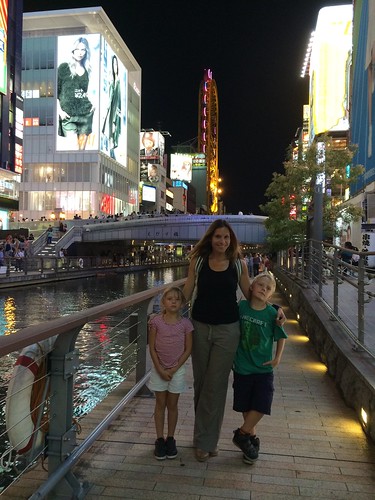
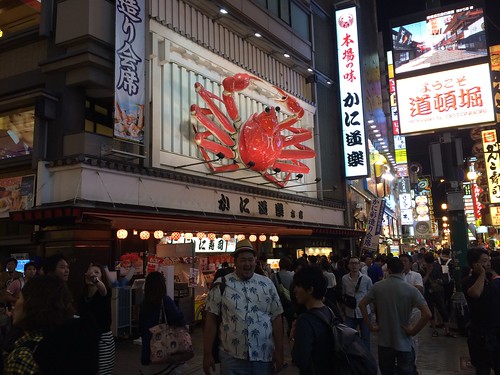
Last night we ventured to the heart of Osaka to the famous neighborhood of Dotonbori. This is the crazy stereotypical urban Japan at its finest, with huge neon billboards, throngs of people, deep-fried octopus dumplings, steaming ramen restaurants, crazy fashion and futuristic designed buildings.

Yasui Doton designed this area as an entertainment hub over 500 years ago. HeThe entrepreneur dredged a canal (bori comes from hori, to dig) of the tiny Umezu River. The area was always zoned for entertainment and originally was a theatre district, the last theaters being destroyed in WWII.

Dotonbori today reminded me of a nicer Times Square. The canal at night is surprisingly peaceful, despite the tour boats passing by and the thousands of shoppers and eaters passing overhead. The number of shops are restaurants must number in the thousands. As it was our first time, we were a bit overwhelmed and with the kids being a bit tired, we struggled in finding a suitable restaurant for a family of 5.

The canal of Dotonbori

There are several icons of Osaka, which is the food capital of Japan. Above the restaurants there is a  giant mechanical crab, octopus, and fugu fish, all advertising the cuisine of Osaka. We stopped to take photos in front of  the Glica Running Man, which is a symbol of Osaka. The giant neon sign was taken down by the candy company Glica, and in its place is a regular billboard portraying a running girl. They did have a small version of the original for tourist. The buildings in Osaka are amazing. The designs and lighting are futuristic and sometimes you feel like you are in a sci fi movie like Blade Runner.

Ocean and Nadia in front of the Glica Running Man

Dotonbori is located just outside the Namba Station, one of the hubs of the Osaka train system. It is certainly exotic and if you are not bothered by crowds, it is a good night out. We will go back again now that we know the place a bit, and sample some more of the Osakan cuisine.

Moving In

Will all this stuff fit! (Yes it did)

We have been here for almost a month and finally starting to feel settled in. With the jet lag (14 hour time difference) and large language and cultural differences, Japan is a difficult place to get used to. I really enjoy experiencing new things and thought the process has been fun. Nadia, and to some degree Owen, have a different personality and have been more challenged with the culture shock and language barrier. Oliver and Ocean made an easy transition, much in part due to their younger age.

Japan is extremely organized and has a culture that values order, tidiness, and documentation. This made finding a house, setting up bank accounts, phones, internet, etc. all the more time consuming. One by one, however, we knocked down the list of errands we needed to do and we are at the point now, of almost settling in to a routine. A few advice points for newcomers to the OIS Community that we learned:

1) IKEA has the best prices for furniture and household goods. It is not too difficult to get to the store, as they have a free shuttle from the Namba Station, one of the major hubs of the Osaka Train Network.

2) Nitori is close by and good for futons (Japanese beds) and kitchen ware, although, is more expensive than IKEA.

3) Be careful with the internet from a wireless satellite provider like Wi Max. It depends on your apartment or house. If there are big buildings near by or you are on a lower floor, the connection speed will be slower. If you want a guaranteed connection, go with a cable version, although you will have to wait for 1-3 weeks.

Some Japanese furniture is low to the ground.


4) You need to get an address first, before being able to get a phone, bank account, etc, therefore your energies will be focused on finding a place to live.

5) Shinsei Bank is the best because they have English service and on line English service.

6) The Minoh local government is full of good resources for newcomers and you should visit the MAGFA Community Center early from your arrival if you live near the school. They have free Japanese lessons, cooking classes, a restaurant, and many other events.

7) The Kansai Scene is a great English-language resource for things to to in the Osaka/Kobe/Kyoto metro region.

8) Ask veteran expats and locals at the school lots of questions, from who is the best cell phone provider to where can you buy good cheap vegetables.

9) The Japanese want to be helpful and will try to do their best to assist you, language barriers aside. The percentage of English speakers is low, but we always found someone who speaks enough to get us through our predicament. Someone always comes to the rescue when sorting out trains, shopping, etc. People in Osaka are very empathetic to newcomers.

Nadia and Ocean at the steps to the promised land!

Thank god I brought my tool kit that my Dad and brother Andy, bought me five years ago. It really helped in assembling shelves and tables we bought from Nitori.


A Samuri With a Tender Heart

Minoh City Icons

We are finally starting to settle into a rhythm of life here in Japan. This is our first time in Asia and it all has been so overwhelming different. Everything we see or experience I want to find out more about. Where do I start blogging?

We live in the suburb of Minoh which is about a 30-minute drive from downtown Osaka. It is on the edge of the huge metropolitan area that surrounds the flat plains ringing the Bay of Osaka. Kobe, Kyoto and Osaka form a distinct metro region with close to 19 million people. Here in Minoh however, it doesn’t feel like that at all. The suburb has a lot of parks and bike/running trains, and the Hokusetsu Mountains form a backdrop for our views. The forested mountain area is a national park and only a 10-minute bike ride away from our house. (more on that later)

On a visit to the Minoh City offices to register as a resident, I noticed this cartoon mascot figure that looks like a samuri orange in the courtyard of the office complex (below) He is the famous Takinomichi Yuzuru, and is a promotional mascot for Minoh City. A yuzu is a variety of citrus fruit (a cross between a sour mandarin and a lemon-like citrus fruit) that is grown from seed in Minoh. The process takes 15-18 years of careful tending, but the taste of the fruit of the mature tree from seed is much better than by grafting. The village of Todoromi in the north of Minoh is famous for growing yuzu. I really have to get up there to see it myself.

Yuzuru is everywhere in Minoh: on buses, flyers, signs, and on the plaque near the main street in the photo at the top of the blog post. The people of Minoh say he is the samuri with a tender heart and if you pat his eyebrows when you see him, it is supposed to bring you luck! I also notice he has a girlfriend mascot, a pinkish Hello Kitty figure. I need to figure out her name.