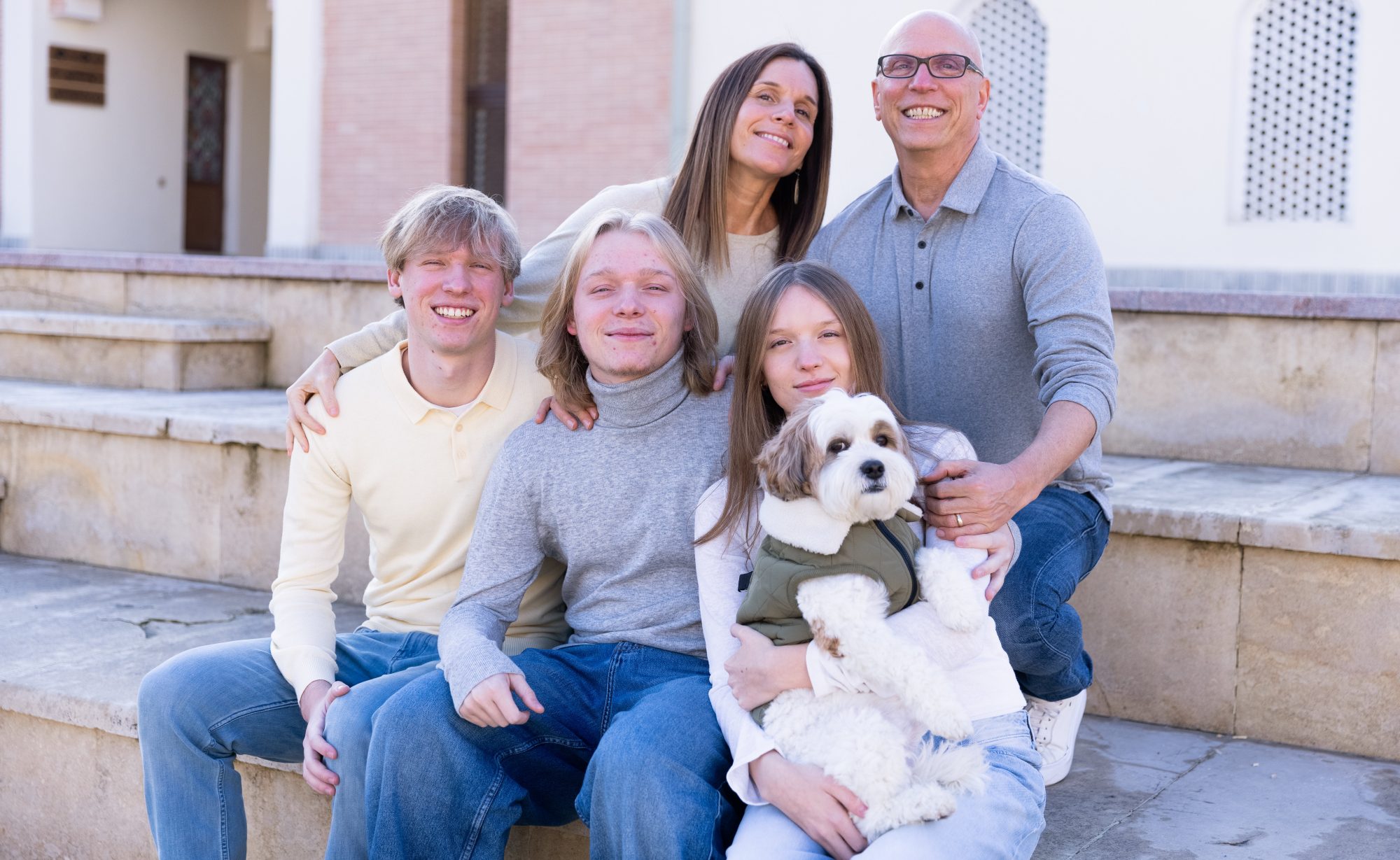
I took this photo of Ollie and Ocean Sunday morning in our bed. Most nights in our house, it is a game of musical beds. Ocean loves to wake us up with crying and she asks for milk. We are trying to wean her this month. Ollie usually is pretty good but in the early morning he comes in and snuggles with us. Sunday, they drove both Nadia and I out. I was up and Nadia was in Ocean’s bed. If they weren’t so cute, I would be very annoyed by them.
It was a busy weekend with four basketball teams visiting our school. I coached both Friday night and Saturday afternoon. On Sunday, I had a morning skype interview but managed some family time. I took Ocean out for a short run in the jogging stroller. It was cold yesterday and looks to be cold all week with temperatures around -7C. We did some shopping in the afternoon and wrapped up the day by visiting some friends.
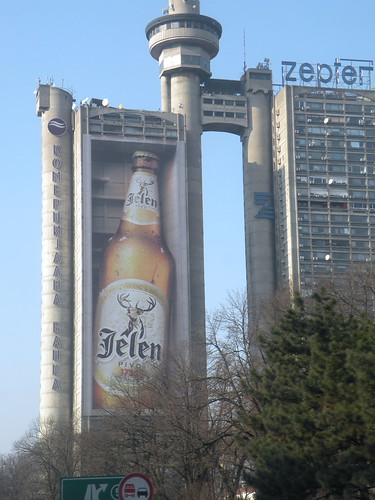
Above is my favorite building in Belgrade, the famous “gate” to the city, the Genex Tower. It has an optical illusion beer advertisement on one of its sides. Jelen Pivo (Elk Beer) is probably the most popular beer in Serbia, although I prefer Lav, the other popular domestic brew. I wonder how much it costs to put a billboard on the side of an entire building? How about the people with offices or apartments on that side? Who makes signs that big? So many questions… I see large advertisements on several buildings around the city.
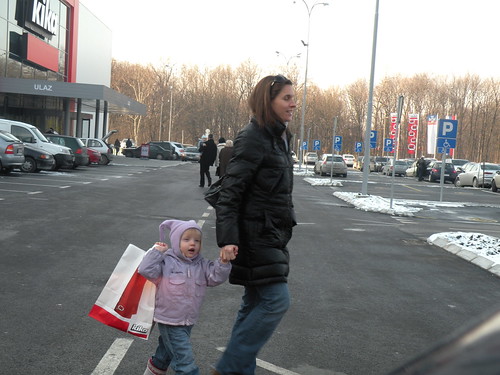
Below, Ocean and Nadia are coming out of Kika, a new home furnishing store in Belgrade, similar to Ikea. Kika is originally from Austria and it is expanding throughout eastern and central Europe.
Last Friday night I made my acting debut in our school’s Improvisational Theater event. “Night of the Stars” was performed in the high school performing arts studio. The ISB Thespian Society sponsored the event and it was open to parents, students, and teachers. I formed a team with a couple of students (Marko and Bjanka) and a colleague, (Susie) and we had a great time. We didn’t win, but I learned a lot about the short form improv theater. Our theater director, Patty, gave us various scenarios, rules, etc for four rounds. One needs to listen intently, think quickly, and react to your teammates.
There was a nice crowd at the event with a happy group of community members. We tried to entertain them. A big thank you to my teammates for helping me out. They were all experienced actors and guided this novice along. We weren’t exactly ready for “Whose Line Is It?” but we didn’t embarrass ourselves too much.
Ocean in front of Cave at Staro Hopovo Monastery - Fruska Gora N.P.
On Sunday we headed up to Staro Hopovo Monastery in the Fruska Gora National Park. I was anxious to get out of the house after a very lazy, and relaxing Saturday. It was a really cold day and we did enjoy the drive and a short walk in the ravine areas near the monastery. We discovered a small cave, which we need to come back to explore as well as the trails in the area. Perfect place for walks, bike rides, and picnics with the kids. The monastery is located just outside of the town of Irig.
It is the simple things that are the best in life. If I could re-live a moment, it would be a Saturday evening walk with Owen and Oliver. We walked through the “spooky forest” (Haid Park) to get a pizza at Zodiac. It is a restaurant near our house in Senjak. The boys were so excited to be walking with a flashlight. We had races to the restaurant as we got close. They were so excited and we laughed a lot. It is nice to have them be so dependent on me for adventure and excitement. I wish these kind of moments could be re lived in the future when they are on their own and more independent. Both Ollie and Owen are so cute and so full of life. What an honor to be a father! I hope I am doing a good job with them.
Christmas/New Year holidays ended for us this weekend. What a glorious three weeks it was! I always value the relaxation and amount of time I can spend with the kids and Nadia. When Nadia and I are working, we are so busy that at times we don’t get to spend enough time with the kids.
We had a wonderful last weekend. The weather finally got better, with sunshine and warmer temperatures. The kids are shown in our yard before we went and played tennis at the local school yard. I also went for a long bike ride with Tim. Both Nadia and I ran quite a bit over the holiday.
Saturday evening we went to the basketball game. Red Star with its new coach, defeated city rival FMP 87-73 to move to 7-8 for the season. They looked better with the new coach by hustling more and shooting the ball well. They still have problems with good, attacking guards. They still have a ways to go. The boys most enjoyed being able to run around on the court after the game. Owen inherited by bow legs.
We enjoyed celebrating as a family the Serbian Orthodox Christmas yesterday. The Serbs celebrate Christmas on January 7th. Here is a link to a great blog post on the traditions of Serbian Christmas. We tried to do some of them yesterday. On Christmas instead of the usual greetings of hello or how are you (caio, kako ste?) Serbs say “Hristos se rodi” which means Christ is born. The person receiving the salutation then replies, “Vaistinu se rodi” which means, “Yes, indeed, he has been born.” I tried this a several times and I always got a surprised look and a smile, and an immediate response. They do this for the two days after Christmas, so I hope to do this some more in the next couple of days.
The other tradition we did was to burn the badnjak (yule log). On Christmas morning, the father and eldest son are supposed to fell a young oak tree and put it on the family fire. This dates back to pre-Christian times, so I told the boys the story of the Slavic god Perun and his battles with the underworld god, Veles. We’ve been listening to podcasts on storynory.com about the Greek myths. The site is great for kids and I highly recommend it. If I have the time, I would like to make one for the boys on Perun.
Burning of the Badnjak
The weather has been horrible. Lots of rain and grey. I would prefer either snow or sunshine and I don’t like this in-between stuff. It has been limiting our outdoor activity so I took the boys to the ISB gym yesterday to play soccer and tennis. Great fun.
I said “Hristo se rodi” (Christ has risen) to every Serb I met.
Monasticism is an important part of the Orthodox religion. Serbia is full of monasteries and they are popular with tourists to visit. This is the first one I visited and I wanted to see the appeal of them. Monasteries usually are put in relatively remote places to protect them from outside invaders. I guess that is what makes them appealing to me.
This particular monastery is located just outside the Fruska Gora National Park. “Frankish Hill”, is a hilly region located just outside of Novi Sad, in the heart of Vojvodina. Vojvodina is the northern part of Serbia that once was the Pananonian Sea in geological times. It is a flat area except for Fruska Gora, which is a large area of hills. The Serbs put many monasteries in this area, I guess the hills offered protection. This monastery is for women and there are no orders in the Orthodox church like the Catholic Church. Above is a photo of the gate house.
On the wall of the gatehouse were two mosaic icons. The one below is of Mother Angelina Branković. She is a saint in the Serbian Orthodox Church and she is buried at the monastery. She died in 1520 and had a tough life due the times.
She was the daughter of Orthodox Christian Prince of Albania, Scanderberg. At this time, the Ottoman Turks invaded and took over Serbia. The leader of the Serbs, Stefan Brankovic, was blinded by the Turkish Sultan (ouch) for an alleged offense. Stefan sought refuge with the Prince Scanderberg and fell in love with Angelina. They eventually married and had two sons. The oppression of the Ottomans continued and they later fled to Italy for their safety. They lived peaceful lives there but not much is known. Angelina’s husband died and the family was in deep poverty. She went to the Hungarian ruler for help and he set her up with her two sons back in Vojvodina, the Austro-Hungarian controlled part of Serbia. The eldest son, George, was the hereditary ruler of Serbia. He chose to become a monk and live a celibate life and took the name Maxim. He abdicated in favor of his younger brother John. The Hungarian Emperor gave John a calvary to manage to help protect the Austro-Hungarian Empire. John didn’t have much power. He had only a daughter who married into Croatian royalty. John died and thus ended the dynasty. Mother Angelina outlived both of her sons. After the death of John, she devoted herself to the monastery and was buried there. Her son Maxim, is also pictured next to her on the gate house.
A few questions come of this. Why did Maxim not want marriage and heirs? Especially if he was the Serbian ruler? What crime was Stefan accused of to get the punishment of having his eyes gouged out? Why did John’s daughter marry outside the Serbs and not have anything to do with the dynasty? These are questions that are difficult to answer 500 years after the events happened. That is a bad thing about the lives of older saints, how much do we truly know about their lives?
Venerable Mother Angelina
Also note the cross in her hand has three bars across it. This is common in the Orthodox Church. The top crossbar signifies Pontius Pilate’s inscription, “King of the Jews” he put mockingly on the crucifix of Jesus. The bottom bar goes way back. When people were crucified, if they were only nailed to the cross by the hands and feet, it would not support the body. They therefore needed an extra support for the legs, hence the third crossbar. Early depictions of the crucifixion show this. Only later did the nail in the crossed feet of Jesus appear and the lower support disappear. I read on wikipedia that the lowest bar is usually slanted, but this one is not. The slant signifies the agony of suffering on the cross as well as the right side raised in allusion to the thief on Jesus’s right side seeking salvation at the end.
Another side note about the place, the Ustase, the Quisling Nazi regime during WWII Yugoslavia, converted the monastery into a concentration camp. Many Serbian and Yugoslavia Partisans were tortured and murdered there.
We were visiting the area to buy some wine. There are lots of wineries in Fruska Gora and the prices are much cheaper at the cellar. For example, a Kovacevic wine is 500 RSD cheaper than in Belgrade. I’ll give a review of some of the wines we purchased in a later blog post.
Oliver is pictured above with the “badnjak” and the “žito” they were sell at our local market yesterday. They are both Serbian Christmas traditions. I blogged about the Christmas Eve tradition of the badnjak last year. We hope again to burn the badnjak (tied to our door) with a church on Wednesday night, Christmas Eve. Thursday, January 7th is the Serbian Orthodox Christmas. Can any of the readers give me background on the žito? The word means “grain” in Serbian. They were selling them in the market. It is a type of live grass. The one I bought is growing in the bottom of a 2-liter bottle. All had a candle put in and a Christmas wrapping. I think it must be something to do with the winter solstice and thanking the sun for its return and wishes for a good growing season and harvest in the upcoming summer.
We had a fire yesterday to roast peppers and egg plant. Nadia made a humus-like paste, I forget the name, with the egg plant. It was a cold day and see the comfort a family fire hearth would give to the ancient Slavic tribes. I could also see where they would be thankful that the days were getting longer. Thankfully with modern heating and electricity, we don’t have to worry about that anymore. I think it is good however, to pay homage to our ancestors and the tough life they lived.
We are enjoying the week in Belgrade before we have to go back to school next Monday. We are pictured below in our trusty Edelweiss at our last gasoline stop for the road trip. We drove through snow and ice on Sunday evening to return home. Traveling with young children is taxing and the kids were very happy to be home after a week on the road.
Happy in the Car
UPDATE: A reader sent me a link regarding the zito:
But the pebbles are grains of wheat that have broken open to release the shoots of new life — a biblical metaphor for Jesus’ death and resurrection taken from the Gospel of John. This tiny garden of wheat is a psenica (SHEN-it-za), a Christmas tradition in the Serbian Orthodox Church, which keeps to the Old Calendar date of Jan. 7
The seeds are planted in a bowl Dec. 19, St. Nicholas Day, and watered after a recitation of the Lord’s Prayer. Waiting for them to grow is a spiritual exercise.
“Isn’t it a fun way to pass the short, dark days waiting for the birth of Christ?” said Ms. Bizic, who retired five years ago as a librarian in the Quaker Valley School District. The green wheat is held tall and straight by a circlet of ribbon in the Serbian national colors of red, blue and white.
“When you first put the wheat in, you wonder if it will grow. But then you see it put out these little knots, and then the shoots. You can see it grow the next day and the next. It fills you with happiness,” she said.
We are shown above in front of a statue of Vlad Tepes, or the famous Vlad the Impaler. He was the Romanian ruler in the mid-1400’s who defended Wallachia, a region in Romania, from the Ottoman Turks. He is remembered today because of Bram Stoker’s 1897 novel, “Dracula” is loosely based on him. We arrived back in Belgrade last night after a week long stay in visiting Transylvania.
We stayed with Claudiu Fuiorea pictured above to my right. He is from Sighisoara, the hometown of Vlad. On our final day with them, he took us on a tour of the city. Sighisoara one on of the 7 fortified cities built by German immigrants in the 12th century in Transylvania. Claudiu lives in Belgrade and works for a multinational corporation. We have become good friends and he and his family were wonderful hosts. We ate and drank extremely well, and got much insight into Romania.
Playing up the Vampire Image of Transylvania
We visited the Bran Castle near Vesna’s (Claudiu’s wife) hometown of Brasov. The castle looks like Dracula’s castle in Stoker’s Gothic novel, but was actually customs office for traffic coming into Transylvania from Ottoman lands to the east. The town of Bran really plays up the precarious relationship with Dracula. The market was full of vampire kitsch and was packed with tourists.
The Beautiful Carpathian Mountains
I wondered what it would have been like for those German immigrants 800 years ago. They went to the far eastern part of the Austro-Hungarian empire, lured by the chance for freedom and land. They built fortified cities to defend themselves and the empire from invaders from the east. It was an interesting relationship they had with the local Romanians. Basically, they were not allowed inside the citadels. The immigrants had very separate lives. Sadly, almost all of the descendants of the Germans and Hungarians have now left. Most left during the communist era (1945 – 1989) and the horrible rule of Romanian dictator, Nicolae Ceasescu. He sold visas to families wanting to escape the horrible conditions. He also made them sign over all property to the government. They did leave these beautiful old cities however, the today they are tourist attractions.
We are pictured in the plaza of the lower city in Sighisoara
The effects of Ceasescu are quite visible in Romania today and it will take a long time for the country to bounce back from his horrible rule. Friend’s of Claudiu were telling us of the December 1989 revolution. One of his friends was in university at the time and he went out and tore down posters of the dictator immediately after his execution in Bucharest. It was a strange time he said, as everyone was confused about the transition. As with other “iron curtain” countries, the secret police kept extensive files on everyone and had many informants. Also, most people joined the party as they had to.
One thing I noticed were the many socialist housing blocks built during this era. They are more prevalent in Romania than Serbia. Below is one of the nicer apartment buildings. They were built for workers for the truck and tractor factory in Brasov. The factory sold low quality vehicles to other eastern block countries and it today abandoned. The apartments however, are still occupied. Vesna was telling me that they were designed for single men, many from Moldovia and Wallachia, specifically in Brasov to work for the company. Today families live in these, despite having shared bathrooms and kitchens at the end of the hall.
In the 20 years since the opening up of the country, Romania has come a long way. We noticed many more products in grocery stores and department stores in Romania than Serbia. It is part of the EU and the economic development that comes with it shows. They do have a ways to go however and it will be interesting to see where they are in another 20 years. The Romanian language is fascinating. It was the first of the Romance languages to split from Latin, the language of the Romans. There are many words similar to Spanish, and Nadia and I tried to speak Spanish when a Romanian did not understand English. The Romanians are generally darker and shorter than the Serbs and a bit less outgoing. It is hard to form a solid opinion because of limited amount of time in the country and not having visited the capital of Bucharest.
We really enjoyed our holiday there. A huge thanks to Claudiu, Vesna and their extended families!
Above is an old map of south east Europe. If you look at the backwards “c” shape of the Carpathian Mountains, you can look for cities of Brasov and Sibiu. These two fortified cities held off the Green Flag of the Ottoman Turks from going further north into Europe. The Emperor of the Austro-Hungarians placed seven citadels in the Carpathians, specifically to stop the Turks.
Today the Romanian cities are tourist attractions. The German immigrants who built the citadels did an amazing job. Beautiful huge walls, churches, schools, etc. They lived in Romania, but lived completely separate lives within the walls of these cities. As you can see from the photo below, Brasov was strategically placed in a tight valley. This made it easier to defend.
The Romanians today owe much to these German settlers. The beautiful old cities bring in many tourist dollars.



 Bill's Blog