Visiting Hong Kong

Morning View of HK from the Avenue of the Stars

Hong Kong is one of the iconic exotic expatriate locales. The place has a vibrancy and bustle that one can feel. Because of the high population density, I wouldn’t want to live there, but for it is perfect for a week-long visit. 

It is over 20 years in Chinese control since the British handed it over in 1997. Hong Kong is considered a special administrative zone by the Chinese and it has its own visa regulations, currency, flag, etc. However, it is definitely under control from Beijing. As they are doing all over the world, Beijing has put in much infrastructure, including the world’s longest bridge to the other former foreign colony, Macau, which I visited in 2015. 

Star Ferry Crossing

My friends, Malcolm and Ingela, former Hong Kong residents, showed us around so we got a good taste of the place. Crossing Victoria Harbor on the Star Ferry is according to my British friends, one of the things you have to do in life. After quick authentic fish n’ chips at the pier, we hopped on the 2.20 HK dollar old boat. We enjoyed the light show from the Kowloon side. 

I wish I had come here 30 years ago, instead of at age 51. The night life in the hills of Hong Kong island was extremely buzzing with young expatriates partying, Maseratis parked outside of Hard Rock and young people looking for a good time. It would have been fun if I was a young, single man. We met a couple of young female Hong Kongers taking donations from UNICEF. One of them is attending the University of Toronto. Being teachers, we had to ask about her schooling. In her engineering program, she enjoys the relaxed nature of the mathematics compared to her high school in Hong Kong. She said they get 3 minutes in Toronto to work through a problem, but in HK, one gets 30 seconds! 

Bamboo Scaffolding – Hong Kong Island

The islands of Hong Kong are quite mountainous and that limits the amount of land that people can live. It makes the population density even greater. There are escalators to assist getting people from the harbor up the mountain through the restaurant and bar districts. We didn’t get to the most expensive real estate in the world, the luxury apartments in the “peak” on top of the mountains of Hong Kong Island. The scale of the office buildings and apartments on Hong Kong rivals Manhattan, but even closer together. 

It was fun to pretend we were financial traders and bankers after work, sitting on the steps of the pier having a beer while looking at the Kowloon skyline. I think of the many Brits who did this through the years. 

Bar & Restaurant District

We only really saw the flashy, tourists parts of the city and I am sure there are poor and crowded apartment blocks. Nine million people squeezed into a small area is crazy and in the taxi ride to Lantau Island to Kowloon on my first night, the sheer massive walls of cubicle apartments is remarkable. So many people squeezed in such a small area. It must impact you view of the world. F

I was impressed with the internet connection in the hotels, convention centers, airport, etc. So much better than mainland China. It was cool to feel the power and rise of China, in the city and at the conference. Country number 66 in my life was fun to visit and I will fondly remember my brief time in Hong Kong. 

Impressions of Bangkok


Bangkok Electrical Complexity

This is my fourth trip to Bangkok. I am not staying downtown near the river like in my previous visits. I am attending the East Asia Regional Council of Schools teachers conference and it is hosted by the International School of Bangkok (ISB). It was an one-hour ride through heavy traffic yesterday from the airport to the Ibis Impact Hotel where I am staying. The hotel serves the IMPACT Muang Thong Thani, which is a huge convention center, arena, sports facilities, etc.

ISB moved from the center years ago to gain space for a gorgeous purpose-built school and campus. An expatriate gated community has grown around the school. It is an oasis from the noisy, litter-strewn and busy streets that make up most of the city. I am happy to be in the tropics again. Winters are cold in Japan and houses are not insulated so one feels the cold both outside and inside. It was refreshing to walk in the heavy, tropical air last night. The hotel is a 20 to 40-minutes taxi ride from the school, depending of course, on the ubiquitous traffic of Bangkok. Much like Los Angeles, it really drives peoples’ lives, and you need to be aware of travel times and routes. The city desperately needs better public transport. 

Final Day of campaigning for the opposition party

The neighborhood around the hotel is being built up with a new mall that is in the process of opening. There are many Chinese-style, huge apartment buildings and so the street life is quite lively. There is much construction projects in progress and the vacant land is rapidly being developed. 

After a six-hour flight and the taxi ride, it was refreshing to take a shower and have some Thai spring vegetable rolls and bubble tea at the mall. D

Sewers, barriers and rubble make it difficult to walk in Bangkok

Day 2 – After the first day of the conference I got back to my hotel room and went for a walk so I could feel refreshed and stay awake. I forgot that I was not in Japan and much of the developing world, including Bangkok, is not a place conducive to pedestrians! My goal was to walk about an artificial lake near the hotel and loop back around to the local shopping mall. It was difficult to go over traffic barriers, unpleasant to smell the odors coming from an open sewer and dodging traffic to cross streets. It is a shame because it is so nice to walk in the silky tropical nighttime air. I take it for granted in Japan to have easy and safe walking/cycling paths everywhere in the city and countryside. 

Street side restaurant

Day 3 – This morning I read in the Economist that Thailand is the country with the most wealth inequality in the world. Something like 1% of the population owns a large percentage of the wealth. They are holding the first national elections tomorrow in 9 years. The previous government was interrupted by a military coup in May of 2014, the 32nd coup in Thailand’s history. A junta of military generals has controlled the country ever since. They have a parliamentary system and the prime minister, Prayuth Chan Ocha, is vying with some other parties to gain a majority. The eldest sister of new King tried to run for the former party in power, UDD, but she was not allowed. UDD is backed by a telecommunications mogul who was ousted from power in 2006 and his sister was taken out by the military in the aforementioned coup in 2014. 

Bangkok skyline from the Radisson Blu Hotel Roof

You can see many signs and campaign rallies around the city. After nine years of no elections, commentators are predicting almost 90% turnout. The military is selling the idea of peace and stability and all parties are talking a lot about anti-corruption. I am curious to see if they will have a result and what direction the country will go in. Thailand is a kingdom and the royal family, especially the former king, is revered and beloved by Thais. His son recently took over after the death of his father. He was a bit of a playboy living in Germany, but he seems to be fulfilling the role as monarch. 

Traffic is a disaster here in the city and signs of poverty are everywhere. I hope the leadership of Bangkok and Thailand can help the poor here in this very friendly and colorful country. 

Norikura Highlands – A Perfect Day of Skiing

A perfect day in the Norikura Highlands

Day two of skiing was even better than the first day. It snowed all night so there was a deep layer of powder. There was also less people on the slopes than yesterday. It was so luxurious to go on as many courses as I wanted without waiting or dodging crowded slopes

Empty slopes – empty chairs

I challenged myself with some steeper runs. There was a lot of choppy snow from boarders and on the highest route, a narrow groomed path for skiers. We did the course about 10 times and by the end, I was feeling more comfortable.

I am looking forward to the final day of skiing tomorrow!

Norikura Ski Trip

Owen snowboarding

Owen, Oliver and I are on a school trip at the Mount Norikura Ski Resort. The trip is being led by NorthStar Alpine Lodge, an English-speaking adventure company. It is one of the perks of international school teaching to be able to chaperone trips to exciting places. It is a lot of after-hours work, but so enjoyable to spend time with the students.

It was a glorious day of heavy snow! It felt so refreshing and different to be out in the snow the entire day. It snowed from about 10:00 until the end of the day. For awhile, visibility was cut down significantly and riding on the chair lifts in driving snow was a bit cold. However, it did let up in the late afternoon and with so much powder (“pow” in Swiss ski slang – thanks Kelly!) it was a different type of skiing. It took me awhile to get comfortable, but by the end of the day, I was a powderhound!

Owen is learning how to snowboard with the NorthStar instructors. Because of his base of skiing, he is picking it up quickly and should be pretty good by the time we leave Friday afternoon. Oliver is with his fellow 7th graders and they are not skiing but practicing winter sports. Today they built an igloo and had snowball fights. He is enjoying time with his friends.

Self-defense forces share the slopes with family skiers

There is hardly anyone on the slopes. I estimated maybe 300 people and there are quite a few runs. Absolutely no wait time in lines – a perfect day for me! It was interesting to watch a brigade of Japanese Self Defense forces training on telemark skiing. They had their helmets and backpacks and military camouflage. I don’t know what they were ski-training. A possible North Korean invasion?

A mega coffee vending machine

A final note – Japan has the most advanced vending machines in the world. This coffee machine at a roadside stop has a selection of 78 different coffee and hot/cold drinks one can choose from. This is just one machine in a row of 20.

Ocean Performs Shrek: The Musical

Ocean (far left) performs in the All School Production

One of the best events our school holds annually is the All School Production. This is a gigantic musical that involves students from grades 3-12 from both of our schools. This year they performed Shrek: The Musical. Ocean played a “rat” dancer. She loves to sing and dance and I love watching her perform. She is a natural for the stage.

Ocean (far left)

The school goes all out for the performance and features a live pit orchestra, Japanese subtitles, elaborate sets, intricate costumes and sound and light crews. It is the most professional theatre performance I have seen on the high school level.

Ito sensei and I thank the community

Nadia and I and the kids went to the final performance on Saturday night. Along with the head of the Senri International School, I thanked the community and gave a few remarks at the end of the performance. They put on four sold-out shows with two casts. We will certainly miss the All School Production.

My Take on Capsule Hotels

I tried my first capsule hotel last week. I was hosting a meeting at the Tokyo offices of our university. I booked a “capsule” at First Cabin Kyobashi in the central business district. First Cabin is a chain of these hotels.

I think capsule hotels are designed for business people who need inexpensive accommodation, especially after a night of dining and drinking with clients and colleagues. Men and women are separated immediately after check-in. In this First Cabin, the lobby is on the second floor and men can rent “pods” on floors 3, 4 or 5. Women can have rooms on floors 6 and 7. There is a “public” (shared) bath for men on floor 8 and women on floor 9. The bath is similar to any sento in Japan. The lobby had some nice lounge and work areas and the entire hotel was new and tastefully decorated.

The “Premium” Cabin

The bad part of the stay were the rooms. They are basically pods with a sliding curtain that does not reach to the ceiling or floor. I could hear men snoring down the hallway, guys coming in later than me, and one guy left his alarm on a 5:30 for about 15 minutes. I did not get a great night’s sleep. I ordered the “premium” cabin that had a bit of leg room. The regular cabins had only a bed and a small floor space just behind the curtain. The pajamas (yukata) provided were comfortable.

I can see how this would be such a foreign experience for people not used to Japan. The ideas of sharing a bathroom with other guests, wearing hotel-issued pajamas, being separated by gender, etc. are all kind of weird for foreigners. Only in Japan!

A “standard” Cabin

I am glad I experienced one, but I would not stay at another one, especially at my age. I did not get a restful night’s sleep. The hot bath in the morning almost made up for it however, and it is much better than the plastic, pre-fabricated bathrooms that come with most standard Japanese business hotels.

The hotel was conveniently located and it is such a thrill for me to be able to work in downtown Tokyo, the largest metropolitan area in the world! The university offices are in Sapia Tower, which is just a few steps away from Tokyo Station. From the 10th floor, you can watch the coming and going of trains and people. The skyscrapers and busy streets make it all the more glamorous, for me, who grew up in a village of less than 1,000 people in the north woods of Michigan.

I will be hosting a couple of other meetings in May and am looking forward to my final trip to Tokyo.

Top Chef Owen

Owen’s presentation

Owen is finishing the Middle Years Programme of the International Baccalaureate this year. All grade 10 students need to do a Personal Project (PP). The project is something students are passionate about and they should put in about 40 hours of work over the school year.

Owen is passionate about cooking. He watched a lot of cooking competition shows. Nadia is also really good in the kitchen and I think these two things inspired him to enjoy cooking. I give his meals a hearty 5-stars and it is nice to have two gourmet chefs in the Kralovec house. Owen’s project was to build a website with simple recipes teenagers can do.

Inheritance: A Memoir of Genealogy, Paternity and Love

I read Dani Shapiro’s latest book about her discovery that her father was not her biological father. Through the Ancestry.com DNA testing, she found out that she was not 100% Ashkenazi Jew as she thought. Her father turned out to be a sperm donor. She tells the story of how she found her biological father and why her parents kept it a secret.

This book appealed to me because I am adopted and am looking into my DNA ancestry recently. I can relate to much of what she goes through, although my story differs significantly. My adopted parents always told me I was adopted. My biological father was not a sperm donor in an institutional setting. Like Shapiro, I made contact with a biological parent and like her, I see the affects of heredity versus the setting and manner of my childhood.

She writes, “…felt, to me, like my native country. I had never lived in this country. I had never spoken its language of become steeped in its customs. I had no passport or record of citizenship. Still, I had been shaped by my country of origin all of my life,”

Discovering my half of my biological family was similar. It helped me understand why I was different in temperament than the rest of my family. I am an extrovert, quick to laugh, and abhor routines, while they were quiet and loved routines. It was quite a shock to the author. Many of her books are memoirs and focus on her growing up and I think she found out why. She is blond and looks “WASPY” while being raised in a Jewish family. Her mother sounded mentally ill and the experience had a big impact on her. At least from what I can perceive, I am not as traumatized from the experience as her.

As Shapiro experienced, finding your biological family later in life is such a good experience. It has helped me learn my complete story. I feel sorry for children of anonymous sperm donors who may never find their father. Although, with advances in genetic testing, that will be changing. As more people get tested, the database will eventually match donors with their offspring. Most donors didn’t think the technology would be able to do this so quickly.

The story also made me think about shame. Shapiro’s parents were ashamed that they were not able to have children and had to resort to a shady or unorthodox clinic to conceive. Eventually, the truth was discovered by their daughter. It would be easy for her to judge them, especially looking back at the past from the world of today. However, I felt in her book, she tries to understand them. We are all human and make mistakes. I’ve made my share of them and Shapiro probably has too. I like how she is going forward with her relationship with her biological father and his family. It also must be embarrassing for him to be discovered by an child from a sperm donor clinic. He handles it with dignity and focuses on the most important thing, the relationship he can have with a daughter.

It was an uplifting book and gave me perspective on my own life.

My DNA Ancestry: Poland / Russia / Slovakia / Ukraine

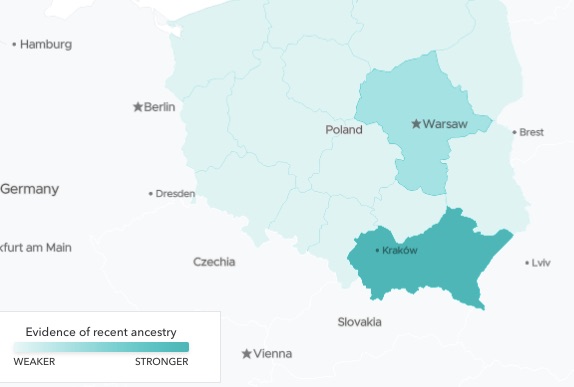
The strongest match for my ancestry was Poland

I was an early participant in the 23 & Me genetic testing database. A big reason for me doing it was because I was adopted and I wanted to know my ethnic ancestry. Recently, the company improved their ancestry section, giving users more precise regions of where their DNA originated from. Previously, I knew I was 100% European from the early ancestry reports from 23 & Me. There were percentages of broad areas, like Eastern Europe, Northern Europe, but no countries. As genetic testing has grown more popular, they now have over 5 million people in their database. Using algorithms with customers in the database that know their origins, they match users to specific places. I think they will get even more accurate as the science improves. I would also guess that their European DNA database is larger than other parts of the world because white Americans are probably a big percentage of their users.

The ancestry report most “highly likely” match was Poland. They even get down to the state level. The two voivodeships (states) in Poland surround Krakow (Lesser Poland Voivodeship) and the border with Ukraine (Podkarpakie Voivodeship) were the strongest matches for me in Poland. We spent New Year holiday in Krakow in 2014, but at the time I didn’t know I had ancestors from there.

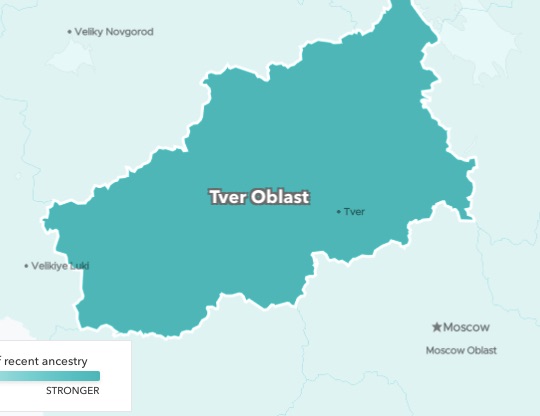
I was surprised to learn that my DNA “likely” matched in three oblasts (states) in Russia. One outside of Moscow, another in the southwest of Russia near the city formerly called Stalingrad, now Volgograd, and Samara Oblast, on the border with Kazhakstan. I am guessing it may be from my father’s side of the family.

Tver Oblast was one of the three areas of Russia that matched my DNA

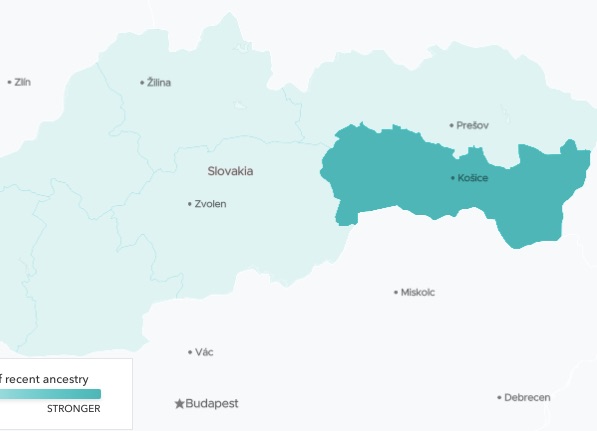
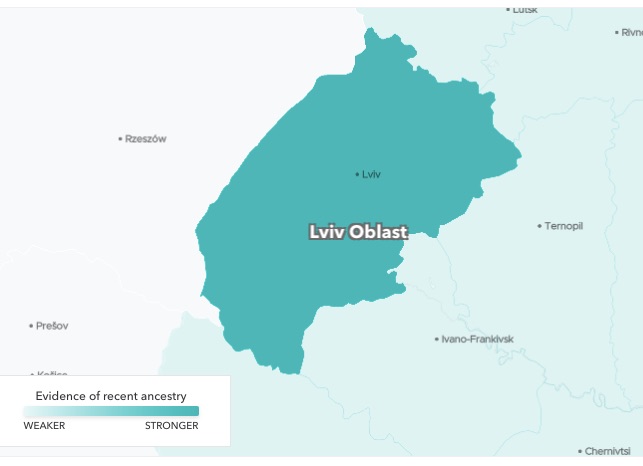
The other two “likely matches” were the western Ukraine oblast of Lviv and the Kosice region of Slovakia. My biological mother’s family still makes pierogi and celebrates their Slovakian heritage. There were many Slavic immigrants to the Appalachian mountains in Eastern Pennsylvania where my biological parents are from.

Slovakia
Ukraine

Besides the big 80% Eastern European part, 11% was Spanish/Portuguese and 9% Austrian. My wife Nadia also did 23 & Me and it zeroed in on Santa Cruz, Bolivia. We both sent samples into the rival company, Ancestry.com and so I will be curious to see if it matches with the 23 & Me findings.