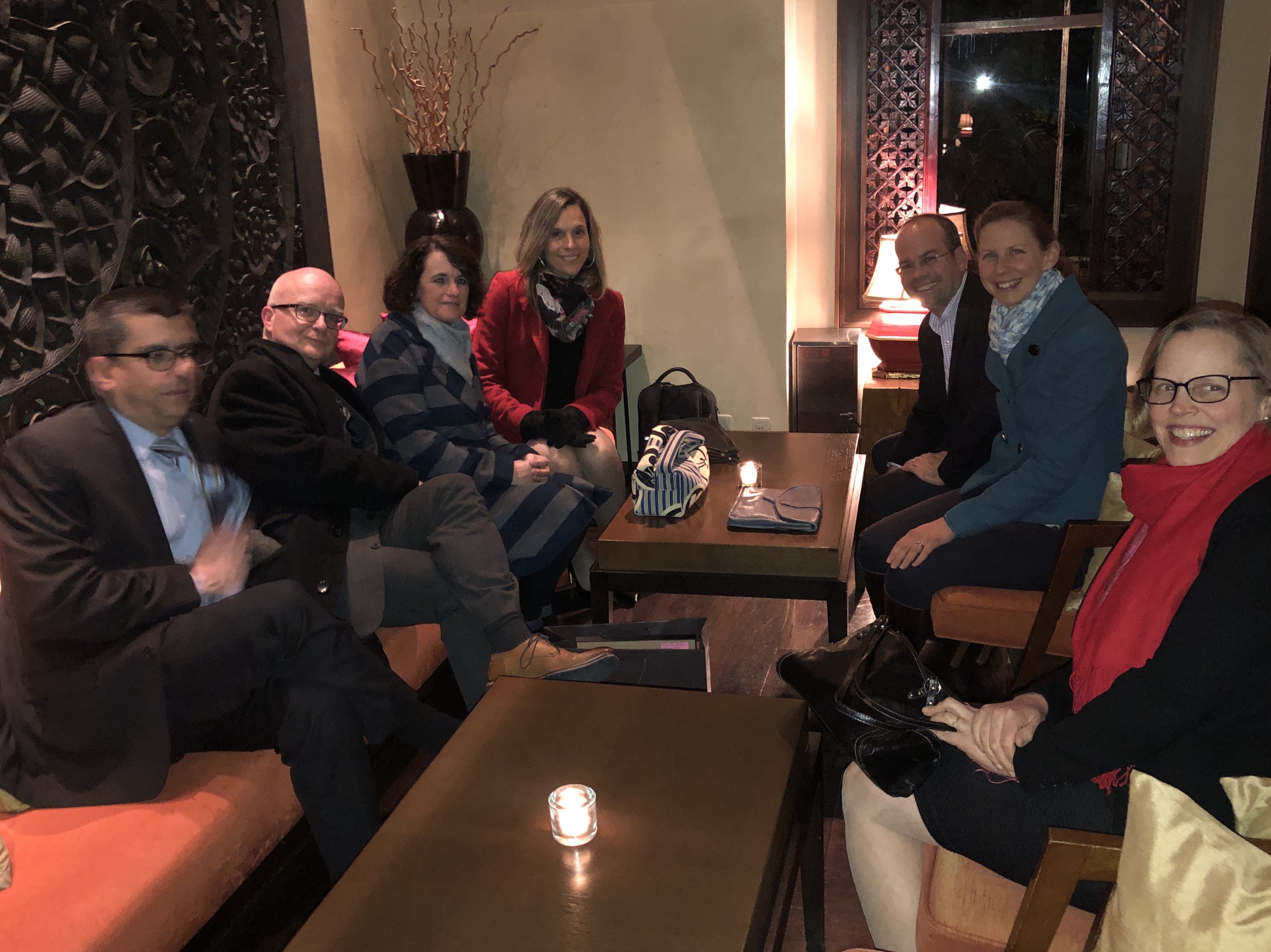
It was my first “free” weekend in 2019 and it was so pleasing to have two days with nothing fixed on my calendar! Friday night Nadia and I attended a fundraiser for Tokyo Emergency Lifeline Japan (TELL Japan). It was held at the Garden Place Soshuen, a gorgeous estate in the hills of Ashiya, overlooking the port of Kobe. It used to be a zaibatsu (Japanese tycoon during the Emperor’s reign – pre WW II) estate. It was converted to a restaurant and events center. The building is like out of the James Bond film, “You Only Live Twice”, in the Ryokan style. We had a lot of laughs with friends! There is a gorgeous bar and we all had a drink to finish off the night.
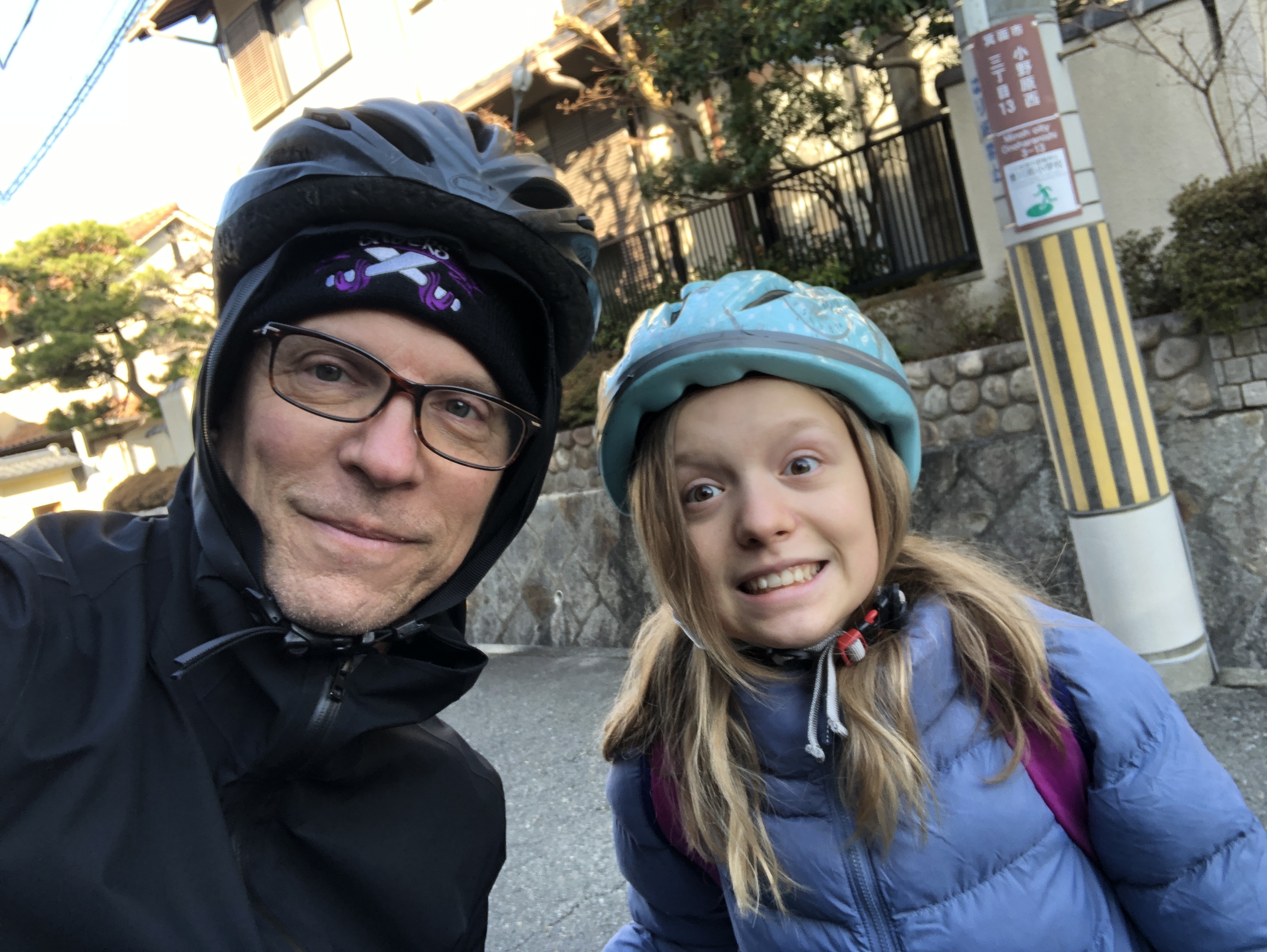
It was so nice to wake up on Saturday and help Ocean get ready for her dress rehearsal. She is playing a part in Shrek: The Musical, the school play. I love making her breakfast and helping her with her speech and preparations for the day. We cycled over to the school. After doing some errands and checking on the other events at school, I cycled to the travel agency, located near the Juso Station. I paid for our upcoming flights. I will be travelling a lot this spring.
Garden Place Bar
After a luxurious nap, I went to play football with Owen. On one of the passes I caught, it jammed my finger and I damaged a ligament in a finger. The doctor diagnosed “mallet finger” and I have to wear a brace for 8 weeks and go through physical therapy. It is not painful, just a nuisance. The ligament was damaged on the last knuckle and I cannot straighten my ring finger on my right hand. The brace keeps it straight while it heals.
Video at the hospital
Sunday I spent most of the afternoon working on an assignment for my doctoral studies and organizing my home office.
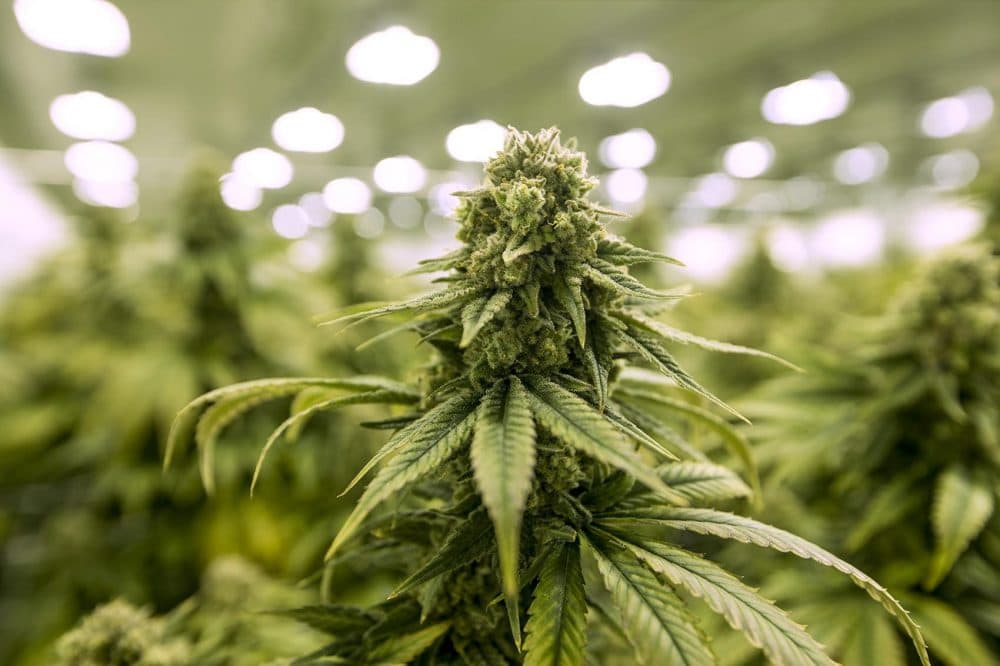
I’ve been thinking about marijuana since my home state of Michigan legalized its use in November. I read Malcolm Gladwell’s piece in the January 14, 2019 issue of New Yorker.
I am ambivalent about legalizing it. The state criminal justice system spends a lot of money prosecuting marijuana crimes, mostly for possession arrests. The majority of people arrested are poor African Americans. After listening to Season 3 of Serial on the impact of the criminal justice system on the poor of Cleveland, Ohio, I feel it is a good idea to eliminate marijuana as a crime, especially with the poor. I think it is good that this is no longer the case and hopefully the government will treat it as a health issue and not a crime.
I am concerned, however, that with the legalization, that more people will be using marijuana. 10 US states have legalized recreational use and there are only three states that prohibit any use. I think that is the last thing Michigan, and America needs. A drug that anecdotally encourages people to be less active, eat more and decrease motivation, will not be good for a country already suffering from this.
Gladwell points out that there are not any long-term, large studies on the effects of marijuana use. Some studies show marijuana use increases incidents of mental illness, especially schizophrenia and perhaps even violent behavior. I know this sounds like the 1936 documentary, Reefer Madness, but I don’t think we know enough about it. As it becomes more mainstream, like cigarettes and alcohol, I believe we will see more research findings.
Gladwell mentions e-cigarettes and how they are being handled by governments as a comparison to marijuana. He wrote that e-cigarettes are 95% less harmful than regular cigarettes, but in many ways, it is more difficult to buy them. Educators are seeing increased use of e-cigarettes by teenagers and this is a concern.
I will be curious to see how we view marijuana use over time. We are embarking on a large-scale experiment on the effects on our society. I wonder how we will feel 20 years from now.
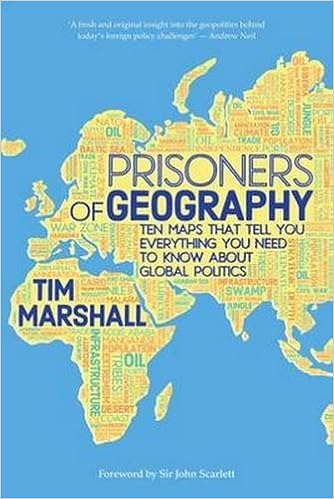
I love maps! I was always fascinated with following the contours of coastlines, mountains, highways and imagining what it was like in those near and faraway places. That is part of the reason I chose an internationally mobile career. So when I saw this book in the Berlin airport, it immediately drew my attention.
I am thoroughly enjoyed British author Tim Marshall’s book. I contemplate his takes on parts of the world and it allows me to fall asleep. The book is not boring, it just gives the reader lots to think about. He is a former foreign correspondent for the BBC and Guardian and he really knows the 10 regions he features in the book. He focuses on how the landscape and geography drive government foreign policy. It is a course on global politics, history, culture through the lens of geography. Below are Marshall’s takes on the different regions and my insights.
Middle East: This part of the world is dominated by desert and Islam. It is an area of conflict of varying levels. I think the big battle for control and influence are the Saudis and Persians, which also mirrors the split of Islam between the traditionalist Sunnis (85%) and Shia (15%). I didn’t realize that Iran was so big, and is larger than UK, France and Germany combined with 78 million people.
It didn’t help that France and the UK drew up nations (Sykes-Picot lines) after taking control of the region from the Ottomans. The idea of nation-states is foreign here and most of the countries, examples include Iraq, Lebanon, Jordan, Syria, etc. bring together cultures and peoples that have an active dislike for each other. Israel is just a small part of the conflict that takes place in the region and the most important stories are taking place elsewhere in the region.
I wonder what the place would look like if after WWI, they kept the “vilayet” system of the Ottomans, which was based on the traditional tribal territories of the region.
India & Pakistan: This area is surrounded by ocean and a ring of mountains. The big conflict here in my opinion, is India and China. Yes, India and Pakistan have nuclear weapons and are enemies, but long-term, I never really thought of India being a rival to China. However, Marshall made me consider that perhaps with a larger and younger population, that this century, they will reach a level of economy that could counteract Chinese hegemony. I also gained a better understanding of the Pakistan and Afghanistan border region and why US forces had such a difficult time controlling it.
USA: Marshall is optimistic about America and thinks with becoming self-sufficient in fossil fuels, a population that is not aging, a huge military and 17 of the top 20 research universities there, that America will be a global force for a long time. He also pointed out how fast the US grew, from the last colony of Georgia in 1732 to Alaska in 1867, the country grew at a tremendous rate.
Western Europe: The region was blessed with a good climate, soils and navigable river so it was natural for it to develop to a high economic standard. The European Union has been good and kept the peace which is a region that has experienced many wars over the centuries. He is concerned that a breakup of the EU, could bring back those bad times.
Africa: Three times the size of the USA, Africa has been hindered by rivers with waterfalls, malaria, no natural harbors and a huge desert in the north. All these factors slowed the growth of the economy. The concept of nation-states imposed by European colonial powers also hurts Africa even today. It was interesting to read the economic competition of the several power centers on the continent. These include Nigeria, Kenya, Tanzania and South Africa. Marshall also predicts a war between Egypt and Ethiopia over water.
Japan & Korea: They along with the USA will always be close as common “enemies” of China and North Korea. Japan’s future is in doubt due to an aging population, which on pace to fall under 100 million by 2050 and under 50 million by 2100. Korea is a small, flat peninsula that was invaded by Mongols, Chinese and Japanese.
Latin America will never reach the economic strength of the USA due to geography. Most of the people live on the coast, no infrastructure in the interior, and it is remote from most population centers (London is closer to NYC than Buenos Aires).
The Japanese Akusa 2 Cruiseship in the Port of Yokohama
In most major cities in North America, there are ethnic neighborhoods that reflect the history of immigration. In Japan, it is rare because, for such a long time, the country was completely closed to the outside world. Even in modern times, they take in very few migrants and the amount of foreigners residing in Japan is very small compared to other countries. That is what makes the top of the bluff overlooking Yokohama Bay unusual. Yokohoma was one of the first ports opened to foreigners after Perry’s black ships ended the Tokugawa blockade of Japan. The Western expatriate workers in the port settled in Yamate, the neighborhood atop the bluff. The Chinese immigrants settled in the swampy lowlands. See Thursday’s post on Chinatown.
Walking around Yamate is like leaving Japan. The architecture is Western and the big trees and historic buildings, make it feel European. I visited the old British athletic club, where tennis was introduced to Japan. It is now the Tennis Museum of Japan. An appropriate pilgrimage on Australian Open finals weekend. They still have lots of courts.
The Japan Tennis Museum
Erected by the foreign and Japanese subscribers to the honored memory of the pioneers who laid the foundations of Yokohama as a port of trade nearly 70 years ago. Also in sympathetic remembrance of the foreigners, both known and unknown, who lost their lives in the Great Kanto Earthquake of September 1, 1923. and of other foreign residents whose names are not recorded in the surviving archives of the cemetery. May they rest in peace, until the day breaks and the shadows flee away.
Yamate Foreign Cemetary Memorial
The Great Kanto Earthquake of 1923 was horribly destructive. Over 150,000 people died. Many from fire, as it the 4-minute shaking took place at lunchtime, and back in those days, many people cooked over fire. Yokohama was absolutely destroyed. It was horrible to read about the vigilante gangs that murdered Koreans because of unfounded rumors of poisoning wells and looting stores. In the chaos that follows and earthquake and the unstable minds of people who suffer something like that, I can see why things like that happen. Officials eventually restored order. It must have been a powerful quake because even the expensive homes on the bluff were destroyed and many foreigners died.
A former silk merchant residence near the Yamate Cemetery
One good thing to come out of the quake was Yamashita Park. The waterfront was reclaimed with the rubble from the earthquake and a Scottish guy, convinced the government to make it a park. It really is a beautiful spot and one of the few tourist friendly port areas in Japan. I went for my daily exercise in the park to take in the sea views and see the ships. They converted the old warehouses (made obsolete with the invention of the container) into shops and restaurants. The whole area is just a nice place to spend an afternoon!
The view from the end of Osanbashi Pier
I would love to go back in time and be there at the beginnings of the foreigners coming to Yokohama. It must have been even more distinct place than Japan of today. I also was thinking a lot about the Great Kanto Earthquake. I wonder when the next big one will come to Tokyo.
When Japan opened to foreigners in 1859, it started with ports and Yokohama was one of the first ports to open. Many Chinese immigrants came at that time to work in the port and many settled nearby. It is the largest “Chinatown” in Japan and one of the largest in Asia, with over 250 Chinese restaurants and between 3,000 – 4,000 Chinese residents. It used to be much bigger, but the Great Kanto Earthquake of 1923 which killed 100,000 people and made almost 2 million homeless, caused many of the Chinese to pack up and go back to China instead of trying to rebuild. The Port of Yokohama is the third largest port in Japan after Tokyo and Kobe. None of the Japan ports compare in size to Busan, Korea, Singapore and several Chinese ports.
Akira and I in the bustling streets of 横浜中華街,
I am in Yokohama for a basketball tournament and am staying in Motomachi, which is adjacent to Chinatown. My friend Akira and I went for a nice Chinese dinner and sento (hot bath). We walked around the narrow streets and took in the sights, including the extravagant Kantebiyo Temple. It is dedicated to the Chinese god of prosperity and good business. That is appropriate for a port town. It is nice to have some Chinese food for a change. We had a nice evening.
Owen and teammates wait to board the Nozomi shinkansen to Shin Yokohama
I put together a short video of our Christmas and New Year’s holidays. My brother Andy and his wife Chantal visited us from Chicago. Nadia’s sister Alejandra and our nephew Sebastian from Singapore also came. We spent a few days in the village of Ochima in the Nagano prefecture, the “Alps” of Japan. It was great to have a bit of snow!
The video shows our snowshoe hike and our visit to the famous “snow monkeys” of Japan. Enjoy!
I am realizing my time in Osaka is limited so I am getting around the city and taking photos/videos so I remember it. The Keishin (Kyoto-Osaka-Kobe) metropolitan area of 20 million people is vast and I discover new buildings, neighborhoods, parks, etc. all the time. Below are some photos of my recent travels on bike, foot, car and train.
Osaka is diverse and it is reflected in the photographs above. The 580-meter long ShinSaiBashi Suji shopping street gets up to a quarter of a million visitors on an average weekend. Osaka is a city of rivers and canals which flow through the city, going from the mountains in the hinterlands of Kansai, eventually pouring out into Osaka Bay. Photos above show the Yodo River downtown and the Muko River near the mouth, which is an industrial port zone. Speaking of ports, a couple of the photos are from the artificial island, Rokko. Japanese construction projects are amazing and for 20 years, from 1972-1993, they moved mountaintops behind Kobe on giant conveyor belts to the sea. They created a 3.4 kilometer by 2-kilometer wide artificial island, built from the Rokko Mountain range. The sunset photo is from my morning bike ride. The sun is coming up over Senri New Town, which is really not “new” anymore, being developed in the 1960s and 1970s.
I survived my first big meal of fugu (blowfish) earlier this week. The school had a consultant visiting and so we showed him some of Osaka. Ganko restaurant in Senri Chuo was serving the winter special, fugu. The liver and some other parts contain poison and if not prepared and served correctly, diners could die. The poison of the blowfish is stronger than cyanide. A possibly poisonous fish was sold last week here.
A hotpot of Fugu
We ate it served in a “hotpot” served right on our table. The mix of vegetables, glass noodles and fugu cost 1,980 yen ($18) and it was enough for three of us. I love in Japan when you can cook at your table. I will definitely have it again if I come across it this winter.
We finished classes this week on Tuesday and the first week of our Christmas and New Year’s holidays has flown by. I am teaching myself video editing with Mac’s Final Cut Pro. I am trying everyday to learn a new technique or part of the program. The best way to get better at something is to get a lot of repetitions, hence the series of videos I am making.
Oliver after one month of wearing an elbow to wrist cast, getting it removed is the subject of the first video. Japan culture is risk adverse and so for a small fracture of the radius, they put an elbow-to-wrist cast on Oliver for one month. It was nice to watch his relief at finally having his arm free. It also speaks to the Japan health care system, one of the best in the world in my opinion. They really do take care of its citizens and provide free health care for everyone. Our family is outside of the national system, so we pay and get reimbursed by our international health insurance company. You can see how automated financial transactions are becoming here at the end of the video.
The second video documents the arrival of Alejandra and Sebastian and our Winter Solstice tennis game at the local courts here in Minoh. Despite a day of rain yesterday, the weather has been really nice with temperatures well above zero and blue skies. It is not good for skiing however, and I am disappointed that higher temperatures are delaying the opening of the nearby Biwako Valley Ski Resort for the season.
The tennis in the video is certainly not ATP-level play, but the spirit of competition is. Enjoy!
Ocean’s grade 5 class performed in a concert on Friday as part of the Osaka International School music program. I put together this video and included a couple of visual art pieces of Ocean also. She really excels in both the performing and visual arts. It was a bit sad that this is the last year of elementary for her and for us as a family as our children grow. Next year we will have two middle schoolers and one high school and none in the elementary for the first time since 2005. A long time…






 Bill's Blog