I finished Richard Russo’s novel Everybody’s Fool on the flight back to Japan. The book follows the lives of people in the small fictional town of North Bath in upstate New York. Having grown up in a similar small town in northern Michigan, I could relate to the characters, although I realized it has been a while since I’ve been home and my friends today are different to the people I grew up with. Although not as pronounced as Hillbilly Elegyauthor J.D. Vance, my life has taken a similar trajectory.
Everybody’s Fool takes place in a 48 hour period and is a sequel to Russo’s 1993 “Nobody’s Fool”, which was made into a movie starring Philip Seymour Hoffman and Paul Newman. The story gains momentum throughout and I eagerly read the last third to find out what happens. I couldn’t help but have the picture of the actors in my head while reading the book. A great casting job! It also reminded me of the plight of small towns in America in a time of economic globalization. The book is not life-changing, but it is an entertaining read.
I spent the last part of our summer holidays in the small Poconos mountain town of Freeland, Pennsylvania, which is probably quite similar to Russo’s North Bath. I saw plenty of signs of Trump support in Freeland. I agree with Vance that he appeals to whites in small towns because of his blunt way of talking, which differs from the polished and privileged speech of Hillary Clinton. One of the reasons Bernie Sanders appealed to me was that he was not a multimillionaire and I think could relate to average Americans. He has a lot of support in middle class urban areas similar to Trump in more rural areas.
Nadia and Kim reunited with their families visit the Pentagon
On our final weekend in the USA before our return to Japan we visited our dear friend Kim in Washington DC. The nation’s capital is a 3 and 1/2 hour drive from the Lehigh Valley. We saw some of the iconic sites like the White House and the Pentagon, toured the National Geographic museum and just spent time with Kim and her daughter. It is always a thrill to see the center of the US government, driving by the Federal Reserve, the Capitol building, etc. Despite the heat, we managed to see a lot. We even got a taste of Bolivia, stopping by a restaurant for saltenas. Around 250,000 Bolivians live in the Virginia side of the DC area and it felt like we were in Cochabamba!
Ocean and I check the bees
Kim allowed us to check on her bees. She is a conservationist and works for the US Forest Service and is an avid beekeeper. It was quite an experience for the kids and me! It is sad the plight of bees worldwide and through the efforts of people like Kim, hopefully they will continue to pollinate and keep our planet’s environment healthy. The bees were doing OK, but we didn’t find much honey. We have been friends for a long time and it was such a pleasant visit. Thanks to Kim for her hospitality!
We are packing in preparation for heading back. I am refreshed and ready to go for 2016-2017!
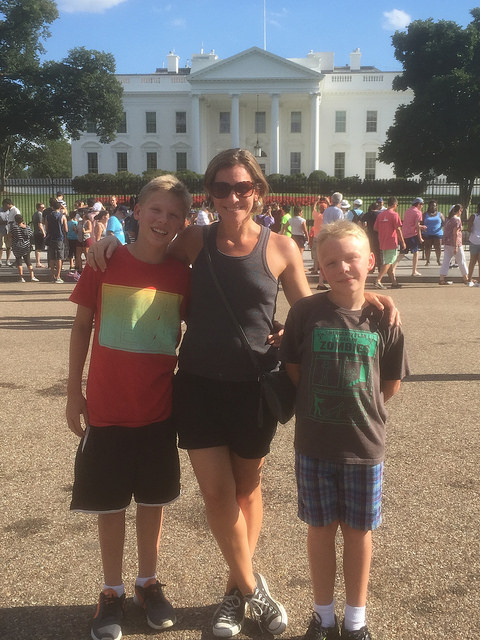
Nadia poses with the boys in front of the White House
We are wrapping up our summer holidays in the USA with a weekend in Washington DC visiting our longtime friend, Kim. We have known her since Nadia and I were in Bolivia.
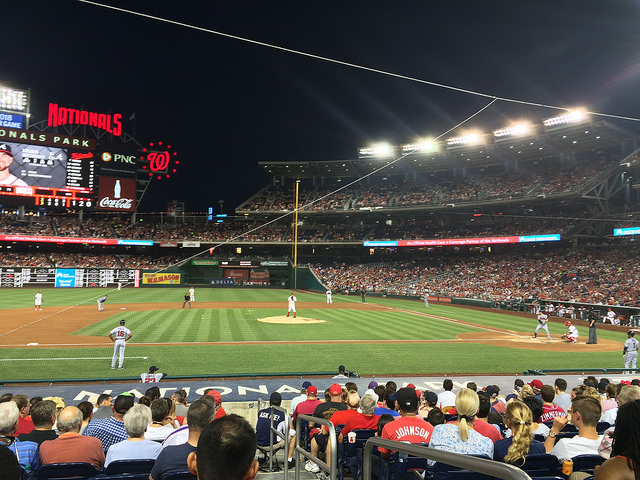
Last night the Washington Nationals were hosting the Atlanta Braves so I took the opportunity to take Owen to his first Major League Baseball game. A father taking a son to his first MLB game is one of those experience people don’t forget. It was a wonderful night for me, regardless of the score or quality of play. The Braves have the worst record in baseball, but they played like champs, defeating the Nationals 8-5. Everyone at the game was sweating profusely with temps in the mid-90s and high humidity. Since it was Owen’s first and only MLB game this year, I splurged and we got tickets very close to the Braves dugout. We were disappointed that Bryce Harper was not in uniform (strained neck) and Max Scherzer (ex-Tiger) was not pitching. The game was highly entertaining and the size and power of MLB players was on full display in contrast to the smaller Japanese players. My big takeaway from the evening was the play of the infielders. On television it looks so easy to field a grounder and throw out the runner, but with the fast players, the catch and throw need to be perfect. I admired their skill. Nationals Park is right downtown near the Potomac and the Navy Yards and it is a fantastic night out. I can see why they have such strong attendance, plus the team is in first place. Nationals pitcher Stephen Strasburg was going for his 14th victory with only two defeats, but led by Braves’ first baseman Freddie Freeman’s three-run homer, he exited the game in the sixth inning as the losing pitcher.
On the negative side, in MLB’s quest to maximize revenue, the average cost of attending a game for a family of four is $326. It would be nice to half this and have everyone in the league, make 1/2 the money they do, owners and players. When a player contract reaches over $300 million dollars, that should be a sign that why put the cost ultimately on the consumer. I know that television revenue play a part in these high salaries, but when you look at the game experience, $5 for a bottle of water, $30 for parking, $92 for a baseline seat, it adds up for the fan attending a game.
On the way from the Lehigh Valley to Washington DC, we stopped by the Gettysburg battlefield in southern Pennsylvania. This was the furthest the Confederate reached in the war and the second day was the decisive battle of the Civil War. I see the are huge differences between the Republicans and Democrats in today’s politics, but the idea of a war between Americans is hard to believe. It was a young country then, (4 score & seven years), and I guess they needed to work out a governmental system for the continent. It was extremely hot and humid so we walked a bit of the battlefield near the climatic battle of the three-day conflict. There is a huge amount of interest in the Civil War and Gettysburg is one of those places every American should visit. Much of the battlefield has been preserved and there is much to be reflected upon while visiting. I recommend watching Ken Burns’s 1990 PBS series, Civil War, which is available and digitally restored on the PBS website.
Upon our return to Pennsylvania, we continued our summer of hiking in the Hawk Mountain Sanctuary, near the small town of Kempton. The 1,400 acre forest was an area that local hunters came to shoot hawks in the 1920s and 30s. Over the fall and spring migrations, thousands of raptors fly over this ridge in the Appalachian mountain chain because of favorable winds and updrafts on their journey between Canada and Florida and Latin America for the winter.
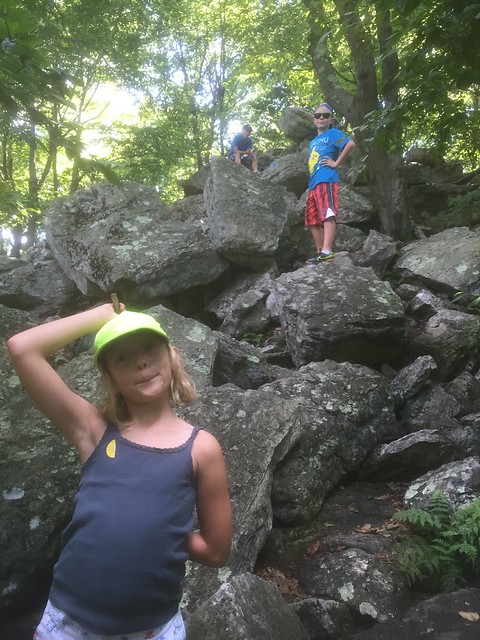
This being early August, there were no migrating raptors. We did see three black vultures soaring over the ridge. Besides migrating raptors, the non-profit association in charge of the center has an education center with many environmental initiatives. They developed a trail system and so we did a 5-mile loop from one ridge to the other ridge. I hiked the trails in July 2013 and I was so happy to have my children climb the many rocky hills. Oliver had the quote of the day as he was ahead of us on the walk and called back, “Mom, you are not going to like this, but for me it is cool!” As you can see from the video, there were some parts of the trail that required minor rock climbing. It was a good total body workout.
I am encouraged reading the history of the sanctuary. The thinking in the 1920s was to get rid of all predators including hawks and other raptors. Local hunters used to shoot them in hundreds during the migration. In 1931, Richard Pough, an amateur ornithologist, collected the dead the birds and photographed them. When a wealthy New York activist named Rosalie Edge saw the exhibition, she leased the mountain and put a warden in to stop the hunters. She eventually purchased the land and formed the Hawk Mountain Sanctuary Association. Through the forward thinking of a couple of individuals, the area today supports raptors in the their migrations and is flight of these majestic birds are enjoyed by thousands of people. I only wish she would have purchased more land to preserve even more forests, instead of the numerous farms that grow corn to feed cows.
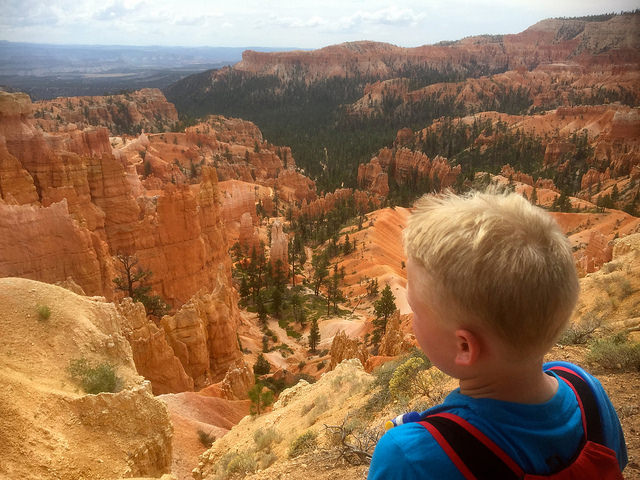
Oliver contemplates the amphitheatre of Bryce Canyon national park
The sandstone Colorado plateau in the southwest has a high density of national parks. We visited our third park on the last day of our stay in Saint George, the Bryce Canyon national park. It is a great hike for artists because the erosion of the sandstone has exposed a varied palette of colors. It is a more subtle beauty and lacked the majesty and scale of the Grand Canyon and Zion. We did a couple of figure 8 loops within the amphitheatre section of the park. It is compact and accessible so we ran into lots of tourists in the second portion of the walk. We completed the Peek-a-Boo loop and did portions of the Navajo loop, Queen’s Bridge trail and finished by walking along the rim.
One of my big take-aways from the trip that there are so many beautiful wilderness places outside of the national parks. There are numerous state parks, conservation areas and local trails that although they are not quite the splendor of the national parks, they lack the high numbers of visitors. I also would ban horses and mules from the parks. They urinate and defecate on the trails, causing foul odors for hikers. We didn’t have time to visit the three other parks in the area, Capitol Reef, Canyonlands and Arches.
There is a lot I loved about the Colorado Plateau region in Nevada, Utah and Arizona. Living in a metropolitan area of 20 million people in Japan, the wide open spaces and lack of people were so refreshing! The awesome geology – driving between towns in the region you see incredible cliffs, ridges, canyons and peaks that back in the eastern half of the US would be celebrated parks, here they are just a mundane part of the scenery, most not even reaching state park status as they don’t stack up against the even more awesome (I can use the word here in its original meaning!) national parks. The church of Latter Day Saints (LDS) culture in many ways is good in that it makes for tidy infrastructure, big families, lower crime rate and a wholesome, safe atmosphere. It truly is “big sky” country and the lack of trees gives you views of clouds and sunsets and sunrises that are just so pleasant.
It was over 20 years since I have been back to the region, I started my teaching career in Nevada and it brought back memories of that time. I noticed a change in the demographics and more Latinos and others from outside the region are providing a bit of diversity, to what used to be a very homogeneous culture, although it is still almost 90% white. Utah and to a lesser extent Nevada and Arizona are growing rapidly and I can see why. The outdoor activities are numerous and I would love the explore the thousands of trails on foot and bike. The weather is also good, a dry climate with hot summers and cool winters.
Ocean in Hurricane, Utah
The downside of the region is the isolation. One definitely needs a car to get around and I wonder about the intellectual and cultural outlets. Not being a member of the LDS church would also have its downsides and I wonder if my family would be accepted. The homes and buildings have a new, temporary feel to them and you don’t see many historic and distinct architecture.
We did do a bit of cultural and sightseeing activities besides the national parks. We saw the first stage of the Tour of Utah professional cycling race in nearby Cedar City, Utah. The racers did three laps around the city park and it was thrilling to see them come by at such fast speeds. The trailing support cars really brought home how fast the bicycles were travelling as I thought to myself the cars were going way too fast for residential streets. It is only a few moments of actually watching the riders, but the sponsors and city officials had a nice fan participation center in the park. I love cycling and want to continue developing my skills as it is a good way to save my knees. I want to be able to run in the next two decades and the years of long distance running (since middle school) means I must reduce the amount of kilometers I run. Cycling is a great way to do this.
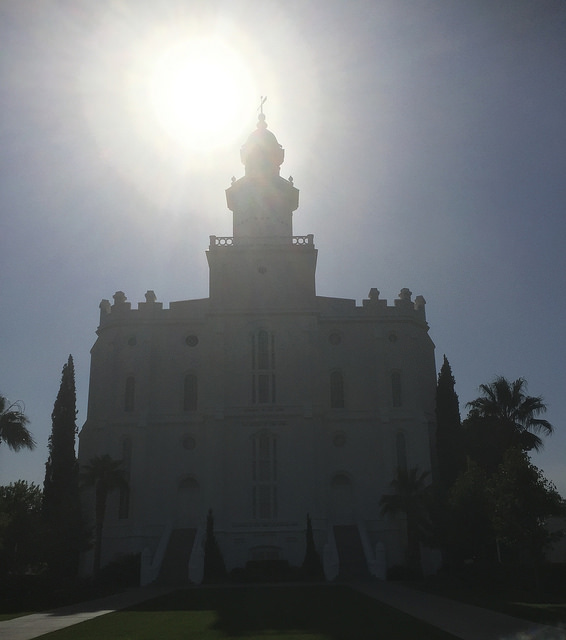
LDS Temple – Saint George, Utah
We also visited the Saint George Temple and the visitor center in the old part of Saint George. Brigham Young himself selected the site of the church, and unfortunately for the workers, it was over an underground spring, so they had to haul millions of pounds of rocks and pound them into a base with huge timbers brought from Arizona before building the impressive temple. When workers suggested they find another spot, Young said that is where God told him to place it, so with the typical Mormon work ethic, they got it done. I admire the resilience and cooperation it must have taken to colonize the region. Near the temple was the Dixie State College campus, reminding us that Saint George was originally a Mormon settlement to produce cotton. The Mormons were persecuted by the US government and had to flee to Utah, and there is still a bit of anti-government/Libertarian feel to the place. I can see why they consistently vote Republican in elections.
I would definitely consider retiring/settling down in the area, although we would be away from our family and friends. I hope to see more of the great American west and the Rocky Mountain / Great Basin region in the future. The wilderness is so accessible and there is so much of it!
Between Greg Milner’s Pinpoint and my Lehigh summer class, Teaching & Learning with Geospatial Tools, I realize the huge effect GPS (Global Position System) has on our life. Milner’s book is excellent, although the chapters covering the development of the GPS industry are a bit dry, and the book exposed me to ways GPS is used that I never even thought up. It was also good to learn how the whole system works. We take for granted the blue dot on Google Maps or WAZE , and how much went into getting this system up and going.
The US military developed GPS to more accurately drop bombs on its enemies. The 31 GPS satellites orbiting 20,000 kilometers above the earth are controlled and monitored by an air force base in Colorado. I didn’t even know about the NGA (National Geospatial-Intelligence Agency) the CIA of GPS, which controls the majority of the earth-based monitoring systems that keep GPS accurate and running. The military was slow in realizing the importance of GPS and its civilian applications.
GPS is being used more and more for such things as predicting earthquakes and tsunamis, airplane navigation and landing, tracking criminals, etc. Milner describes the phenomena of “death by GPS” where people follow the commands of a GPS unit to their deaths, whether off a bridge under construction or little-used roads in remote mountains where they become stuck and die. Relying on GPS has changed humans’ sense of place and the mental maps in our brains. For me, growing up without GPS, I rely on paper-based maps, landmarks and always knowing which direction is east/west/north/south. Recent generations may be losing this sense according to some experts and brains do not generate the connections for place sense like they used to. There is a lot of science in the book and some sections are full of acronyms and abstract topics. The latest advancement in GPS is accurately mapping the shape of the planet (it is more like a squashed grapefruit) and the minor changes caused by earthquakes, tides, etc.
I am interested in how GPS can be used in my field of education and learning analytics. I would like to do a study of tracking the movements of school leaders and maybe even teachers and students to see where we spend our time. Am I in my office for too long? Are there sections of the classroom or building that I am not getting to? Where should I be spending most of my time? Universities are tracking students’ time in the library and seeing if there is any correlation to failures. The book and class inspired me to apply for an EARCOS action research grant.
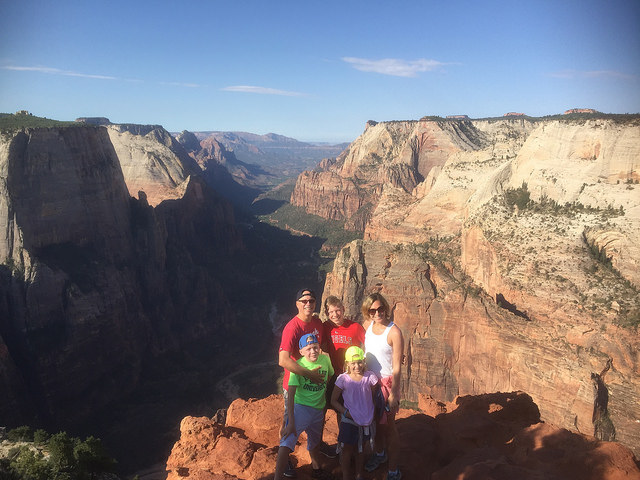
It may have been the most scenic hike I will ever do! Yesterday we climbed 2,100 feet in elevation and 10 miles in distance to make it to Observation Point, a beautiful overlook in the Zion National Park. You can see the Virgin River in the background, which carved the canyon out of the sandstone of the Colorado Plateau over millions of years. It was also our starting point for this glorious morning walk in stunning Zion.
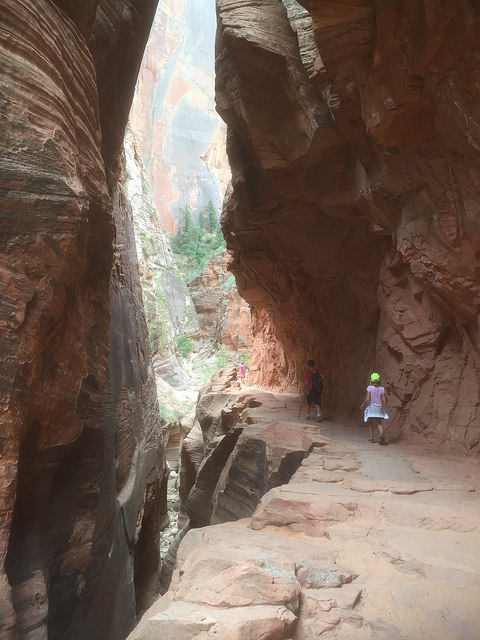
Nadia and I were proud parents of our children. They showed the grit of experienced hikers, easily making it to the top and back. On the way they needed to manage the many climbing switchbacks, a narrow trail with a cliff wall on one side and a precipice on the other. I was really tired upon our return and needed to take a nap, but the kids stayed awake in the house and later played tennis and swam in the pool.
Besides the amazing views at every turn, we saw lots of wildlife. A mule deer crossed our path near the start of the hike. An unidentified little gray bird mother was feeding her young in a nest near the end our goal of Observation Point. We also saw chipmunks, squirrels, a bluebird, lizards, etc. The hike was also varied in the types of rocks, trees, and canyon shapes. The Virgin River was very muddy yesterday after the flash floods the night before. Erosion in action!
The kids became official Junior Rangers when a park ranger saw them complete the strenuous hike and gave them badges. It is our last day
We learned a lot of geology yesterday during our hike from the north rim of the Grand Canyon. The Colorado River and precipitation carved through the dry, sandstone plateau during millions of years to create a breathtaking canyon. The earth’s strata are on magnificent display. Anyone with an interest in geology needs to visit the park. Simply awesome! It is crazy to think how a river winding through a dry, elevated plateau made something so grand.
The north rim much less visited than the iconic south rim. It is much harder to get to the north rim from Las Vegas, Flagstaff and Phoenix. The high elevation of the north rim (8,297 feet – 2,528 meters) means more rainfall. I was surprised at the heavy forested trails down the canyon. We were planning a light hiking day and so had a leisurely breakfast at the lodge. The view was absolutely spectacular and the food wasn’t bad as well. It didn’t feel crowded at all and had a Yellowstone feel with rangers giving talks, Smokey the Bear signs, cabins, etc.
Nadia at the north rim lodge.
We wanted to get down into the canyon a bit and so took the Kaibab trail 2.7 miles down to a man-made tunnel. The trail should have been called “mule poop” trail and we learned that mule urine smells much worse than mule feces. The scents from the ponderosa pines and views of the canyon made up for the occasional foul smelling excrement. It got much warmer as we made our way down the canyon. We were walking through time as the many layers of rock are visible. We only made it down to the 6th layer, the Redwall Limestone, a mere 340 million years old. The bottom layer is approximately 1,700 million years old. The way down is much easier than the way up so we didn’t go down as far as I wanted.
A Geologist’s Paradise!
Hiking can be tiresome and boring, but I find the long hours on the trail gives our family time to talk and reflect on our lives. We were sharing stories with the kids about when they were babies. They are fascinated in their own stories, and talking about them getting colic, changing diapers, drinking milk, etc. brings them much delight. It cements the bonds of family. I can’t wait for our return hike to Zion tomorrow.
The work of the Virgin River on the Navajo Sandstone in the Zion National Park is breathtaking! We were awestruck by the geology and beauty of the park. I can see why the US government wanted to preserve the canyon from development and make it accessible to all.
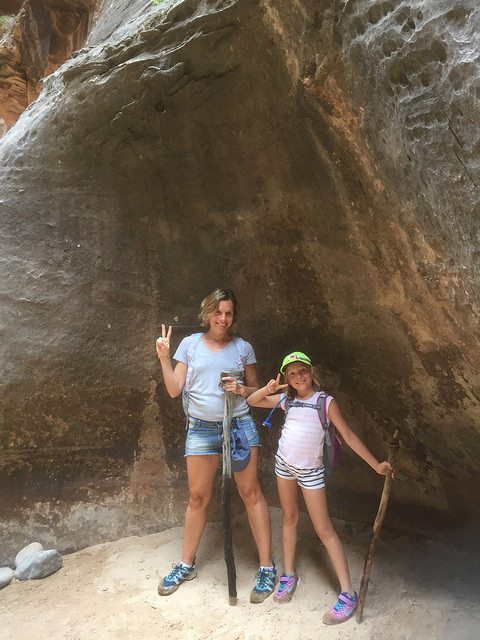
We spent the day yesterday in the park, arriving before sunrise and leaving exhausted at 4:00 PM. Our first hike was through The Narrows, an aptly named gorge at the end of the road leading through the canyon in the southern part of the 500 kilometer square park (larger than Guam). On a planet dominated by the impact of humans, walking through the river confined by the massive rock walls of the gorge, made me feel tiny and insignificant. The enormity of geological time it took for the river to carve through that much solid rock! Humankind has been here for such a short time and those rocks will probably be here long after humanity is gone. I know this is all a cliche, but when one is looking up a 200 meters+ sheer rock wall while standing in a gently flowing creek, it is the only thing that comes to mind.
The air was cool because the sun does not reach the bottom of the gorge very often. The cold water and green lushness were in stark contrast to the rest of southern Utah. Temperatures have been over 100 F all week with a relentless desert sun forcing us indoors in the afternoon. It was good to arrive on the first shuttle bus to trail so we had the river to ourselves in the morning. We walked the mile trail to where you can enter the water. The river depth ranged from ankles to mid-thigh and was easily fjorded. We walked 3 miles downriver to the Orderville side canyon, ate brunch and headed back out. On the way back, we ran into hordes of walkers. I highly recommend an early arrival!
In the afternoon we hiked the trail leading to observation point. We wanted to see some the canyon from a different perspective after being in the bottom of it for the morning. As you can see in the video, the views did not disappoint. We were a bit concerned for the kids, as the trail dropped off precipitously as we ascended quickly. The hot sun and steep incline caused the kids to whine a bit, but we made it to our goal of a shaded canyon area on the rim. This was my favorite part of the day. The contrast of the red/white rocks and green vegetation and blue skies was heavenly. The majestic canyon walls as a backdrop, made walking up the trail easier. It was one of the most beautiful places I have ever been to! After a rest day today, we will head back tomorrow to complete the hike to the top!
In reading about the park before the trip, we were worried about the crowds and the dangers of the park. Because we arrived at sunrise, there was absolutely no traffic and elevation rise of the strenuous trails takes the vast majority of visitors away. We met a few hikers, but mostly had the place to ourselves. Our children, ranging in age from 8-13 did fine on both hikes. They are experienced hikers and can handle a variety of terrains. I hope I’ve instilled in them a love of wilderness and being active outdoors.











 Bill's Blog