Gypsies in Belgrade

Above is a photo I took last weekend. We were on the way to an open market in New Belgrade. We stopped at the traffic light, and these three gypsies were asking for handouts from cars waiting in line. At the major intersections downtown and in New Belgrade, it is common to have gypsy beggars or window washers. It has been a source of fascination for our family since our arrival. This is my second post (for my first post, click here) on the gypsies and I intend to do more while I am living here.

I recently finished reading Isabel Fonseca’s excellent book, “Bury Me Standing: The Gypsies and Their Journey” in which she writes of her experiences of living with the Romany people of several Eastern European countries for 4 years.

There are over 100,000 gypsies living in Belgrade. They are an on-going social problem in the city. They get little support from the government and have difficulty integrating themselves into modern, Serbian society. The latest news was the government moving (bulldozing) of a settlement in New Belgrade. It seems that no one wants them to live in their neighborhood. There are gypsies that are successful, but most are extremely poor and outside of normal society. Beside hustling for money at intersections, they are also seen collecting cardboard and other recyclable materials or selling junk at markets in New Belgrade.

They remind me of the Aboriginal people of Australia. They have their completely separate culture and lifestyle living right next to a majority “Western” culture. They are closer to the North American Indians, and are more integrated than the Aboriginals, but the same view applies. Like the Slavs, the migrated to Serbia from the east. Researchers discovered they originally came from India, leaving about 16-20 generations ago (approximately 12th century). They stopped in central Asia (Armenia) and reached Serbia and eastern Europe in the 14th and 15th centuries. Their official name possibly dates back to their original caste in India. Fragments of their Indian origin are maintained today in many words in their language and their Hindu-like customs of cleanliness and superstition.

Their original nomadic lifestyle has ended in modern times.  Today they are mostly poor, illiterate, living on the edges of cities and towns. There are an estimated 6 -11 million gypsies world wide with most in Eastern Europe. The biggest population is in Romania. Fonseca reasons they were used as slaves in historical Romania and that explains the high numbers there. They have been persecuted since their arrival to Europe. They are the forgotten part of the Holocaust.

The girl above is probably the mother of the baby in her arms. Gypsies have their own cultural norms and one of them is to become a mother as soon as physically possible. What is amazing is many are illiterate with no concept of history, time, and Western cultural literacy.

Ocean is up and I need to attend to her. I’ll be writing more in the near future…

Below are some excerpts from the Rom News Network a website based in Germany that produces news items about the Romany people. I took the excerpts from an article by Olga Nikolic, called, “Life on the Margins of Society” from 2001.

“Romanies form the youngest portion of the population in Serbia – over a half, 62 per cent of them, are under the age of 25, while only 4,1 per cent of them are over 60 years-old. The said age structure is accounted for by experts as the result of high birth and death rates and a low average life expectancy. According to some statistics, the average Romany life span is 10 per cent shorter than is the case when all other citizens of Serbia

Dragoljub Atanackovic, the president of the Romany Congressional Party, claims that 90 per cent of Romanies live in extremely insanitary conditions and that in Belgrade itself there are 60 enclaves with over 90 thousand Romanies living in wretched circumstances. “The social position of Romanies is exceptionally difficult. But three per cent of the population of working age are employed, only 31 per cent have primary school education, the rest are half-illiterate or illiterate. We do not have a single newspaper in our mother tongue or a radio and TV program financed by the government.

According to statistics, the rate of unemployment among Romanies is four times higher than is the case with the country’s majority nation and in the past ten years the negative ratio has doubled. Every fifth Romany of working age is illiterate and every third has merely primary education. A fifth of all Romany families have no earnings whatsoever, while the majority barely survive by doing odd jobs in the black market sector, such as selling contraband cigarettes and similar smuggled goods or by collecting secondary materials.”

Visit to the Bajrakli Mosque


The minaret of the Bajrakli Mosque


Tuesday I tagged along with the grade 8 humanities class as they took a tour of the Bajrakli Mosque in downtown Belgrade. It was my first time to a mosque and I felt like the Ottomans were speaking to me. The name Bajrakli means banner or flagship. The name originates from when the Ottomans left Belgrade in the early 1800’s, this was their lasting monument of their presence.

The mosque was built in 1690 by Sultan Suleiman during the heydey of the Ottomans in Serbia. At the time, there were 22 mosques in the city, and this is the last one remaining today, although the iman told us several newer mosques are being built. The Austrians converted it to a Jesuit church for a short time, and then when they left, it was reopened as a mosque. The iman showed us the window that was walled up on one side of the mosque by the Austrians.

As you can see, the minaret is the classical Turkish style -thin, with a pointed cone peak. The mosque featured a huge dome, typical of the Ottomans and strongly influenced by the Byzantines. I also noted that St. Sava’s Cathedral has a large central dome. 


Ottoman Stonework
Ottoman Stonework

The authorities of the mosque were very kind to allow us access to the mosque. I understand in countries with a more strict interpretation of Islam, non-muslims may not be allowed as much access as we did. The iman explained the prayer service, and answered all of our questions regarding the building and the faith of Islam. I guess the Balkan form of Islam is more like the Turkish form than in Saudi Arabia. From his talk I learned the following:

  • Allah has 99 names which are related to His virtues. In a mosque, pictures of humans are not allowed and so the 99 names were written on plaques in Arabic script. 
  • Islam has prayer beads similar to a Catholic rosary. There are beads of 33 prayers or 99 prayers. 
  • The congregation worships in straight lines to emphasize their equality before god. 
  • They always face towards Mecca. 


The students align as worshippers would as the Iman explains the prayer service.

I would like to thank Mr. Vrbaski for allowing me to attend the trip with his class. I would also like to thank the mosque authorities for giving us the opportunity to experience a mosque. The students unit on Islam was really enhanced with this trip. It was also nice to see the students translating for us, the iman’s Serbian speech to English. 

The mosque trip also continued to perk my interest in learning more about the Ottoman empire. 


The girls wore headscarves upon entering the mosque.

Family Journal: Friday December 26, 2008


This morning we went down to Nikola Pasic Square in downtown Belgrade and did some skating. The city has an outdoor rink over the Christmas holidays and so we took advantage of skating. It was really nice to be surrounded by beautiful old buildings like Parliment and enjoying the fresh wintertime weather.

Owen is quite good and able to move around on the ice. This is from his roller blading in Venezuela. Ollie had a tough time with it and never did get the hang of it. He is a bit young. Nadia was getting into it and made it around the ice several times. I really enjoyed myself as I haven’t skated for a long time. We hope to go back again and are considering buying skates. We’ll see.

This afternoon I took my car down to get the oil changed and antifreeze put in. The air bag light keeps coming on so I also got that checked. We leave tomorrow for Slovenia so I wanted the car to be ready to go. Later on, Brad and I took the boys for a night walk through the parks near our house. We played spy games and the boys enjoyed it, despite the -2 Celcius (28 F) weather. The snow stayed on the ground from yesterday but no new snow today. There is a 20% chance of snow this weekend and temperatures will be below freezing both days.


Mama taking a break with the boys

Family Holiday Journal December 21, 2008: Visit to the 25th of May Museum

Lil’ angel Oliver sure looks holy in this photo. We stopped at the St. Sava’s Cathedral with his grandfather, Hermes Chavez (affectionately known as “Popa” by the boys) to show him the scaffolding. Hermes owns a scaffolding rental and sales business in his hometown of Santa Cruz. The cathedral is under restoration now that is is finally peaceful in Serbia.

The girls (Alejandra & Nadia) went with Brad & Ocean to the big outdoor market downtown while Hermes and I took the boys the cathedral. We then visited the 25th of May Museum. The museum holds memorabilia and the mausoleum of the former Yugoslav leader, Josip Broz “Tito”. The museum is named after his birthday. The day used to be huge in Yugoslavia. One of the events was the annual running of the baton across the country by socialist youth. The boys were fascinated with the different batons.

They wanted to know which baton was the oldest (1945) and the newest (1985). The first was right after WWII when the Partisans rid the country of the Nazis, and the final one was five years after the death of Tito. There was a wall display of different batons that were gifts to Tito. The boys were picking their favorites. Most had very cool socialist themes. There was the heavy industry factory baton, a red star on top of a standard screwdriver, another with a JNA tank, a rocket missile, etc. Perhaps I’ll have them make their own batons in the Communist Style of the 60’s and 70’s. A big part of the complex is showcasing the gifts Tito received from Heads of State and Yugoslav citizens throughout the years. The current exhibition were a display of all of his hunting rifles and equipment. He was a big-time hunter and there were antler trophies mixed in with the guns, and photos and videos of his hunting trips. Tito started the Non-Aligned Movement and the museum housed many gifts from developing countries including an elephant tusk gong from Burma and a devil carnival mask and costume from Lake Titicaca in Bolivia. My only criticism of the museum is I would have liked a bit more information about his career and personality. I envisioned the place like the Carter Center or Clinton Library, that would be a place to for scholars to study the writings, photographs, etc. of Tito. It was more a showcase of his gifts more than anything else. It does hold his remains. Owen asked should we say a prayer when I explained that his remains were probably buried under the big marble tombstone. I replied that he was an atheist and didn’t believe in God so we shouldn’t.The museum is close to our house, located between Haid Park and the Partizan Football Stadium.

For a man that believed in communist ideals, he sure lived a life of luxury.

The boys yearned to be good socialist youth!

Oliver, Owen, and Sebey loved running around the complex. The grounds were nice although a bit neglected. They were running up and down the hills and stairs and in between the many trees. We then went home and played soccer in the yard with Brad. Nadia is cooking a delicious soup while everyone else is playing Wii.

Roma Girl

This beautiful little girl was begging on the side of the road a few weeks ago. Our taxi was stopped in traffic on the entrance ramp to the bridge that spans the Sava River here in Belgrade. She came up to our car and so we gave her some coins. Broke my heart to see such a lovely child living in such horrible conditions.

She is a member of the Romani people, otherwise known as gypsies. There is a settlement of around 400 families that lives near the Gazelle Bridge. We see them as we go to and from New Belgrade to our suburb of Senjak. The Romani of Serbia are known as “Machvaya” and they are quite numerous here. You see them often collecting card board and garbage from the receptacles in the streets. They eek out a living by collecting refuse and recycling it.

A Gypsiemobile cruising by with a load of cardboard.
A "Gypsiemobile" cruising by with a load of cardboard.

The settlement under the bridge has been there for decades. As you can see from the photo below, they live in absolutely horrendous conditions. I just imagine what it will be like in the winter. There is an incredible amount of stuff they have collected. More Roma have recently come as there has been talk of the city government will relocate them and provide them with housing. The problem is no one want them as a neighbor. There are plans to renovate and expand the bridge, and the settlement will have to move. Although this has been planned for years.

Main Street on the Gazelle Bridge Roma Settlement

The Roma are fascinating. I don’t understand why they cannot be helped and integrate into society. I really want to help them! They look different that the Latinos of South America and I am interested in learning more about them. You will probably see more posts in the future.

Typical House in the Gazelle Bridge Settlement

The Eternal Derby


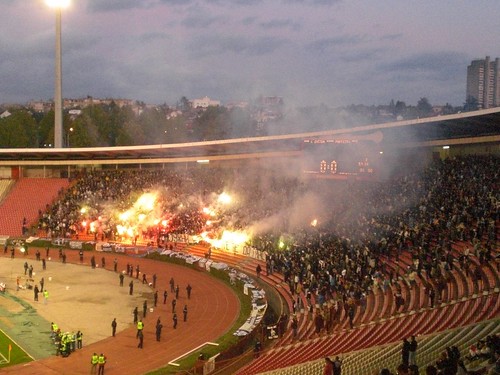
Sunday Oliver and I attended the “Eternal Derby” in Belgrade. The derby is the game between the two biggest teams in the Serbian Professional Soccer League, Red Star and Partizan. The game was held in the Red Star Stadium (Crvena zveda in Serbian) in front of over 20,000 spectators.

Both teams are known for their fanatical hooligans, and I was a bit tentative from attending the game. But the father of one of my students kindly purchased tickets in the VIP section of the stadium for us which was safe. The father happened to be former NBA basketball star Vlade Divac. He hand delivered them to me on the morning of the game. You can see him behind Oliver’s head in the background of the photo above. He is known for his kindness and humanitarian service and it is true. It was a very nice gesture and I want to give him a huge thank you! Please donate to Humanitarian Organization Divac. Vlade is a big star still here in Serbia. I guess the equivalent of this in the US would be Magic Johnson giving us tickets for a Laker-Celtic game. Very cool!

The stadium had an amazing atmosphere! The fans of Partizan especially sang, had banners, fireworks, etc and were on their feet the entire game. We went to the game with my colleague, Luiz, a science teacher in the secondary school. He is from Brazil and used to this kind of rabid fans, but even he was impressed.

The Partizan Fans Celebrate A Goal

Partizan won this 134th edition of the derby, 2-0. There were many goal opportunities for both teams and the action was non-stop. This is Partizan’s sixth straight win in six rounds of the league and they are in first place. Red Star is in eigth place out of twelve teams, with 2 wins, 2 ties, and 3 losses.

Red Star is the biggest and most popular team in Serbia. They were formed in 1945 shortly after Tito took over, hence the communist red star symbol. They won the forerunner of the European Champions League in 1991, the only former Yugoslavian team to do so. Since the breakup of Yugoslavia, they have fallen on hard times, as most of the top Serbian players go for the higher salaries of other European leagues. Oliver is a big fan of Red Star and so am I.

Partizan is more of a working class team and the second most popular team in Serbia. They were also … (time to go to school, I’ll finish this post later.)

St. Sava’s Church


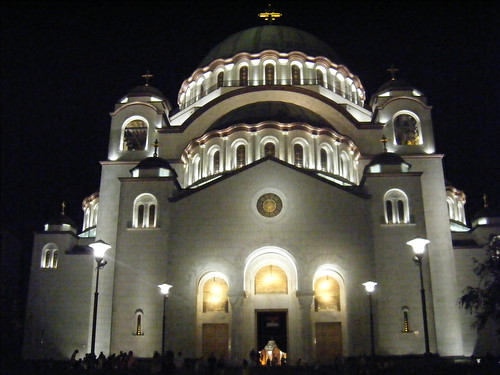
I took a photo Friday evening inside the giant St. Sava’s Church here in Belgrade. The church’s massive dome is 70 meters high and 10,000 people can attend mass. It can be seen from all over city. It is the third largest Orthodox church in the world and the largest neo-Byzantine building constructed in the 20th century. The Byzantine architecture style features a large, central, dome and thin windows to let in light. The inside is truly awe inspiring!

We walked down to the church from the main shopping area. I was surprised to see so many children and families near the church. It sits on a small hill surrounded by a park. There were roller bladers, kids playing tennis on the outside walls of the church, and teenagers riding mopeds up and down the side walks. No holy reverence here which is refreshing to experience. The church was open and a few people were taking photographs and looking around. Oliver and I went inside and were blown away.

As you can see in the photo, work is still being done on the church. Construction did not begin until 1935 and has been interrupted by the numerous wars Serbia has experienced. This is the first Orthodox Church I have been in and I was impressed by the mosaics on the walls, which are another feature of the Byzantine style. The Orthodox Church in Serbia is not under the direction of Greece and is independent and has its own pope (Patriarch) and hence the Serbian flag prominently displayed on the front entrance.

St. Savas Church At Night
St. Sava's Church At Night

The grave of Serbian Saint Lazar is in the basement of the church. He is the Serbian Jesus. He was a Serbian noble who died at the famous Battle of Kosovo in 1389. According to legend, he was visited the night before the battle by the Prophet Elijah in the form of a gray falcon. Elijah offered Lazar an Earthly Kingdom or a Heavenly Kingdom. Lazar takes the Heavenly Kingdom, but to earn it, he has to die on the battlefield. He was canonized by the Serbian Orthodox Church and his feast day is the most holiest of all days in the Serbian calendar, June 28.

The church is named after the son of the founder of the Serbian medieval empire. Sava was originally Prince Rastko Nemanjić and he lived in the late 1100’s – early 1200’s. He was the founder of the Serbian Church. The location of the church was put here because Sava’s remains were believed to be burned here in the 1500’s by the Ottoman Turk leader Sinan Pasha.

I really felt I was at the heart of Serbdom! With the church being in the center of Belgrade, the capital of Serbia and with the remains of two of the founders of the Serbian nation and church here, you can’t get more Serbian than this. With the breakup of Yugoslavia over and a new era for Serbia, hopefully they can complete the church. The church represents the long history of the Serbs and the bright future ahead for the country.