Inner City Night Patrol

I got to see another side of Osaka last weekend when I accompanied the students from our school on a community service activity. We went to the Sanno Childrens Center in the poorest ward of Osaka, Nishinari-ku. The ward is infamous in Japan for its crime rates, red light district and homeless. Now this being Japan, a country with one of the lowest violent crime rates in the world, I felt quite safe and yes it did seem a bit run down and not as new and tidy as other parts of the city, but compared to disadvantaged districts in cities in other parts of the world, it is extremely safe.

The Childrens (Kodomo) Center was founded in the 1960s by German missionaries. To this day, it continues to provide after school care and other services for children from the ward. As you can see from the photo above, one of the children the center cares for was fascinated with my European, bald, head. One of the initiatives of the center is a monthly yomoguri or night patrol. Volunteers led by the pugnacious director of the center Mami, lead groups into the streets to deliver food (onigiri – spheres of rice wrapped in seaweed) and blankets to the homeless men sleeping in the streets of the shopping arcades in the district. I was filled with a sense of goodness seeing how grateful and kind the men were in talking with the students, including my 7 year old daughter.

Mami gives us instructions for the patrols and you can see Ocean leaning over the middle of the table.

Within Nishinari-ku is a neighborhood called Kamagasaki. This area is home to many male day laborers, who through a variety of circumstances (gambling, alcohol, mental illness) are homeless. The government forbids the official use of the name and they try to hide media from portraying issues in the area. A recent NHK documentary about the Sanno Childrens Center featured one of the orphans the center cares  for and it has brought increased donations to them. It was sad to see them laying on newspaper with cardboard boxes around them as their only protection against the elements. It gets cold at night in Osaka in November. There are several organizations helping them, including a center to organize them finding short-term manual labor, free or reduced price shelters, etc.

We also walked through Tobita Shinchi, another neighborhood within the ward. Tobita Shinchi is infamous for its red light district. As in Amsterdam, the women are displayed for street view, although here, it is open air and the architecture is old Japan style. They were only protected by an elderly woman minder that sat to the side of them. She yelled at me when I tried to take the photo (see below). The police tolerate prostitution, but again, I felt sorry for the girls, as it is a tough way to make a living.

I was so inspired to help and want to make it a regular part of our experience while we are here. I would like to thank Lyn and Hannah for assisting me and Ocean and introducing us to the center.


Osaka Soul Food: Okonomiyaki

The cool autumn weather has finally arrived here in Minoh. Last night the temperature dipped down into the 40s F (5-7 C) and so we wanted a hot meal. We rode our bikes to a restaurant in our neighborhood called Warai. They specialize in Okonomiyaki. The okonomi part of the word means “as you like it” and yaki means grilled or cooked. This style of food is associated with our Kansai region and a there is a slightly different version in Hiroshima. It is popular throughout the country. It is interesting that I have never seen it featured in Japanese restaurants outside of Japan.

The best thing about these types of restaurants is the hot stove that is seated in the table top and the little spatulas everyone is given. The kids love being able to do some “cooking” but one has to be careful with younger children that they do not burn themselves. The staff brings out various dishes half-cooked and lets patrons finish them on the hot stove. The stove also

The famous pancake of Osaka!

We ordered squid, corn and dumplings as the first course. The second course was the famous Osaka pancake. It is made of flour mixed with cabbage and yam, and either seafood or meat is added. It is topped with super thin fish flakes and you can add Japanese mayonnaise or the signature sauce of okonomiyaki, which is like  Worcestershire sauce. I love them and it is known as the soul food or signature dish of Osaka.

Delicious squid and corn

There are many restaurants that serve Okonomiyaki. Warai is a chain of family-style restaurants and there are over 20 in Osaka and Kobe. It is conveniently located for us and is kid friendly. I am looking forward to comparing the Hiroshima-style pancake.

Nadia and Oliver in front of the restaurant in Onohara.

Visualizing 17 Million People

Looking up at the Umeda Sky Building

One of the biggest adjustments for me in our move to Japan is living in a very large city. The metropolitan area of Osaka – Kobe – Kyoto has a population of over 18 million people. That is larger than Moscow, Cairo, Los Angeles, and Bangkok and ranks #14 in the world, just below Mumbai. The three cities are known as Keihanshin and the GDP of this area is roughly the same as London or Paris. There is a lot of people here and a lot of money. The most populous metro area in the world is Tokyo with almost 40 million people. It has a population density higher than Bangladesh. I will certainly be exploring Tokyo in future visits.

The view towards Osaka Bay from the top of the building

Although we live in a big metro area, we do not feel it on a daily basis. The school is located in the suburb of Minoh, which is 17 kilometers (10.5 miles) from the city center. By train it is about 20 minutes. We live only a few blocks away and it is about a 5-minute walk to school. Minoh is full of parks, wide sidewalks, bike paths, and is minutes away from the forested hills of a “quasi national park” so one gets the impression of living in the suburbs of any city. The only time we get a sense of the vastness of Keihanshin is when we take the train into the center or go over to Kobe. The apartments, houses, and businesses go on endlessly.

Our goal yesterday was to get to the top of the Umeda Sky Building. This is an Osaka landmark, built by Toshiba in 1993. During the heady real estate boom of the late 1980s they had originally wanted 4 interconnected towers, but only built two. In between the two towers at the top, there is an outdoor observatory, an escalator on one of the top floors leading across the open space, and modern sitting area with restaurants and cafes. The views are spectacular. They really helped me see how big Keihanshin really is. It goes on forever with hundreds of skyscrapers, all the way out to the Osaka Bay. Around the Sky Building, there are some parks, wide walkways filled with cafes, restaurants, and shops. It is very pleasant, except when one gets closer to the Umeda train station, as there are too many people for my taste in that station.

The garden next to the Umeda Sky building

We had dinner in the basement floor of restaurants. In Japan, it is common for entire floors of buildings or train stations to be devoted to restaurants and bars. There were probably 20 different restaurants to choose from. We chose an Indian restaurant and it was really good. I recommend a visit to the building. The architecture is interesting, it is a really nice area, and the views, especially at night or at sunset are beautiful. It gives one a good sense of the layout of the city.

Growing up in a small town of 900 people in a very rural and isolated part of northern MIchigan, living in a city that has twice as many people as the state of Michigan, is going to take some getting used to. In some of my previous postings overseas, I have lived in cities of around 2 million (Perth, Santa Cruz, Barranquilla, Belgrade) but never this big.

View looking towards our house – Yodo River in foreground

The Times Square of Osaka: Dotonbori

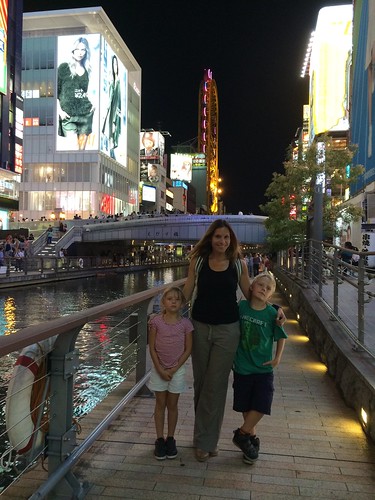
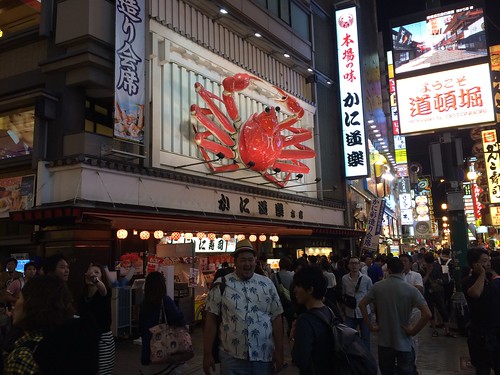
Last night we ventured to the heart of Osaka to the famous neighborhood of Dotonbori. This is the crazy stereotypical urban Japan at its finest, with huge neon billboards, throngs of people, deep-fried octopus dumplings, steaming ramen restaurants, crazy fashion and futuristic designed buildings.

Yasui Doton designed this area as an entertainment hub over 500 years ago. HeThe entrepreneur dredged a canal (bori comes from hori, to dig) of the tiny Umezu River. The area was always zoned for entertainment and originally was a theatre district, the last theaters being destroyed in WWII.

Dotonbori today reminded me of a nicer Times Square. The canal at night is surprisingly peaceful, despite the tour boats passing by and the thousands of shoppers and eaters passing overhead. The number of shops are restaurants must number in the thousands. As it was our first time, we were a bit overwhelmed and with the kids being a bit tired, we struggled in finding a suitable restaurant for a family of 5.

The canal of Dotonbori

There are several icons of Osaka, which is the food capital of Japan. Above the restaurants there is a  giant mechanical crab, octopus, and fugu fish, all advertising the cuisine of Osaka. We stopped to take photos in front of  the Glica Running Man, which is a symbol of Osaka. The giant neon sign was taken down by the candy company Glica, and in its place is a regular billboard portraying a running girl. They did have a small version of the original for tourist. The buildings in Osaka are amazing. The designs and lighting are futuristic and sometimes you feel like you are in a sci fi movie like Blade Runner.

Ocean and Nadia in front of the Glica Running Man

Dotonbori is located just outside the Namba Station, one of the hubs of the Osaka train system. It is certainly exotic and if you are not bothered by crowds, it is a good night out. We will go back again now that we know the place a bit, and sample some more of the Osakan cuisine.