Gypsies in Belgrade

Above is a photo I took last weekend. We were on the way to an open market in New Belgrade. We stopped at the traffic light, and these three gypsies were asking for handouts from cars waiting in line. At the major intersections downtown and in New Belgrade, it is common to have gypsy beggars or window washers. It has been a source of fascination for our family since our arrival. This is my second post (for my first post, click here) on the gypsies and I intend to do more while I am living here.

I recently finished reading Isabel Fonseca’s excellent book, “Bury Me Standing: The Gypsies and Their Journey” in which she writes of her experiences of living with the Romany people of several Eastern European countries for 4 years.

There are over 100,000 gypsies living in Belgrade. They are an on-going social problem in the city. They get little support from the government and have difficulty integrating themselves into modern, Serbian society. The latest news was the government moving (bulldozing) of a settlement in New Belgrade. It seems that no one wants them to live in their neighborhood. There are gypsies that are successful, but most are extremely poor and outside of normal society. Beside hustling for money at intersections, they are also seen collecting cardboard and other recyclable materials or selling junk at markets in New Belgrade.

They remind me of the Aboriginal people of Australia. They have their completely separate culture and lifestyle living right next to a majority “Western” culture. They are closer to the North American Indians, and are more integrated than the Aboriginals, but the same view applies. Like the Slavs, the migrated to Serbia from the east. Researchers discovered they originally came from India, leaving about 16-20 generations ago (approximately 12th century). They stopped in central Asia (Armenia) and reached Serbia and eastern Europe in the 14th and 15th centuries. Their official name possibly dates back to their original caste in India. Fragments of their Indian origin are maintained today in many words in their language and their Hindu-like customs of cleanliness and superstition.

Their original nomadic lifestyle has ended in modern times.  Today they are mostly poor, illiterate, living on the edges of cities and towns. There are an estimated 6 -11 million gypsies world wide with most in Eastern Europe. The biggest population is in Romania. Fonseca reasons they were used as slaves in historical Romania and that explains the high numbers there. They have been persecuted since their arrival to Europe. They are the forgotten part of the Holocaust.

The girl above is probably the mother of the baby in her arms. Gypsies have their own cultural norms and one of them is to become a mother as soon as physically possible. What is amazing is many are illiterate with no concept of history, time, and Western cultural literacy.

Ocean is up and I need to attend to her. I’ll be writing more in the near future…

Below are some excerpts from the Rom News Network a website based in Germany that produces news items about the Romany people. I took the excerpts from an article by Olga Nikolic, called, “Life on the Margins of Society” from 2001.

“Romanies form the youngest portion of the population in Serbia – over a half, 62 per cent of them, are under the age of 25, while only 4,1 per cent of them are over 60 years-old. The said age structure is accounted for by experts as the result of high birth and death rates and a low average life expectancy. According to some statistics, the average Romany life span is 10 per cent shorter than is the case when all other citizens of Serbia

Dragoljub Atanackovic, the president of the Romany Congressional Party, claims that 90 per cent of Romanies live in extremely insanitary conditions and that in Belgrade itself there are 60 enclaves with over 90 thousand Romanies living in wretched circumstances. “The social position of Romanies is exceptionally difficult. But three per cent of the population of working age are employed, only 31 per cent have primary school education, the rest are half-illiterate or illiterate. We do not have a single newspaper in our mother tongue or a radio and TV program financed by the government.

According to statistics, the rate of unemployment among Romanies is four times higher than is the case with the country’s majority nation and in the past ten years the negative ratio has doubled. Every fifth Romany of working age is illiterate and every third has merely primary education. A fifth of all Romany families have no earnings whatsoever, while the majority barely survive by doing odd jobs in the black market sector, such as selling contraband cigarettes and similar smuggled goods or by collecting secondary materials.”

Princess Katherine

It is not everyday that I find a message from my administrative assistant like the one above. “Oh, Mr. Kralovec, by the way, the Princess called you twice this morning and wants you to call her.”

Serbia does have a royal family. Princess Katherine married into the Serbian royal family and is from Greece. The crown prince of Serbia, Alexander Karađorđević, married Katherine in 1985 in London. It was the second marriage for both. Alexander’s family goes back to the first Serbian uprising against the Ottomans in 1804. His ancestor was the famous, Black George, who established an autonomous Serbia within the Ottoman Empire. George, like most Serbians at the time, came from typical peasant stock, growing up on a pig farm. Very nice to see that Serbia didn’t import their royals like many European countries did.

Alexander is the “crown prince” and the official heir to the vacant throne. His father, Peter, was the last king of Serbia before Tito and the communists came in 1945 and got rid of the monarchy. Alexander is a good guy, having come back to Serbia permanently in 2001. He says that Serbia must first establish a democracy before they can establish a monarch again. He lives close by in the Royal Palace. Katherine invited the school to come anytime to take tour.

Alexander and Katherine do much charitable work here in Seriba. Katherine heads the HRH Crown Princess Katherine Humanitarian Foundation
and she is working with the ministry of health to improve the health care system of the country. Her current focus is cervical and breast cancer. She had a charity fashion show last night to raise funds for a cervical cancer center. Serbia’s health care needs improvement and it is nice to see her taking a role in improving it.

Princess Katherine called asking if the school would promote the charity show with our families. I was hesitant to do this, because we often receive requests from organizations seeking access to our community. In this case, I allowed it because it was for a non-profit organization dedicated to helping Serbia. It is a chance for ISB to give back to our wonderful host country. I hope to visit the palace someday and meet the Princess in person.

That is a cool thing about living in a small country and working at an international school. I get to meet and work with the leaders of Serbia. If I was working in a school in the USA, that would not be possible. I feel honored and grateful to be a part of ISB.

Serbian Orthodox Christmas Eve

Parishioners Gather Collectively Burn the Badnjaks

Yesterday we participated in a Serbian Christmas tradition. The Serbs celebrate Christmas today, January 7th, because they still use Julius Cesear’s originally calendar. It was replaced by the modern Gregorian calendar because the Julian calendar required too many adjustments through the years to keep it accurate. One of the remnants of the old Slavic religion is the custom of the burning of the “badnjak” on Christmas Eve (January 6th).

In earlier times when most Serbs lived in the countryside, the father used to head into the woods and fell a young oak tree. The badnjak was a big log that was then thrown onto the fire in the hearth of the home.Today, most Serbs live in the cities and the tradition has changed a bit. The log (kind of like a yule log) is represented by these thin branches arranged like a bouquet of flowers. They sell them all over the city and that is what first got us interested in the custom. We were wondering, what were these dead leaf arrangements?I took the photo below while we were running errands. We bought a couple and found that attached to the bottom was a plastic bag of sunflower seeds and corn kernels with a ribbon.

A large badnjak market in downtown Belgrade, near the Kalenica Market.
A large "badnjak" market in downtown Belgrade, near the Kalenica Market.

Another change in modern times is the badnjaks are burned collectively in a church yard instead of the family fireplace. Our nanny Vera, invited us to attend the mass and ceremony at the St. Trifun Church located in Topčider Park near our house. It was a bitterly cold night but we managed to get all the kids out. We first lit candles in a little side house next to the church. The bottom shelf where the candles were placed in sand was for souls of the dead and the top shelf for the living. The boys said a short prayer for their all of their grandparents. The church was too full to attend the mass. I was raised Catholic and am very curious to attend an Orthodox service. We did see the interior of the church and it was much different than a Catholic church.

We did join in the procession following the short service. It wound its way around the church and then into the front yard. It was led by the priest and several altar boys and men carrying banners and incense. After a few words, the bales of hay were ignited and people began throwing their badnjaks on the fire. It is supposed to bring health, wealth, happiness, money, etc. in the upcoming year. Owen and Oliver were thrilled with the large fire and the opportunity to throw in their badnjaks. Owen and I hung out by the fire as we are both pyromaniacs. Nadia, Oliver, and Ocean were cold and went straight back to the car.

Saint Trifun Church

The ceremony for me had a greater significance than just experience Serbian culture and an Orthodox church ritual. In the old Slavic religion, trees were sacred. The Serbs today hold a great reverence for trees as I do. It harks back to original Slavic religious thought. In burning of the log,it represents a sacrifice to the gods, and the fire also represents sunshine. With today’s temperature of -7 C and icy fog limiting visibility, I can understand the Slavic tribes reliance on the spring sun. I can also imagine what it was like for them before modern heating and home construction.

I facilitated a course last year for a student at my school in Venezuela (Evan Huff). He was interested in Vikings and we did a Teaching Company course on the history of the Vikings. Part of the lectures dealt with Norse religion. It made me wonder what the world and Europe would be like without Christianity. A part of me is disappointed that a Middle Eastern religion conquered the world. It would be interesting to see what would have happened if the Slavs and other peoples of Europe never converted to Christianity. The preferred tree for the badnjak is the Oak Tree, which is strongly associated with the supreme Slavic god, Perun. Perun is similar to the Norse god Thor.


Saint Trifun Church

European Gas Prices

Lots of people ask me how much gas costs in Serbia. I took a photo of the meter when we filled up yesterday at Beopetrol gas station in our neighborhood. I put in 50 liters (13 gallons) into Edelweiss and it cost 3,900 Serbian dinars. That comes to $63 at today’s rate of 62 dinars per 1 US dollar. Doing the math then, that comes to $5.80 per gallon. Much higher than anything in the USA! The “dinara” is the plural for the Serbian currency the Dinar.

We don’t buy a lot of gas as we live very close to our school. Most of our driving consists of a weekly trip to New Belgrade for grocery shopping. We are trying to do more on weekends and that will also mean more gas consumption.

To put the $5.80 into perspective, the average gas price in the USA this week is around $1.60. It is about average for Europe with Norway $7.76 being the high and Estonia being the low $4.30. I sure miss the 12 cents / gallon of Venezuela.

Family Holiday Journal December 21, 2008: Visit to the 25th of May Museum

Lil’ angel Oliver sure looks holy in this photo. We stopped at the St. Sava’s Cathedral with his grandfather, Hermes Chavez (affectionately known as “Popa” by the boys) to show him the scaffolding. Hermes owns a scaffolding rental and sales business in his hometown of Santa Cruz. The cathedral is under restoration now that is is finally peaceful in Serbia.

The girls (Alejandra & Nadia) went with Brad & Ocean to the big outdoor market downtown while Hermes and I took the boys the cathedral. We then visited the 25th of May Museum. The museum holds memorabilia and the mausoleum of the former Yugoslav leader, Josip Broz “Tito”. The museum is named after his birthday. The day used to be huge in Yugoslavia. One of the events was the annual running of the baton across the country by socialist youth. The boys were fascinated with the different batons.

They wanted to know which baton was the oldest (1945) and the newest (1985). The first was right after WWII when the Partisans rid the country of the Nazis, and the final one was five years after the death of Tito. There was a wall display of different batons that were gifts to Tito. The boys were picking their favorites. Most had very cool socialist themes. There was the heavy industry factory baton, a red star on top of a standard screwdriver, another with a JNA tank, a rocket missile, etc. Perhaps I’ll have them make their own batons in the Communist Style of the 60’s and 70’s. A big part of the complex is showcasing the gifts Tito received from Heads of State and Yugoslav citizens throughout the years. The current exhibition were a display of all of his hunting rifles and equipment. He was a big-time hunter and there were antler trophies mixed in with the guns, and photos and videos of his hunting trips. Tito started the Non-Aligned Movement and the museum housed many gifts from developing countries including an elephant tusk gong from Burma and a devil carnival mask and costume from Lake Titicaca in Bolivia. My only criticism of the museum is I would have liked a bit more information about his career and personality. I envisioned the place like the Carter Center or Clinton Library, that would be a place to for scholars to study the writings, photographs, etc. of Tito. It was more a showcase of his gifts more than anything else. It does hold his remains. Owen asked should we say a prayer when I explained that his remains were probably buried under the big marble tombstone. I replied that he was an atheist and didn’t believe in God so we shouldn’t.The museum is close to our house, located between Haid Park and the Partizan Football Stadium.

For a man that believed in communist ideals, he sure lived a life of luxury.

The boys yearned to be good socialist youth!

Oliver, Owen, and Sebey loved running around the complex. The grounds were nice although a bit neglected. They were running up and down the hills and stairs and in between the many trees. We then went home and played soccer in the yard with Brad. Nadia is cooking a delicious soup while everyone else is playing Wii.

Humanitarian Organization Divac Program at ISB

Our Community Service Program at the school is turning it up a notch for the holiday season. The high school students on Wednesday, participated in a presentation by the Humanitarian Organization Divac (HOD). HOD employee Aleksandra is shown above, explaining the Christmas Card program. All of our students are selling Christmas Cards to raise money and awareness for HOD. Ana, shown to the right, gave a moving talk on the refugee problem in Serbia. HOD was founded by ex-NBA basketball star Vlade Divac. He is now living in Serbia and when he visited along with his wife Ana, the collection centers for refugees in Serbia, he was moved to help. Vlade was known for his philanthropic deeds, and now he is focusing his work in his home country.
During the break up of Yugoslavia, hundreds of thousands of ordinary Serb citizens were forced to flee their homes in Croatia, Kosovo, and Bosnia. Many were traumatized by the violence and the loss of their homes, jobs, and lives of loved ones. Many of the refugees still live in these centers, getting by with limited resources. The Serbian government and economy are still recovering from the wars and the international embargoes and can only supply limited support. HOD’s goal is to help these people get their lives back together. They have purchased over 100 homes for families and they are also giving job training to help the refugees start again.
From the HOD website is an excerpt about the program:

Today, Serbia is a country with the largest number of refugees and internally displaced persons (IDPs) in Europe.

Thousands of refugees and IDPs still live in collective centers across Serbia, in poor conditions, terrible hygiene, without jobs, salaries, pensions and often without the opportunity to legally obtain any type of income.

They can’t return to their homes. The refugee camps are their only “home”.

After more than 10 years of living in such circumstances, they feel abandoned, forgotten, without hope that they can make any change for the better. They have no will or strength to even try.

We ask that anybody who feels compelled, to join us in this effort to help them find new homes, material and financial security, so they can live a decent and dignified life once again.

Humanitarian Organization Divac (HOD) launched the “You Can Too” initiative with the mission to help these people realize their right to a home, a job, material security, psychosocial help and an opportunity to start a new life after years of living in refugee centers.

Individuals such as Vladimir Radmanovic, Zarko Paspalj, Scot Pollard, Sasha Danilovic, Chuck Peterson, Sasha Djordjevic, Chris Webber, Savo Milosevic, Dejan Bodiroga, Zoran Savic, Peja Stojakovic and many others, have already taken part. We invite you to join us.

If Divac can help, You Can Too!

I will let the refugees tell their own story in the video below. We plan on visiting a collection center in two weeks and the students want to help more.


Refugees collect rainwater in a center in Kralijevo

I also came across a really good post on video lecture sites on the internet.

A New Era Begins

Shown above is my friend Ethan in an US Embassy-issued Uncle Sam outfit. We had an enjoyable night at the Ambassador’s party for election night. We only stayed until around 1:00 AM as the very first results were coming in (Kentucky & Vermont). It was a school night so we couldn’t stay longer. We found a sitter earlier in the evening.

As I posted earlier, the vote at the party was a landslide. My real vote, absentee I did in my home county of Iron in the state of Michigan helped Obama win by 133 votes. The final tally in Iron County was 3,080 – 2,947. An amazing 7 counties in my region of Michigan, the Upper Peninsula, went for Obama this time, finally making Michigan, truly a blue state.

I met the Ambassador, Cameron Munter, who is a nice guy. The Prince of Serbia was there, as well as some other big wigs in the country. We laughed and had a great time. I awoke to hear Obama’s speech, wonderful! He made me proud to be an American. I really hope that this will move all of us to be better people and begin again to be a beacon for the world for individual freedoms and excellence.

Kirsten, Janna, & Nadia With the B92 Cameras

Serbian President Tadić had these things to say:

“Your election paves the way for opening a new chapter in the long history of relations between Serbia and the United States, during most of which we have been allies and friends,” the Serbian president’s message read, Beta reported.

In his words, Serbia is staunchly determined to improve bilateral relations with the U.S, while contributing to stability and the European future of the Balkans.

Tadić added that he hoped the new American policy would demonstrate more understanding for Serbia, which is defending its legitimate interests in a peaceful and diplomatic way.

NLB – Adriatic Basketball League

The Adriatic Basketball League (NBL is a bank that is the league sponsor) is a regional league consisting of 14 teams from the countries of the ex-Yugoslavia. After the bitterness and violence of the seccesionist wars of the 1990’s, it is surprising this league exists. I guess it must be a testament to the power of sports to transcend these things.

All of the countries have their own regular professional leagues, and the NBL is a “Champions League” type of format. The 14 teams play each other home and away for a 28 game regular season. Serbia has 5 of the 14 teams. The two big sport clubs in Belgrade, Red Star and Partizan are represented along with FMP from the Belgrade suburb of Zelenik, Hemofarm, from the city of Vrsac near the Romanian border, and  Vojvodina “Serbia Gas” from Serbia’s second city of Novi Sad. Croatia has four teams, Slovenia three teams, and one each from Bosnia and Montenegro.

The league started in the 2001-2002 season and the number of teams has varied through the seven seasons. For one season, Israeli team Maccabi Tel Aviv was a member of the league. The champion of the first season was a team from Slovenia, and the second year was the Croatian team Zadar. The last 5 seasons, Serbian teams were crowned champions. Zelenik won twice, Hemofarm once, and the past two seasons the champion was Partizan, who also won the Serbian Soccer League last year.

This year they have played six games each and once again, Partizan is atop the league at 6-0. Red Star is second with a 5-1 record. The league starts in October and ends in April. Red Star American players are Andre Owens, the 6-4 guard from Indiana University played to brief seasons in the NBA and Lawrence Roberts, ex-Mississippi State star and Memphis Grizzly player. The 6-9 power forward played the last two seasons in the Greek league and is new to Red Star. Partizan features ex-UMass star Stephane Lasme, who played briefly with the Miami Heat.

I haven’t been to a game yet, but plan to. The league website is quite good.

Roma Girl

This beautiful little girl was begging on the side of the road a few weeks ago. Our taxi was stopped in traffic on the entrance ramp to the bridge that spans the Sava River here in Belgrade. She came up to our car and so we gave her some coins. Broke my heart to see such a lovely child living in such horrible conditions.

She is a member of the Romani people, otherwise known as gypsies. There is a settlement of around 400 families that lives near the Gazelle Bridge. We see them as we go to and from New Belgrade to our suburb of Senjak. The Romani of Serbia are known as “Machvaya” and they are quite numerous here. You see them often collecting card board and garbage from the receptacles in the streets. They eek out a living by collecting refuse and recycling it.

A Gypsiemobile cruising by with a load of cardboard.
A "Gypsiemobile" cruising by with a load of cardboard.

The settlement under the bridge has been there for decades. As you can see from the photo below, they live in absolutely horrendous conditions. I just imagine what it will be like in the winter. There is an incredible amount of stuff they have collected. More Roma have recently come as there has been talk of the city government will relocate them and provide them with housing. The problem is no one want them as a neighbor. There are plans to renovate and expand the bridge, and the settlement will have to move. Although this has been planned for years.

Main Street on the Gazelle Bridge Roma Settlement

The Roma are fascinating. I don’t understand why they cannot be helped and integrate into society. I really want to help them! They look different that the Latinos of South America and I am interested in learning more about them. You will probably see more posts in the future.

Typical House in the Gazelle Bridge Settlement

The Eternal Derby


Sunday Oliver and I attended the “Eternal Derby” in Belgrade. The derby is the game between the two biggest teams in the Serbian Professional Soccer League, Red Star and Partizan. The game was held in the Red Star Stadium (Crvena zveda in Serbian) in front of over 20,000 spectators.

Both teams are known for their fanatical hooligans, and I was a bit tentative from attending the game. But the father of one of my students kindly purchased tickets in the VIP section of the stadium for us which was safe. The father happened to be former NBA basketball star Vlade Divac. He hand delivered them to me on the morning of the game. You can see him behind Oliver’s head in the background of the photo above. He is known for his kindness and humanitarian service and it is true. It was a very nice gesture and I want to give him a huge thank you! Please donate to Humanitarian Organization Divac. Vlade is a big star still here in Serbia. I guess the equivalent of this in the US would be Magic Johnson giving us tickets for a Laker-Celtic game. Very cool!

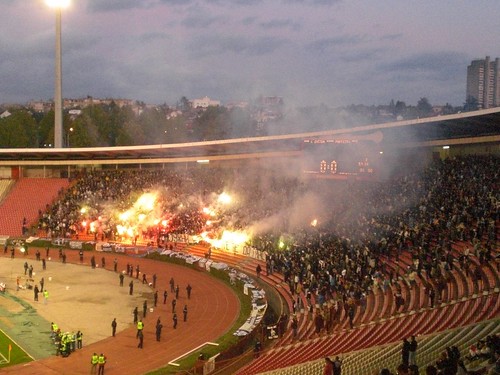
The stadium had an amazing atmosphere! The fans of Partizan especially sang, had banners, fireworks, etc and were on their feet the entire game. We went to the game with my colleague, Luiz, a science teacher in the secondary school. He is from Brazil and used to this kind of rabid fans, but even he was impressed.

The Partizan Fans Celebrate A Goal

Partizan won this 134th edition of the derby, 2-0. There were many goal opportunities for both teams and the action was non-stop. This is Partizan’s sixth straight win in six rounds of the league and they are in first place. Red Star is in eigth place out of twelve teams, with 2 wins, 2 ties, and 3 losses.

Red Star is the biggest and most popular team in Serbia. They were formed in 1945 shortly after Tito took over, hence the communist red star symbol. They won the forerunner of the European Champions League in 1991, the only former Yugoslavian team to do so. Since the breakup of Yugoslavia, they have fallen on hard times, as most of the top Serbian players go for the higher salaries of other European leagues. Oliver is a big fan of Red Star and so am I.

Partizan is more of a working class team and the second most popular team in Serbia. They were also … (time to go to school, I’ll finish this post later.)