Ocean Samples the 2008 vintage Euphoria dessert wine
We visited the Aleksandrovic Winery last week in Vinca, a small village next to Topola in Serbia’s Šumadija region. I have not been to too many wineries here in Serbia yet, but the cellar had the nicest facilities I have seen yet. There is a beautiful wine bar on the ground floor connected to a huge restaurant, and in the basement, there are many large oak barrels. They obviously have invested lots of money into the place.
In their promotional video and website (link above), they tell the history of the winery. The name Vinca comes from the Latin (Roman) wine, as the area has been a place of wine production for a long time. The winery is located a the bottom of the Oplenac hill, the estate of King Petar I, that I blogged about yesterday. The Aleksandrovic family produced wine there for the Serbian royalty for over 100 years. The winery was abandoned after WWII during the communist era of Yugoslavia.
The family began developing the winery again about 10 years ago. The signature wine of the cellar is “Triumph” a mix of Sauvignon Blanc, Pinot Blanc, and Riesling grape varieties. The recipe for that wine was sent from Canada by the former royal cellar master who fled the country after WWII. The winery is unusual in that they only most of their wines are mixtures of grape varieties. Even the few pure (100%) wines with only one variety, they give a name to them like Harizma (Chardonnay), Varijanta (Black Muscat), etc. The wines we sampled were all pretty good and we bought 4 bottles. They also have home delivery service which is an excellent idea. It takes about an hour to drive from Belgrade to the cellar.
Grape Vines of the Aleksandrovic Winery at the bottom of Oplenac
We are heading back to work today after a restful holiday. We stayed in Belgrade and just enjoyed time with the kids and doing things around the house. It is always great to reconnect with the kids and Nadia and I as a couple. School gets hectic for all of us and it is just nice to have the luxury of free time with each other.
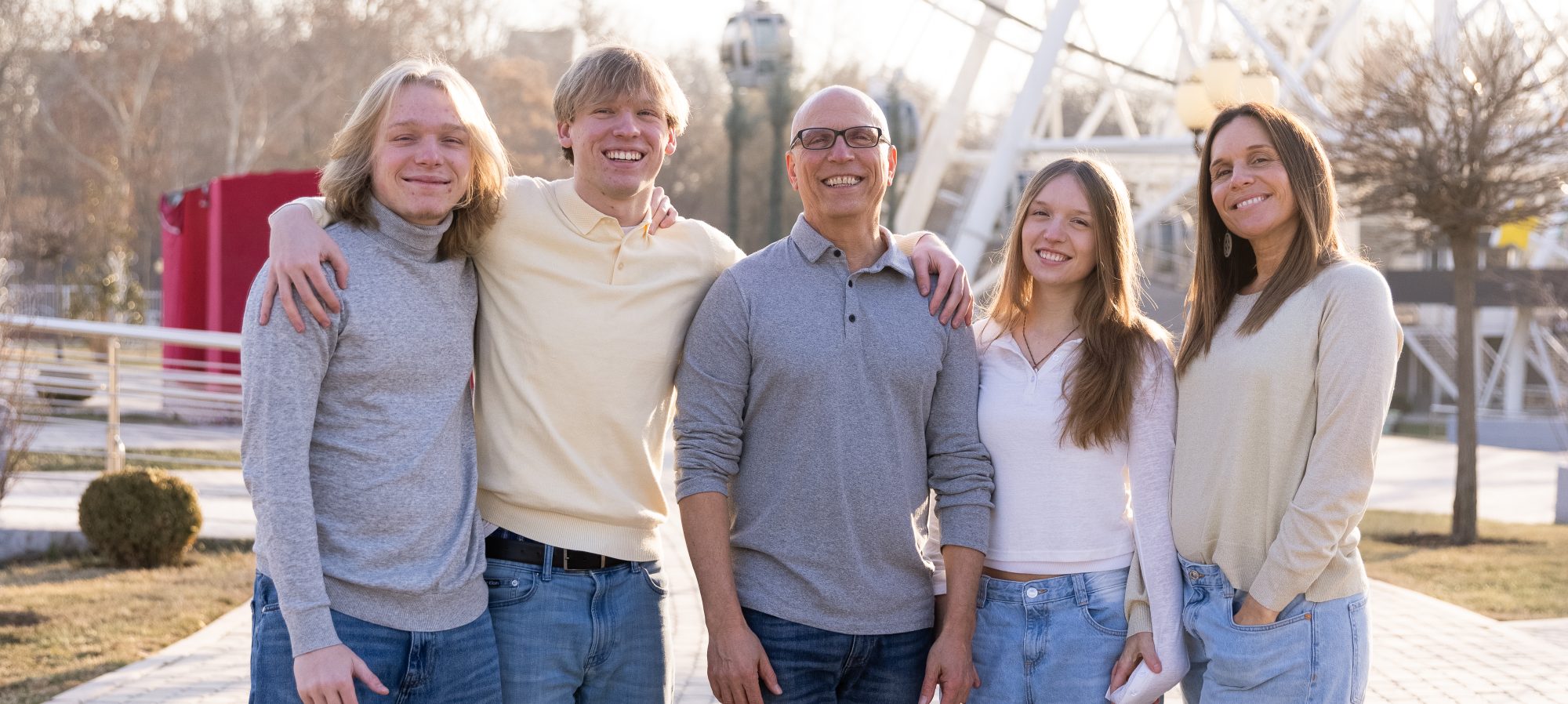
Family Poses on King Petar's Grounds in Topola, Serbia
We did manage to make a couple of day trips into the Sumadija region of central Serbia. “Shoomadeeaaa” is located just south of Belgrade and it is a region of farms, rolling hills, pastures, orchards, and forests. It is the traditional heartland of Serbia at the time of Ottoman occupation. We visited a winery and toured the grounds of King Petar I, who was the King of “Yugoslavia” in the early 1900’s. He had a house near the village of Topola. It was a beautiful sunset and with perfect lighting and trees, we took some photos of the family.
On the sixth of April 1941, the Germans bombed Belgrade heavily for two days. Hitler called it “Operation Punishment” for the Serbs for not becoming an Axis satellite in World War II. The Germans wanted to use Yugoslavia as an area for industry and agriculture and setting up military bases. They controlled much of it, but the Serbs chose the high road and suffered greatly.
Above is a photo of the wreath and flowers placed at the site of the former National Library of Serbia. The bombing of Belgrade by the Nazis targetted not only military targets, but civilian as well. Tragically, thousands of civilians died in the carpet bombing. The library was also destroyed, taking with it valuable 900 year old documents and a treasure trove of the history of the Serbian people.
The bombing was made worse by the ex-Yugoslavian pilots in Croatia, an ally of Germany during the war. They knew where to strategically hit the Serbian part of the Yugoslavian military infrastructure.
I visited the site yesterday with Owen and Oliver and gave them a history lesson about Germany’s ambitions in World War II. The site contrasts well with the buildings left from the NATO bombing of 1999. It would be good for Belgrade to leave one of the sites like this as a physical memory. I wonder if the Yugoslav Defense Ministry building will look like this in 70 years.
Visiting the site also made me think of the long battle the Serbs have had with the German/Austrian people. One reads much about the 500 years of subjugation of the Ottomans, but throughout the years, the Austro-Hungarians and Germans have also inflicted much pain on the Serbs. Hitler could have eliminated the Serbs in World War II if they would have won the war.
I would like to see the site made more into a museum. On the site within the ruins, they could set up rooms with photos and memorabilia from World War II or perhaps a bit on the type of documents that were lost.
. We have been spending a lot of time in the yard playing with the kids. I play soccer, basketball, and football with the boys on a daily basis and we’ve stepped it up during the Easter holiday break. It is so nice to have loads of time at home with my family. The weather has not been great, but we don’t care. It has been a relaxing and rejuvanating holiday. As you can see in the photos, the boys like to jump off the swings.
Ollie Gets Into the Act Too
Yesterday I cut the lawn for the first time this spring. It really needed it. I am almost finished with planting in the garden. This year besides herbs and flowers, we’ll be trying to grow veggies and fruits. I don’t know why the fascination with gardening hits people as they get older. I can’t get enough of it.
Nadia and I went for another run yesterday. We’ve exercised every day this break. My left knee is a bit sore and I should rest it, but we are getting ready for the Belgrade marathon which takes place next Sunday, April 18th. We will both try to complete the half marathon. Last weekend, we ran 15 kilometers and it felt good. So good that it started me thinking about going for the full marathon. But, with my knee in the shape it is in, I would be unable to do anything for a few weeks afterwards. Nadia is looking as beautiful as ever…
Yesterday it was a rainy day, and despite the wet weather, we still ended up having a great day. The highlight for me was going to a pig roast at the school hosted by our good friend, Goran. He is shown above with a fresh, Obrenovac-raised pig. I joked that it was a “prase” which means piglet in Serbian. That was my word for the day, svinja that means an adult pig and pork. The meat in the store would be referred to as svinjetina.
The Serbs are masters of preparing pork. For many centuries, they specialized in raising pigs and selling them to the Austro-Hungarians. The Royal Family of the Serbia, the Karadjordje dynasty started as pig dealers. I think they should have a pig sty in the White Palace grounds as homage to their past.
Goran served the svijetina with kupus (coleslaw), bread, and condiments of light green peppers or green onions. Delicious! A big thank you to Goran for letting us share in the feast.
Last night we visited the home of our friends, Vera and Miloš Tutuš. I didn’t have my camera, so the photo above was taken September of 2008 at party we attended together. Miloš is a 28 year old artist and art teacher at the Chartwell School, a British private school here in Belgrade. He is a fine artist and we have a couple of his works hanging in our home. He is both a sculpture and painter and he has a wide range of works. He maintains an on line gallery of his work where you can view and purchase many of his pieces. The web site with his page is managed by a non-profit organization called ARTE that focuses on promoting artists and web entrepreneurs with emerging technologies.
Keyhole "Engrova" - A piece by Miloš in the Kralovec Home
Yesterday errands took us over to the suburb of the famous “Eastern Gate” of Belgrade. The gate is an apartment complex that is a highly visible landmark as cars enter Belgrade on the main E-75 freeway from the east. The Genex Building, also on E-75 but on the other side of Belgrade is known as the “Western Gate.” The two communist era “Socialist Realism” architecture style buildings are the most highly visible of a city full of these monsters.
I personally love looking at them and have been reading some on their development. The Eastern Gate Apartments were built in 1976 and there are three buildings that form a circle and they house around 2000 people. They were built in 1976 and the complex is named after the town of Rudo, Bosnia. The idea behind communist architecture was to glorify the common worker and downplay individualism. They loved cement in those days as it is the main structural and decorative medium. Today’s apartments are made more of brick, wood, glass, and steel.
I am so curious to know what it is like to live in them. As I wrote, they are interesting to look at, but I am not sure what the residents think. I would imagine the hallways, stairwells, and elevators must be a disaster because they are not well-maintained. The majority of Belgraders live in apartments, but it seems that they do not devote much resources to communal upkeep of the buildings and grounds.
I guess the reason I like this architectural style so much is that it is so different from anything I have ever seen. They remind me of a science fiction movie of a Orwellian future, a type of “Blade Runner” post-apocalypse skyline.
I hope I get a chance to go into one. All of my current Serbian friends live in smaller apartment buildings. I’ll be blogging more about these Socialist Realism buildings in future posts.
We had a nice day around the house yesterday. Nadia and I took the opportunity to do some serious spring cleaning. I stored away all of the winter clothes and organized our basement storage boxes. With a family of five, we have a lot of stuff! We also sorted through drawers, shelves, etc. It is amazing the amount of stuff that piles up during a school year. Nadia did a thorough cleaning of the house.
As you can see from the video above, the kids enjoyed the easter egg hunt. We are not religious but still celebrate the holidays all the same. I started telling the story of the crucifixion of Jesus, but need to re-look at the Biblical accounts to give a proper bedtime story to the kids. We also listened to the storynory.com origin of Easter eggs and the Saxon pagan beliefs where the holiday originates.
The weather continues to be perfect, cool temperatures and blue skies. The neighbors brought colored eggs to our children. Eastern Europeans are really into decorative eggs, which I’ll blog about more later.
As with Christmas, the Serbs exchange phrases when greeting each other on Easter.
Ollie Attempts to Throw His Popsicle Stick in the Danube
Yesterday afternoon the sun came out and so we took advantage of this and went for a bike ride in the Park of Friendship in New Belgrade. This is the park that world leaders used to plant a tree when they came and visited Tito during the Communist years. It is also the park that Milosevic used to hold mass rallies during the turbulent times of his presidency. More recently, Madonna held a concert last August there for over 40,000 people. There is a nice bike trail that runs along the Danube River. There were lots of people walking along the river as well as sitting in the cafes located on barges in the river. You can see a couple of the “splavs” behind Owen in the photo below.
We stopped for an ice cream before turning around and heading back to the car.
Last week Partizan defeated Maccabi Electra 3 games to 1 in a best-of-five quarterfinal series in the Euroleague Basketball playoffs. They now qualify for the Final Four tourney to be held in Paris in early May. Maccabi is from Tel Aviv, Israel and for those readers not knowledgeable about basketball, the Euroleague is the equivalent of the Champions League in soccer. It is the premier professional club basketball league in Europe.
Logo of Partizan Basketball Club
Above is the logo of club. On top it says шампиони which translated from the Serbian Cyrillic means champion. In the Serbian Latin alphabet, is reads a bit easier for English speakers – Šampioni. On the bottom, KK stands for košarkaški klub. Košarka is “basketball” in English. The name Partizan in the cyrillic script then follows. The team is named after Tito’s resistance army in World War II, hence the Red Star in the middle. The club was founded right after WWII in 1945 as part of a youth sports association in the People’s Army of Jugoslavia (JNA).
I’ve been thinking about the Euroleague and Partizan. I wonder how Partizan would do in America’s National Basketball Association (NBA) or in the National Collegiate Athletic Association (NCAA). One point I want to make, the Euroleague should study the nba.com and espn.com web sites on how to market and cover its league. The Euroleague website really could do a lot more in promoting the teams and players. There is little in-depth information and commentary on the games or match-ups. They do not highlight star players at all. If I was running the Euroleague, I would make it a lot better. I know that basketball is not as popular in Europe and it needs to compete with soccer, but a David Stern-like commissioner could really raise its level of popularity and money earning. They need an American sense of marketing sports entertainment.
When I arrived to Serbia last year, I picked Red Star as my team. (note – I just read an article that describes how Red Star basketball is facing bankruptcy.) But this year, I have admired the Partizan basketball team and now am a big fan. Two of our students at the international school have parents on the management board and another two play for the youth teams. I have a connection to the team and hope they can win it all. Unlike most European countries, basketball is a bit more popular in Serbia than soccer, although the Serbian national soccer team is in this year’ s World Cup and Red Star won a Champions League title in 1991. This gives Partizan an advantage in that it has access to a big pool of good young players and the packed arenas with knowledgeable and rabid fans, makes them tough to beat at home. Other arenas are much quieter. Serbs are also tall, active, and tough generally as a culture and this also translates to good basketball teams.
Partizan plays an exciting, fundamentally sound style of basketball. A big factor is their coach, Duško Vujoševic. The guy began coaching at age 17 and spent most of his career in Italy. He must not have been much of a player. He is currently the coach of the national team of Montenegro besides Partizan.
Like all the Euroleague teams, Partizan does have several imported players and three start for Partizan. This also gives a good chance to compare Euroleague basketball to the NBA or NCAA. The type of American players that end up playing in Europe are those guys that had excellent university careers, but couldn’t stick with an NBA team. So considering they are a bit older than the current college players in the US and they had strong careers in the NCAA, I think that they would do well in the “March Madness’ tourney, but not so well in the NBA. The two Americans players for Partizan are 6-8 center Lawrence Roberts and 6 foot point guard Bo Maccalebb. Roberts used to play for Red Star so I have followed him for over a year. He was an All-American and the SEC Player of the Year for Mississippi State. Maccalebb was the Sun Belt Conference player of the year for the University of New Orleans. Both guys first played in Turkey or Greece before coming to Serbia. I would like to interview them to see how they like living in Belgrade. The other import is 6-11 Czech forward, Jan Vesely. He is very thin and more of a small forward than a power forward. The other two starters are Serbian. Dušan Kecman is a solid 6-5 shooting guard and Aleks Marić is a 6-11 center that is a force inside, averaging 17 points and 9 boards in Euroleague play this year. Marić is a Serb that grew up in Australia (many Serbs left during the war) and then had a good career at the University of Nebraska, being named to the All Big-12 team as a senior.
They also have a strong bench of young local talent. Slavko Vraneš is a 7-6 giant Montenegrin. He played one game for the New York Knicks. He is a bit slow, but he takes up a lot of space near the basket. Aleksandar Rasić is a good back up point guard. Partizan puts a lot of effort into its youth program and they produce many great players. Unfortunately, many of them eventually leave for more money on other European club teams.
I’ll be watching the Final Four in Paris. Partizan faces some stiff competition with three giants of Euroleague basketball also qualifying for the final four. Barcelona (with Minnesota Timberwolf prospect Ricky Rubio), CKSA Moscow (last year’s runner up), and Athens Olympiacos (also in Final Four last year). The format is knock-out, just like the NCAA Final Four, and they play Olympiacos on May 7th. I don’t understand the delay, perhaps the national leagues are finishing first.