With Nadia at an Educational Conference in Dubai until Monday, I have a full weekend with the kids. We are starting the Ski Week Holiday also on Monday so I’ll have more time to blog.
We started the holiday last night by playing some pick up basketball at the school with the teachers. Owen and I then went to Kolorac Hall in downtown Belgrade to watch the Belgrade Philharmonic Orchestra. We have season tickets for the “New Years Cycle” which is a series of six concerts having the theme of New Year. Last night it was the theme was Chinese New Year, which the actual date happened earlier this month. It is the year of the Rabbit.
The concert last night featured a Chinese pianist named Haochen Zhang. The first piece was aptly a piano concerto and the big Steinway was in the center of the stage. Zhang came out and played Tchaikovsky’s Piano Concerto Number 1. Zhang made it look easy. The highlight for me was introducing Owen to the orchestra and the different instruments and Tchaikovsky. He did fall asleep in the second movement, but did get to get the feeling of it. The theater was warm (In Serbia in the winter, everyone cranks the heat because they are afraid of cold drafts causing sicknesses.) and cozy.
The video above is Zhang playing a Chinese folk song which I’ve heard before in some movie. I really like the song and if any reader of my blog knows the name of it, please send it my way.
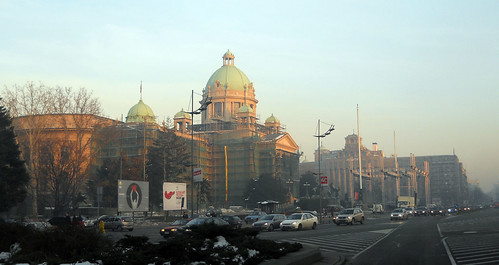
The Party is Over (4:00 PM - Serbian Parliament Building)
The Serbian Progressive Party rally yesterday in Belgrade was really a non-event for me. I was busy reading questions for the Knowledge Bowl (see our school’s blog for more information on that event) at the school during the rally. I did get down around 4:00 PM and snapped a few photos, but by that time, everyone was gone and the moving trucks were taking down the stage. Estimates from the B92 put the number at around 55, 00o. As this commentator put it on the B92 website,
The usual blabla from these two guys. 55 thds people that mostly came from south and central Serbia in buses! As always these people most probably received some daily allowance to participate!
It is certainly important to have a good opposition but when it comes to these two, apart from critics I have never heard, read any mention of a program that make sense or could change the situation in Serbia. So waste of time and money.
I would have to agree with this. The purpose of the rally was to complain about the performance of the current government and a call for early elections. People around the world want good government (ex- Egypt) but they don’t want ideals, or platitudes, which most politicians give.What they want are the basics like tax money being spent well, roads without pot holes, decent schools, clean hospitals, a dignified retirement for senior citizens, job opportunities, feel secure in their neighborhood, etc. I don’t see Nikolic (the Progressive Party leader) and others in his party being able to do this. They don’t see smart enough, or empathetic enough to manage an economy and a nation.
But instead of just criticizing them, I will give my ideas on how Serbia should be run. I see a nation with great potential, but it is being wasted, as young people who are innovative and ready to make their mark in the world, being disillusioned because the economy is horrible. I haven’t given it enough thought, but if I were president of Serbia, I would have the following platform:
1) Foreign Policy
I would eliminate the military. It is a big expense for the Serbian government. This would free up the large amount of military land for the good of the public. This could be used for parks, schools, green housing projects, hospitals, etc. There should also be money to train ex-soldiers for civilian life. The ending of the military would also say a lot to our neighbors and the world that Serbia is past violence and open for tourism and business investment.
The end of the military would also mean the end of military service. I would make a Peace Corps for the Balkans and send young people for 1-year missions around the ex-Yugoslavia and the poorer parts of Serbia. They could be intern teachers, nurses, security guards, construction workers, engineers, etc.
Invite Montenegro and Republika Srpska (the Serbian part of Bosnia) to join Serbia. I would also negotiate with Kosovo and get the northern part to join Serbia. The majority Kosovar Albanians will never want to stay in Serbia. With a recognized government, Serbians will eventually be able visit whenever they want anyway. The dream of multi ethnic societies should be dropped for now.
2) Domestic Stuff
Ban the Serbian Latinica alphabet. The Cyrillic script looks cool and this is a part of Serbian culture that should be protected and promoted.
Eliminate the antiquated and Byzantine (appropriate for this place) laws on the books that make it impossible to do business. The amount of paper work for building permits, starting and ending businesses, hiring and firing workers, etc. is a huge impediment for companies. Belgrade is a natural business hub for the Balkans and with a business-friendly environment, it would entice more companies to move in and we would see more start-ups.
Fight corruption and organized crime. These elements hurt society in the long-term.
Collect income tax from everyone, including the rich.
Pump huge amounts of money into schools and build a cutting edge, “green” curriculum that targets entrepreneurship, technology, and problem solving. (you can tell I am a teacher)
Clean up graffiti and garbage around the city. Help neighborhoods to form cooperatives to beautify their apartment buildings and parks. Give matching grants to apartment associations for renovating of their buildings.
Continue moving towards Europe because this would give young Serbs the opportunity to work in other countries in the EU as well as Serbian companies possibly expanding their markets.
Adapt the ex-Yugoslavian slogan of “Unity and Brotherhood” to “Tolerance and Pursuit of Happiness.”
Those are my initial, undeveloped thoughts. If any bilingual Serbian wants to be my running mate, I would like to run for President. I don’t speak Serbian well and that would probably hurt me in government.
Last week we recognized Holocaust Memorial Day (January 27) at my school, the International School of Belgrade. The Israeli Ambassador to Serbia, Arthur Koll spoke to the student body about the Holocaust and mentioned the atrocities that occurred here in Belgrade. He refered to the first systematic use of a “gas van” to kill the Jews of Belgrade. I did a bit research and found a website put together by UK professor Jovan Byford and funded by the British Academy. Professor Byford, with the help of Serbian researchers, has put together an informative web site about the Nazi concentration camp in Belgrade.
The camp, called Semlin Judenlager (German for Zemun Camp for Jews), is located in New Belgrade, right on the banks of the Sava River. In the 1930’s, the Belgrade government drained a swampy area on the other side of the Sava, and established a fair and exhibition grounds. It was a popular place for theater, cinema, etc. and one of the first areas developed on the north side of the river. Today, much of New Belgrade, as the north side is referred to, is developed out to the airport, several kilometers away from the river.
The Nazis took over Yugoslavia in 1941 and occupied the city. Semlin was technically in the part of Yugoslavia administered by the fascist Croatian movement, the Ustase. Belgrade itself was officially in German-occupied Serbia. The fairgrounds were used to round-up all of the Jewish people of the city (around 15,000) as part of the genocide campaign of the Nazis. It was supposed to be a temporary camp, but when a permanent facility couldn’t be found, it became one. It differed from the more famous concentration camps like Auschwitz, in that it was very close to the city. A photo of the camp in 1941 is below. Yesterday, I stopped at the site and photographed the original tower as it looks today (above). The camp is significant in that it marks an escalation of the systematic elimination of the Jewish people in Europe. Ustase officials were proud to report to Hitler that Serbia was the first area to be “Jewish-Free” in WW II. Today I am not aware of a Jewish community in Belgrade.
The Semlin Camp - Circa 1941
After the elimination of the Jews, the camp also processed Partisan and Chetnik prisoners, Communist sympathizers, political opponents, Romas, etc. Most were used as force labor and many died in the camp because of inhumane conditions and disease. The camp was kept open for several years, eventually being the target of Allied bombing in 1944 during the liberation of the city.
It is sad that it is not a protected landmark. Thousands of people perished at the site and the camp is a very important part of World War II history. I was surprised to see people living in the tower. It has been converted to apartments. The other former pavilions are also now apartment buildings. I wonder if the people living in them know about the atrocities and terror that occurred here. I recommend the web site about the camp. It is gripping reading, especially the letters from a Serbian-Jewish nurse who perished in the camp.
The Fairgrounds Today - February 2
There are a couple of monuments in the area, which I visited when we held an art exhibition in a hall near former fairgrounds. If I had the resources, I would buy out the current tenants and restore the grounds to its original state and make a museum and educational center. Serbia and the rest of the Balkans would benefit from the tourist attraction in addition to being a center of tolerance, which will always be needed in the ex-Yugoslavia.
I can’t imagine the horror that took place here. Entire families murdered. Tragic. There are several other Holocaust sites in Serbia that I plan to visit before I leave the country. There is an excellent museum in Banjica about the prisoner camp there.
Nadia and i after shortly after we got married, moved to Australia. I began teaching and the Aussie students loved to hear my American accent and asked if I knew the various Hollywood celebrities they saw on TV and movies. I laughed because I didn’t think they realized that the USA had over 300 million people and I was from Michigan, a long way from Los Angeles. Australia has a population of 18 miillion, and I guess an ordinary citizen’s chances of meeting or getting to know a celebrity like Nicole Kidman, was higher than mine. By the way, one of my first substitute teaching jobs when I moved to Australia, was at the actor Heath Ledger’s old school, the Guildford Grammar School.
Serbia is even smaller than Australia, and the capital city, Belgrade, has a population of 1.5 million in the metro area. Working in the richest private school in the city and living in the most expensive neighborhood, it is easy to meet the “celebrities” of Serbia. Last weekend, our middle school girls’ basketball team hosted a local basketball club. On the visiting club team was the daugher to Serbian President, Boris Tadic. He can be seen in the crowd in the photo above. He is the grey-haired gentleman with the white-striped jacket. He also lives just a few houses down from our new apartment. One nice thing about him is that he is a former high school psychology teacher.
In my time here in Serbia, I have met many of “rich and famous” and it is interesting to see their lifestyle up close.
Yesterday Belgrade received a decent snow! It was only the second snowfall of the winter, the first being right before we left for Bahrain, on December 18th. I can’t wait to go outside and play with the kids today! I will definitely be posting photos our our family winter fun. Nadia, Oliver, and Owen are shown above walking to the car. Our new apartment building is in the background.
We will be finishing our move this weekend also (hopefully). We moved suburbs, going from Senjak to Dedinje. The suburb of Dedinje, which means “Old Man’s HIll” (note that deda is grandfather or old man in Serbian), is the most exclusive, and in my opinion, the most interesting neighborhood in Belgrade. The area reminds me somewhat of Gross Pointe, in suburban Detroit. That is a nice thing about teaching overseas – educators can live in the nicest neighborhoods in the city. In the US, our middle class salaries put us in more modest areas.
Anyway, Dedinje is interesting because of all the history that has occured here. The suburb is located on the slopes of Topcider Hill, and was home to the city’s rich and elite for many generations. After World War II, Tito and the communists came in and occupied the mansions and villas of the old money families of Belgrade. Later, ex Yugoslav President Slobodan Milosevic, and other shady characters like Arkan, moved in. I’ll be posting about the various aspects of the suburb for the next couple of years. Our apartment is quite modest compared to the diplomatic residences and other mansions around us. It is very comfortable however, and we’re very happy to be in a newer and better constructed apartment. We are just off the main drag of the suburb, ulica Užička. (ulica is street in Serbian, and Užiče is a city in southern Serbia)
After 2 and ½ years of living in Serbia, I am finally getting decent with my Serbian. I’ve made a commitment to myself to complete my studies in Serbian and to be as fluent as possible. I know I will never be totally fluent because most of my day is in English at work and at home it is Spanish and English. My opportunities to speak Serbian are few. I am speaking with Serbian colleagues in Serbian now and going to the super market , gas station, etc. trying to do the transactions in Serbians.
I am devoting time to the study of Serbian because I like the intellectual challenge, it gives me more understanding of my surroundings and makes my experience here in Serbia richer. I am in unit 10 of the Teach Yourself Serbian by Vladislava Ribnikar and David Norris. It is published in the USA by Contemporary Books, a division of the educational giant McGraw-Hill. I’ll be reinforcing my learning by blogging from time to time in a humorous manner.
Uncle / Aunt – In English this concept is quite easy. There are only two words for the siblings of your parents, and you call them either your aunt or uncle depending on their sex. But in Serbian, the title changes depending on what side of the family the sibling is on, as well as a different name for the spouse of the sibling. I guess the title give more information to everyone in the room, but I am not sure why that is important, because in most families, everyone knows what the exact relationship an aunt or uncle has within the family. It does complicate it for the foreigner trying to learn the language.
Let me see if I got this straight. On your father’s side of the family, the “uncle” can either be a stric or a teča, depending on if it is the father’s brother, or brother-in-law. On the mother’s side, the “uncle” can either be an ujak or once again teča. In summary, the stric & ujakare the brothers of your parents, while teča is the brother-in-law of one of your parents.
On the father’s side of the family, the “aunt” is known as a tetka if she is the sister of your father, and if she is the brother-in-law of your father, then she is known as the strina. On the mother’s side of the family, the sister is known once again as the tetka and her husband, or your mother’s brother-in-law, is known as the teča again. The sister-in-law of the mother is known as the ujna, who is married to the ujak.
The Serbs also take this differentiation as step further with the next generation; the cousins. There is not a separate word for „cousin“ in Serbian. They are known as brat od …strica/teča/ujaka. The term brat od means „brother from…” Could they also be referred to the brat od…tetka/strina/ujna also? Especially is the uncle is divorced or deceased? Why do they do this only with uncles and aunts and not grandparents who are known as deda or baba, regardless of what side of the family they are on?
Now, what do you call brother-in-law and sister-in-law? I know that the godparents are known as kum or kuma.
I went through my family tree and attached titles to the various to our children’s uncles and aunts to help me learn the various new terms.
Belgrade is gearing up for the Davis Cup Tennis finals this weekend. Serbia is hosting France in the finals. I took the photo above during an earlier round in the Davis Cup, when Serbia defeated the USA here in Belgrade last spring. Since then, they went on to win at Croatia in the quarterfinals this summer, and earlier this fall, came back from behind to beat the Czech Republic.
There is a really good New York Times article this week about the Novak Djokovic family and Serbian tennis. It appears that Serbia is the favorite. They are at home in the friendly hard court confines of the Belgrade Arena. They have the world’s #3 player in Novak Djokovic, who should get 2 wins. It would then take one more win by Serbia to clinch the best of 5 series. If Djokovic falters, then Serbia could be in trouble. Assuming Novak comes through, where will they get the other win? France will be playing with world #12 Gael Monfils, who is one of my favorite players to watch because of his exciting and risky style of play. They are also bringing 30 year old Michael Llodra who is in top form as the world #23 player. He beat Novak last month in Paris at an ATP-100 tourney event. Serbia will counter with either world #30 Victor Troiki, or world #49 Janko Tipsarevic. Janko was the hero against the Czech Republic last round and I hope they use him, despite the lower ranking. The doubles match will be interesting also with Serbian veteran and world double #3 Nenad Zimonjic.
There is a lot of pressure on the Serbs playing at home, but there will also be a lot of support, which could rattle the French. Guy Forget, the Captain of the French team, has been playing up the “we’re going to a hostile scene” and the “Serb fans could get violent” cards in the media. A good strategy to get his players pumped up.
I won’t be able to attend the games this weekend, sadly. Nadia is going on her annual girls shopping and dining trip to Budapest, Hungary and I’ll be alone with the kids. We’ll watch the matches on TV. The Davis Cup web site will also carry live radio broadcast as well as a blog by The London Times reporter, Clive White, who is here in Belgrade to cover the matches. It really inspires me to play more tennis and get my children started in a tennis academy.
I would like to wrap up this post with a prediction. It is tough not knowing what the match ups will be as both teams are keeping their selections private until the day of the games. It would be nice for Serbia to win. The Serbs are much more fanatic and passionate about tennis than the French are and a win for Serbia would mean much to nation. I predict Serbia winning 3 – 2.
Yesterday I accompanied the school’s high school journalism class on a tour of the B 92 media company. The “B” stands for Belgrade and “92” comes from their original radio broadcast frequency, 92.5 FM. Besides radio, they have two television channels, an internet site, book publishing company, music production company, and a cultural center. Sasa Mirkovic, one of the founders of the B 92, showed us around the B 92 complex yesterday in New Belgrade.
B 92 is famous for its role in the 90’s fall of Milosevic. They were one of the few independent media outlets and their radio station supported peace and protest rallies against the government and their policies. They were shut down and taken over by the government three different times. They were also shut down during the 1999 NATO bombing because they were a target. One of the founders, Dragan Dilas, is now mayor of Belgrade.
Today B 92 is the third most popular television outlet in Serbia. Their 11:00 news program is very popular in the city. I appreciate their English language web site which I link to on this blog. Their cable news channel is carried throughout the region and into Austria. They are still regarded as a serious source of independent news in the country. They balance this will “infotainment” and Sasa explained the business side of media. I was particularly interested in hearing about the delicate political side to this. The two largest advertising agencies in the country are owned by prominent politicians, hence B 92 is somewhat limited in freedom of the news. It sounds not much different than the US today, with Fox being very Republican and CNN more Democratic. Both of the advertising agencies are linked to the current pro-Europe integration liberal movement.
I was surprised at the size of the operation. The building was once the Yugoslav national bank building. They have over 500 employees. The news room was similar to the CNN Center I toured several years ago. I would like to thank Sasa, Ray (the journalism teacher above with me) and B92 for arranging this informative visit.
You can see more photos and videos on my flickr.com web site.
The Serbian Parliament last spring passed a public smoking law that went into effect last week. I was surprised at how well restaurants and cafes are enforcing the new law
Serbs love to smoke. According to the Ministry of Health, 1/3 of all adults smoke. but I would say it may even be a bit higher. In the US, according to the CDC (Center of Disease Control) about 17% of adults smoke. I believe this high percentage of smokers in Serbia is the same throughout Eastern Europe. I am not sure how many countries in the Balkans or Eastern Europe have anti-smoking laws. It would be interesting to get some statistics of smoking here and around the world.
The law gives police the power to fine individuals for smoking in prohibited areas (65 dollars) or businesses (13,000 dollars). It also bans smoking in theaters, cinemas, and most importantly, shopping malls. For restaurants, bars, and cafes, it depends on the size of the establishment. If it is too small, a business has to declare smoking or no smoking. Larger buildings must designate a smoking and a non-smoking area.
I say Hurray!!!! That has been one of the annoyances of living in Belgrade, especially in winter. There were so many places that we avoided because of the smoke. After coming home from a social gathering, our clothes were always stinking of cigarette smoke. We ate two great meals at Zodiac and Daco restaurants this weekend. They both had large non-smoking sections with the signs above posted. We also had smoke free experiences in the Usce and Mercator malls. What a difference!
I am sure some businesses do not like the new law. The smoking sections of restaurants that we see has more people than the non-smoking sections.
The nice weather continued this weekend in Belgrade. It was a bit cooler, but still unseasonably warm. I cut the grass, hopefully for the final time on Sunday. We also played with the kids in the yard as you can see below.
The Cast Receives Applause (Kusturica in the center)
Last night I got the chance to see Bosnian Serb film director, Emir Kusturica’s “punk opera” Time of the Gypsies.” The opera is based on his 1988 movie by the same name. It is a story about the Roma community and follows the lives of two gypsy orphans living with their grandmother in the ex-Yugoslavia and a criminal gypsy living in Italy. It was a very good movie and I really enjoyed the show last night. I am glad I watched most of the movie before attending the show so I could follow along with what was happening. The libretto was in a Roma dialect with Serbian subtitles. My Serbian is at the point where I can recognize 2-3 words per sentence and can kind of put ideas together.
I liked the music. It was a combination of classical music, gypsy folk music, and rock – all live music with the musicians down in the pit. The scenery and props were visually stimulating – a great night out. I would like to thank LJ for the tickets!!!!
The Final Scene - With the Milan Cathedral in the Background
You can read the New York Times review of the opera. I got a bit burned out on magic realism while living in Latin America, but it is a good story nonetheless. The Roma are fascinating to me and the movie gives a bit of insight into their world. Kusturica is a very interesting fellow and I highly recommend seeing the opera or any of his movies if you get the chance. It was a full house at the “communist science fiction” styled Sava Centar, and this was the fifth night of the performance.


 Bill's Blog