Remembrance Day & Marine Ball


Last weekend we observed Armistice or Remembrance Day with a ceremony at the Commonwealth War Cemetery in Belgrade. Nadia participated in the ceremony as part of the International Choir of Belgrade. It was a good educational experience for the kids. It was sad thinking of the 453 lives lost when looking at the graves. Many of them young men in their 20s, killed in World War II. The Commonwealth War Graves Commission had a short history of the cemetery.

The cemetery was created to receive the remains of British and Commonwealth casualties brought in from more than sixty small burial grounds and from isolated sites all over Yugoslavia. The largest number from any one place came from Milna Military Cemetery and the Royal Naval and Harbour Cemeteries on the island of Vis (Lissa) which was our base.

The burials in the War Cemetery include escaped prisoners of war from Italy and Greece. The civilians buried here include a mining technician, a teacher of English, a newspaper correspondent, a member of the Embassy staff and the child of another member of Embassy staff. They were buried or re-buried in the cemetery by permission of the Army Graves Service.

The kids are shown above with a British military office in front of the memorial. Several Embassies were represented at the ceremony and laid wreaths at the foot of the memorial statue.

Also last weekend we attended the Marine’s Ball. It marks the 238th anniversary of the founding of the US Marines. It was held at the Metropol Hotel in downtown Belgrade. There is a small marine contingent that guards the embassy stationed in Belgrade. There were speeches and military ceremonies, and then our favorite Belgrade band, Makao, entertained everyone, military and civilians alike. We are pictured below with our friends, Kevin and Laura.

Welcome Air Serbia


I have not been blogging much lately due to be very busy at work and other things.

Recently I saw the new desk at the Nikola Tesla Airport of Air Serbia. JAT (Jugoslav Airlines Transport) recently sold 49% of the airlines to Etihad Airlines, the national carrier of the United Arab Emirates. JAT was 100% owned by the Serbian government and had debts of 170 million Euros.

Considering how hard it is to make money on any airlines, it is a big risk for Etihad. I understand why the government owns the airlines, but it is not a good idea to own one, and it is a drain on the Serbian taxpayer and government. Hopefully the expertise of Etihad and the extra resources will make the airlines profitable. The JAT planes were very old and in dire need of investment. In my opinion, they should sell it all off and get out of the business entirely, although that might be against EU law to have a foreign, non-EU company own a major airlines in Europe. Serbia has many state-owned enterprises and properties that need to be privatized and hopefully this is a trend that will continue.The sports clubs Red Star and Partizan are two that come to mind…

Another problem is market size. There are too many regional airlines in the Balkans as each small country has their own carrier. The market is just not big enough to support so many different airlines.

I like the new logo. The double eagle is homage to the Serbian Orthodox crest, and the lines below look somewhat like Arabic script. I am looking forward to flying on the new Airbus A 319, “Novak Đoković” and wish Etihad and the Serbian Government best wishes for profitability!

Master Distillers – Serbian Rakija

October is harvest time in the Balkans and last weekend I had a special experience of learning how the national drink of Serbia, Rakija is made. Rakija is fermented and distilled from a variety of fruits, the most common and classic rakija being the šliva, or plum. It can also be made from walnuts, quince, pears, apricots, etc. Friends from the school took us to the small town of Obrenovac, which is about 30 kilometers from Belgrade, on the Sava River to see it being made first hand.

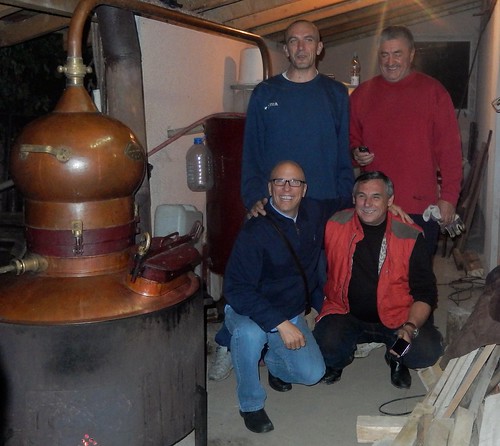
With typical Serbian hospitality, we got the royal treatment with a hearty BBQ meal of lamb, sausages, cabbage, and homemade bread, which was absolutely delicious. We were hosted by the Master Šliva (plum rakija) Distiller and restaurant owner, Ljubo Pljevaljčić. We also toured his restaurant, Pećina (The Cave) which is considered the best in the town. He is pictured in the front row next to me.

They had quite an operation going! In the foreground of the photo is the stove, where the fermented plum juice is heated. The fire needs to be consistent temperature, not too hot, which will burn the juice, or not too cold so it does not evaporate. The guys were adding wood when needed, mixing air and waiting for the moment to release the valve which brought the gas through the pipe where it is cooled in the water tank and condenses. They do the process twice, and after this first distillation, the percentage of alcohol is around 25%. They will do it again and will get the percentage up to around 40-45%. This is where a lot of šliva can be made with a poorer quality. Some people in order to produce more, add sugar to the left over mash and do the process again. This lowers the quality of the final product. Ljubo is a professional and never adds sugar.

They take the left over mash and dump it in a big pit in the yard and later bury it. They had several huge tanks of fermented plums. There is an incredible amount of juice that comes out of the plums, so much so that I thought they added water. The homemade rakija is quite smooth for having such a high alcohol content. It is much better than the cheaper rakija one finds in the supermarkets. Ljubo sells it in his restaurant and he gave us complimentary bottles. I do not drink alcohol often and find šliva a bit too strong for my taste, but it was fascinating to see how it is produced and it gave me an appreciation of the craft and this part of Serbian culture.

The leftover fermented plum juice

It was truly a Serbian evening and I was touched to be treated so nicely. It was a privilege to learn how authentic rakija is made. This is illegal in the USA, but here in Serbia it is quite common, with many people distilling their own “moonshine” in their back yard. Of course, it is not on the scale of Ljubo’s operation. When I asked about safety and did they know of distillation operations going wrong, and I always thought it was quite dangerous.

I would like to thank Ljubo, Hido, Goran, and the rest of the guys for a wonderful night. I will never forget it!   Živili!

Serbian Orthodox Relics


Relics of Angelina, Maksim, originally uploaded by bill kralovec.

This week I visited the church in the Krušedol Monestary in the Fruška Gora National Park. A kind priest showed our group the relics of the saints that founded the monastery, over 500 years ago. Krušedol, after Studenica and Hilander, is the third most important monastery of the Serbian Orthodox Church. Above are the remains of Mother Angelina and her sons, Maksim and Jovan. Relics in Eastern Orthodox Churches are often displayed on Sundays and the priest nice to show us the relics on a Thursday.

It is very interesting this concept of having relics and all of the major religions have this tradition. I would like to see a DNA test of these to trace the genetic heritage of the Serbian people.

The Church at the Novo Hopovo Monastery

I visited three monasteries of Fruška Gora and they always give me a sense of calm and awe. The combination of the ancient and dark mosaics, the beards and black dresses of the monks, and the beautiful natural surroundings of them make for a good visit. It is one of the things people do in Serbia.

I will have to visit Studenica sometime this year.

Interior Chapel of Novo Hopovo

The Real Hungarian Goulash

Mangalica, originally uploaded by bill kralovec.

Last weekend we traveled to the Srem part of Serbia and had a delicious goulash made with the rare Hungarian breed of pig, the Mangalica. Srem is a flat, agricultural area next to the Croatian and Bosnian borders. We spent a glorious late summer day at the Zasavica Nature Reserve, a farm and ecological area located outside the town of Sremska Mitrovica.

Pictured above is a Mangalica breed of pig. They have thick, curly hair and used to be quite common before World War II. They were a favorite breed of Franz Josef, the Austro-Hungarian Emporer, who kept them for their lard. They are a fatty pig and have been replaced by leaner breeds. The Mangalica has made a comeback in Hungary however, and in this region of Serbia that has Hungarian influences. They are used mostly for sausages and the Hungarians regard them as a traditional food. They are also catching on in the USA, as this New York Times article featured. They are also known to have less cholesterol than other pigs.

The farm borders on one of the rare wetlands areas in Serbia. It has been somewhat preserved as a park and is a great spot for bird watching, fishing, and boating. The nearby Sava River provides water for the lowland ground.

We had a nice meal and lounged around and played football in the sun. Owen and I also went for a walk through the Podolian Cattle herds, another rare breed of livestock.

I recommend spending the day and the next time we go out, we will certainly rent a boat to explore the wetlands.

The Best of Šumadija


Last weekend we escaped to the heartland of Serbia – Šumadija. Šuma is forest in Serbian and the area used to be covered in forests and the Serbian people have been in this region for a long time. It is just south of Belgrade and today is full of small farms and rolling hills with pockets of forests.

We visited the Radovanović Winery in the small town of Krnjevo. It is one of our favorite wines from Serbia. The country has an excellent wine industry and it is growing. They were very friendly and gave us the full tour of the premises and arranged for a wine tasting. They even had low alcohol wine for the kids to taste. We are not that big of wine drinkers, although I did take a wine-tasting course at Western Australia University years ago and am interested in science and pleasures of fermenting grapes.

Fresh Grapes Ready for Wine Production

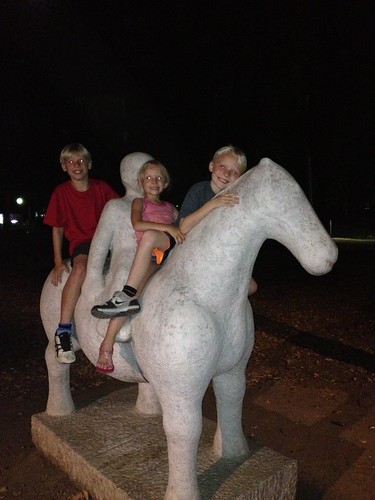
We then spent the night in the spa town of Aranđelovac, home of the famous Knaz Miloš bottled water. They opened up a large new hotel and water park. The park was quite crowded but the kids liked it. In town there is a huge park where the original spa used to be and it is filled with these beautiful statues carved from the local venač marble. We walked around and the kids played on the statues. It was a glorious mid-summer evening and lots of people walking about.

The Marble Statues of Aranđelovac

It is only 78 kilometers from Belgrade and makes for a perfect overnight get-away. I also highly recommend Radovanovic wines and visiting the mali podrum (little cellar).

Visit to the Central Trades School in Rakovica

It was an uplifting experience yesterday to visit the Central Trades School (Srednja Zanatska Škola) in the Belgrade suburb of Rakovica. The school is a government initiative that focuses on social rehabilitation and job training for vulnerable students in the Belgrade metropolitan area. Single mothers, refugees, victims of domestic violence, people with disabilities, Roma children, etc. are the target population. Most of the students are from ages 17-20 and include about 30% Roma.

The school was hosting a school year culminating fair, called, “We Can Overcome the Boundaries Together.”  There were food stands, music and dance performances, judo exhibitions, craft bazaar, etc. I toured the school and met with the teachers and students. I was invited as the representative of the International School of Belgrade. This year our students through the Community Action and Service Program at our school have been regularly working with the severe special needs students in the garden and green house program of the school. The idea stemmed from one of our students, whose parents through their work in the diplomatic community, became aware of the school.

My daughter Ocean poses in the school’s greenhouse

The school’s goal is to train and find job for their students. To that end, they have working auto mechanic garages, welding workshops, beauty salons, and even a small restaurant. Students also do internships with local businesses to help them make the transition into employment. An article in the Studio B web site stated that 40% of their students find jobs.

It is nice that the Serbian government supports these kinds of schools. A society can be judged on how it treats its most vulnerable members. I was also impressed with the positive spirit of the students and teachers and especially, the dedication of the faculty. Everyone I met was very dedicated to students and felt good about making a difference

ISB Students At the Bazaar of the Central Trades School

Tašmajdan Park


Azerbijan President Statue, originally uploaded by bill kralovec.

Last Saturday morning we enjoyed a picture perfect spring day at Tašmajdan Park. The park is located in the center of Belgrade. The city has loads of parks and Tašmajdan is one of the largest and most popular. I saw this statue above and wondered why there was an Azerbijan flag, flying next to the Serbian flag. It turned out that the Ayerbijan government donated funds to improve the grounds of the park. In appreciation, Belgrade put up a statue of the former president of Azerbijan, Heydar Aliyev. The park also honors Serbian poet and author, Milorad Pavić. His most famous work is “Dictionary of the Khazars” that I want to read.

The park is full of trees, playgrounds, and a public swimming pool. It is near the Metropol Hotel, Madera Restaurant, and St. Mark’s Cathedral. I recommend an evening or daytime stroll. There are always friendly Belgraders to meet.

The Blue Danube


Ocean, originally uploaded by bill kralovec.

We had a lovely stay at the Hotel Danubia in the Silver Lake Resort. The resort is just outside of Veliko Gradište, The town is located about an hour east of Belgrade on the banks of the Danube, Dunav in Serbian. It is a new hotel and reasonably priced. We took our bikes and there are many great biking trails, perfect for kids. We rode to main plaza in Veliko Gradište twice. The town is quite poor and nothing spectacular, but the bike trail is safe, and there is a really nice park for kids. The Danube itself is quite wide and really fresh. It made me remember the summers on the lakes of Upper Michigan. We also did some swimming, frog catching, and eating some fresh perch. Today on the way home we stopped at the Ram Fortress and climbed around it a bit. Typical Serbia, no signs, no interpretive materials, just an old abandoned fort the kids could climb around. Awesome!!!!

I highly recommend a visit for a weekend get-a-way from Belgrade.

A Serbian Sporting Legend

A couple of days ago I met Igor Milanović, who many experts consider the greatest water polo player ever. We were looking for a new apartment and our real estate agent showed us an apartment for rent owned by Igor.

Water polo is huge in Serbia a and the region, and Serbia is usually one of the best teams in the world. They won bronze at London 2012. The two greatest water polo nations are Serbia and neighbor Hungary.

Milanović’s career achievements are amazing! He won 2 Olympic Gold Medals (LA 1984 and Seoul 1988) and 2 World Championships (1986, 1991). He would have probably won more, but Yugoslavia was banned from international competition during the war.

Igor played 340 games for Yugoslavia, scoring over 500 goals. The 6 foot 4, 240 pounder, was a powerful player whose coach said could play any position. He was relentless in the pool and inducted into the International Swimming Hall of Fame in 1996.

He was a really nice guy. He coached Partizan last year and they won the European Club Championship. I asked him how water polo players compare physically to the swimmers, and he said they are two totally different sports. I thought perhaps water polo players would make great swimmers as well.

When I mentioned to my friends that I met him, everyone knew who he was. The Belgrade native is very famous in Serbia. It was an honor to get to speak with him.

I’ve only been to one water polo match in my life and that was for the 2000 Sydney Olympics. I’ll try to take the family to see a match this spring.