History of New Belgrade

Ljiljana Blagojević in her blog, “Art-E-Fact” has a nice post on the history of New Belgrade.

“New Belgrade is a modern city, built in the second half of the twentieth century, on the marshy plain bordered by the rivers Sava and Danube, stretching between the historical cities of Zemun and Belgrade.[1] The terrain of this modern development, most dramatically beheld from the position of the ancient Belgrade fortress, served for centuries as a no-man’s-land between the borders of the two empires, the Ottoman and the Austrian/Austro-Hungarian.[2] Devoid of any urban structure, it fulfilled the function of a cordon sanitaire, observed and controlled as no-connection-zone between the Orient, where Belgrade, as it were, marked its end point, and the Occident, of which Zemun was the, first, even if modest and marginal, port of call. In the short period between the World Wars, with the unification of the Kingdom of Serbs Croats and Slovenes/Yugoslavia, when the river Sava ceased being a state border, various planning strategies for the urbanization of this terrain were elaborated. Common denominator of all of these, otherwise widely divergent strategies was that they primarily envisaged the new development on this site as an expansion of, already uncontrollably sprawling, city of Belgrade. When the actual construction began in 1948, albeit in the changed socio-political conditions after the Second World War, the new city was conceived upon totally different premises. Most significantly, New Belgrade carried a potent symbolic function of being conceived as a new capital city of the new Federal People’s Republic of Yugoslavia.”

Above is a photo of a typical New Belgrade apartment building I took in September of 2008.

Genex Tower

This cool looking building is one of the landmarks we use to find our way around New Belgrade. I took this photo from the highway entering Belgrade from the airport. We call it the “Zepter” building because of the advertising sign on the left, but it is actually called the Genex Tower. The official name is “Western City Gate” and it is the first thing one notices upon entry to the city.

Genex was a state-owned company dealing in foreign trade and tourism. They also built the Intercontinental Hotel in Belgrade and a hotel in Kaponik, a ski resort in southern Serbia. The tower was completed in 1980, the last year of Tito’s rule in Communist Yugoslavia. On the left side are 30 floors of residential apartments and on the right side are 26 floors of offices. The bridge and tower between the two buildings serves as a restaurant which we will have to eat in. It is not one of the projects featured on their web site however. They have done many engineering projects in Serbia and eastern Europe.

While researching the building, I learned that it is designed in the architectural style called Brutilism. The name comes from the French and refers to raw concrete. The style flourished in the 1950’s – 1970’s. Critics think that it is alien and out of touch with the local landscape and culture. It is the dominate architectural style of New Belgrade. Brutilism was also associated with socialist, Utopian ideals, hence the use here.

I like the look. This is my first time in Eastern Europe and I have never seen a place that looks like New Belgrade before. After WWII, the communists drained the swamps on the other side of the river and built many Brutalist buildings. Over half a million people now live in New Belgrade. I like going over because it is spread out and feels more like the USA with wide streets. I want to learn more about New Belgrade and the buildings and you will see future posts on the subject.

Underneath the Towers (courtesy of Wikicommons)

NLB – Adriatic Basketball League

The Adriatic Basketball League (NBL is a bank that is the league sponsor) is a regional league consisting of 14 teams from the countries of the ex-Yugoslavia. After the bitterness and violence of the seccesionist wars of the 1990’s, it is surprising this league exists. I guess it must be a testament to the power of sports to transcend these things.

All of the countries have their own regular professional leagues, and the NBL is a “Champions League” type of format. The 14 teams play each other home and away for a 28 game regular season. Serbia has 5 of the 14 teams. The two big sport clubs in Belgrade, Red Star and Partizan are represented along with FMP from the Belgrade suburb of Zelenik, Hemofarm, from the city of Vrsac near the Romanian border, and  Vojvodina “Serbia Gas” from Serbia’s second city of Novi Sad. Croatia has four teams, Slovenia three teams, and one each from Bosnia and Montenegro.

The league started in the 2001-2002 season and the number of teams has varied through the seven seasons. For one season, Israeli team Maccabi Tel Aviv was a member of the league. The champion of the first season was a team from Slovenia, and the second year was the Croatian team Zadar. The last 5 seasons, Serbian teams were crowned champions. Zelenik won twice, Hemofarm once, and the past two seasons the champion was Partizan, who also won the Serbian Soccer League last year.

This year they have played six games each and once again, Partizan is atop the league at 6-0. Red Star is second with a 5-1 record. The league starts in October and ends in April. Red Star American players are Andre Owens, the 6-4 guard from Indiana University played to brief seasons in the NBA and Lawrence Roberts, ex-Mississippi State star and Memphis Grizzly player. The 6-9 power forward played the last two seasons in the Greek league and is new to Red Star. Partizan features ex-UMass star Stephane Lasme, who played briefly with the Miami Heat.

I haven’t been to a game yet, but plan to. The league website is quite good.

Learning Serbian (Part III) “The Verbs”

It is really nice to already have learned another language besides my native language. I am finding Serbian to be easier than Spanish. When I learned Spanish starting back in 1992, I had no idea what it meant to “conjugate” or “inflect” a verb. That is because in English, the verb basically stays the same. For example in English, the verb “to run” is – I run, you run, she runs, we run, they run, you (formal) run. Run is run no matter who is running.

Not so In Spanish and now once again in Serbian, the verb ending changes.

For example, the verb imati which means “to have”” is conjugated like this:

  • I (ja) imam
  • you (ti) imate
  • he (on) ima
  • we (mi) imamo
  • they (oni) imaju

That is not too bad. The most frequently used verbs like biti (to be), hteti (to want), moći (to be able, can) have irregular forms, but the rest are pretty straight forward. I can remember that the “I” is usually ends with “m”, the you with “š” which sounds like “sh”, we is “mo” and he/she/it and formal you with a vowel “a” or “e”.Now it is just a question of learning more infinitives. Of course it does not get into the future or past tense. Hopefully Serbian will not have two different past tenses like Spanish.

Roma Girl

This beautiful little girl was begging on the side of the road a few weeks ago. Our taxi was stopped in traffic on the entrance ramp to the bridge that spans the Sava River here in Belgrade. She came up to our car and so we gave her some coins. Broke my heart to see such a lovely child living in such horrible conditions.

She is a member of the Romani people, otherwise known as gypsies. There is a settlement of around 400 families that lives near the Gazelle Bridge. We see them as we go to and from New Belgrade to our suburb of Senjak. The Romani of Serbia are known as “Machvaya” and they are quite numerous here. You see them often collecting card board and garbage from the receptacles in the streets. They eek out a living by collecting refuse and recycling it.

A Gypsiemobile cruising by with a load of cardboard.
A "Gypsiemobile" cruising by with a load of cardboard.

The settlement under the bridge has been there for decades. As you can see from the photo below, they live in absolutely horrendous conditions. I just imagine what it will be like in the winter. There is an incredible amount of stuff they have collected. More Roma have recently come as there has been talk of the city government will relocate them and provide them with housing. The problem is no one want them as a neighbor. There are plans to renovate and expand the bridge, and the settlement will have to move. Although this has been planned for years.

Main Street on the Gazelle Bridge Roma Settlement

The Roma are fascinating. I don’t understand why they cannot be helped and integrate into society. I really want to help them! They look different that the Latinos of South America and I am interested in learning more about them. You will probably see more posts in the future.

Typical House in the Gazelle Bridge Settlement

The Eternal Derby


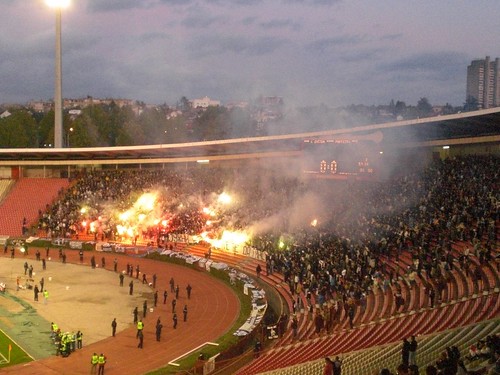
Sunday Oliver and I attended the “Eternal Derby” in Belgrade. The derby is the game between the two biggest teams in the Serbian Professional Soccer League, Red Star and Partizan. The game was held in the Red Star Stadium (Crvena zveda in Serbian) in front of over 20,000 spectators.

Both teams are known for their fanatical hooligans, and I was a bit tentative from attending the game. But the father of one of my students kindly purchased tickets in the VIP section of the stadium for us which was safe. The father happened to be former NBA basketball star Vlade Divac. He hand delivered them to me on the morning of the game. You can see him behind Oliver’s head in the background of the photo above. He is known for his kindness and humanitarian service and it is true. It was a very nice gesture and I want to give him a huge thank you! Please donate to Humanitarian Organization Divac. Vlade is a big star still here in Serbia. I guess the equivalent of this in the US would be Magic Johnson giving us tickets for a Laker-Celtic game. Very cool!

The stadium had an amazing atmosphere! The fans of Partizan especially sang, had banners, fireworks, etc and were on their feet the entire game. We went to the game with my colleague, Luiz, a science teacher in the secondary school. He is from Brazil and used to this kind of rabid fans, but even he was impressed.

The Partizan Fans Celebrate A Goal

Partizan won this 134th edition of the derby, 2-0. There were many goal opportunities for both teams and the action was non-stop. This is Partizan’s sixth straight win in six rounds of the league and they are in first place. Red Star is in eigth place out of twelve teams, with 2 wins, 2 ties, and 3 losses.

Red Star is the biggest and most popular team in Serbia. They were formed in 1945 shortly after Tito took over, hence the communist red star symbol. They won the forerunner of the European Champions League in 1991, the only former Yugoslavian team to do so. Since the breakup of Yugoslavia, they have fallen on hard times, as most of the top Serbian players go for the higher salaries of other European leagues. Oliver is a big fan of Red Star and so am I.

Partizan is more of a working class team and the second most popular team in Serbia. They were also … (time to go to school, I’ll finish this post later.)

Family Journal: Sunday September 21, 2008


Ocean and the Greenhouse, originally uploaded by bill kralovec.

We spent the equinox in the botanical gardens of University of Belgrade. The grounds were formerly an estate owned by Prince Milan Obrenovic. It was donated to the university in 1889 on the condition that it was named after the prince’s grandfather, hence the name Jeverem.

Ocean is pictured in front of the hothouse, which is a classic but it definitely needs to be renovated. There was a collection of bonzai trees out front that were pretty impressive. I enjoy and feel it is important to learn the names of the trees of all the countries I live in, so I appreciated the signs identifying the trees in English and Serbian. I will definitely begin to photograph and blog the various trees I learn of on my other blog about the plants and animals of Serbia. The other nice thing about the gardens was the Japanese pond and hill area. Oliver loved running around them.

We walked back home and Nadia cooked a great meal again. The weather has been cool and cloudy and it just feels like autumn, or first in many years. I am loving it!!!! Ocean is now saying “daddy” “owo” “mama” “no,no” “tu-tu-ta-at” (Bolivian for night-night) and is approaching her birthday number one, Friday. Owen has a loose tooth and a new tooth is coming in right underneath it. Nadia has a bit of a cold.

Good day at school today (Monday) – the highlight was meeting with the school designer on the new middle school. First day of autumn and we are looking forward to the fall colors.

Euro Basketball Qualifying

Serbia is participating in the qualifying rounds for the 2009 European Basketball Championship. The tourney takes place a year from now in September of 2009 and it is hosted by Poland. Sixteen teams will participate in the championships, with half the teams already set. The host Poland plus the seven teams who qualified via the Olympic qualifying matches. 17 other teams are competing for the final 8 spots, one of which is Serbia. They are in Group A and they have have a record of 5-1 in their first six games. They play Wednesday against Finland here in Belgrade. That is their only loss, so they will be looking for revenge. The Serbs finish up their schedule against Bulgaria which will probably be the deciding match for supremacy of the group and direct passage to Poland and the European Championships next year. 

Serbia’s top player in the qualifying is Nenad Krstic who is averaging 13 points and 5 boards a game. The 7 footer played for several seasons with the New Jersey Nets and now plays in the Russia. Hopefully I will be able to go to the game Wednesday. 


Krstic goes for two against Bulgaria earlier this month.

Family Journal: Sunday September 14, 2008


Chinese Market Gang, originally uploaded by bill kralovec.

We visited the Chinese Market today over in New Belgrade. It was a cold, rainy day but we braved the elements and headed over in a taxi. We met our friends, Tim/Janna, and Jennie and their children. The photo above was taken in between the buildings of the market.

I was expecting something a bit more “Chinese,” something like Chinatown. A place where you could buy Asian spices and there would be an old Chinese man with a noodle shop. Instead, it was a like the market Barrio Lindo in Santa Cruz, Bolivia. Yes, there were plenty of Chinese salespeople manning the stalls. The market was filled with cheap merchandise. It was mostly clothes and houseware. Everything was of very low quality. The only thing I found I liked was bee-bee guns that looked like M 16 US military rifles. I was tempted to buy two for the boys, but they are a bit too young for those. We did buy them plastic guns and transformer masks. We also got a pair of shoes for Oliver. Nadia was really bothered by the smoke and the crowds. I guess if you combine Chinese (heavy smokers) and Serbians (also heavy smokers) you get a lot of smoke. There were thousands of people there. New Belgrade is full of huge Communist era apartment buildings. The low prices probably attract the locals.


Nadia considers the bok choy.


We then went grocery shopping at IDEA, a mega-store like Wal-Mart. The chain is out of Croatia and it was a very nice store. You can buy in bulk there so we stocked up on the essentials. We had some excellent bread, a whole wheat with other nuts and grains.


Nadia and Owen move through the produce section of IDEA.


We took a short nap in the late afternoon and played football in the yard with the boys. We were loving the cold weather! It will be so different to experience the changed of seasons. Our mudroom is full of jackets, something foreign to us.

I skyped with Andy today. My brother is enjoying teaching at Academy Cotopaxi in Quito, Ecuador. Great to talk with him.

All is finally quiet here tonight. Tomorrow we have a UBD workshop so no classes.

The Fall of Yugoslavia: The Third Balkan War

I just finished reading this book by Misha Glenny. It is the second book I read by him and it was an excellent read. Glenny worked for the BBC as a journalist covering the conflict with the break up of Yugoslavia. He is considered by many Serbs to be biased. In this book he points out war crimes against civilians from all sides.

It was a chaotic and horrible time in the history of Serbia. With the fall of the Soviet Union Eastern Europe faced a time of uncertainity. The end of Yugoslavia was probably the most violent repercussion of the end of communism in Europe.

It would have been great if all of this could have been done peacefully. I think somewhat the force of history and more poor leadership caused this violence. For the good of all, I think all the republics that made up Yugoslavia should have stayed together but it was not to be. The Yugoslavia experiment ended up being a group of tiny, ethnically homogeneous, nations. I was surprised to learn that 12 “parastates” were declared during this time. The secession from the federation of Yugoslavia would have been easy and violence free if all the nations were ethnically pure. The two closest ethnically pure republics, Slovenia and Serbia, ended up with not much violence occuring. The bulk of the war occured in the Serbian parts of Croatia and Bosnia-Hercogovinia where many groups lived together. It was a confusing war as there were many factions. Some of the major sides were the Bosnian Serbs, the JNA (Yugoslavian Army) consisting of mostly Serbs but also other ethnic groups, the Croats, and the Bosnian Muslims. Each side had their different factions and paramilitary groups which added to the mix.

Glenny was a witness to much of the war and his descriptions are tragic and horrifying. World War II was devastating for Yugoslavia and so many families experienced death and violence during that time. The effects of WWII played big factor with this war as massacres were remembered from that time. Being an American I have trouble understanding violent hatred between ethnic groups and people staying in one place generation after generation. For example some of the Serb villages in Croatia have been Serb dominated for hundreds of years. The biggest shock for me writing the book is the violence suffered by civilians. Entire cities were made to evacuate on a moment’s notice before the oncoming invading army. Families were traveling by car, tractor, and eventually foot to escape. Many didn’t make it.

In Glenny’s previous book that I read, The Balkans, he describes how larger nations meddle in the affairs of the smaller Balkan states. It is no different with this war. Germany, the US, Russia, the EU all played a part, sometimes for the better and sometimes for the worse.

The book ends with the Dayton Accords. Bosnia was divided into two parts, a Serbian controlled Bosnia called the Sparska Republic and a Croat-Muslim federation on the other.

It is too bad that the Serbs were depicted in the media as the only villains in this war. It was interesting to read about the rise of Slobodon Milosevic. He won less than 50% of the Serbian vote and thousands of Belgraders protested against him and the war. Since I live in Belgrade, I was curious about what the people here did. Most people in Belgrade didn’t participate in the war, but suffered from the years of international blockades and the NATO bombings, that happened after the book was written. When the JNA called for a draft, 90% of the young men eligible hid from the service. I will be talking with my friends about their war experiences and hopefully documenting a bit about what they went through. Very sad the whole thing.

The first nanny we interviewed upon arrival to Belgrade, said she came to Belgrade from Croatia, leaving because of the war. She said that her life in Croatia for her family was much better than here, and it was tough for her father to start over. It is sad that the countries of the former Yugoslavia couldn’t maintain a big ethnic diversity. I believe this enriches nations and makes life better for all, generally.

I’ll be reading more about the history of this fascinating country of Serbia and blogging more here.

According to data collected by the Sarajevo-based Research and Documentation Centre, RDC, 98,000 people were killed in the Bosnian war – 57,000 soldiers and 40,000 civilians. Bosniaks accounted for 64,036 of the dead, Serbs for 24,905 and Croats for 7,788.

The RDC also provided a detailed picture of what happened in Brcko.

RDC’s Snjezana Filipovic said their research showed that between 1991 and 1995, 1,432 people were killed in Brcko, with 226 people still missing. Most atrocities were committed in 1992, when 944 people were killed, including 505 civilians – 409 men and 96 women.”

Excerpt from “Voices of Victims Heard at Belgrade Conference” Institute for War and Peace Reporting web site that is covering the International Court of Tribunals for the ex-Yugoslavia trials. September 12, 2008.