Olympic Wrap Up for Serbia


Phelps and Cavic in a photo finish
Cavic (left) and Phelps (right) in a photo finish

Serbia’s brightest moment came in the 100 meter butterfly event. Milorad Cavic (pronounced Chavich) in Serb is shown above nearing the wall in the finals. He was beaten by Michael Phelps by .01 second. It looked like he reached first but was gliding as he neared the wall while Phelps was coming forward with his arm. In my opinion, it was just a lucky break for Phelps and the race could have gone to either swimmer. It was the closest scare, besides the relay event that Phelps had in reaching his goal of 8 gold medals. It is also funny that Cavic has a name very similar to Nadia’s maiden name! Milorad set the Olympic record in a previous heat that still stands in the event. He received a hero’s welcome here in Belgrade with thousands coming to a rally in his honor upon arrival from China. 

It was a bit sad to see Novak Djokovich lose to Rafael Nadal in the semifinals. He did come back and win the bronze medal in the consolation match against Blake. He was the second best tennis player in the games and deserved a silver medal, but was seeded in Nadal’s bracket. We watched his exciting quarterfinal match against Frenchman Monfils in the shopping mall here in Belgrade. Everyone went crazy when he won. I could tell that Novak wanted to win the medal very badly. 

The third and last medal was won by the men’s water polo team. Serbia defeated neighbor and best friend Montenegro to win the bronze medal. Last Olympics, those two countries were together and I wonder how they would have done competing together. Serbia’s three medals were its first medals as an solo independent nation. With only 6.5 million people, three medals is pretty good. That is a ratio of just over 2 million people per medal. Compare that to the USA’s 2.7 million people per medal and it is slightly better. I wonder how the former Yugoslavia would have done together in this olympics? I also enjoyed listening to the Serbian Olympic Theme, Srbija Navija! or Serbia Cheers! Thanks Sanja I. for sending it to me. 

I really enjoyed watching them but am glad they are over as it dragged on a bit with so many obscure and unwatchable sports. I think the Olympics could get rid of many sports like synchronized swimming and diving, equestrian, shooting, table tennis, judo, etc.


St. Sava’s Church


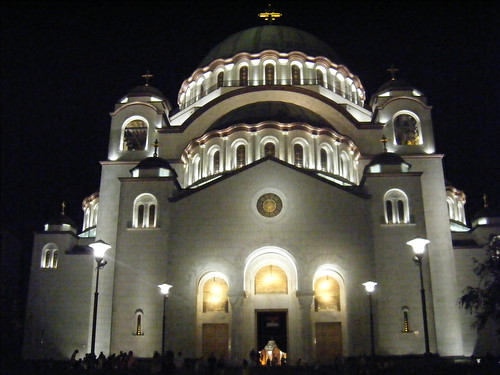
I took a photo Friday evening inside the giant St. Sava’s Church here in Belgrade. The church’s massive dome is 70 meters high and 10,000 people can attend mass. It can be seen from all over city. It is the third largest Orthodox church in the world and the largest neo-Byzantine building constructed in the 20th century. The Byzantine architecture style features a large, central, dome and thin windows to let in light. The inside is truly awe inspiring!

We walked down to the church from the main shopping area. I was surprised to see so many children and families near the church. It sits on a small hill surrounded by a park. There were roller bladers, kids playing tennis on the outside walls of the church, and teenagers riding mopeds up and down the side walks. No holy reverence here which is refreshing to experience. The church was open and a few people were taking photographs and looking around. Oliver and I went inside and were blown away.

As you can see in the photo, work is still being done on the church. Construction did not begin until 1935 and has been interrupted by the numerous wars Serbia has experienced. This is the first Orthodox Church I have been in and I was impressed by the mosaics on the walls, which are another feature of the Byzantine style. The Orthodox Church in Serbia is not under the direction of Greece and is independent and has its own pope (Patriarch) and hence the Serbian flag prominently displayed on the front entrance.

St. Savas Church At Night
St. Sava's Church At Night

The grave of Serbian Saint Lazar is in the basement of the church. He is the Serbian Jesus. He was a Serbian noble who died at the famous Battle of Kosovo in 1389. According to legend, he was visited the night before the battle by the Prophet Elijah in the form of a gray falcon. Elijah offered Lazar an Earthly Kingdom or a Heavenly Kingdom. Lazar takes the Heavenly Kingdom, but to earn it, he has to die on the battlefield. He was canonized by the Serbian Orthodox Church and his feast day is the most holiest of all days in the Serbian calendar, June 28.

The church is named after the son of the founder of the Serbian medieval empire. Sava was originally Prince Rastko Nemanjić and he lived in the late 1100’s – early 1200’s. He was the founder of the Serbian Church. The location of the church was put here because Sava’s remains were believed to be burned here in the 1500’s by the Ottoman Turk leader Sinan Pasha.

I really felt I was at the heart of Serbdom! With the church being in the center of Belgrade, the capital of Serbia and with the remains of two of the founders of the Serbian nation and church here, you can’t get more Serbian than this. With the breakup of Yugoslavia over and a new era for Serbia, hopefully they can complete the church. The church represents the long history of the Serbs and the bright future ahead for the country.

Serbia Olympic Update

We are crazy for the Olympics here in the Kralovec family. Yesterday’s 4 x 100m relay swimming race had us on the edge of our seats. We hope Phelps reaches his quest for 8 golds. We also enjoyed the dunkfest of the USA Redeem Team against China in basketball. They will have tougher competition upcoming. 

Serbia’s quest for their first medal as an independent nation has had it’s ups and downs. Their best hope is in tennis, but it suffered a set back yesterday when nagging injuries kept Ana Ivanovic out of the draw. The three other Serbs, Novak Djokovic, Janko Tipsarevic, and Jelena Jankovic all won their first round matches and now are into the round of 32. Janko upset seeded David Ferrer of Spain. Novak has Raphael Nadal on his half of the draw, while Janko has Roger Federer on his side. Both should move on to the round of 16. Jelena is the number two seed, but has Venus Williams and Marat Safin’s sister on her half of the draw. 

Ana drops out of the women's singles tennis draw.

In water polo, the Serbian men defeated Germany in the first round and are scheduled to face arch rival Croatia today. The Serbian men’s soccer team looked outclassed against the Ivory Coast on Sunday in a 1-3 defeat. Their final group match against Argentina is a must win situation. Argentina has already qualified to the quarterfinals and might play with substitutes. The Serb men have one point from a first round draw with Australia. They need a decisive win against Argentina tomorrow and an Ivory Coast close loss. 

The Serbian Women’s Volleyball team has two wins against two lesser opponents and plays powerhouse Brazil tomorrow which will be a good test. The men’s volleyball team is trying to bounce back against Brazil today after a narrow defeat to Russia in round one.

Serbia’s Olympic Team


Ana Ivanovic is shown above during last night’s Opening Ceremony of the 2008 Olympic Games. I love the Olympics and the whole family is following it, especially the teams of our countries. We are especially focusing on Serbia this year, and Ana, Jelena, and Novak are some of the favorites to win medals for Serbia this year.

It is a historic year for Serbia in the Olympics. It is the first time since 1912 that they have competed as Serbia. Since that time, they have either been a part of Yugoslavia or with Montenegro. They have 92 athletes participating in 11 sports. They did not win any medals in those Stockholm games of 1912, so this could be the first medal for Serbia in history!

Other medal hopes for Serbia are in the team sports. The water polo team recently won the World League championship in Germany. The men’s volleyball team placed second in the World League warm up tourney in Brazil last month. Serbia also has men’s soccer and handball teams.

I’ll hopefully have time to post a follow up during the games on Serbia’s medal tally.

Weekend Journal: August 2-3, 2008


We had a nice weekend, our first in Belgrade without jet lag. On Saturday we went to Ada Ciganlija which is a long, flat island in the middle of the Sava River. It is a few kilometers from our house and has an artificial 4 kilometer lake in the middle. As you can see, on a hot Saturday in August, it is quite popular with Belgraders! The island is great, with bike trails going for miles all around. 
Despite the hordes of people, we had a really good time. The boys enjoyed all of ice cream vendors and swimming. Ocean loves the water and she was laughing and playing and would have stayed in there as long as I did. Nadia and I enjoyed the people watching. Old folks doing the European sleeping under a tree in the shade and women in bikinis sauntering down the path with purses and high heels. 
We then went to the Delta City mall and Nadia and the boys watched a movie. I strolled around with Ocean and she fell asleep. 
On Sunday we relaxed around the house. I did some yard work, took the kids to the park and went for a long walk with Ocean. We had a big lunch outside and ordered pizza for dinner. I will be back at work all day today. 


Learning Serbian

I am in lesson #4 of my Serbian language book and I have a few observations about the language.

  • I was surprised at many foreigners in Belgrade don’t bother to learn the language. I can see there point that many Serbs, especially younger people, speak English. Also, world wide, Serb-Croat speakers probably number 20 million, max (I just looked on wikipedia and they have the figure of 12 million.)  There are more people in California than that.
  • It is my goal to get through the book and have working vocabulary. I know I’ll never be totally fluent, but it would be nice to be able to follow a conversation. I believe it will be worth the effort to put into to study. As with any language, it offers insight into a different perspective into seeing the world. 
  • Being a slavic language, it feels like I am getting back in touch with my roots and speaking the language (or similar) of my ancestors. 
  • The dual alphabet of the Cyrillic / Latin is interesting. I don’t know of how many languages that have alternative alphabets. Of course the Latin is easier for a westerner and that is the one I am focusing on in picking up new vocabulary. But with so many signs in cyrillic, one can’t help but try to learn them. It is like a puzzle, and we are always trying to sound out the signs we see. 
  • The cyrillic differentiates Serbs from Croats and Serbs take pride in this. It is a remnant of the Byzantine Empire influence over Serbia. Serbia has always been a frontier between east and west, mostly being inside the eastern influence rather than the western side. 
  • I now understand why people who have learned one language can learn another easier than someone with only one language. 
  • Serb is similar to Spanish regarding verb conjugation. So far I have only learned the I ending -m, the you (informal “ti”) and the you (formal “vi”) -te The infinitive ending of the verbs is iti, for example govoriti means to speak. 
  • Nouns have three genders (Spanish only has two). Masculine nouns end in consonants, feminine is “a” and neutral in “o”. The is no articles in Serb so no confusion over the “el” or “la” of Spanish. The difficult part, and I am bitter about this, is that the ENDING OF NOUNS CHANGE DEPENDING UPON THEIR USAGE. For example, the word for coffee is kafa. In the nominative or basic form, one can easily see that it is a feminine noun. But when you are ordering a coffee, the ending changes to kafu because it is the direct object of the sentence. For example, Ja bih jednu kafu. (I would like a coffee.) Jednu is the number one, and this also changes depending on the noun it describes. 
  • Serbs get a big kick out of a foreigner speaking Serb. They have been very patient with me and my accent must sound funny to them. My Serb always illicit a smile and a laugh.
  • I am at the point in my learning that I am memorizing and using short phrases for common things. Below is a list of the phrases I have mastered:

Kako se zovete?  (What is your name?)

Zovem se Bill. (My name is Bill)

Molim bac (please and welcome)

Hvala (thank you)

Drago mi je. (nice to meet you)

Ya sam (I am) / ti si (you are) / vi ste (you are)

When you ask a question, throw a “Da li” in front of it. For example, Da li govorite Engleski? Do you speak English?

Ne razumen. (I don’t understand.)

New Phrases I want to learn this week

Izvolite – Can I help you?

Živolite!  – Cheers

Ja bih (kafu) molim bac?  – I would like a coffee please.

Dajte mi (kafu) molim bac? – Give me a coffee please. 

U redu – okay / all right

Sava River (Reka Sava)


Our children are pictured above on the jogging trail that goes along the banks of the Sava River. After buying a table cloth at Home Center, we took a stroll along the river. The river is just down the hill from our home in Senjak (Belgrade). I discovered the trail on a run I went with Ocean yesterday morning. It goes north towards the city center for at least 7 kilometers and south for another 5 from our entry point. The trail is paved and perfect for biking or jogging. I am sure we’ll be cruising it a few times as it will become one of my running loops around the city.

The Sava is over 600 miles long and runs through four countries of the former Yugoslavia. It connects three capital city. The Sava originates in Slovenia and ends here in Belgrade, when it connects with the Danube. It is the second biggest tributary of the Danube.

It is one of the few rivers that still has flood plains as it is not regulated. It flooded the lower parts of Belgrade in 1981 and 2006. The name Sava is not Slavic – it has Celtic and Roman origins.

I see many people fishing on the river and lots of bikes and runners in the late afternoon. There are plenty of boats, many of the old and rusty boats that look like they are permanently anchored near the banks. There is also some algae buildup and plenty of refuse, so I question the water quality. It would be a lot better if it was better taken care of, but I am do not know the strength of environmental agencies and groups here in Serbia. It is still nice and our neighbor Radko swims in it all the time. He says there is a clean spot between the bridge supports pictured behind. I enjoy the fresh water air coming off of the river and the large number of birds along the shoreline. The bike trail is great too! The Serbian word for river is reka.


Refuse and Algae on the River Sava


It was my last day of summer holidays as I report to work tomorrow (August 1). In the morning I took the kids with their bikes to the park. In the afternoon we organized the shelves in our house and the computer and camera equipment. I went to the airport with Eric, Goran, Jasmina, and Dominik to pick up the new elementary principal, Tim, but his flight was delayed with Lufthansa. After I came back, we went to the river. We wrapped up the night with watching Spiderman with the boys under our gazebo outside and Nadia and I had a nice glass of Macedonian white wine.

Aftermath of the Karadžic Arrest


Riots in Belgrade, originally uploaded by bill kralovec.

Above is a screen shot from the B 92 television channel here in Belgrade. Nadia and I watched a small group of protestors clash with the riot police on Tuesday evening. The radical socialist party held a rally downtown attended by about 15,000 people. The protestors were throwing rocks and flares at police while they were responding with tear gas. There were some injuries and arrests, and the windows got smashed on the McDonald’s, but that is about it. It is funny that the center of the protests has been on Makedonska Street, the first place Nadia wanted to go to when we arrived because of the Pizza Hut being located there. On our side of the river in Senjak, all was quiet. We did see the riot police on Monday preparing near the Kalemegdan Park downtown. (photo below)

In my very unofficial poll of Serbians, most seem unconcerned about the arrest. Two said that Karadžic had ties to organized crime and they were happy he was finally arrested. A taxi driver wanted to forget about the past and have Serbia concentrate on improving its economy.

I need to read more about the break up of Yugoslavia before I can have an opinion. It was a very difficult and chaotic time for a nation to break up as well as the Communist form of government. I would like to see all sides articulate their actions. I also think the trial should take place here in the Balkans and not in the Hague. An clear documentation of what happened needs to completed so the people of the ex-Yugoslavia can reflect and learn from what happened.

Karadžic flew to the Hague yesterday, so we will surely be hearing more about his years of being a fugitive. It is very unclear as to who arrested him and who supported him during his time on the run.

The New York Times has three interviews with journalists about the arrest. All three have met the ex-Bosnian Serb president and have authored books about that breakup of Yugoslavia.

Bon Apetit! Escargot Anyone?

With all the yard work we have been doing, we have come across many of these snails like the one above. It rained all week and there were probably 20 snails in my back yard along the wall and in the wood pile.

After a bit of research I discovered that it was the famous, Roman Snail, or as the French refer to it as Escargot. This is the common edible snail native to limestone areas of central and south-eastern Europe. The parks and yards of Belgrade are full of them. This morning on my run with Ocean (a later post), I saw two old men collecting them in the park. This afternoon I saw a woman also collecting them down the block.

They are called the Roman Snail because the Romans used to eat them too. The scientific names is Helix pomatia and it is also known as the Burgundy Snail, from the Burgundy region of France. They can do damage to trees and garden plants.

I have to try these, perhaps if the wet weather persists, we’ll collect a bunch. From ehow.com website I copied the recipe on how to prepare them:

Preparing Live Snails
Step1
Put the snails in a container without any food for 2 days. Wash them frequently to rid the snails of any toxins and empty their intestines.
Step 2
Remove the snails from the container and again wash them thoroughly. Either boil them for a short period of time or put them in the freezer to kill them.
Step3
Remove the snails from their shells using tweezers or a hook.
Step4
Remove the intestines and the body of the snail. You only want to eat the foot. The internal organs are not tasty.
Step5
Take off the shell door (the operculum) of each snail. If you want to reuse the snail shell to prepare an appetizer, sterilize them by washing them thoroughly with baking soda, rinsing them repeatedly and boiling them.

I wonder what the Serbs call them? Any Serb readers know?

Arrest of Karadzic

Protest , originally uploaded by bill kralovec.

We happened to be downtown today at the same time the protest march was coming around. Above is the front of the group that was marching through the streets of Belgrade. Our taxi was diverted by police and I snapped this photo through the window. There were many policemen all decked out in riot gear, but it was quite civilized and peaceful. We were on our way to dinner to Pizza Hut which is downtown, but we decided it best to get back to our neighborhood of Senjak to find something to eat.

The protesters are against the arrest of Radovan Karadzic. He was the first President of the Republic Srpska. The Republic Srpska is the Serbian half of the nation of Bosnia & Herzogovina. Mr. Karadzic has been a fugitive from the International Criminal Tribunal for the former Yugoslavia since 1995. He is the 44th Serb to be brought to the ICTY. He is charged with 10 counts of various war crimes from his time leading the war effort in Bosnia from 1992-95.

Radovan sounds like a character in a Dostoevsky novel! He has lived a full life to say the least. I can see why many Serbs admire him, he is steeped in “Serbdom.” His father was a Chetnik fighter in WWII and after the war was imprisoned by the Tito’s Communist party. Karadzic is a psychologist by training, even spending a year at Columbia University in New York. He is a published poet and has won awards for his works. He was imprisoned for a year himself by the Yugoslav Communist government on charges of fraud and embezzlement while working at a hospital in Belgrade.

He next got into politics and founded the Serbian Democratic Party of Bosnia. This was during the chaotic time of the breakup of Yugoslavia and the downfall of communism in Eastern Europe. His Bosnian Serb party promoted a union of Bosnia with Serbia and they organized a vote for an independent government. A day later Bosnia went independent from Yugoslavia and that is when the violence started. Karadzic assumed the Head of State powers of the Republica Srpska. Like in the USA, the President is also Commander in Chief of the Armed Forces and head of the Security Council. Karadzic is being charged by the ICTY for being the leader of the armed forces that carried out the Siege of Sarajevo, the Srebenica Massacre, and kidnapping UN personnel. In his defense, he is claiming that he acted as any normal president would in a time of war.

He was captured Monday on a public bus in Belgrade. He had been running an alternative medicine clinic under an assumed name. He was a guru of “Human Quantum Energy” and claimed that his methods helped sexual disorders among other ailments. He looks like Saddam Hussein looked when he was captured in December of 2003. Below is the front page of the Blic newspaper of Belgrade and it shows how long his hair and beard are.