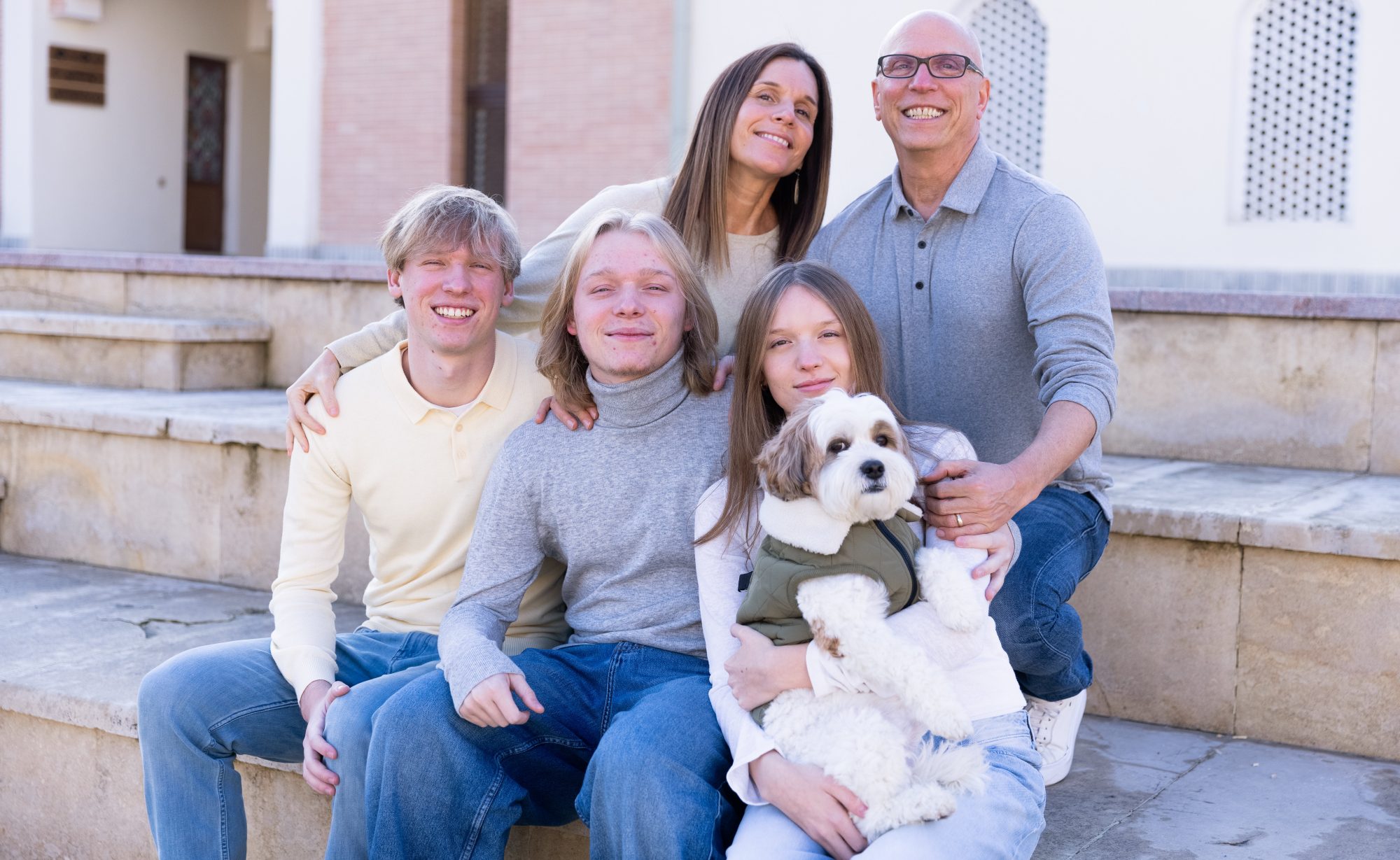
Last night we went to Saint Sava’s Cathedral here in Belgrade for the burning of the badjnak and the Christmas Eve Service. As you can see from the photos, it was a beautiful and culturally enriching night for my family.
Each of the kids had a “badnjak” which is like a yule log. The word badnjak may be derived from the verb, bdeti, which means to stay awake or keep the vigil. The tradition stems from pagan times and the man of the house (domaćin) or sons on Christmas morning went into the woods and cut down a young Oak tree. The yule log is kind of like a ceremonial sacrifice to bring health and happiness to the family for the coming year. The log was burnt over the family hearth. Today, an assembly of twigs with Oak leaves, corn, pine sprigs, and straw is tied together with a red ribbon and sold in markets and street corners around Belgrade. Every church has a bonfire on its grounds where people can come and throw their badnjaks in the flames.
There were hundreds of people there and outside the church a mini-market was set up selling religious and holiday crafts and mulled wine. We went inside the massive cathedral to watch a bit of the service and light candles in memory of lost family members. The service, shown below, had a lot of priests singing and waving incense. There were also lines of people waiting to kiss various icons.
Afterwards we went to have some Lebanese appitizers at the Byblos Restaurant and the kids played in the park.
This weekend I visited the Terra Art Colony located just outside the town of Kikinda. Kikinda is a city of 45,000 near the Romanian border in the heart of the plains of Vojvodina.
The Terra Art Colony is a government-funded project that provides an amazing studio and property for the fine arts. It is a former brick and roof tile factory that closed down in the 1950’s. The “Banat” region of Vojvodina is a historical region in the agricultural plains of Hungary, Serbia, and Romania. The area was once a sea and has rich, red, clay soils that were perfect for bricks and terracotta ceramics. The factory is an amazing place for making a movie or hosting a Halloween party. The head artist-in-residence Jovan, showed us around the complex. There were several studios and exhibition areas. Most of the art was terracotta sculpture and there were many interesting pieces on display. Behind the main building, there was a long drying shed that used to be for the tiles. The kids loved running up and down the spooky aisles between the drying racks. It is very nice that the factory was preserved and is put to good use. I bought a small statue of a “Lala” which is a typical guy of the Banat region. He is a chubby guy because the food is so good in the “breadbasket” of Serbia and he is pictured on top of a pumpkin. This is because the Banat is so flat, that one only has to get on top of a pumpkin to see a long way.
The Summer Studio
The artists also had a pet dog that is a breed typical of the Banat region. The Puli is a working dog known for its athleticism in protecting sheep and other livestock. They have a thick, curly coat that is waterproof. They are usually black and their fur can be very long, almost like dreadlocks.
A Puli dog
I recommend visiting the town and especially the art colony complex. I am not sure what the opening hours of the gallery and if they give tours. My friend introduced us to the place and I think the artists came just for our group. That is one of the best features of Serbia is that it is not geared for tourists at all, so there are not many maps, brochures, advertising, etc. for the place and it felt like we discovered a secret place. I’ll try to get our visual art students to spend a day at the place.
Last night I attended the Belgrade Philharmonic’s performance in the New Year Cycle. The cycle is a concert series based on the various religious New Year celebrations. Last night’s concert was the Islamic New Year. It is always interesting to watch the “VIPs” enter hall and last night was no exception. With a lot of cameras, etc, Belgrade Mufti Muhamed Jusufspahić came in to be seated. I snapped this photo of him speaking with the Philharmonic Director, who looks “artistic” with the spiked hair and fashionable glasses.
The Islamic community in Belgrade and in Serbia is quite small with only one mosque in Belgrade and about 300,000 Islamic people in the country. Most are found in the Sandzak, a region in Southern Serbia that borders Kosovo, Montenegro, and Bosnia.
Jusufspahic is a somewhat controversial figure in that he is the self-proclaimed leader of the Islamic community in Serbia. Several muftis in the Sandzak dispute this and there is political tension because of it.
I think it is nice for Serbia and the rest of the former Yugoslavia to have an Islamic community. It gives a bit of “exoticness” to the overwhelming majority Slavic Orthodox Serbian architecture and culture. The Islamic followers however, are Slavs, having been converted during the 500-year Ottoman occupation of Serbia. They don’t have different foods and look very Slavic. I enjoyed visiting Sarajevo and Mostar and hearing the call to prayer and seeing the towers of the mosques. I also visited the Bajrakli Mosque here in Belgrade in January of 2009.
We didn’t stay for the whole concert and Nadia and I went for a drink next door to the Hotel Square 9. A really nice atmosphere with not much smoking. We laughed quite a bit.
Yesterday for the opening of our gymnasium a Serbian Kolo Dance Troupe performed. The “kolo” or circle in English, is a traditional cultural dance performed in the ex-Yugoslavia, in Bosnia, Croatia, and Serbia. This being Belgrade, it was the Serbian version of the dance. A professional troupe performed in the ceremony as you can see in the video above. I loved the music and costumes. Note the elf-like shoes, which traditionally are made of pig skin and are molded to fit one’s foot. They have a little “pig’s tail” on the tip of the toe.
It is a beautiful dance and great outfits. I felt like drinking a rakija while watching them!
I’ve noticed around the city the past couple of weeks many political posters. This spring they will be holding parlimentary elections and next year there will be a presidential election. The campaign has begun!
The posters definitely have a negative tone to them, highlighting the faults of the other parties.
The poster above reads, “Their interest in our debt!” and the subtext is “they brought the Belgrade economy to the edge of destruction.” The poster shows city mayor Dragan Đilas speaking with the economic minister. In a “city-state” such as Belgrade, the mayor has almost the same amount of power as the president and it is a position that the major political parties go after.
The current president, Boris Tadić will be serving out his five-year term in 2013. I think this is the first time a president has done that in Serbia’s short time as an independent nation. I don’t know how he can win reelection with the economy the way it is in Serbia. Experts are predicting Barak Obama facing difficulties getting a second term with 9% unemployment and a slow recovery. Tadić should be in big trouble with 23% unemployment, foreign direct investment falling in half in the past two years and inflation close to 10%. They also have 1/3 of their budget going to pensions.
But with a situation as dire as it is, it will be awfully difficult for anyone to turn the economy around. I don’t see much difference between the political parties (much like the USA) with all of them in favor of a 1 billion Euro subway system, promising more jobs, and cutting down on corruption. Most also agree to support the agriculture sector of the economy, which is already a healthy 13% of the GDP.
The argument used to be should they try to join the EU or go it alone or have a special relationship to Russia. I don’t see the EU accepting Serbia in the near future with the economic problems of Greece, Italy, and Spain.
Serbia needs leadership that will make it easier for businesses, both foreign and domestic to start up. Serbia is one of the most difficult places in the world to do business because of the bureacracy from Communist times. The rule of law needs also to be established here with everyone paying taxes and punishment of crime and corruption. I feel they should be putting their energy to trying to unite the Balkans instead of going for the EU membership. The negative campaigns are not focusing on the real details of what needs to get done and who can do it. Politics are the same in most countries and the USA is not an exception.
The poster below is making fun of Serbian Progressive Party leader, Tomislav Nikolić. He used to be with the Radicals and the left side shows him wearing a t-shirt of Voja Šešelj, the former leader of the Radicals, now on trial at the Hague. “Who is the person who never lied to you, Nikolić or the real Toma?”
Serbia deserves good leadership and I hope whoever gains power in the next election, and focus on good government and the betterment of lives of its citizens.
I took this photo Saturday evening while coming back from New Belgrade. All six lanes of traffic were open for the first time in many months as a large repair construction project was completed 7:00 PM on Saturday. The Gazela Bridge is one of the main bridges in the city connecting the old part of Belgrade with the New Belgrade. Besides being used for intra-city traffic, it is also part of two major highways crossing Europe (E70 and E75) and so besides Belgrade traffic, there is lots of foreign cars cruising through. The bridge has more cars crossing it than it was designed for.
The bridge built in 1970 was in desparate need of reinforcement and it looks and feels much better. The project did however, make everyone’s lives a hassle because of the limited options in crossing the city. Hopefully with all six lanes open, this will cut down on the traffic delays that were a daily part of many Belgraders lives.
The city is working on another bridge across the Sava River (see photo below) which should be done in the next few months. It will be interesting to see how this affects traffic flow. There are only two other bridges going across the Sava in the center part of the city. The bypass project, which would divert E70 and E75 traffic is still in the planning stages.
By the way, the name “Gazela” comes from the fact that on a side view, the bridge does look like a gazelle running.
View from the river, of the almost completed Sava Bridge (August 2011)
I just finished reading All About Tesla – How Nikola Tesla Invented the 20th Century by Michael Krause. I have heard much about the scientist and it was good to read a complete biography of him. His picture graces the 100 RSD note and the airport is named after him. The book is a bit dry, but Krause does a good job of covering the details of his life as well as mixing in his personal experience during the research on his life.
The famous "Blue Portrait" of Tesla, circa 1916
I would compare Tesla to Steve Jobs of today, but with bad business sense and a bit of autism/depression in the mix. He was one of the superstars of a new technology, electricity, and fortunes were made as the young industry got its start. It would have been amazing to live at that time, and the book captured the sense of society’s first reaction to electric light. Like the internet and computers of today, it fundamentally changed the way we lived. Before reading the book, I was under the impression that it was Thomas Edison versus Nikola Tesla to determine if direct current (DC) or alternating current (AC) would become the dominate form of electrical circuitry. But in reality, there were many more people involved than just those two. Tesla’s contribution was producing a motor that George Westinghouse used to become rich and have AC be the current of choice. Tesla’s big mistake was selling Westinghouse the patent and not collecting royalties. The generator allowed Westinghouse and then others produce enough power to transport the current over distances. Like Jobs, Tesla was famous for his presentations. He gave lectures all over the world that were known for his showmanship. He wowed crowds with his demonstrations of wireless transfer of electricity to light early fluoresent light bulbs.
Publicity Photo of Tesla in his Colorado Springs Laboratory - circa 1899
Tesla is a “rags to riches” story. His father was an Orthodox priest in a small village in Croatia. Tesla barely got into university in Austria. His uncle pulled some strings and he got in on a military scholarship. Like many peasants in the late 1800s, Tesla fled the Austro-Hungarian Empire (my ancestors did a few years after Tesla left) to go to the US to make his fortune. He eventually became a world-class inventor and scientist, and also a huge celebrity. He lived large, living in luxurious hotels his entire life, and gave lectures demonstrating all sorts of electrical phenomena, like flourescent light bulbs lighting without being plugged in. He was good friends with Mark Twain and other famous personalities. Due to his extravagant living, it was constantly a boom and bust for Tesla. Many venture capitalists like J.P. Morgan, invested in his research and development laboratories, but because he as a wacko and didn’t focus on products that could be sold for a profit, he lost a lot of people a lot of money. The lectures and his articles for New York journals, made him quite a celebrity. He lived life large!
Serbian currency with the measure of magnetic field unit named after him
Tesla did come up with many patents and his ideas were ahead of his time. His ideas contributed to someone else making money in the fields of radio, x-rays, hydro-electric power, remote-controlled submarines, etc. As he got older, he got more out there, focusing all of his experimentation on impossible schemes. He was obsessed with a tower in his lab in New Jersey. He had the idea of a super tower that could send electricity across the world, as well as being a weapon, kind of like a laser death-ray of science fiction. Indeed, many of his ideas were used by science fiction writers of his time. In comics in the 1940s, some writers based their “evil scientist” character on Tesla.
I loved his idea of tapping into the cosmos’ energy, kind of like being able to power devices on cosmic rays or dark matter or the collective consciousness of living beings. Maybe someday this will be a reality.
He had many strange quirks. He was celibate his entire life. He worked insane hours with little sleep (10:30 AM – 5:00 AM) and avoided all sunlight. This led to periods of exhaustion and depression. He had to put pieces of rubber under his bed for a time, because of his hyper bat-like senses wouldn’t let him sleep because he detected the friction of the bed posts and the floor.
He was also proud to be a Serbian and in his later years, the Yugoslavian government supported him. I learned from the book that his name may be Ukrainian, because Tesla is not a typical Serbian surname. He was a fascinating fellow to say the least and Serbia and Yugoslavia should be proud of his contributions to the human race. I really want to go see his museum here in Belgrade. I’ll do a post on my visit there.
My son Oliver is trying a peach slatko last weekend at the restaurant Stari Majdan.Slatko is an interesting traditional Serbian fruit preserve. It is like a jam but with chunky pieces of fruit and it is served with water. It is very sweet and immediately afterward, one needs a sip of water. I guess that is why it is named slatko which means “sweet” in English.
It used to be served to guests when they arrived in a Serbian home. Today, it is only found in rural areas in Serbia or occasionally in green markets in the city. Nadia absolutely loves it and we usually have a jar in the kitchen. I’ve seen that strawberries and figs are the most common types. My friend mentioned a watermelon (lubenica) slatko that I would like to try.
Update – July 9, 2012 – I read an article in the Spring 2012 edition of BelGuest that mentioned slatko comes from the Sephardic Jewish community of Belgrade before World War II. The Spanish (Ladino) word for the desert is dulse and the Serbs adapted it from their interaction with the large (22,000) Jewish community in the city.
We are in the peak color season in Belgrade. In Europe, as opposed to my birthplace of Michigan, the colors are mostly yellow. The theory goes that there are more tree species in North America that gives more colors and the ice age killed more of red-producing pigment trees in Europe than in North America. Despite not having the reds and oranges, it is still a beautiful time of year. Above is a photo of a wall at our school.
It was great this morning. I was walking with Ocean to our car and she said, “it is leaf day today.” There were leaves literally falling all over the drive way. It has been great to experience the change of seasons, especially for the kids.
It has also been foggy this week in the mornings. Below is a photo of our yard yesterday morning.
I saw this well done mural on an old building near the Sava River on a bike ride home from Ada Ciganlija earlier this week. The caption reads as follows:
Živ je Draža – umro nije – dok je sprstva i Srbije!
As long as there is Serbia and the Serbian Spirit – Draža lives!
It pictures Serbian military hero Draža Mihailović. Mihailović fought in four wars in his lifetime. He was a young man in the two Balkan Wars and World War I. Especially in World War I, when there was the very real possibility of the loss of the Serbian nation, he fought on the front lines from Corfu, through Albania and back to Belgrade. He is most remembered for World War II, but I feel he shouldn’t be. He was almost 50 when the Nazis invaded in 1941. He fled the Yugoslav army and led the resistance group called the Chetniks. They differed from the more famous Partizans in that they were mostly ethnic Serbian, loosely supported the Yugoslav King in exile, and avoided direct confrontation with the Germans. Draža believed the German reprisals against Serbian civilians were not worth the minor gains in guerilla attacks. I agree with this and he was waiting for the Allies to eventually come and take out the Nazis.
Unfortunately for him, the Partizans won control of the country after the war and Tito had him put on trial and executed. One research study suggests his body is buried close to the mural, on the entrance of Ada Ciganlija. Mihailović and several of his commanders were dumped in a mass grave in a secret site.
He was used as a source of inspiration by Serbian military groups, both formal and informal in the wars of the Secession of Yugoslavia in the 1990s. This has made him unjustly, a controversial figure even today. It is similar to the World War I battle hymn, March on the Drina , which should be the Serbian national anthem, but due to its use in the wars of the 1990s also, is considered too controversial.
Mihailović’s final words were “I wanted much; I began much; but the gale of the world carried away me and my work.”
He lived a hard life to have it disrupted so violently with four major wars. He deserved a better fate than to be executed by the communists. He should be rightly honored for his resistance against outside major powers trying to take over smaller Serbia. Perhaps his ideas of a looser federation of Yugoslavia with stronger autonomy for the ethnic republics would have resulted in a longer existing Yugsolavia.
On a lighter note, he should be depicted on t-shirts more than Che Guevara, the Argentinian bum turned Cuban Revolutionary hero. The beard, glasses, and Šajkača are a very “cool” look for Draža. I’ll look to see if I can find his image on a t-shirt or make my own.


 Bill's Blog