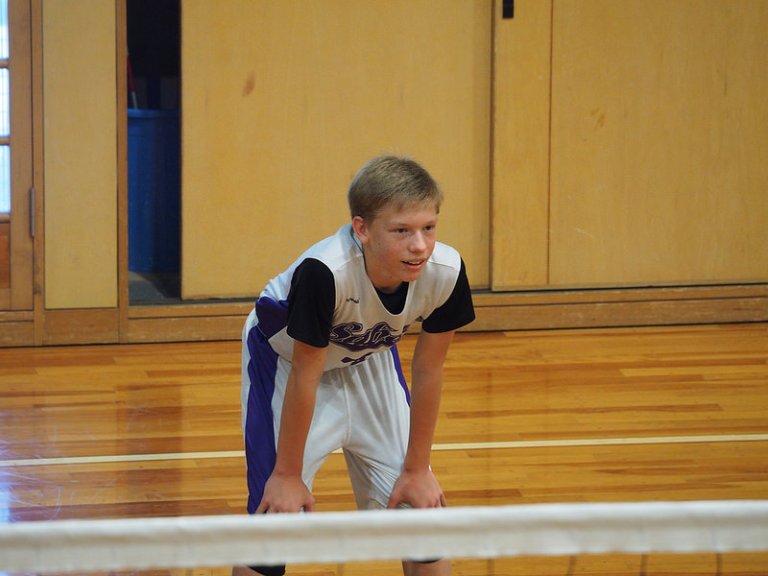
Owen’s middle school “B” team won the Western Japan Athletic Association volleyball championship on May 20. This was his first year out for the sport and he really enjoyed it. The “A” team also won their division. Both teams are pictured above.
He was the captain of the “B” team although he could have been a substitute for the “A” team. It was his first year and he wanted to play more and when the coach gave him the choice, Owen chose to start and lead the team. It was a good experience for him.
Owen loves sports and played baseball, basketball, soccer and volleyball this year. I am glad we are at a small international school where he can play different sports, not specialize like many students have to in the USA to even make the team, and he can make the teams. His team won first in the WJAA in all sports except basketball, where they finished third. I would like to thank athletic director Pete Heimer, and coaches Mike McGill, Rodney Ray, Michael Routh and Nakamura sensei for their work with Owen this year!
I have been super busy with school as we are approaching the end of the year, so I have not been posting as much as usual. Yesterday, Oliver, Ocean, Nadia, Kenta and I biked to Expo ’70 park. We spent the morning walking around the park while Nadia and Ocean shopped in the mall. The park is a huge green space near our house in the north of Osaka. It was the site of the Exhibition 1970, similar to the world fairs they used to hold in the 19th and 20th centuries. The park today is a multi-use area with fields for playing sport, playgrounds, a couple of museums, some nature areas, etc. Behind the boys is a massive work of art built for the expo, called “Tower of the Sun”. 47 years later, I wonder what they were thinking, although it is quite distinctive. We met up for lunch at the food court in the mall and then biked home. A really nice time!
Ocean right before the conference
Thursday we went to Oliver and Ocean’s student-led conferences. You can see the videos of Ocean going through her learning on our family YouTube channel.
It is so funny that the kids get really nervous and excited for showing us what they have been doing in school. Oliver will be heading to middle school next year and I think it will be a good change for him. Being with the same teacher all day must be hard for him and the teacher. The moving around and different teaching styles will help him. However, the challenge of staying organized will be tough for him.
My new favorite drink in Japan
The convenience stores always a huge variety of cold drinks they come out seasonally. I discovered the “Relax Orange – Orange + Jasmine”. It was the perfect refreshment on a bike ride on Thursday night. It is not very sweet and the jasmine gives it a nice aroma and after taste. It will be replacing the “Litchi + Salt”, which is a spring drink.
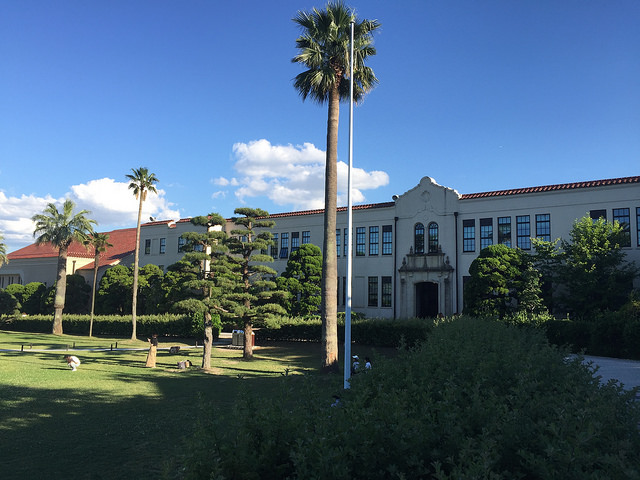
Finally, the weather in May and early June has been perfect! It feels like that Mediterranean sunshine, with bright blue skies. The nights and mornings are cool, however, the humidity feels like it is lurking. The summer in Osaka is oppressively hot and wet. I often go to the university for meetings and I snapped the picture below. The Spanish-style buildings and Chinese fan palms give it a California feel.
Academic building off the main lawn at Kwansei Gakuin University
The narrow streets of Osaka’s Korea town, Tsuruhashi
This book is right “in my wheelhouse” in many ways, so of course, I liked it. I enjoy historical fiction, the story takes place in Osaka, where I live, and expatriates play a role in some of the stories. Author Min Jin Lee is Korean-born but raised from age 7 in New York. Her book brings attention to the discrimination Korean immigrants faced and are facing, in Japan, still today. It follows four generations of a Korean family, starting in a fishing village in Busan in 1912 and ending in Yokohama in the late 1980s.
Many Koreans immigrated to Japan from when Japan annexed Korea in 1910 through to the Korean War in 1953. Over 2 million Koreans came to Japan, but most repatriated to their ancestral homes following the end of World War II. They were treated very badly in Japan, not being able to find jobs or good housing. The book really gives you the sense of how tough they had it, always on the brink of starvation and struggling to get ahead. Adding to their misery, life in Korea at the time was probably worse, so they were stuck in Japan. The Korean people had been through a lot in the 20th century, and even today, the misery continues for the North Korean people.
A yaki-niku (grilled meat) restaurant in Tsuruhashi
Today there are about 800,000 Korean residents in Ikuno-ku, a ward in the southeast of Osaka. It is the area in Japan with the most Korean immigrants and their descendants. As you can see in my top photo, it is a rather poor area, with narrow streets, older buildings, etc. It reminded me a bit like a typical Southeast Asian city like Bangkok or Kuala Lumpur, but of course, somewhat cleaner and more organized, because this is Japan. We went to dinner a couple of weeks ago at a well-known Korean restaurant (second photo). We heard people in the streets speaking Korean. It is a really cool area to walk around and explore.
The main avenue in Tsuruhashi
The title of the book, Pachinko, is a Japanese gambling game, something like a slot machine. They are quite popular in Japan, but like casinos, they have a reputation of being associated with organized crime. It was one of the few industries that Koreans could find employment. Several characters in Lee’s story become rich through owning pachinko parlors.
The book mentioned the burakumin (hamlet, or village people), which is a lower caste of people from the feudal era in Japan. I had never heard of this group, but apparently, they are still around today. I need to learn more about them.
In summary, Pachinko is a good story and brings attention to the Korean community in Japan. Lee has a good understanding of Japan, having lived here, and knows the Koreans here. I highly recommend the book.
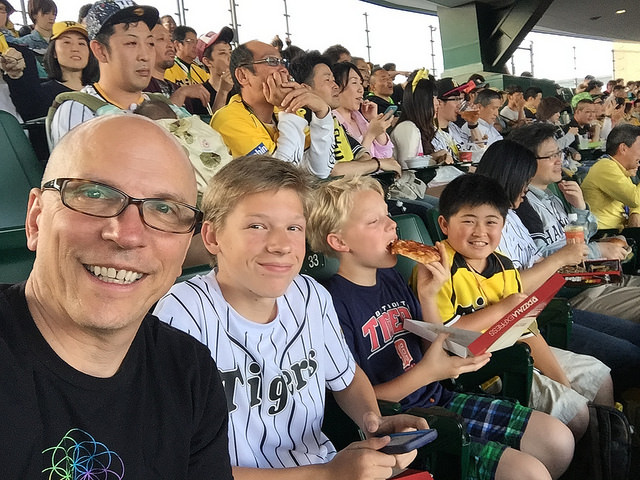
Owen, Oliver and I enjoyed watching the Tigers beat the Fighters, 4-2 last night at Koshien Stadium in a Nippon Professional Baseball (NPB) League. It was the first time we witnessed a victory by the home team in the 3 years we’ve been attending games. Hanshin improved to 30-21, still 1 game behind Hiroshima Carp in the Central League. The Fighters are now 22-29 and in fifth place, of six teams, in the Pacific League.
The game was also special because it was one of the 16 interleague games the Tigers will play this season. There is a short span of games in the middle of the season that the two leagues play each other. I wish there was more because with only 6 teams per league, playing the same five teams regularly is boring. Unfortunately, we did not get to see the “Babe Ruth” of NPB, Shohe Otani who is rehabilitating from a foot injury with their farm club. They also have one of the best names in sports, Nippon Ham Fighters. Nippon Ham is a processed foods company (think Kraft), that owns the team. They play in Sapporo, the capital of the northern island of Hokkaido. For most of their history, they were the second team in Tokyo, sharing the same stadium of the richest club, the Yomiuri Giants, but moved north in 2004. I like that they represent Hokkaido and play a slate of regional games on the island. Sharing Tokyo Dome with the most popular team in the league must have been tough. We’ll try to see Otani play later in the season at the Pacific League Kansai-based team, the Orix Buffalos.
As always, the best part of the game was spending time with my sons and our friend Kenta. To get to the stadium via public transport, we ride our bicycles about 2 kilometers to the train station. We take it to the center of Osaka and then take the express over to Nishinomiya, which is between Osaka and Kobe. It takes about an hour to get to the stadium from our house. On game days, Hanshin Railways run cars specifically for fans going to and from the stadium. It is a comfortable way to get to the game and it does not feel crowded, despite lots of people.
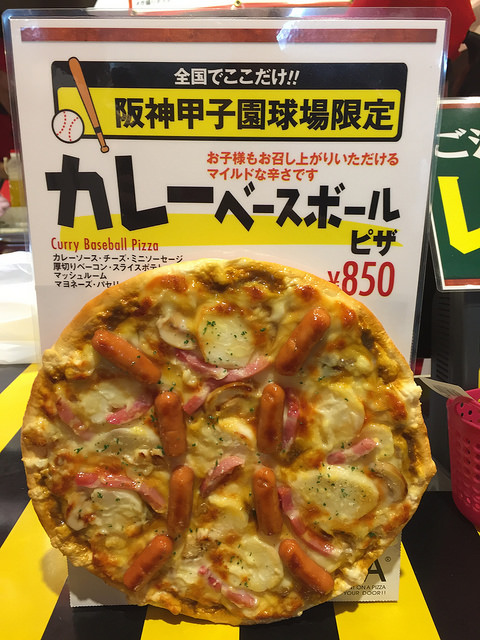
Only in Japan – the baseball pizza ($7.60)
As you can see in the video on this post, my favorite player for the Tigers, Yoshio Itoi, had a good game with the RBI single. Itoi is similar to Bryce Harper with his power and athleticism. He has a lot of range in center field, in the leadoff spot he hits for average and steals bases, but also has the power to go deep. He is an exciting player to watch.
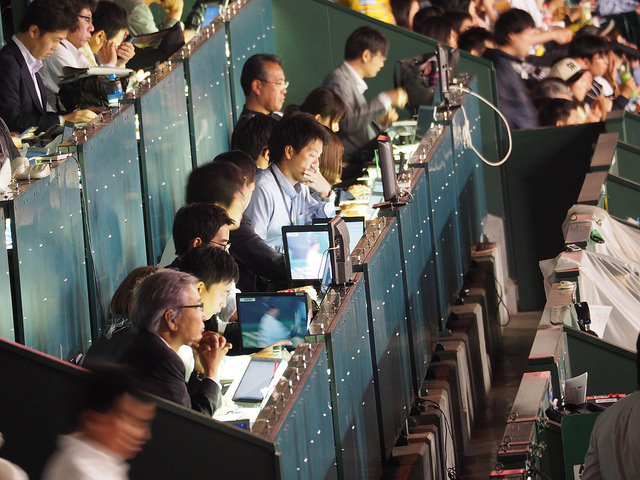
Press Row at Koshien Stadium
I am always curious about the import players. The guys who end up in Japan are the fringe Major League players. These players usually excel in the top minor league (AAA) but are not good enough, or lucky enough, to stay with the MLB team for long. For example, the Hanshin closer, Rafael Dolis. He pitched 44 innings for the Chicago Cubs in 2013 before being demoted and then traded. He never made back to MLB with attempts in the San Francisco Giants and Detroit Tigers. The 29-year old Dominican then gets to be the closer here in Japan and making good money. Or take Brandon Laird, the third baseman and #3 hitter for the Fighters. He played 53 games over three seasons with the Yankees and Astros. Brandon had a key hit in the World Baseball Classic this year playing for Mexico. His brother Gerald, was a back up catcher on the Detroit Tigers for a couple of seasons.
Brandon Laird
It is an entertaining atmosphere at the stadium due to the enthusiasm of the fans. They like to sing songs for players and the team throughout the game. They also like the routine of the 5th inning Asahi beer toast, the janken (rock,scissors, paper) scoreboard games, releasing of balloons during the seventh inning stretch, etc.
I wanted to get out of town for the day so we rented a car and headed to Awaji Island. It is the largest island in the “inland sea”, the water between the main islands of Honshu, Shikoku and Kyushu and it is a short cut between the Sea of Japan and the Pacific Ocean. Awaji forms the east side of Osaka Bay and it was only about a 2-hour drive to Keino Matsubara (black pine) beach, our first destination.
Beach season does not begin in Japan until June, so there were very few people. The water was nice and the kids enjoyed skipping rocks and catching moon jellyfish. The beach gets its name from the huge stand of black pine trees which house a camping area. The pines are beautiful and always remind me of the white pine stands next to Lake Superior in my home state of Michigan.
200 yen a bag for the famous Awaji onions
We bought several bags of onions on a roadside stop. Awaji is known for its onions and there were numerous farms, interspersed with forested hills. Bicycle companies promote it as an ideal150-kilometerr circumnavigation ride, which I would like to do someday. The Naruto whirlpools were a disappointment, reeking of “tourist trap”, but there were nice views
Onaruto Bridge over Naruto Strait
The Naruto whirlpools were a disappointment, reeking of “tourist trap”, but there were nice views of the bridge and the strait. The sea level differences between the Pacific and Seto inland sea cause strong currents under the bridge. At certain times whirlpools form, but when we visited in the late afternoon, there were just lots of currents, but no whirlpools.
It is a perfect weekend get-away and I found the day relaxing. Owen stayed home because he is battling a bad cold. He also was tired from a volleyball tourney which I will blog about later this week.
The culmination of the International Baccalaureate Primary Years Programme (IB PYP) is the grade 5 exhibition. It is a good “rite of passage” for elementary students as they complete elementary school and move into middle school. The exhibition is a deep-dive into a topic. This year’s central idea is migration is caused by push and pull factors. Oliver researched African immigrants trying to get into Libya. He focused on dictators and bad government as “push factors”.
Congratulations to Oliver for finishing up grade 5 and becoming a middle schooler.
Last Monday I hosted a meeting of the Japan Council of International Schools. The officers and committee chairs needed a place to meet so I offered Kwansei Gakuin University’s Tokyo office as a venue. I forgot how centrally located the office is, just steps away from the doors of Japan Railway’s Tokyo station. It is on the 10th floor of the Sapia Tower and is probably one of the most expensive pieces of real estate in the world. Our view looked over the station and the area around it.
A part of my quirky Japan series, I had to purchase a Japanese “egg McMuffin” or at least the convenience store version of it. The egg and sausage are wrapped in a layer of rice and seaweed. So Japanese! It gave me the energy to prepare the office for the meetings.
The Nozomi (hope) shinkansen to Tokyo
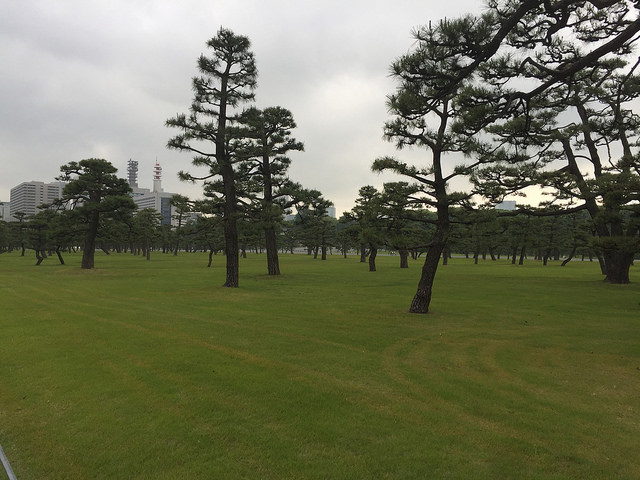
After the meetings, I wanted to get some exercise before heading back to Osaka on the shinkansen, or bullet train. Amazing that I can travel to and from Tokyo for the day with a comfortable commute of a little over 2 hours each way. By car, the trip would take 5-6 hours. Anyway, just blocks away from the station is the Emperor’s palace. It is a massive green space in the heart of Tokyo. I combined a loop around the palace with a side run around Hibiya Park to have a 10km run. It was cool and cloudy, perfect running conditions. The endless green lawns, manicured trees and ponds and just space is so rare in Japanese cities.
On my way out of the building and a final check to make sure the meeting room was clean, I thought about how far I have come since my childhood. Spending the day in a high rise in the largest city in the world is so different from growing up in the village of Caspian, Michigan, my hometown. Over 25 years working abroad has given me an appreciation for large cities, but, both the village and metropolis are special to me.
We have a 5-day weekend due to Japan national holidays. They string together the anniversary of the constitution, nature day and children’s day and name it “golden week”. Our family is not going anywhere for the holiday, but relaxing at home and spending time together. I am finishing a couple of papers as it is exam week at Lehigh University where I am working towards my doctorate degree.
Yesterday we played a stirring game of baseball and even Nadia joined us. After the game, we challenged each other to sprints. Both Nadia and I are sore today, we need to get to the track more to work out.
After finishing a big paper this morning and “invigilating” IB exams, I went for a 20-kilometer bike ride up to Katsuo-ji, a temple in the Minoh national forest. The Japanese call this season “new-green” which gets its name from the spring growth of trees. The new leaves are a brighter green and combined with the blue skies and cool breezes, it is the absolutely perfect weather!
View to the city from the hills of Minoh national forest
I love riding my bicycle in Japan. Although it is always a risk, drivers here are very safety conscious and respectful to pedestrians and bicyclists, so it is much easier to get out and go! Almost all school children and many adults ride bikes daily to work or shopping and running errands that cars are used to watching out for them.
The “new green” season in May
It is so nice to have time to reconnect with my children and wife! I am loving this break and feeling recharged for the “stretch run” of school.
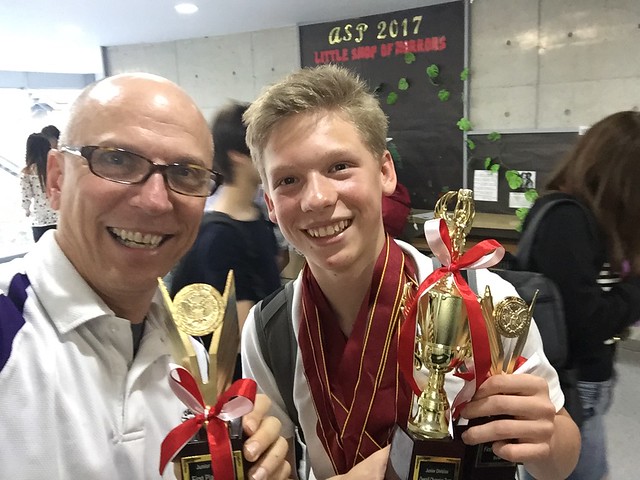
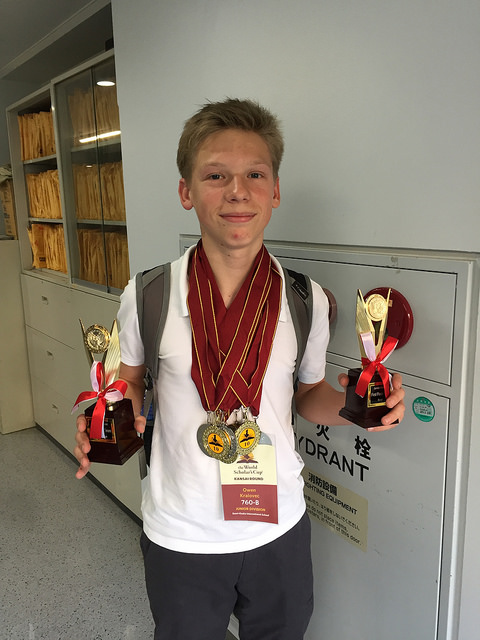
Owen won several medals and team trophies at last weekend’s World Scholar’s Cup. He had his highest score in the debate. Fortunately, he was with two experienced teammates and his team of three won the junior division.
The World Scholar’s Cup is fantastic for young people as it puts academic achievement on the same level as sports. The founders of WSC find interesting topics for the kids to learn more about. They are also “hip” and between the music and schtick (stuffed alpacas, jokes) kids are super engaged in the challenge rounds which are like knowledge bowls. There is also an essay contest. My favorite is the debate competition. The resolutions for the senior category this year were “Japan should land a manned mission on Mars” and “it should be legal to bring back people from the dead”. These kinds of questions force students to form logical and evidence-based arguments and develop their public speaking and presentation skills. These types of skills are really needed here in Asia especially. Owen will not be going to the Global Round in Hanoi this year, although he qualified, but depending on his work ethic, we hope to send him to next year’s round. You can watch his debate on YouTube. He is so far ahead of me if I compare him to my grade 8 self…
We took this selfie after baseball practice today. I am coaching elementary baseball and Ocean is the only girl on the team. She doesn’t have a great passion for the sport, but she wants to support me so she comes out for the team. She was disappointed that her ground-rule double was not a home run. Ocean is athletic and is just as good as many of the boys!
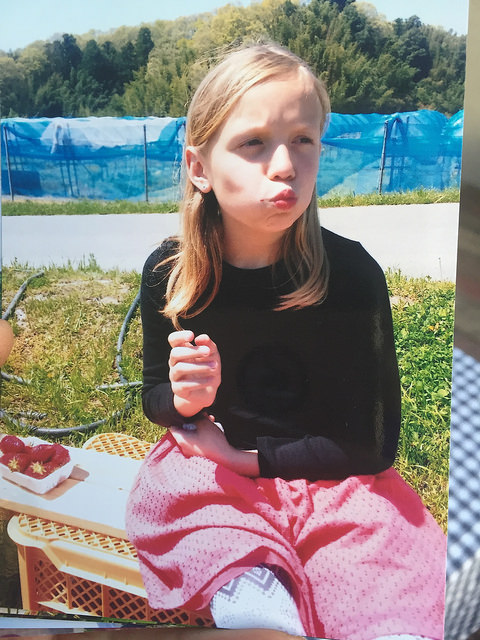
She went strawberry picking with her friends last weekend. I love the photo of her. I can’t write enough how lovely and kind she is! Some of her best friends are pictured below
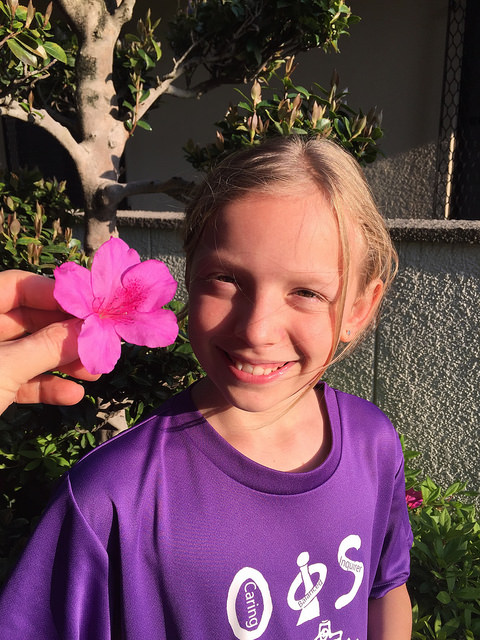
The azaleias are in full bloom in our garden. Beauty is all around this spring.












 Bill's Blog