Skiing in Hokkaido

There is plenty of powder snow on the slopes of Hokkaido, the main northern island of Japan. We are staying at the Kiroro ski resort, which is located 43km west of the capital city of Sapporo and 28km from the seaside town of Otaru. We really enjoyed the day yesterday, with almost no one on the runs, inspiring views and  fresh mountain air. The resort is much less known than Niseko and it is perfect for kids and intermediate skiers. The elevation only goes up to 2,000 meters but there are no snow-making machines in sight. I estimate around a meter of snow on the ground.

This is our first time in Hokkaido and skiing in Japan. One of my first impressions was the care of the lift operators. They take their job very seriously and are so caring, especially with the children. When Ocean dropped her ski on the lift, they went and got it and brought it up the mountain for her. They are also super helpful on entering and exiting the chairs. One of the nice things about living here is that you are always well taken care of.

Ollie and Ocean had a great time on the beginners slope. Owen and I went further up the mountain and did the intermediate runs. We are planning on going all the way to the top on day 2. The spring break for Japanese schools doesn’t start for another week so there are no lines waiting for the chairlifts and clear lanes on the runs. My only complaint is a lack of cross country ski trails. Nadia is being a trooper and playing a support role for the kids.


We finished off the day with a relaxing onsen here at the hotel. The boys liked the outdoor hot baths and were throwing snowballs at each other. They are getting over not wearing bathing suits and are learning the Japanese customs in public baths.

I sampled one of the delicacies of Hokkaido for lunch at the New Chitose airport, salmon roe on rice. Mixing in wasabi/soy sauce and combined with seaweed miso soup,it made for a perfect start to our Hokkaido adventure.

Hokkaido is surprisingly not that far north (43 degrees) but gets plenty of snow coming from the westerly winds off the massive Siberian plains. It looks and feels like the Baltic nations with the snow and pine trees. I really want to explore more of the island, which is the size of Ireland.

I would like to thank our friends Naomi and Tara for inviting us to go with them. We are having a fabulous holiday.

Life in Japan: School Uniforms

Boys leaving the train station in their school uniforms.

Last Saturday upon dropping off Owen at the train station for his trip to Kobe for soccer, I ran into a large group of students. They were on their way to school. Many Japanese students do go to school for a half day on Saturdays. This may be to do some special test preparation for university or high school entrance exams or special lessons in civics or community service that are not covered during the regular school week.

Prussian military officer in uniform circa 1912 (courtesy of Worldwar1.com)

The boys’ school uniforms are distinct. They are called ga-ku-ra-n, which translates to “gaku-school/student” and “ran-Netherlands”. Historically in Japan, the “west” or all Europeans, were referred to coming from the Netherlands because at the time, they were the most common traders in the few ports that were opened to foreigners. The school uniforms first were designed in the late 1800s and modeled after western military styles. I read where uniforms for boys were modeled after either French or Prussian soldiers. I wonder why they haven’t changed since? Is it the Japanese respect for tradition and uncomfortableness with change for certain things?

I think it is a good look, however, in putting myself in a young person’s shoes, it must be a bit uncomfortable to where these to school, especially the hats and buttoned jackets. As you can see from the photo above, they do look like soldiers or policemen directing traffic.

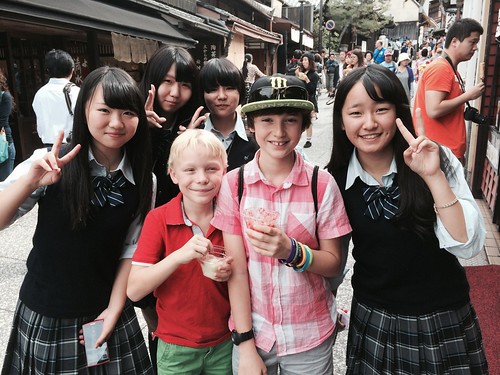
Girls uniforms are modeled after naval uniforms. I’ll get some photos later. Some uniforms are more in the British style classic school girl uniform with plaid skirt, tie, and vest. You can see this in the photo below. The girls wanted a photo with my son Oliver and nephew Seby when we were visiting Kyoto this fall.

At the private international school I teach at, uniforms are not required. Some girls however, where the British school girl outfit as a fashion statement. Some want us to adopt them as the school uniform, I think because they have been featured in pop culture in television, movies and graphic novels.

Hinamatsuri (Girls’ Day)

The hinamatsuri display in our school’s library.

March 3 is hinamatsuri or girls day in Japan. It is traditional to display the doll set above and it is a day for praying for young girls’ health and happiness. The custom of displaying the dolls comes from the Heian Period which was from around 800 AD to 1,100 AD. Heian means “Kyoto” and this was the period when Kyoto was the capital, the imperial court was at its height and ideas from China (Buddhism, Taosim, etc.) were most popular. It is not a national holiday.

The librarian Chieko showed Ocean and I how to make hinamatsuri dolls.

The display above is the traditional 7-tier and red carpet. The platforms are as follows, moving from top (1) to bottom (7):

  1. Emperor & Empress
  2. Three court ladies holding sake equipment
  3. Five court musicians
  4. Two ministers, and old and young man; tables with bowls and food
  5. Cherry tree and Peach tree enclosing three samurai
  6. Items used within the palace
  7. Items used outside of the palace (ex- palanquin)

My favorite doll is one of the samurai with the grumpy look on his face.

I would like to thank the librarian staff for putting up the display and for Chieko for spending some time with Ocean and I and making it a special day. I will spend some extra time with Ocean tomorrow in honor of the celebration.

Family Journal: Winter Weekend on the Coast

Nadia and Ocean hanging out in Amanohashidate

I didn’t have any school commitments this weekend so we took advantage of the opportunity and heading across Honshu (the largest of the 4 major islands that make up the Japan archipelago) and spent some time exploring the north shore, on both sides of the Hyogo-Kyoto prefectural border. It was a relaxing get-away and only a couple hours away.

Wearing the traditional robes at our hotel

It was uncrowded, being the middle of winter, except for the onsen (bath) town of Kinosaki. The highlight for me was the visit to the Oriental White Stork reserve near Toyooka. Through stork-friendly farming practices and the efforts of dedicated citizens, the stork has been reintroduced into the wild after becoming extinct in Japan in 1971. See my nature blog for more details. On Saturday evening we had a delicious meal in Kinosaki. We wanted to stay in a ryokan there, but had a hard time finding a place so we stayed in nearby Kumihama. The town was full of tourists (almost all Japanese) walking from onsen to onsen in their robes and clogs.

The view from the top of the trail at the stork reserve

The next day after watching the Tokyo marathon on television, we headed up to one of the three most scenic spots in Japan. We were laughing at the ranking system, thinking that it was a tourist bureau promotional ploy. Actually, it was the opinion of the historian Hayashi Gayo, who was an advisor to the Tokugawa rulers in the mid-1600s. He was in charge of education and applied Confucian principles to his work. He thought the sandbar, Amanohashidate, was one of the three best views in the country. I would agree that it is a really nice spot! I love the combination of pine trees and big water, as it reminds me of my beloved Lake Superior in Michigan. The kids enjoyed playing among the trees and the beach. We will definitely head back in the summer. Our tour of the Tango peninsula was cut short by rain. Instead we stopped for lunch, enjoying the winter speciality of kino or Sea of Japan crab.

A rainy day on the Tango peninsula

There is so much to explore in this beautiful country and we are only beginning to scratch the surface. I highly recommend a visit to this part of the Sea of Japan coast.

Family Journal: More winter

The video above shows Owen scoring on a penalty kick in yesterday’s game at the school.  He was taken down in the box by a Canadian Academy defender. He cooly delivers a hard kick, which the goal keeper guessed correctly on, but it was not enough to prevent it from scoring. The game ended in a 3-3 draw.  Owen came out in the second half with a muscle strain. He is really enjoying soccer this year.

I am so happy the boys got haircuts last weekend, they were looking pretty shaggy. Ollie and I are shown afterwards below.

A good Japan story. Yesterday I was leaving the supermarket on my bike with a basket full of bags. As I just started to cross the street, one of the bags fell out, of course the one with eggs in it. About half the pack broke on the street. Before I could park my bike and start the clean up, one person came over and picked up the bag, another person gave me a new plastic bag, to put the rest of the egg in, and they helped me get out of the street and back on my way. The cars also waited patiently until the mess was cleared, no horns or mean looks. The Japanese are so aware of the plight and feelings of others. It is nice to live in a society that thinks that way.

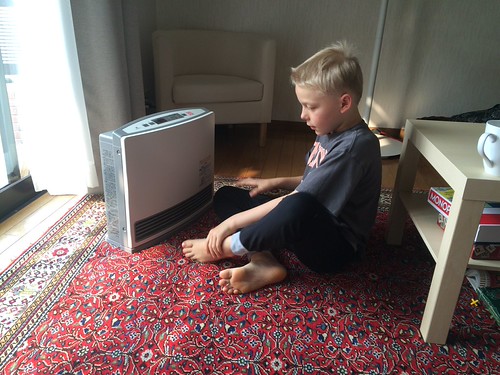
I am still trying to understand why Japanese homes and apartments do not have insulation. My daily routine in the winter is to go down stairs to turn on the heaters before the kids and Nadia come down. The house gets really cold if the heat is not on. The windows are single-paned and the walls and roof have no insulation. I find this strange in a society that appreciates the finer things in life, like food, clothes, cars, etc. Why not be comfortable in winter without having to close doors, wear warm clothes, etc. Osaka is not terribly cold in the winter, only a couple times it has dipped below freezing (0 C), but it feels a lot colder because in the house, you feel the cold. I Ollie is shown below sitting in front of our gas heater.

Hike to Katsuo Ji Temple

Today is a national holiday in Japan and so I took the boys on a hike up to the Katsuo Ji temple. It is a Zen Buddhist temple about 4 kilometers away from our house, by a trail through the Minoh Quasi National Park. It was a special afternoon of father and sons bonding that I can’t express the amount of pleasure and pride I felt walking through the woods with my sons. We talked about movies, music, clash of clans, and whatever came into their minds. They are growing up and it is so cool to be able to have real conversations with them. They love stories so I explained to them the full story of classic movies such as the Planet of the Apes, Terminator, Blair Witch Project, etc. It was one of those afternoons that I would like to live over and over again!

The walk is pretty much straight up from our house. We rode bikes the first kilometer, crossing the busy 171 highway, through the rice fields, to reach the border of the forest. We dumped the bikes at the gates and started the climb up the hills. It is pretty much going up the entire time, with some respites along the flat tops of the ridges. The trail is well-marked, both by the park officials and the temple pilgrims. We took a couple of rest stops and so the walk up took about an hour.

Front Gate

The Katsuo Ji Temple was a beautiful destination. The 1,300 year old temple is known for the daruma (dharma) which are traditional Japanese dolls that bring “winning luck” to visitors to the temple. People come and purchase them to bring them resilance and fortune with many things, such as exams, trials, ill health, etc. If they do bring one luck, they are supposed to be brought back to the temple and placed on the grounds. We saw them all over the place, so lots of people have been helped by the daruma. They are then burned on the day after New Years. Guests can stay on the grounds and there are gardens and pools for quiet meditation.

The temple has a long history as described in the English guide to the temple. In 727, two priests, Zenchu and Zensan constructed a hut on the mountain. The son of the Emperor Konin established Mirokuji Temple on the spot in 765, in “his quest to reach the spiritual realm of Buddha.” The Emperor Seiwa regained his health miraculously due to the prayers offered by a priest at the temple, and thus changed the name of the temple to Katsuo (win over the Imperial Highness) Ji (temple). In 1184 the temple burned down in a civil war but it was reconstructed in by the first Minamoto Shogun a few years later.

I highly recommend the hike up to the temple. You can get their by road as well, but the best way is through the forest. It makes for a perfect afternoon. Thanks to Owen and Oliver for giving me a precious day.

Celebrating Setsubun

The mask of the oni.

One of the nice things about living in different countries is the opportunity to learn about the local traditional customs and folkloric celebrations. In many Asian countries, February 3 is celebrated as the end of winter and the start of spring. Here in Japan it is known as setsubun, and it is the day before the first day of spring. I always try to understand the local customs by experiencing them first hand and respect the local beliefs and traditions. I didn’t know that besides dividing the year up into the two solstices (Dec 21 / June 21) and two equinoxes (Sept 21 / March 21), the ancient Chinese further divided the calendar into smaller sections. This helped farmers know when cold or hot temperatures were expected and to predict the levels of precipitation. February 3 is the end of one of those smaller divisions. As with much of Chinese ideas, neighboring countries adopted and adapted them to their cultures, hence, setsubun.

Tuesday evening our family each ate the roasted beans, the number of beans depending on our age. I had a tough time after dinner consuming 47 of them. This is supposed to give us a year of good health. Since 2015 is my Japanese zodiac birth year, the year of the sheep, I put on the oni, which represents evil spirits. Nadia put on the good fortune mask, although we didn’t know until the next day that it was good fortune. The kids throw the beans at the oni, saying out with the bad spirits of winter and in with the good spirits of spring. Oliver of course, got carried away with banishing the oni and threw the beans a bit too enthusiastically (see video below).

Next year we hope to go to a temple to see the official ceremony and to eat the famous Osakan “lucky direction” sushi rolls which we did not do this year. Supermarkets conveniently had kits with roasted beans and masks for people to take home.

Weekend in Osaka: January 24-25, 2015

We had a really nice weekend with family. Owen plays for the school’s middle school boys’ soccer team and they hosted Marist Brothers International School of Kobe on Saturday. Owen enjoys playing soccer and his athleticism helps him be a good player. He is also starting to feel more comfortable at the school and Japan and it shows with more relaxed performances. His team won 7-1 and he scored two goals and assisted on another two. You can see in the videos above and below. There is a good core of athletes in grade 6 at the school with Eun and Rhen. I hope to see years of athletic success as they mature and play together more.

Ollie being cool at the park

The weather was nice, with temperatures getting up to 11C and sunny, so I joined the kids at a local park to play. It is so nice to feel safe enough to let them go to the park on their own and play. It brings back memories of my childhood in the 1970s, when we did a lot by ourselves without the modern helicopter parenting of today.

Nadia, Ocean, and Wakana

On Sunday we met our old friends from Belgrade, a former classmate of Ocean, Wakana. Her father Tsutsuru is on a business trip, but Miyuki brought the girls to Umeda and we met them for lunch and skating. The rink was in the plaza of the Grand Front Osaka . It is nice that city officials are taking what used to be a huge train freight yard and converting it to parks, apartments, restaurants, etc. There was no ice but instead a plywood rink with a white, wax-like covering. One could skate relatively well, but it was not as smooth as real ice. I felt like a cool dude because most of the people on the rink were not very good skaters. I don’t know if that is true of all Japanese and how popular skating and hockey are here. On the way home we stopped at H&M to buy some long-sleeved shirts for the kids.

Japanese Literature: Yasunari Kawabata

I am reading Japanese authors whose works have been translated into English. I just completed Kawabata’s “Beauty and Sadness'”. He won the Nobel Prize for literature in 1968. He was born in Osaka, where I currently live in 1899 and committed suicide in 1972. He is most famous for his books Snow Country (1956) and Thousand Cranes (1959).

Beauty and Sadness is his last novel, which came out in  1961. It is the story of author Oki Toshio. When he was newly married, he had an affair with a 16-year old girl, which ended with her getting pregnant, having a miscarriage, and spending a short time in a mental institution. Today, this would be considered a criminal offense. In the book, he keeps his marriage and gets fame for the book he wrote inspired by the affair. The story mostly takes place 25 years later when the girl is an artist in Kyoto. I won’t give more of the plot away, but it involves a possible murder. I thought it was a good story and the descriptions of Kyoto’s temples were vivid. The women are wearing kimonos often, which I find today in Japan, very rare.

In my opinion however, it had rather weak character development and there were many holes in the plot. Kawabata wanted to be a painter and the book has a lot of references to visual arts. The book has been made into a movie twice, one Japanese and one French. The ending allows for much reader speculation and it would make a good book club selection, as there would be lots to discuss.

I don’t think I will read any more of his works but it was good to be introduced to such an important literary figure in Japan.

Impressions of China and Thailand

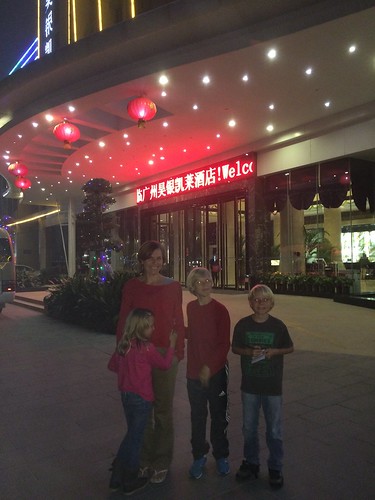
The family in front of our hotel in Guangzhou

On the way back from our family holiday in Byron Bay Australia, we had an overnight stop in Guangzhou, China. This was our first visit to China and after reading so much about the growing economy of China and their takeover of the world, I was very curious to see it. We flew Southern China Airlines, which has excellent service, and in legroom, my most important factor, they scored extremely high, and they provided a free hotel for an overnight stay. The hotel was located about 20 minutes from the airport. Guangzhou is a huge city, about the size of Chicago, but I had never heard of it before moving to Asia. China is so big with a number of massive metropolises that most people in the world know little about. I know that it was one night in one city, but according to my initial impressions, China has a long way to go before being a world leader in culture and society, like the US, Europe, and Japan. The number of construction projects were impressive and it was a massive hotel, but the infrastructure of the roads and buildings, etc. reminded me more of Latin American and Eastern Europe than more developed countries.

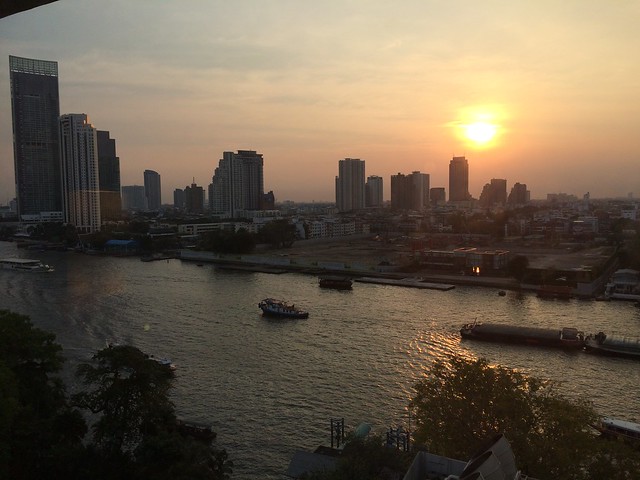
The view from my hotel room of the Chao Phraya River in Bangkok

We had a nice stay however, and found some high quality, cheap fruit in a market nearby. We were certainly stared at and I assumed not many American families with blond children go through there. The pollution was really bad, with a chemical odor in the air and a hazy morning. I know China will get it under control eventually, but they really need to take drastic measures to improve air quality. Many expats who teach there complain of this and it is a shame when children have to have an indoor recess because of pollution. I am intrigued to see more of the “middle kingdom” one of the oldest civilizations on earth to understand the country better.

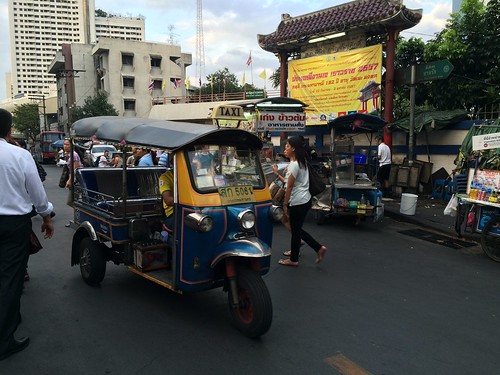
One of the famous tuk-tuk taxis of Bangkok

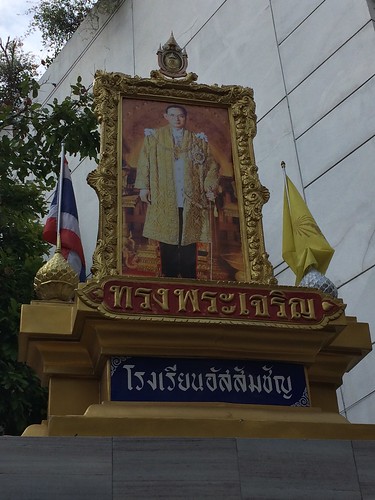
I also spent a weekend in Bangkok, Thailand for a job fair. Most of the time was spent working, but I did get to go out for a couple of dinners and a walk to the night markets. Bangkok is a huge city set in the tropics and it reminded me of other tropical cities I have visited. The big impression it left on me was the influence of a colorful form of Buddhism. There were ornate shrines, big and small everywhere. This is much different than the more sedate form of Buddhism in Japan. I was also surprised to see so many transgender men/women. It is totally acceptable in Thailand, in part due to the tolerance of Buddhism. I also noticed the king is venerated with photos and books. I didn’t know it was a kingdom. The food as always, was delicious and I hope to come back to visit this tourist mecca.

Picture of the King of Thailand