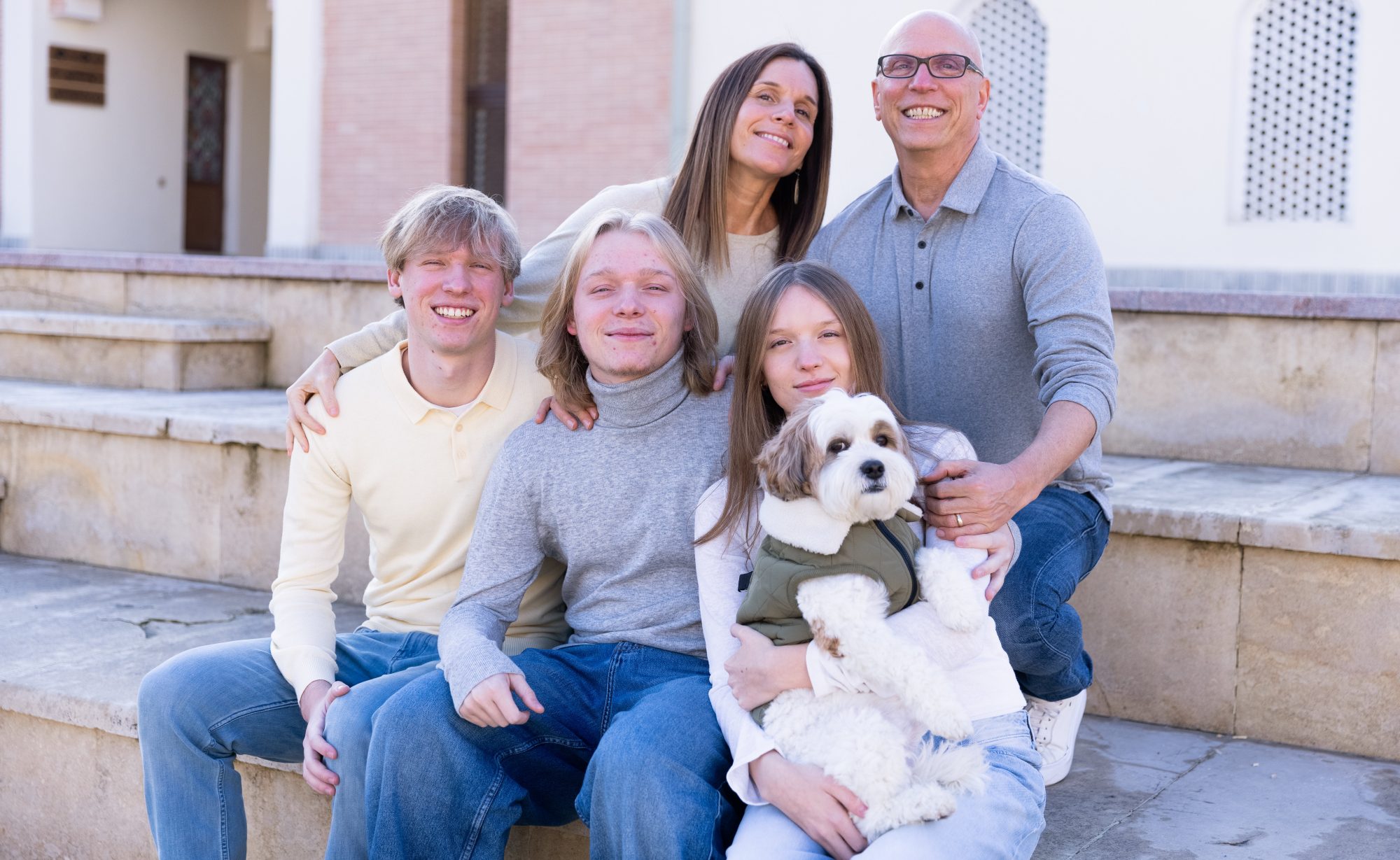
Family Holiday to Dubrovnik (Ragusa) Croatia


Family Photo on the Wall of the Old City

I spent two summers in Mallorca, one of the Spanish Balearic islands.  Dubrovnik felt much like Palma de Mallorca, the capital city. They are similar in that both are on the Mediterranean Sea, both are tourist destinations, and both have a long history of trade and conquest.

I really like many aspects of the Mediterranean lifestyle, or in this case, the Adriatic lifestyle. The climate is great with hot summers, and cool wet winters. We loved the weather in Perth, Western Australia for our two years living there, another place with a “Mediterranean” climate. One can be active all winter as it never gets so cold to force people indoors. On our last full day we had the classic bright sunny Mediterranean day. The brilliant light brought back memories for us of Perth. We also enjoyed much delicious seafood and we love the gardens filled with orange trees, pomegranates, etc. Some of our expatriate friends have purchased homes or boats and devote many holidays to the Croatian coast. There is a lot to explore here and I would like to see some of the islands and smaller towns on the “Dalmatian Riviera.”

Dubrovnik, which means “grove of Oaks,” is a city of around 100,000 people. Its claim to fame is their walled city. The city is a small part of the metro area, but it is the draw for the cruise ships and tourists coming to visit. There were two huge ships in the port yesterday, which we can see from our rented apartment. I as write this, another ship is coming into the harbor. Dubrovnik, for hundreds of years, was known as “Ragusa” and was an independent city-state, like Venice or Athens. The people of Dubrovnik today, still make a living off the Ragusans accomplishments. The old city is beautiful, with high walls jutting dramatically into the sea, stone streets worn smooth by centuries of traffic, and the amazing architecture of porticos, arches, towers, cathedrals, steps, etc.

Yesterday we walked around and enjoyed the day. It was a bit crowded; I can imagine the place in the summer. The kids enjoyed the umbrellas, as it poured early and rained on and off all morning. The kids were photographed by the many Asian tour groups. A small group of Japanese ladies even posed with them. I can imagine if we lived in Asia, they would be absolute superstars.

Ragusa was founded by Greeks escaping from a nearby city. They were technically independent, although they did have to pay tribute to the Ottomans to maintain their “independence.” Throughout the centuries, I am sure they made deals with the Hungarians, Venetians, and other empires of the Mediterranean. Being on the sea, they were great traders and they built up quite an economy and culture. It was interesting that the Ragusan culture in some ways was quite liberal, with probably the first ban on slave trading in the world. The society however, was quite strict in other ways, and did not allow freedom of worship with only Catholic churches being allowed. Eventually, this caused their downfall, as Peter the Great, the Russian Tsar, did not give the city protection of their independent status in one of the many treaties of the 19th century. His grandmother Catherine, had been snubbed by Ragusa when she asked for them to establish an Orthodox Cathedral so I guess he got back at them.

Ocean and I Enjoy the Adriatic (It's warmer than Lake Superior!)

When Yugoslavia took possession of the city, they changed it to a Slavic name. I read they thought it sounded too Italian. Today, almost all of the inhabitants are Slavic Croatians, and the Greek ethnic heritage has disappeared.

It is noticeable the animosity of the Croatians towards the Serbs. We live in Belgrade and so we got some reactions to this. As you may know, the Jugolsav National Army (JNA) attacked the city about 20 years ago. Some of the old city and hotels were destroyed. When I mentioned that I am learning Serbian or offered Serbian currency to pay for a bill, it was like I mentioned the Nazis. They didn’t want to have anything to do with anything Serbian. We also got some dirty looks driving around Sarajevo, another victim of JNA attacks. People would see the Belgrade license plate and then look up to us with a sour look. Our plates our diplomatic however, and being blond and short, we obviously do not look Serbian. I bought a couple of books about the siege in Sarajevo and one book on the war in Dubrovnik. I want to learn more about the breakup of Yugoslavia and the violence that occurred because of it.

Our apartment is located on the Lapad peninsula, a few minutes’ drive outside the old city. The neighborhood of Lapad is very California-esque, with many date palms and there is a nice promenade bustling with cafes filled with mostly locals. I went for a run in the morning. It is amazing the difference in temperature from Belgrade.  It was almost balmy, despite the clouds and intermittent showers. After spending the morning shopping and looking around the old city, we went swimming at a nearby beach. The water was wonderful and being mid-October and temperatures in the 70’s, we were alone on the rocky beach. The kids loved climbing on the rocks and we collected quite a few colorful and unusual rocks. It was the first time the kids swam in saltwater since Venezuela. It was Ocean’s first visit to an ocean.  It was the highlight of my day.

We came back from the beach and Nadia cooked a delicious pork roast with rice, green beans, and salad. I played “crazy eights” with the kids and after dinner, while I cleaned up, Nadia watched “Rat Race” with the kids in bed. As we were going to sleep, Owen was saying how much he loved family vacations and was not looking forward to Wednesday. These are memories and family bonds were are establishing on these holiday trips. I would tend to agree with Owen. It is wonderful to spend so much time with my wife and children. I hope they remember this trip!

Last morning in Lapad – We had two super days filled with family fun. We managed to go swimming each day and the kids enjoyed throwing rocks and swimming in the turquoise waters. It was our “last day of summer” for a while as we are heading into a cold, continental European winter, and then next summer we will be in Bolivia, the southern hemisphere winter.

The Famous "Stradun" (Walking Street)


It was interesting to compare and contrast the Croatians and Serbians. This was our first time in Croatia and I am only comparing Dubrovnik metro area to Serbia. The city infrastructure and buildings are better than Serbia. It does certainly feel more “western” although I can’t put my finger on what exactly it is that is western. The Croats seem a bit colder than the Serbs. It may be because they are jaded on tourists, especially here, but we found them less out-going, less talkative, and heard much less laughter than we do in Belgrade. They look similar but I still think the Serbs are a bit taller. They should be one country because of the language. I know they have a lot of bad history that will take a long time to heal. There is always hope with the next generation and a few more decades with both countries with a democratic, capitalist system will in my opinion, bring them closer together.


Ceausescu’s Legacy – Trip to Bucharest


Last weekend I had a quick trip to Bucharest, Romania for an educational conference. We had one evening to explore the city and this post is my initial impressions of the capital. It felt bigger than Belgrade, with an unofficial population of over 3 million in the metro area. I enjoyed my visit to the nation’s capitol, as this is now the third time I’ve been to Romania, but my first to Bucharest.

Above is the weird Palace of the People built during the time of the bizarre “Genius of the Carpathians” reign, Nicky Ceausescu. It is the second largest building in the world, after the Pentagon and was constructed at the end of his time in power. He started it in 1984 and it ended after he was executed in 1989. It is quite an imposing building but unfortunately, we couldn’t go in as it was closed. It would be great to have free reign of the place for a few days. It is 12 stories high and several (unknown) floors deep. Much of it is still unused. It would be a great place for a movie.

Leading from the building is the “Victory of Socialism” boulevard, a replica of the Champs de Eleyse.

Ocean Turns Three

Sunday we celebrated my daughter Ocean’s third birthday party. We invited Claudiu and Vesna over with Mark and Tudor to share in the celebration. Nadia made a delicious chocolate cake, and appropriately, being in Serbia, she cooked pork. An absolutely spectacular meal and a great day. Ocean wanted a scooter, and we also got her some play dough toys. Her nanny Ivana, bought her a Barbie make up kit.

Above is the video. Congratulations Ocean, my Angel Princess!!! Below, I think Ollie is a bit jealous with all of  the attention Ocean is getting.

Owen & Oliver Start a New Season

Owen Dribbles the Football in a Drill

Yesterday was the opening outdoor practice for the Atacante Soccer Klub. Owen and Oliver are both members of the team. The team practices twice a week in the ISB Bubble Gymnasium, and on weekends at various places around the city, mostly at the FK Bulbulderac Field above. This year Owen will be playing in a “real” league for players born in 2002. They will have special uniforms and play weekly starting next week. I am a bit concerned that Owen will be one of the youngest players, as he was born in December of 2002. After reading Malcolm Gladwell’s “Outliers”, studies show that older players do much better and develop leadership habits on the field when they are older than most of their peers. I’ll see how it goes and how much playing time he gets.

Oliver is enjoying the club also, but he is not quite ready to fully concentrate on the game. He spends a lot of time playing power rangers or looking for bugs instead of soccer during the practices. Oliver is a strong and tough athlete and will be an excellent soccer player.

Serbia To Davis Cup Final


The Hero for Serbia: Janko Tipsarevic

Yesterday I went to the Davis Cup Tennis Semifinal Matches between Serbia and the Czech Republic. It was a capacity crowd in the Belgrade Arena for the two reverse singles matches. In the first game, world #2 Novak Djokovic looked impressive in a 4-set victory of world #7 Tomas Berdych. That set the stage for the final fifth match between world #37 Janko Tipsarevic and world #35, Radek Stepanek. Janko came through for the home crowd with a straight sets victory! He not only one yesterday, but beat Berdych on Friday in an upset. His two wins, combined with Djokovic’s win, propelled Serbia to their first Davis Cup final. In early December, they host France, who defeated Argentina in the other semifinal. 

Novak's Perfect Form and Concentration

I got free tickets from a friend, (thanks Victor and Sandra) and so I invited my friend Claudiu and his father-in-law. We enjoyed the 6 hours of tennis. The weather was cool and rainy outside, but it was a great atmosphere inside the arena. The crowd was into the match and we saw some excellent tennis. It amazed me at how difficult it is to win a point in professional tennis. The shot needs to be perfect, otherwise the opponent will return it. 

Serbia should be the favorite being the host and have the highest ranked player. Serbia has never won a Davis Cup, only 12 nations have in the history of the tourney.

Latest Reading: “How Soccer Explains the World” by Franklin Foer

I am almost finished reading this entertaining book. The sub-title is “An (Unlikely) Theory of Globalization” and Foer looks at the two competing forces of globalization and tribalism. I am very interested in the tribalism aspect of soccer, especially when he begins the book here in Belgrade and looks at Red Star, my favorite team in the Serbian professional league.

Red Star Fans in the Background of last year's "Eternal Derby" Game

In every country I lived, I always pick a soccer team to support. In Colombia, it was Junior of Barranquilla, in Bolivia is is Oriente Petrolero of Santa Cruz, in Australia it was the now defunct Perth Glory, and in my last post in Venezuela, baseball took the role of soccer and I supported Caribes de Oriente. So it was natural for me to select a team upon arrival in Belgrade. I am not sure what determines the team, as I usually have a choice. Part of it is the tradition and history of the club, another are the uniforms, atmosphere at the stadium, etc.Many Serbs question why I would support Red Star when they are financially unstable and in recent years, have not been very successful.  I guess it is that I live in the part of Senjak neighborhood that is rabidly devoted to Red Star and the team was formed by Serbs who were against facism shortly after WWII.  The club is associated more with the police and the Serbian Chetniks, than the Communist era of Tito. They are the most popular club in Belgrade, with approximately 1/2 of all Serbs supporting them. I also like the red and white color scheme over the black and white of Partizan, the rival club and the second most popular team in Belgrade.

The book is a bit dated being published is 2004, and I would like the New York Times writer Frank Foer to update each chapter. The most poignant idea Foer presents in the book is the human need to associate with a group or tribe. Humans he states, have a natural urge to associate themselves with a group, and in today’s society, the family or tribe is not relevant. Soccer clubs in many instances, fill that role and it explains the rabid enthusiasm of fans at times, even when they are not really big soccer players and do not show this allegiance in other parts of their lives. I see the appeal of this and it might be the reason I always support a local club when posted overseas. It is something that is definitely missing for most Americans. My family is spread out over the world, the USA is very large and diverse and although it somewhat gives me an affiliation, a “tribe” based on the constitution and the ideal of the freedom of the individual, it doesn’t make me feel part of an intimate group.

Ultra Boys Graffiti In our Neighborhood of Senjak

Serbians, being part of a small ethnic group, naturally have that feeling. And with Red Star and other clubs, they also feel the comfort of the “tribe.” Foer goes into the uglier side of tribalism in the Red Star chapter. The Red Star fans are called Delije, which is a moniker given to them by the infamous Serbian soldier, Zeljko Raznatovic, “Arkan.” Historically, they called themselves Gypsies. The book details some of the fan clubs within the Delije, which can be translated as “heroes” or “warriors.” Above is a photo of one of the many fan club murals popular here in Senjak, the Ultra Boys. Around Red Star Stadium there are some interesting murals which I should do a blog post about someday. Anyway, the Red Star fans played a big part in the wars against Croatia and eventually the revolution against Milosevic, according to this book.

The book has chapters on Celtic-Ranger, Barcelona-Real Madrid, Brazilian professional soccer, etc. and they read as separate essays. I would recommend the book to any soccer fan and people interested in history and politics. On a separate note, nice to see Red Star on top of the table in the Serbian Professional League after five rounds. They defeated Javor yesterday, 1-0.

Nice Photo


Nadia and Owen, originally uploaded by bill kralovec.

Last Sunday we went for lunch at the Devetka Restaurant located in the Kosutnjak Park. It was a beautiful day in a nice setting, although the food wasn’t the best and I wouldn’t recommend it to friends, it was a nice meal in that we had a relaxing time together. I snapped a few photos and liked this one the best.

Cold weather this weekend and it feels like autumn and winter are on their way.

Wedding Anniversary

The Happy Couple Posing With Nadia's Aunt Silvia

Eleven years ago in Coral Gables, Florida, Nadia and I were married. On September 17, 1999, we exchanged vows and became legally married at the Coral Gables District Court, one of the several Miami-Dade County locations to obtain a marriage license. It was a short ceremony attended only by Nadia’s aunt Silvia and her cousin Arturo.

We didn’t intend to get married in Florida. We both left the Santa Cruz Cooperative School in Bolivia in June of 1999. We planned to get married in Michigan. Nadia’s father was still living in Spain at the time, and so we thought it would be best to do it in Michigan with my parents. It didn’t work out for us there

For the sake of posterity and honesty, I feel after thinking about this blog post, to discuss a bit on why it didn’t work out for us in Michigan with the wedding. I found it strange my mother’s reaction to the idea of us getting married in Michigan. I thought that her oldest son getting married would be a joyous occasion, but she didn’t see it that way. I think it may have been that Nadia was so different from what she was used to. She was not from the upper midwest, or even from the US for that matter. It may have also been that I had been gone from home for 9 years. I’m not sure why she didn’t embrace the idea. She even told me that she wish we had gotten married in Bolivia. Nadia quite rightly was furious. I on the other hand didn’t have a reaction either way. I never spoke with her about it, but I did have some resentment over this. Well, that is all “water under the bridge” now and as I look back, the important thing is that our marriage is a solid one and so far, we are doing well and are happy.

, so we then considered going to Las Vegas. When Aunt Silvia found out about this, she insisted we do it in Miami. She was staying with her son at the time, so we went down to Miami in September. We were waiting for my visa for Australia to come through as well as Nadia’s acceptance to an Australian university, so we had a semester off. Aunt Silvia made a nice dress for Nadia and her cousin Arturo and his girlfriend at the time, Suallapa, were gracious hosts and we had a nice dinner with them after the ceremony.

We then went to Colombia for our honeymoon. We stayed at one of my favorite places in the world, the National Park Tayrona, a idyllic tropical beach and forest on the Caribbean coast of Colombia. Eventually we made it back to Michigan and finally arrived in Perth, Australia in February of 2000.

Through our eleven years of marriage, we have lived in 4 different countries and have been blessed with 3 beautiful children. If I had to do it all over, I would marry her again. We are having a wonderful life together. Happy Anniversary Nadia – I love you!

FIBA World Basketball Championships – Serbia Made The Final Four

I really enjoyed following the recent World Basketball Championships in Turkey. Serbia and the USA both did extremely well and played an exciting brand of basketball. Serbia made it to the semifinals with a thrilling win over Spain and then they lost by one point to the host Turkey. The crowds and players were into it – highly entertaining viewing. It was great that Owen also got into the games. He watched the entire fourth quarter of Turkey – Serbia with me. We played a lot of hoops this month with Oliver and Ocean also trying too.

My favorite player for Serbia in the tourney was Duško Savanović. He is a 6-7 forward who plays for Valencia in the Euroleague. Savanovic hit some big shots and was a real team player. I also admired coach Dušan Ivković for getting his team to play hard every game. Serbia had a great tourney despite the heartbreaking loss to the hosts. If Miloš Teodosić could ever play some defense, they might have won that game. I think the US would have been too much for them in the finals, but they deserved to be there.

Savanavic in battle against Angola

Jewish New Year Concert

Budapest Klezmer Band, originally uploaded by bill kralovec.

Last night we went to the first concert of the Belgrade Philharmonic season. We bought a ticket package themed “New Year Celebrations” and the first in the series celebrated the Jewish New Year, which was this week. The evening program featured Jewish composers.

In the second half of the concert, the Budapest Klezmer Band from Hungary. Klezmer is a traditional music form of the Eastern European Jews. Klezmer is quite lively, featuring the accordion, clarinet, violin, trombone, bass, and drums. Think of the dance tunes of Fiddler on the Roof. I really enjoyed the music and it was a welcome change from the seriousness of symphonic music. Many of the audience were still the normal somber, hushing tones of a classical music patron, but the musicians were asking for people to clap, and by the end, the infectious music had everyone in a good mood.

Sadly, not much is known about the original klezmer music due to the genocide of European Jews last century. It was brought back by the Yiddish immigrants to America and it survives today. It would be great to have a live band at a wedding or party. Give a listen to the short clip above. Having so many cultural opportunities is one of the nice things of being posted in Europe.