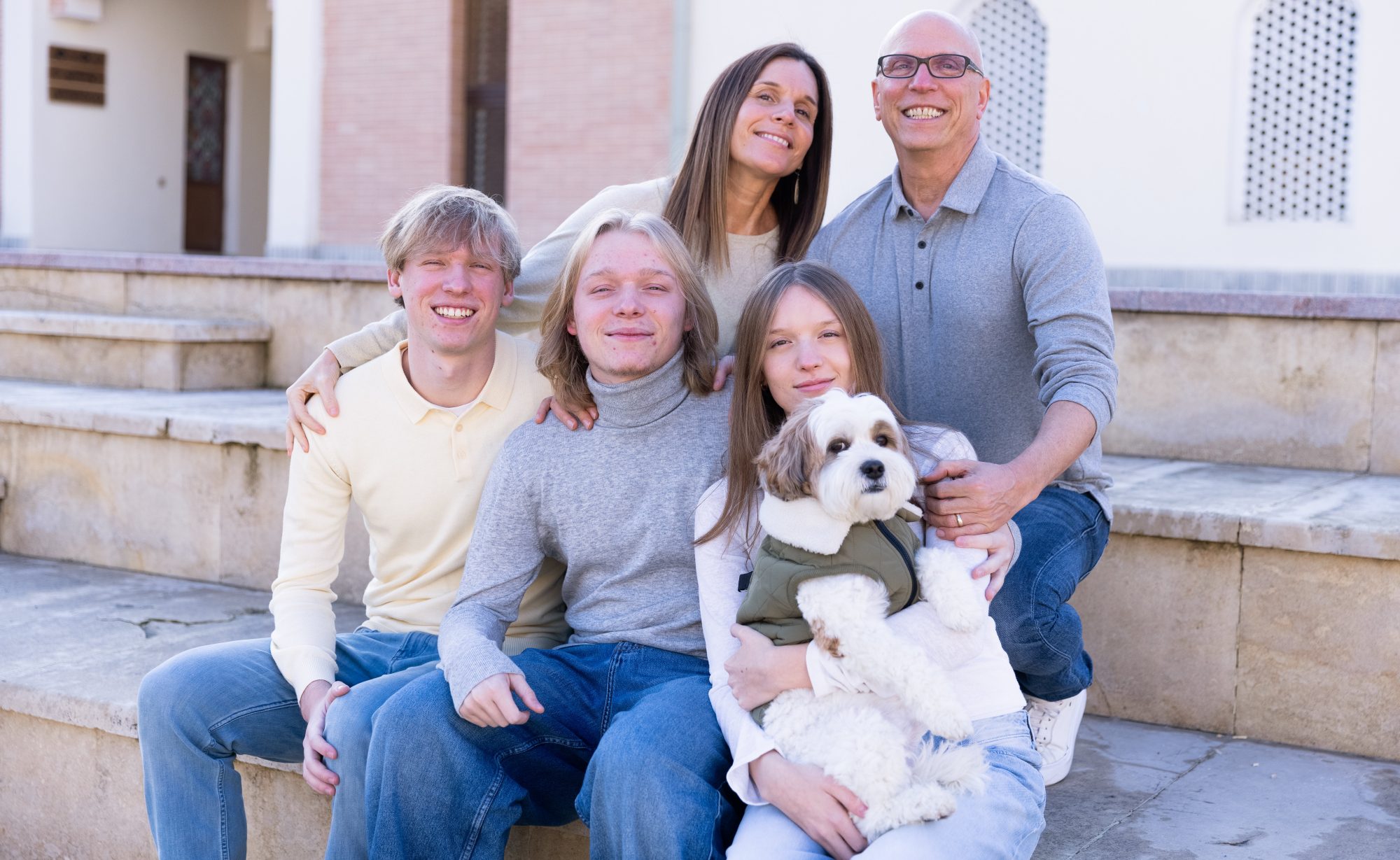
Yesterday we received the boys’ school photos. This ia a tradition that I really like. We see the kids everyday and often do not notice how much they have grown up. Oliver above, looks adorable! He is a such a cute, mischievious little guy, it is impossible to stay angry with him. Oliver has a heart of gold underneath is rambunctious exterior.
Owen's Grade 2 Picture
I carried Owen last night from our bed to his because he fell asleep next to mom. I really noticed how big he is getting and looking at the photo above compared to last year’s photo, he is now a young man.
Both guys are growing up way too fast. We just have to enjoy the limited amount of time we will have with them. I mean limited in the sense that they go on to university and start lives of their own. I guess I am more in tune with that stage of life with my job as a high school principal.
I made mosiacs of the boys’ school photos from previous years. My mother used to put the school photos of me and my two brothers each year on the wall going up the stairs to the second floor of our house. I guess below is the electronic version of this practice.
We do not have any photos of Ocean yet, as she is not going to school. She just turned three in September.
An earthquake struck last night in Serbia at 2:00 AM. We slept through the earthquake, but most of my friends were woken up by a shaking bed here in Belgrade. It was a moderate (5.3 on the Richter Scale) quake, with the epicenter being about 75 miles southwest of the city. There was a lot of damage in the city of Kraljevo, where 2 people were killed and 50 people injured. They also lost water, electricity and there was much debris in the streets.
Europe turned the clocks back one hour on Saturday evening – 1 week ahead of the US turning the clocks back. We took advantage of the extra hour and visited the Salvador Dali exhibition at the Yugoslavian History Museum near our home.
I had heard of Dali and knew of his surrealism painting style, his big moustache, and flamboyant lifestyle. The exhibition focused on his commissioned works by the Italian government to commemorate the 700th anniversary of Dante’s “The Divine Comedy”. The exhibition also featured a series of illustrations of Biblical themes he did in the 60’s. One of his Italian friends was trying to get him back to the Catholic church. It was a good opportunity for me to explain some of the Bible stories to Owen and Oliver. It made me think about the Catalan artist in a different light.
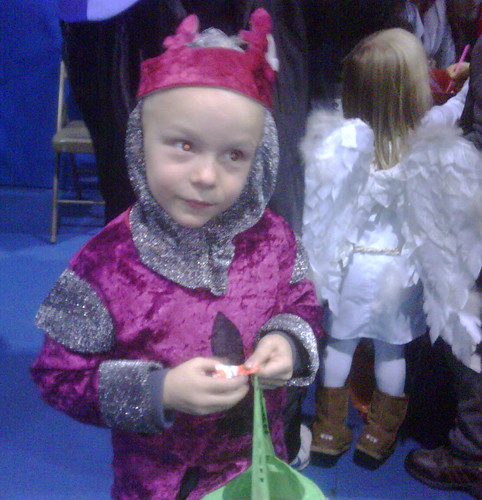
We took the kids to two Halloween parties this weekend. The first was Friday evening at the school and then on Sunday, the boys went over to a friend’s house for a party on Halloween day. They were so excited for trick or treating. Ollie said, “I love Halloween!” and Ocean, when she got up on Saturday morning at 6:30 AM, came to me and asked me where the candy was.
Owen went as a ninja, Ollie was on Friday night Sir Lancelot and on Sunday Superman. Ocean went as an angel. All three of our chldren used the angel outfit. The wings were made by a sweet lady in Venezuela who sadly passed away shortly after making the wings. All of our children I consider angels, especially my “angel-princess” Ocean.
I really love living the holidays through the eyes of my children.
We went to the annual Belgrade Book Fair this afternoon. We love books and reading, and it would have been great to listen to some of the discussions and lectures, but unfortunately, there was way too many people. Too many to the point where we were in fear of losing our children. It says a lot about Belgrade however – it is an intellectual and cultural city besides it reputation for its night life.
We did find a lot of good books for the kids at the Oxford Book Store. They were very reasonably priced, which is rare for anywhere outside the US. I was looking for one of Ian McDonald’s books. The Scottish Science Fiction Writer is in Belgrade this week promoting his Serbian language version of his latest, The Dervish House, which is set in Istanbul. I have never read anything by him. I couldn’t find the English version, so I’ll just get it on my Kindle, although the price for the electronic version is only 3 dollars less than the hardcopy. Note to self for future fairs, go during the week or early in the morning.
We had our first frost this morning (October 30) and it is time to get out the winter clothes. The peak colors for fall were last weekend, as they are dropping rapidly. Welcome November!
Earlier this month our school’s website was “hacked” by some kids from Kosovo. We have a very good security system and we quickly cleared it up. This in not the first time they got through. It is a bit funny that they attack the International School’s website. We are all about open-mindedness and our school is trying to instill a global outlook for our Serbian students. I see they are using the Albanian Black Eagle to show their pride. Our IT people know that they are from Kosovo because they use the same internet provider found in Serbia. Above is a screen shot of their infiltration.
I had a wonderful weekend with our students and teachers at our first annual autumn retreat. We stayed at the Sunny River (Sunčana Reka) Camp in Mali Zvornik. Mali Zvornik, which means “little bell” in English, is a small town located on the Serbia – Bosnia border, about 2 1/2 hours south west of Belgrade. The resort camp is on the Drina River and it was a very peaceful time, with beautiful sunshine and autumn colors all around. The landscape reminded me of the Appalachians, because of the forested hills.
The town is across the river from its sister city in Bosnia, Zvornik. I didn’t realize how close Zvornik was to the infamous Srebrenica, the scene of the biggest massacre of the Yugsolavian Wars of Secession. A lot of horrible and sick events happened in Zvornik also, but they are not as well known as Srebrenica. The town was once 60% Bosniak Muslim, but they were driven out and it is a majority Serbian town today. If the United Nations sponsored commission reports are accurate, so many bad things occured in the area. I only felt peace however, with quiet walks along the river, nice meals with friends and students, and sports on the grounds of the resort.
Serbia is always full of surprises and Mali Zvornik was no exception. The owner of the resort arranged for the local Serbian Orthodox Priest to show us two underground sites. The first was the Holy Cross Church (Crkva Casnog Krsta) which is a cross-shaped cave that is an ordained church. There is not electricity in the cave, but they hold mass there the last Friday of every month by candlelight. It fits around 100 people. The second site was more impressive. It was a secret, underground city constructed in the 1930’s for King Alexandar I of Yugoslavia. You can see us above in one of the 78 rooms of the 2 kilometer complex. The city was never completed because of World War II and the Communist Era. Today it is just light bulbs and cement walls. We toured a bit of it. Very impressive however, being that large. It would be a great place for a movie. I hope someday that they find the money to renovate the city how they had envisioned it during King Alexandar’s time. With the state of Serbia’s economy, I don’t see this happening for a while. The underground rooms and hallways can fit between 3,000 and 5,000 people. Very cool.
It would be nice if this area of Serbia and Bosnia could receive more tourists. It is a gorgeous, peaceful place for relaxation. I will definitely take my family back to the resort. For all the former areas of conflict, it will be good for them to develop their economies through tourism. There is lots of potential.
We had to make a special stop on our way home from the Dalmatian Coast during our fall break. Both Nadia and I were raised in strong Catholic families and both of our mothers would have loved to have visited Medjugorje. Medjugorje is a small town in Bosnia & Herzegovina where 19 years ago, 7 teenagers had visions of the Virgin Mary. The apparitions have not been officially sanctioned by the Catholic Church like Fatima in Portugal or in Lourdes, France. The site is still a huge pilgrimage site and I was surprised at the number of tourists visiting the site on a rainy Tuesday in October. I was also surprised at the devotion of millions of people who truly believe in the apparitions. Many of the tourist there on the day we visited were Italians, which makes sense. It is relatively close and Italy is the home of the Pope.
Oliver and Owen Pose at the Outdoor Mass Complex
It would have been nice to have our mothers with us to visit the site. Sadly, both of them passed away, but we thought of them while we were there and got some holy water from the church for Nadia’s Aunt Silivia. We introduced Owen and Oliver to the concept of a Rosary and explained to them a bit about the Virgin Mary. I am no longer a believer, but I feel it is important that my children understand different religious beliefs because so many people in the world are still strongly religious.
Three of the seven still have visions or revelations and annually announce new messages from Mary. I am quite skeptical myself, as I don’t believe in anything supernatural. I am open to changing this view, but I didn’t feel or sense anything different when I was there. For me, I was happy for the village in regards to the help to the economy that the apparitions have brought, as well as the pilgrims, who come back from Medjugorje feeling refreshed and more spiritual.
I wouldn’t go back again but it was a very interesting stop. We did buy a couple of bottles of wine from the region, which are supposed to be very good.
The Beautiful River Neretva Winding Through Mostar
We stopped on the back to Belgrade during fall break in the town of Mostar. We wanted to stop for lunch and see the famous Stari Most. I also wanted to see how the reconstruction of the city was going. It suffered great damage during the war of Yugoslav Seccession. First the JNA or Yugoslav Army bombed and occupied the city and later, the Bosnian Croats and Bosniak armies fought a vicious war. There were many building destroyed, including the landmark Ottoman era bridge. The city is still divided today into a Croatian side and a Bosniak side. The Bosnian Serbs in the city were forced out during the war and have not returned.
Many countries have supported a reconstruction of the city. They did a great job with an accurate remaking of the bridge as well as the market area that surrounds it. It is a big tourist attraction and I can see why. The historic market area around the bridge has an exotic feel to it. Nadia found a lot things in the market. Driving out of the city however, I still saw many buildings that have not been repaired and there is a long way to go to get rid of any evidence of the conflict.
Oliver Loved His Islamic Hat
Herzegovina is a rugged, beautiful countryside that reminded me of the basin and range area of Nevada in the USA. The call to prayer and mosques, give it an exotic feel. It is too bad it is still a divided city, even after 15 years since the war. I definitely want to go back and spend a bit more time there as well as explore the national park north of the city between Mostar and Sarajevo. It was a stunning drive going through the deep river canyons. The rivers in Bosnia are a bright green color. It must be from the tannins of the plant life around the rivers or the geology of the rocks that causes the green color.
I didn’t know much about the battles and conflict here on the Dalmation coast during the wars of Yugoslavian Seccession in the 1990’s. Some Serbian friends told me they don’t go here because of what happened. I wanted to learn more about it so I picked up the book, War in Dubrovnik, which was a collection of pieces written from that time. Obviously it is very pro-Croatian and I was disappointed in the book. I was hoping for more analysis of why violence broke out, but mostly what I got were essays lamenting the destruction of heritage of Ragusa. There was an excellent chronology of events as well as one piece by Hrvoje Kačić called, “Dubrovnik and the Calamities of War,” which was the best critical in-depth analysis answering my question of why would the JNA attack Dubrovnik.
Owen and Ollie Overlook Dubrovnik from Strategic Heights
Kačić brought up an interesting contrast between the USSR (Soviet Union) and the SFRY (Yugoslavia). I never thought of them as empires, but they were. They controlled a collection of formerly independent nations. Kacic asks why there so much war with the breakup of Yugoslavia and not of the Soviet Union. He hypothesizes that it was because the communist party of the USSR died in capital Moscow first, before countries started pulling out of the USSR. They also had two excellent leaders in Gorborchav and Yeltsin, who avoided civil war. In Yugoslavia however, the main communist party stayed together in the capital Belgrade while countries were seceeding. The party morphed from Yugoslavia to Serboslavia and had a strong military intact and ready to maintain the status quo. The leaders also were not interested in avoiding war like Gorborchav, and Milosevic, and three others mentioned by Kacic, (Jović, Kadijević, and Adžić) did not avoid conflict.
Getting back to my question, why Dubrovnik? The climate at the time was unstable because of the fall of communism in Eastern Europe and a crash of the economy that went with it. There was also the fact previously mentioned, with the core communist party still functioning and controlling the army. There was not a large population of Serbs living in Dubrovnik. The Croatians in the essays in the book, mentioned the “two wings” being clipped. This refers to the shape of Croatia, which is like a boomerang or bird. The southern wing is the Dalmatian coast with Dubrovnik and the northern wing is the area Vukovar. Vukovar was undergoing heavy fighting and there was a large Serbian population in the city. One of the reasons posited by Kacic is the JNA (Jugoslav National Army) wanted to improve their morale and hurt the Croatians. They were not making progress in Vukovar like they had planned. Other possible reasons could be that Dubrovnik brings in a lot of tourist currency and it would expand the coast of Serbia. The satellite country of Montenegro is about 50 kilometers south of here. The author also met with a JNA general who offered the idea of Dubrovnik returning to its independent city-state status like Monaco.
JNA Artillery Bunker
I thought that the JNA only bombed the old city from the nearby mountains, but they also attacked all along the coast by ship. The apartment in Lapad, that I am writing this piece from was also attacked, and the Tirena Hotel, which is just down the road, was destroyed. I can imagine the trauma on the civilian population living here. They were unarmed and caught in the middle of a battle. They suffered the electricity and water being cut off for months. The Croatians did manage to form a defense and got weapons and soldiers here to protect the city. There was also much support from international aid agencies that got food, water, and medical supplies in and refugees out during the siege.
The first attack occured in October of 1991 and for almost the next year, regular bombings and firefights occured until finally in August of 1992, Cyrus Vance from the UN, negotiated with both sides to get a withdrawal of the JNA to Montenegro. Despite the withdrawal, sporadic attacks occured all the way up until the Dayton Accords of 1995.
Owen, Oliver and I climbed up to the former JNA artillery positions. We enjoyed the hike and the breathtaking views. We also saw two snakes and the boys loved the adventure of the climb.
Sadly, 92 civilians died as well as 129 Croatian soldiers. There is no mention of how many JNA soldiers died. Over 33, 000 people had to flee their homes, and over 7,000 buildings were damaged. Over 500 people were also injured and over 2,000 unexploded mines were removed. In our time spent in the Old City this week, we didn’t notice any war damage in the historic fortress and city within the walls. There was also a lot of looting of private homes in the occupied areas.
Today, the city and coast are controlled by Croatia. In speaking with the ticket guy in the old city, over 1,000 tourists paid 70 Kuna to walk around the walls of the old city. In the summer, between 6 and 7,000 walk around the walls. With the many cruise ships and tourists staying in the area, the city must be a cash cow for the nation’s coffers. I hope the tax revenue is going for helping the lives of the less fortunate citizens of the country.
Dalmatian Coast Views
I want to learn more about the wars of seccession in Yugoslavia and I’ll be reading more accounts and speaking with people and writing about my understanding of the conflict and its impact today on the Balkans.




 Bill's Blog