John Lui “Earth’s Hope”

I attended a talk by John Lui at the CEESA Educators’ Conference in Tallinn, Estonia.

Mr. Lui Shows Sediment Flow in a Creek


He gave a talk on his restoration of a highland wetland in Rwanda. Jarod Diamond gave the reason of the genocide was a fight over scarce resources. He was working at the head waters of the White Nile and Congo River, and environmental problems at that highland, it affects all the way down the river basins. All of these horrible events are caused by deforestation by humans.

He feels this is the “panda” of biome restoration. This is an extremely beautiful place with rare orchids, birdlife, volcanoes, lakes, etc. This is also a place that is coming out of genocide.

Plants are 80-90% water and when they are removed from a hillside, and the rain during the rainy season is not soaked up by the missing plants. This causes sedmintation, even mud slides,  which bury villages and kill villagers. No one ever talks about the cause of the mudslides on the news. The cause is deforestation. Another indicator of a degraded environment is when rivers do not flow the whole year. One thing they did in Ethiopia, they make the gullies meander to allow a slower flow and the water infiltrate the soil. This also raised the water table. This is a physical change to aid restoration. The other change is biological, with the planting of trees. The amount and percentage of biomatter is huge.

The determinate of ecosystems is the infiltration of rainfall water. He also feels that biodiversity is separate from the process of water retention. He says that we exist because of wilderness, and we need to nurture biodiversity for the possibilities. He also feels that we are not capable of making good decisions.

He commented on the Copenhagen Summit. Two accomplishments were the setting up a carbon-trading scheme and the second was REDD (Reduction of Carbon Emissions by reducing deforestation). He has been publically speaking for 5 years and it is always accepted by every crowd that has watched his presentations.

All cradles of civilization went through the same process. Cut down the trees, plant on slopes, leading to serious degradation of their environment. The wealth and power of a civilation leaves, but the peasant farmers stay for generation. One example is the Loess Plataue in China, the cradle of the Han people.

Idea of canopies, not only the tree canopy and the grass canopy. There is a microclimate under the trees AND under the grass.

You can click on the “Hope on a Changing Climate” link to see one of John’s movies. There is also a good website that will help educators use his ideas and work in their classrooms. The Environmental Education Media Project web site can help. His main web site is also full of more information.

In Colombia there is a project called Las Gaviotas. They used a pine species to improve the pH of the soil and they are no pruning. I’ll need to look it up.

Estonia: A Beautiful (and strange) Frozen Kingdom


Besides learning how to be a better principal from the CEESA conference, I am also learning much about the host city, Tallinn, Estonia.

I wonder how many Americans have heard of Estonia, know where it is located, and a little of its history? I bet it would be about 1/3 of Americans who could answer those questions correctly.

It is the smallest and furthest north of the Baltic States (Latvia, Lithuania being the other two) with a population of 1.4 million. Tallinn, the capital, has a population of slightly over 400,000. It is slightly larger than Vermont and New Hampshire combined. As you can see from the snow above, Estonia is located 59 degrees north latitude. The Estonian ethnic group is not related to the two other Baltic states. The language and the looks of the people, make them very similar to the Finns. Finland is a two-hour ferry ride away, across the Baltic Sea.

For most of its history, Estonia has been under the control of a larger and more powerful country. The Swedes, Danes, Livonians, Germans, They have only been an independent country for 38 years. A short period between WWI and WWII and then again in 1992 after the Russians left. I am surprised that the Estonians kept their language and culture and ethnic identity alive during all of those years under the control of other nations. They did leave their marks however, and I see the beautiful Old Town arrchitecture of the Germans and the ugly block apartments left by the Russians.

The Narrow Streets of Old Town

It is an odd little place.For example, in the fridge in the hotel, there is a “good morning pickle.” Do Estonians eat pickles for breakfast? Two nights ago for St. Patricks day, we went out to an Irish Pub to celebrte the day. The band playing that night featured a lead singer that sang like Alvin and the Chipmunks and with a lead violinist with wild, hairspray, hair. For their last set, they brought out three girls playing white violins. I think they would be huge celebrities in the US. It was an original idea, I think they would be immensely popular world wide.

We spoke to the waitress last night at dinner. She was around 20 and was thinking of going to university. She said Estonia was a bad place for young people as there was not much opportunity to develop a career. She was looking to make a move to a larger city in Norway, Sweeden, or Finland.

The city is buried in snow which makes it even more beatuiful The Old Town is incredible. I’ll blog more about my impressions of Estonia.

Instructional Strategies That Improve Student Achievement

These are my reflections and notes from Fran Prolman, an educational consultant from the US. The workshop took place on March 18, 2010 as part of the CEESA conference in Tallinn, Estonia.

What will I take back to Belgrade?

10 – 2 Rule: For every ten minutes of teacher centered talk, there must be 2 minutes of student talk.

These are the strategies to get the students talking.

  • “Paired Verbal Fluency” – Take what you heard and put it to long-term memory. Important to shift from teacher to talk and more for the students to talk.
  • Think Pair Share – teacher assigns a question,  students solve it.
  • Journal Entry on Blog –
  • Graphic Organizer

Collegiality versus Congeniality – everyone brings food/sunshine club, which is nice, but schools need to have professional learning community.

Five Behaviors for a Highly Collegial School

1)      Talk concretely, precisely about teaching and learning

2)      Planning and making materials together (not planning in isolation) it is easier

3)      Observing each other’s classroom – Go on an strategy hunt

4)      Teachers share their expertise – faculty meetings take place in various teacher classrooms

5)      Teachers are asking questions and providing assistance to one another

Another idea was to get a sub for the teacher and have them follow a student for a day.

The average number of pages in a textbook in the USA is 800 pages.

She loves the standards AERO because they are geared to international schools. http://www.projectaero.org/

M.A.P. has a good correlation to the AERO standards.  

What are the indicators for a Standards-Based School?

Published criteria, posted work , students are able to tell you what they did and what

Shift from focus on teaching to learning.

Shift from a coverage mentality to a mastery mentality.

Engage teams in building shared knowledge with documents

Teams help looking rubrics at “rater reliability” –

Beginning the Lesson – Frame the Learning for your students

  • Standard, mastery objective, essential questions, – tell the students what they will learn – remember, no secrets
  • Activators – relate the material to what the students have already learned or know
  • Rubrics http://rubistar.4teachers.org/; free easy site for teachers to do rubrics quickly and easily
  • Word Splash (this is an activator) – splash words on a page that the students will be learning – have the students make predictive statements on how the terms are related – 

http://www.wordle.net/ this is a good web site for creating word splashes,

  • K / W / L –
KWhat I KNOW WWhat I WANT to Know LWhat I LEARNED


Confusers – ex) having latitude and longitude in the same lesson 

Examplars are great for kids – for example a good lab report with arrows pointing to points in the rubric

Middle of the Lesson – Checking for Understanding

  • White boards (mini slate) for each student – ask a question to one student, and only one student is understanding – quiet ones demonstrate  (content check)
  • Signal Cards – red/yellow/green (thumbs up / thumbs down /thumbs sideways
  • Sentence Stems – put these on 3by5 cards and it can be used by the index cards
  • Descriptive Feedback –

Important to have detailed feedback for the student – Ex) Your L look like the letter Y instead of sloppy

Do a re-write so you can incorporate it in the text.

Teachers do not put a final grade on the paper instead have the students judge themselves.

Good feedback tells me how to improve, non-judgmental, limited focus, specific, based on the standards,

The “stand up and talk” dialogue and the movement really helps the students to focus. Big sitting down is less oxygen in the brain – many people think better when they are running.

Walk – Talk – This is a good kinestetic strategy, we read an article about feedback and then walked and talked about it.

Personal Relationship Building is a spoke on the umbrella and class climate is the umbrella. Respect, courtesy, fairness, honesty, realness, humor, (Much like the IB Learner Profile)

Pouring on praise on a student actually shuts down thinking and conversation. It makes teacher’s pets, and creates a competitive environment. (Arthur Casta – says not to put a value on it, no student gets a judgment. )

Performance Goal  – Don’t take risks, wants to maintain the seven.

Learning Goal – With great feedback, this becomes front and center instead of the performance goal.

How to Train Students to Think Creativity

E. Paul Torrance / Alex Osbourne

1) Elaboration (not a new idea, take a basic idea and elaborate)

2) Fluency – Mental stamina,

3) Flexibility – mental, move your brain to different ideas smoothly

4) Originality

The End of the class: Evidence of Student Learning

“The Important Thing” (summarizer)

I like the term, SELF ADJUSTMENT.

Nebojša Čović – Industrial Magnate / Basketball Fanatic


Arena #2, originally uploaded by bill kralovec.

For those of you following my blog, our team won the grand final game against Gimnasium Milos Crjnanski by 2 points and were crowned CEESA champions for 2009-2010. More on this later. I am blogging about today is the basketball machine called FMP.

Saturday we played the final games of the CEESA basketball tourney at “Basketland” which is a wonderful basketball/steel factory facility. Above is one of the two gymnasiums on the basketland grounds. We took the tour of Basketland and between the two gymnasiums are the assembly lines and warehouses for making metal products like aluminum cans, silverware, etc. This combination of factory and basketball training center is the vision of the owner of FMP (Fabrika Metahl Proizvoda), Nebojsa Covic.

When Covic bought the basketball club ILR Zeleznik in 1991, they had folded due to the increased cost of competing in the higher leagues in Serbia. They started out as a neighborhood (Zeleznik is a large suburb of Belgrade with about 20,000 inhabitants) team that played their games outdoors in the 1970’s. They eventually got better, but could not afford the costs of maintaining the team in a higher division.

Covic has made KK FMP into the third Belgrade basketball team after Red Star and Partizan. They do well in the NBL, or Adriatic Basketball Association. Note that the KK stands for kasorka (Serbian for basketball) klub. The strength of the club is its youth program. Covic has several basketball complexes in Zeleznik and they really develop great players. On Saturday, a group of 14 and 15 year olds were practicing in the other gym. One of them had to be close to 7 feet and was dunking with ease.

FMP is represents for me, Serbia’s serious approach to basketball. I can see why there are so many Serbs in the NBA and European leagues. They just play a lot and many of them are very tall. The neighborhood also has a lot of Communist era block apartments. This combination of beautiful basketball facilities surrounded by industrial and grey ugliness impresses me.

The Factory Grounds of "Basketland"

All of the CEESA teams had a fantastic final day at Basketland. With four games, it was an orgy of basketball and the great facilities. Thank you Mr. Covic.

Friendships


One of the nicest things about these CEESA events are the opportunity to make new friends. The visiting student-athletes are traditionally billeted with our students’ families when we host an event. This is a great way to forge new friendships and get to know people from a different cultures.

We are hosting two young men from the International School of Helsinki. They are shown above yestrday morning in the school parking lot with Nadia and the boys. Owen and Ollie have been so excited to have the “Husky” basketball players staying in our home. They will not leave them alone. They were so excited the first night, that we had a difficult time putting them to sleep.

Both Josh and Jani are very nice gentlemen and we have enjoyed hosting them. We’ll be sad when they have to leave on Sunday for Helsinki. These are just two of the many friendships that form over the years in CEESA. When we travel to the various events, our students are billeted with the various host families. The players get to know one another and make lasting friendships. It is all about bringing the nations of the Balkans and eastern Europe a little bit closer to each other.

It was nice that yesterday’s game between the International School of Belgrade and the American International School of Zagreb was about the students and no politics involved. All of the teenagers in the game yesterday are great examples of products of international schools. They was a strong spirit of camradarie and athletic competition.

We had the coaches dinner last night and that again, is an opportunity to make friends. We had a lot of laughs and this season, Nadia and I have gotten quite close to several of the other team’s coaches.

It has been a very rewarding basketball season. Our final game is this afternoon. It will be our 20th game of the season. We have 12 wins and 7 losses. We’ll see what the end brings us.

ISB to the Finals

It was an emotional 58-56 win today in the semifinals for the International School of Belgrade against the American International School of Zagreb, Croatia. A tight game throughout, but the Dragons prevailed in the end. Above is a photo from the an earlier game today at the Pechersk International School of Kiev, Ukraine. The Dragons also won that game 53 – 37.

We will now play in the finals against cross-town rival, Gimnasium Milos Crjnanski. We split games with them this year, winning by 5 the first time and losing by 2 the second game. They have been the dominant team in the tourney, so we’ll see how it goes.

Day One CEESA Tourney


Official Team Photo, originally uploaded by bill kralovec.

We had a successful day number one of the CEESA “Blue” Division tourney. In the first game we defeated the Anglo American School of Sofia 50-20. In the second game, we came back from a sluggish first half to beat Nova School from Skoplje, Macedonia 55 – 38.

We now complete the round-robin schedule with a game tomorrow morning against the Pechersk School of Kiev, Ukraine.

Note the big fellow in the back right. I wish he was playing for our team!

All of the results for Day One of the Tourney are below.

Pool A
Belgrade 51-20 Sofia
Pechersk 46 – 33 Skopje
Belgrade 55 – 38 Skopje
Pechersk 52 – 34 Sofia

 Pool B
Latvia 45 – 13 Helsinki
Zagreb 43 – Crnjanski 59
Latvia 42 – 50 Crnjanski
Zagreb 42 – 22 Helsinki.

CEESA Basketball Tourney Begins Thursday

It will be a busy weekend of basketball as we are hosting the annual CEESA (Central and Eastern European Schools Association) Boys’ High School Basketball championship. This is the “blue division” or small school division of CEESA. We have a high school of 100 students. Teams are coming from Bulgaria, Finland, Ukraine, Latvia, Macedonia, and Croatia. One team pulled out of the tourney at a late date so we have another Belgrade team, Gimnasium Milos Crjnanski participating also. We will play at least 5 games in three days and it will be quite tiring and exciting.

Our family is also hosting two players from the International School of Helsinki. That is one of the nice things about these CEESA events, is that the players stay with host families. It cuts down on expenses for the players and helps them form friendships with families from other countries. Above is a picture of the team during practice last week. I’ll keep you posted with how we do.

Owen and Oliver Join Atacante F.C.

The Logo of Football Club "Atacante"

Owen and Oliver the past few weeks have been practicing with a new football club, Atacante. Click here to see the boys’ photos on the club website. The boys practice on the weekends and they quite enjoy it. Oliver is a bit too young for the club, but the running around is good for him.

The club is run by Mihailo Jovanovic, a former professional player. The Belgrade native played first division soccer in Finland and Hong Kong. He speaks English and caters to the international community of Belgrade.

USA Stays Alive in Davis Cup Tie

Janko Tipsarevic & Nenad Zimonjic, originally uploaded by bill kralovec.

Update: John Isner lost in five sets last night to Novak Djokovic. He made Novak work hard and we have a new favorite player from the USA. Good on ya’ John. Serbia advances to play Croatia

This weekend Serbia is playing the USA in a Davis Cup Tennis round of 16 “tie.” Tie is Davis Cup speak for team match. Nadia and I attended the “rubber” yesterday, which was the middle doubles match of a 5 match series. A Davis Cup tie consists of 4 singles matches and 1 doubles, and the country that wins three, wins the tie.

We really enjoyed yesterday’s game between the Serbs (shown above) Janko Tipsarevic and Nenad Zimonjic and the USA team of 6’9″ John Isner and Bob Bryan. Nenad is the number one ranked doubles player in the world, but he usually plays with Daniel Nestor, a Serb born in Belgrade but Canadian-raised. Instead of Nestor, who can’t play for Serbia because he represented Canada in Olympic and Davis Cup play, Janko played with him. Tipsarevic is currently ranked #36 in the world and is the third ranked Serbian tennis player behind Novak and Victor Troiki. Isner was playing for the US in place of Bob’s twin brother, who contracted food poisoning. (I wonder where he ate?) Isner looked really good and should be playing more doubles tennis. He is suited for doubles with his powerful serve and quick reactions at the net. His mobility is not a factor in doubles and I hope he takes my advice and plays more doubles.

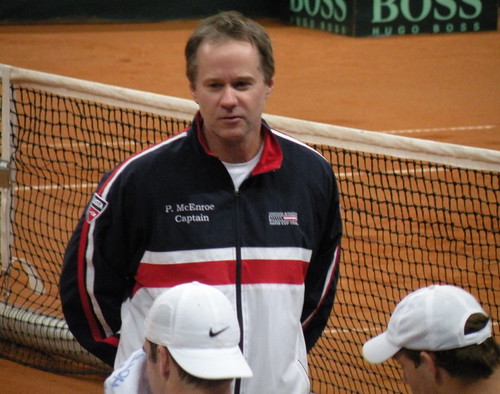
John's brother Patrick gives instructions to his team.

The US duo were clearly the stronger team and won in four sets. This gave the US their first win after losing the two singles matches American Sam Querry takes on Victor Troiki (#35 in the world) if necessary.

Whoever wins this tie will advance to the quarterfinals to take on Croatia in Croatia. A Serbia – Croatia will be a fascinating match and the first time the two nations have met since the breakup of Yugoslavia in the Davis Cup.

The Davis Cup is great and it has created a buzz in Belgrade. They even made a clay court in the Belgrade Arena to give the hosts an advantage. But what is lacking however, is a world buzz for a world championship event. I propose big changes in the event to make it better.

First, I would play the whole tourney in a two week Grand Slam format instead of stretching it over the year. Currently, they play Davis Cup weekends during lulls in the over crowded ATP schedule. It would be like the World Cup of Tennis and the top 8 teams in the world would be invited. You could have a playoff to determine teams if there are several closely rated countries. It could become the fifth Grand Slam on the ATP Tour.

The current Davis Cup is to determined by surface and host. Usually, the home nation wins because it has the crowd behind them and they choose the surface that best suits their players. In my Davis World Cup, I would have the surface selected randomly for each rubber, then the teams would have to find their best on a variety of surfaces. To make it even more interesting, lets select the surface AFTER the players have been selected to play. The four surfaces would be clay, grass, two hard court surfaces, perhaps one indoor and one outdoor.

It think if they select a good time, it would really take off and be a big event. I think the best players would play and there would be more worldwide fan interest.

We had great seats in the US Section