Romanian Holiday Part I


Ocean is pictured above chasing pigeons in Opera Plaza in Timisoara, Romania. Timisoara is the most western city in Romania. We stopped there for lunch and a walk around Christmas Market in the plaza. On Day One of our holiday we made it to Sibiu, Romania. We are spending a few days in Transylvania, visiting our friends from Brasov. Transylvania is one of the historic regions of Romania. Brasov is in central Romania, about a 3 hour drive north west of Bucharest, in the southern Carpathian mountains. 

Sibiu and Brasov were two of the seven citadels of Saxon immigrants in Romania. The emperor of the Austro-Hungarian empire had them settle in what is today central Romania, but at that time, part of the Austrian empire. It was the border between the Ottoman Turk world and Austro-Hungarian world. The Saxon immigrants built cities and basically kept the locals (Romanians) out of it. They lived separate lives. (more later)

Christmas Joy


Ocean, originally uploaded by bill kralovec.

We had a nice day yesterday as a family. The kids were up early and so excited to open their gifts. Nadia and I have been using the “Santa Card” to get them to be calmer and to listen to us. Too bad that option is now over. it was so funny that Oliver even asked had he been good enough to receive gifts when he first awoke on Christmas morning.

Ocean really wasn’t sure what was going on, but she got into it when she saw her “Dazzling Dreams Castle” doll house. She also enjoyed her Princess car. We bought a monitor and key board to go with Nadia’s old Mac Mini for Owen so now he has his own computer. Ollie’s favorite gift was a car race track.

We ate a real Serbian turkey. I am used to those industrial factory raised turkeys from the US with the bland taste. This turkey tasted “meaty” and for example, had bones and cartilage on the drumsticks that I didn’t know existed. In the US, turkeys are not bred to walk and so the drumsticks have less connective tissue to get in the way. Nadia also made a raspberry dessert that was absolutely spectacular. I ate way too much and had a hard time jogging in the afternoon due to a full stomach.

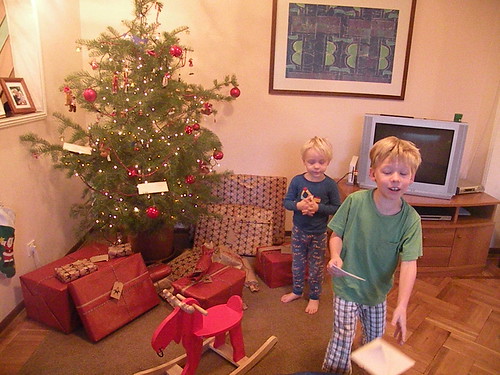
As you can see in the photo above, our Christmas tree is doing fine. We bought it from a tree farm, roots and all a few weeks ago. We intend to plant it in our yard after the holidays are done. We bought  a large pot and extra soil for it to stay alive. This is common with Serbs, as the culture appreciates trees and almost regards them as sacred. Belgrade is filled with trees on every street and there are strict laws which prevent people from cutting them down. I guess that trees helped the Serbs survive against the Turks. The hajduks hid in the forests while the Ottomans inhabited the fortresses in the cities and towns. I think it is a great tradition and our family will never again use a fake tree or cut a tree to use for a few weeks.

Big Mac Index In Serbia

Last night we took the kids to McDonald’s. I recently read a blog post about the Economist Magazine’s annual article on the Big Mac Index. The Big Mac Index is an informal method of predicting future currency exchange rates between the USA dollar and other currencies. The idea is the Big Mac, the world’s most popular sandwich should cost the same in every country. It there is a difference in prices, then the currency is overvalued or undervalued and should change in the future. 

The cost of a Big Mac in Serbia is 200 RSD (Republic of Serbia Dinar). This was at the McDonald’s on Slavija Circle in downtown Belgrade. The current price of a Big Mac in the US is $3.54. Today’s exchange rate is $1 = approximately 67 RSD. That would make the cost of a Big Mac in Belgrade to be $2.99, significantly cheaper than the US. In calculating a purchasing power parity percentage, the RSD is undervalued by 15.68%. The significance is that the power of the RSD should rise in the future and the exchange rate of 67 RSD/dollar should fall. 

Interior Dining Area of McDonald's near Terazije Fountain (Aug. 2008 photo)

Dining at McDonald’s in Serbia is not the same experience as the US. Generally speaking, McDonald’s is more of an upscale dining experience in Serbia than in the US. Lower income people in Serbia can’t afford to eat there often while in the US the poor go more often. McDonald’s in the US is viewed as a cheap meal or an eventful experience for families. We go about once every couple of weeks because the kids love it and it is an easy meal for us. 

I’ll be interested to see where the exchange rate goes in the first half of 2010. According to the Big Mac index, it should be dropping.

Green & Brown Christmas


Mud Bowl , originally uploaded by bill kralovec.

As you can see, all of the snow melted in Belgrade the past couple of days. Just in time for the Western Christian Christmas. We had a really nice family Christmas Eve day. In the morning, Nadia and I went for a long walk through Dedinje with temperatures in the mid-60’s, it was a beautiful sunny day. The temperature rose from 20’s to 60’s in only a couple of days. Oliver and I played against Owen in soccer and as you can see above, he got a bit dirty.

It is nice to be on holiday to do the simple things with my children and wife. I took a hot bath with Ocean and blow dried and combed her hair. Owen and I went to the Automobile Museum. Oliver and I ran through Karađorđje Park.

Last night after visiting the museum, we went out to eat at Byblos, a Lebanese restaurant near St. Sava’s Cathedral.

Lebanese Christmas Eve Dinner


Santa Claus visited us this morning. Ollie had the quote of the morning when he came down the stairs into the living room. “Was I good?”

Reading About Romania and Transylvania

Update: I read a bit more about Ceausescu in Misha Glenny’s book, “The Balkans: Nationalism, War, and the Great Powers, 1804-1999. 
Ceausescu was elected First Secretary in 1965 after the death of Gheorghe Dej. It took several years for him to establish power and get rid of his rivals. Once he did, he tightened control. It was his vision to turn Romania into a dominant force in s.e. Europe and an industrialized nation. Romania is resource rich and could be independent from USSR. Unfortunately, he centrally-planned the economy and ran it down the toilet. 
He was most popular in 1968 after verbally supporting Czechoslovakia’s stand against the USSR invasion. After that, it was all downhill. In 1971 he posted 17 “theses” on the door of the Central Committee and had his own cultural revolution, ala China. He tried to turn a rural, agricultural Romanian society into an urban, industrial country. As he tried to do this, he also monopolized power. For example, he introduced job rotation, forcing party members to rotate jobs often. This stopped them from gaining any expertise and power. It made the administration incompetent. It sounds like Chavez in Venezuela, putting people in important ministries and positions without the expertise or experience, but loyalty. Makes for a poorly run government. His opponents were more in fear of being demoted than worrying about running the government. Ceausescu’s family was exempted from the rotation, of course. 
He crowned himself President in 1974 and a cult of personality formed. Ceausescu made Tito seem modest in his material wealth. His economic policies took away from agriculture and lowered consumption, and heavy borrowing from Western banks. He expanded the secret police and the country was full of informers. “The first great socialist industry was the production of personal files.” Speaking to foreigners was prohibited, ownership of a typewriter required a certificate, etc. Penalties included losing a job, banishment from university education, etc. Paul Goma and others spoke out. 


I finished re-reading Robert Kaplan’s book, Balkan Ghosts. I focused on the section for Romania as I am preparing for our family to travel to Brasov, Romania, located in the Transylvania region of Romania. The book is a mix of travelogue and history. Kaplan visited several areas of Romania, included two of the cities in Transylvania near Brasov. He was there 20 years ago and the book is now a bit dated, but it did give me a good historical perspective of the area. Romania celebrates the 20th anniversary of end of the “communist” dictatorship of Nicolae Ceausescu. He and his wife were executed 20 years ago tomorrow (Christmas Day). It is an interesting time to visit and my second to the country. We went earlier this fall to the border region with Serbia, to the former Roman bath village of Baile Herculane.
From my reading I learned several things.
1) I didn’t know that parts of Romania used to be part of the Austro-Hungarian Empire. (The Russians also fought for control of other areas in the north of the country.) Brasov’s original name was the German Kronstadt. I wonder if they still have an influence after so many years of Romanian and communist oppression and control. Are there still Hungarians and Saxon Germans in Romania? 
2) I didn’t realize how horrible Ceausescu’s rule was for the Romanians. Besides Stalin and the guy in Albania, I can’t think of a worse ruler. I can see why on my visit in October, the Romanian side of the border was so run down. It will be interesting to see a richer part of the country and are the harmful effects of Ceausescu’s legacy still seen and felt. Is the economy growing? Are the Romanians better off today than 20 years ago? 
I found two sources of differing views on Romania. The first is more of a negative view of the country from phot0journalist, Christian Movila and his photo essay in today’s New York Times. The second is a recent book by former US Ambassador to Romania, Jim Rosapepe, entitled Dracula is Dead: How Romanians Survived Communism, Ended It and Emerged since 1989 as the New Italy. I am looking forward to forming my own opinion on the place and also having a good time with my family and friends. 
 
My notes on Transylvania from Robert Kaplan’s book, “Balkan Ghosts” are below. 
  • Vlad the Impaler  had his castle on the plain of Wallachia, not T.  Bram Stoker’s story Dracula is closer to Bucovina and Moldavia than Transylvania.
  • Transylvania is more Western than the three areas above. The Turks did not conquer Transylvania. William Penn almost named Pennsylvania Transylvania because he was  so impressed with the religious tolerance of the area between Catholics & Protestants.  
  • Hungarians and Saxon Germans repressed the Romanians in Transylvania. Romanians not impressed with the eastern beacon of the West. 
  • For both the Romanians and Hungarians, Transylvania is special. It is where the Romans had the original colony of Dacia, and for the Hungarians, many important victories over the Turks occurred. Bela Bartok and several other famous Hungarians are from the region.
  • After WWI treaty, Romania got Transylvania from the Austro-Hungarian Empire. Romanian names replaced the Hungarian names of cities and towns. Big Orthodox Cathedrals were built during this period. 
  • In WWII, the Hungarians re-took the region, but with Romania changing sides towards the end of the war, the Romanians were once again awarded Transylvania. 
  • Ceausescu forbid all Hungarian language, schools, newspapers, etc. He colonized the area with hundreds of thousands of Moldavian and Wallachian laborers. He also forcibly relocated Hungarians to other parts of Romania. There is a lot of enmity between the two countries. 
  • The 2.1 million Hungarians in Romania helped with the downfall of Ceausescu. They were led by Calvinist pastor Laszlo Tokes of Timisoara (Temesvar in Hungarian). 
  • Kaplan loves the city of Cluj-Napoca, very beautiful. 
  • A great quote on page 155, he was discussing an acquaintance, Nigel Townson, an English professor working at the university in Cluj. He married a Serbian and lived in an apartment in the city with his two children. In 1990 when Kaplan visited, was a time of shortages, when Romania was just coming out of the communist years. “Life wasn’t easy for Nigel, but he had a better elemental grasp of what Romanians and their country were like than any pampered foreign diplomat could ever hope to.”
  •  “Romania was one of those places overflowing with passion, where you meet the best and the worst people…”
  • Ceausescu was a real tyrant and did horrible things to the majority of Romanian people. Uneducated, from the Appalachians of Romania, he ran the country like a peasant would. Carter invited him to USA during the worst of the atrocities in Romania. 
  • Kaplan thought Marie Windsor Hohenzollern was Romania’s best ruler because she secured the seccessio of Transylvania to Romania after WWI. Slept with troops on battlefields of WWI and Second Balkan War and dressed as pagan warrior goddess of Dacia. 
  • Ceausescu sold visas to Romanian citizens of German and Hungarian descent during his dictatorship. After oil, it was a good source of income.  
Budućnost Defeats Red Star


Pionir Hall View from our Seats, originally uploaded by bill kralovec.

Last night Owen, Ollie, and I attended the Adriatic Basketball Association game between our favorite Red Star and Budućnost of Montenegro. It was an important game for both teams as they are in 7th and 6th place in the league standings respectively.

The superior guard play of Montenegrins and the weak defense of Red Star contributed to the 88-77 win by Budućnost. I was very impressed with the backcourt tandem of Goran Jeretin (26 points) and Nikola Otasevic (a 6 foot guard who can reverse dunk). They really controlled the game. Red Star did make a run and tied the game with 4 minutes left in the third quarter at 56 apiece behind a couple of nice plays by Red Star import Mike Taylor.

Budućnost pulled away from that point outscoring Red Star 32-21 the rest of the way. Red Star has several problems. Number one is they don’t play defense with intensity. The two guards for the Montenegrins kept penetrating and passing effectively the whole game. Second, Red Star has no guards and play makers. The team is heavy on tall, stiffs with few ball skills. Our favorite player, Vladimir Štimac played little and was constantly being yelled at by the coach. I would find a new coach ASAP if I was Red Star management. I would also find a slasher/scorer at the 2 or 3 position as well as a solid point guard.

We got to stay for the whole game. Ollie most loved the popcorn and running around the stadium. It is a great night out for the kids. I bought a ticket for 200 RSD ($3) , the kids were free, and the boys had popcorn and pop for another 200 RSD. The crowd was enthusiastic, but not violent or rude. Serbians love basketball (košarka) and play it well. Serbs are a tall, athletic race in general, and it shows with the quality of basketball. There are many Serbs in the NBA and US universities. They also play all over Europe and Partizan, the defending champion of the NBL, went far in the Euroleague Basketball last season.

We also had a final day in the snow. The weather was above freezing yesterday and much of the snow melted. We took advantage of the snow again yesterday morning, and went to Banavo Brdo (Ban’s Hill) a suburb of Belgrade. They have a big sledding hill and boys loved it. I promised no more snow videos or pictures but I couldn’t resist. Here is Owen heading down Ban’s Hill. As I update this late on Wednesday evening, the snow is almost gone.

Last Snow Video


Ollie & Papa Toboggan, originally uploaded by bill kralovec.

Owen shot this video yesterday of us going down Senjak Hill. Kablarska street is blocked off to traffic by two garbage containers and made into a sledding hill. We are planning to go again today. I promise no more snow videos. it is just after so long in the tropics, I am really enjoying the winter. It reminds me of my childhood in the Upper Peninsula of Michigan. I am happy to experience this with my children.

I have used the opportunity to introduce the boys to the Olympic sports of luge and bobsledding. We did a bobsled competition last night in the house. They were having trouble understanding the concepts of tenths of a second and the lower number means a faster time and a higher place in the standings.

Yesterday both Nadia and I took advantage of having our housekeeper working this week and we both went for runs. I went outside and Nadia inside. Despite a temperature of -11 C, the whiteness was refreshing and I enjoyed a long run.

In the afternoon we almost completed our Christmas shopping. Nadia baked gingerbread cookies last night and we ate tacos. I hope I can take the boys to the Red Star basketball game this evening.

Ocean Walks Through the Yard

Toboggan Run in the Neighborhood


With all of the snow we received last week and the cold temperatures this weekend, conditions are perfect in Belgrade for sledding runs. Last year, we had to go over to Banavo Brdo (Ban’s Hill) which is a neighborhood on the other side of Kosutnjak park. This year, there is a sledding run 100 meters from our house. The street is blocked to cars with two large garbage bins. A bunch of kids were there yesterday afternoon. I took the kids over with a toboggan we bought in Slovenia last year. Owen and Ollie loved it. Ocean didn’t as she was a bit scared. Above is a video of one of Owen’s run. If you listen closely, you can here Nadia in the background. We’ll head back today for another run. 

It was a nice Sunday. I went for a long run in the morning and cooked a hearty pancake breakfast. We went grocery shopping in the late afternoon. We finished off the night with dinner and watching Mythbusters and Atlantis. 


Ollie pulls Ocean down our Street

Christmas Shopping


We had a nice first day of our zimovanje (winter holiday in Serbian). Nadia, Owen, and Ocean are shown above in downtown Belgrade. We did some shopping (kupovina) for Christmas. We stopped at the Turbo Limac, a toy store, similar to Toys R’ Us but smaller. I think it is Croatian.

It was very cold yesterday with below freezing temperatures. It snowed again last night, adding an inch or two. It truly is a winter wonderland.

Owen is not feeling well, with occasional fever and headaches. We went to the US Embassy commissary also. Oliver had a birthday party at his friend Oscar’s house.