I just finished reading Michael Schuman’s “The Miracle: The Epic Story of Asia’s Quest for Wealth” and I really enjoyed it. Schuman is a journalist with Time magazine and the Wall Street Journal and has covered Asian economics and news for ten years. Asia is a part of the world that I don’t know much about and I have never been there (Australia excluded), and so the book is a good primer on the recent history of the region. He covers China, India, South Korea, Indonesia, Malaysia, and Taiwan.
Schuman gives a brief recent history of each country and chooses an important political figure and businessman for each country to tell his story. Asia since WWII has passed other regions since then in standard of living. He goes into the many reasons. I understand the biggest reason was tapping into the global economy through encouraging foreign investment and increasing the quality of businesses in the country. He also writes that all of the countries put politics and history aside and concentrated on the generating of wealth. That is a good lesson for the Balkans!
I particularly liked the chapter on China. It is an example of one person’s efforts and opinion changing a countries destiny. That is what great leaders can do for a country. He profiles Deng Xiaoping and his reforms of the communist party. It also gave another perspective on Tiananmen Square protests. Deng had the view that China is too large for a democracy and without a single party suppressing it, China would be chaotic. I wonder as Chinese grow richer and better educated, how that will play out.
I also am realizing that India and China have 1/3 the world’s population and their rise will change the current international political and cultural structures. He argues that the USA started this globalization of economies after WWII and when Asia gets richer, it is good for the US. I hope it spurs our schools and our young people to improve as there are a lot of children and teens coming from homes that don’t value learning and a strong work ethic in the USA. We have to compete with Asians for jobs and business.
I recommend reading the book. I think eventually our international careers will take us to Asia. I would like to see for myself what it is like, although I am not a fan of big cities. One thought is to have our children attend Australian universities while we work in international schools in Asia.
Update November 27, 2009 – This post generated a lot of comments which surprised me. Some people called me on my understanding of the Serbian Orthodox Church. I don’t have a fact-checker or the time often to verify everything I write. The comments did inspire me to do a bit of reading and I learned that the Orthodox church prides itself on being the most “original” of all of the Christian sects. Although the Serbian Orthodox Church is not the “official” church of the state, it is so closely tied with politics and the Serbian ethnic identity, that is the de facto official church. All of the political parties are lobbying for their candidate to be named the next Patriarch.
Few of my Belgrade friends attended the funeral and procession. A couple went to pay their respects at the wake. It seemed to me that most people attending the funeral were from smaller towns and outside of Belgrade where religious sentiment is stronger. I think it was good to see that many people gather for a decent man. I love the pagentry and tradition and am following the naming of a successor. I am an atheist so this whole event does not have any religious or deeper meaning for me.
In regards to Pavle’s legacy. It would have been tough to stop the war. I can’t think of any religious leader, besides maybe Ghandi that did stop a war. I think the media is a bit harsh in that respect in judging him. It is my hope that his successor give a message of tolerance and honesty for the people of the Balkans. It would be good for the church to work to heal Bosnia and relations between Serbia and Croatia instead of whether the country moves towards the EU or Russia.
The big news this week in Serbia is the death of the Patriarch Pavle. Pavle (Paul) in English is the name taken by Gojko Stojčević and he was the head of the Serbian Orthodox Church. Like the Pope to the Catholic, the Patriarch is the supreme leader of the faith. He was 95 years old and his death comes after a long illness – the last two years he was in the hospital.
Pavle died on Sunday and the country declared three days of mourning. People are lined up to pay their respects to the open casket in the cathedral in downtown Belgrade. The funeral will be at St. Sava’s Church on Thursday and the burial will be at the Rakovica Monastery located in the southern suburbs of Belgrade. The BBC reported on his legacy.
Serb interests
Pavle was a respected theologian and linguist, known for personal humility and modesty.
After the fall of communism and rise of Serb nationalism, the Church regained a leading role during his rule.
At the beginning of the Balkan wars that followed the dissolution of Yugoslavia in the early 1990s, Pavle said – according to Serbian state television: “It is our oath not to make a single child cry or sadden a single old woman because they are of another religion or nation.”
But critics accused him of failing to contain hardline bishops and priests who supported Serb paramilitaries against Catholic Croats and Bosnian Muslims.
After those wars, Pavle became more directly involved – openly criticising Serbian President Slobodan Milosevic, after he lost Kosovo following Nato’s intervention.
Since then, the Serbian Orthodox Church has strongly supported the Serbian government in its efforts to stop Kosovo’s independence drive.
“Kosovo is not only a question of territory, it is a question of our spiritual being,” he said after Kosovo’s declaration of independence.
The Serbian Orthodox Church is the official state church. For a long time, it was suppressed by the Turks, Austro-Hungarians, and most recently, the communists. Pavle was the 44th Patriarch and the church officials will announce when a successor will be named. At least 40 days must pass before one can be chosen. Most Serbs I know are not that religious, although because the church is so strongly tied to the state, I feel people support the church out of patriotism. This is so different from my home country of the USA, where there is a clear boundary between the church and state, and no one church is officially sanctioned. The Orthodox Church is the Byzantine side of Roman Catholicism and when they split from the Pope, the orthodox churches in the various countries split into their own administrative units instead of maintaining a single head like the Catholics.
I hope to get a chance tomorrow to go downtown and see the faithful and take some photos. I am working Thursday, so doubt I’ll get a chance to go to the funeral. I am not a believer or member of the Orthodox Church, but I respect the historic significance of the position and his passing. It will be interesting to see who will replace him.
I also think the Serbian Orthodox priests look holy with their long beards, black robes, and hats.
The Patriarch Pavle Visits Monasteries in Kosovo in 2005
The traditional school photos were taken a couple of weeks ago. I usually post the photos for family back home to see the boys as they grow. Above is Owen’s grade 1 photo from this year. He is definitely an improved version of me, thanks to Nadia’s beauty. Oliver’s a handsome fellow also, and his Pre-Kindergarten photo is below.
Oliver Age 4
The boys teachers this year are Ms. Marianne Whaley (Owen) and Ms. Duda Vesić.
Thursday evening Nadia and I attended the Eros Ramazzotti concert at the Belgrade Arena. Nadia is shown above in the suite that we usually get tickets. We have a friend who gets tickets to all of the concerts at the arena. They are free and it is really nice to see so many artists.
Eros Ramazzotti is very famous in the non-English speaking world. He is Italian and is popular in non-English speaking Europe and Latin America. He records songs only in Italian and Spanish. He is most similar to Phil Collins, with a bit more romantic ballads that Collins. He has a very distinctive, nasal toned voice. We enjoyed the concert, especially Nadia because his older songs bring back memories of her growing up in Bolivia. Eros is 46 years old and still going strong, but definitely in the twilight of his career. The music is very pop with the romantic ballads, and medium rock anthems. He put on a good show playing for about 2 hours. The stage lighting and showmanship was very professional.
Owen and Ollie are shown above this morning in our yard. It snowed yesterday a few inches and it temporarily turned Belgrade into a winter wonderland. Sadly, it was warm and sunny today and almost all of the snow melted. The boys did find time after school to make a snowman, although I was not able to because of work. I love when it snows and hope we have more this year.
I snapped this photo of Ocean yesterday while we were having lunch at Usce. The light was perfect and she was looking so adorable. What an absolute angel! We got a lot of things done around the house and played quite a bit with the kids.
A highlight of the weekend was visiting Supermarket, a concept store here in Belgrade. A very hip place. It is a restaurant, spa, store, art gallery, etc. We went on a Sunday evening and the place was full. We want to check out their Sunday Jazz brunch which one of the attendants says is well attended by families. They had great gifts there and Nadia bought an agenda. I highly recommend a visit. It is located in Dorcol, #10 Višnjičeva street.
Dinner at Whatever @ The Corner - Belgrade, Serbia
I took this photo from a hilltop above Olympic Stadium in the northern suburbs of Sarajevo. The large gray area above the apartment buildings and below the snow is a cemetary of war dead. The siege of Sarajevo lasted over 4 years and over 11,000 people died. What a horrible waste! The cemetary pictured is only one of many.
The grave to the left is of a seven year old Bosniak. Most of the tombstones had deaths from the time of the siege. One of the horrible characteristics of the war in Bosnia was the heavy involvement of civilians. The fighting in Sarajevo was especially disturbing. There were few traditional front lines or strategic geographic points like a river or mountain top, but mostly building to building and apartment to apartment exchange of fire. I can’t believe so many non-combatants were trapped in the city. It sounded like from what I have read and from what people tell me is most ordinary citizens didn’t think there was going to be such a level of violence. The photos, videos, and accounts of the war are shocking. It was interesting to look for and experience the effects of war 15 years after it occured. I have visited battle sites before, like the Battle of Carabobo site in Venezuela. They were hundreds of years after the fact and seemed like ancient history. This was fresh. I wonder if this is what my father felt as he served in the US army of occupation in Germany in the early 1950’s. The devastating effects of WWII must have been all around him, not only in the buildings, but in the people also. Most of the people we talked to in the city were very nice and I didn’t ask much about the war. I thought that it would be too personal, especially questions coming from a tourist.
One of the most fascinating sites was the tunnel museum. This was the “tunnel of hope” that ran underneath the airport into the city. The tunnel was used to get people and supplies in and out of the city. The museum is located out by the airport and a short section of the original tunnel remains. The original house that sat above the entrance is now full of war displays. We watched a video about the war and the role of the tunnel. Owen was most excited about the fact that actor Daniel Craig (James Bond) also visited the tunnel and his picture was on the wall
I loved the city of Sarajevo. The mosques gave it an exotic touch, the mountains and ski areas around the city are beautiful, and the markets and friendly people make it a very cool place to visit. The older part of the city was crowded and parking was difficult. It will take a long time for the city to shake the effects of the war. The pre-war ethnic mix is now gone, with most Serbs leaving. The city is still great, but with the emotional and physical scars of war in the buildings and people, it is less of a city.
The Dayton Accords ended the war and it divided the country by the frontlines between the Bosnian Serbs and the Croats/Bosniaks. It is still one country, but divided into “cantons” which in my mind are basically countries. I was interested in how the Republika Srpska (RS) would be. RS is mountainous and beautiful. I saw one Bosnian flag while seeing in every village, huge Serbian flags without the coat of arms. The Bosnian flag was flying in a park made with EU money. In a few of the towns were new mosques, obviously built with money from the Middle East. The trip made me think about the Serbs of Bosnia. I got the impression that they were the “country cousins” of the Serbs. I suppose it would be like the differences between the New Yorkers or the people of Boston and Texans.
What both Bosnia and the Republika Srpska need are more money. With a better economy, people would have other worries besides ethnic or religous differences. As my friend in Belgrade said, “give them mortgages and bosses, and they will forget to shoot at each other.” He also said that before the war, there were more similarities between Bosnian Serbs and Bosniaks that between people the Bosnians and people in Belgrade. The war and afterwards made people express their differences more. As Barak Obama said, it is harder to find our similarities than our differences.
I hope to return to Bosnia again. I would like to go skiing there, see the Catholic shrine of Madjure (spelling) and the coastal area and highlands of Hercegovina.
Last weekend I went on a hiking trip to the UNESCO Heritage site called Đavolja Varoš (Devil’s Town). The main attraction advertised were the 200 odd pillars you can see in the photo above. These huge pillars are formed through many years of erosion. You can see the hikers on the far right of the photo. They are set in a beautiful canyon which we climbed into. The sun came out as I was taking this photo and the beautiful fall colors added to the scene. Legend has it that the devil made a secret potion into the spring water at the site, and when the local settlers drank it, they forgot their familial relationships. A brother and sister were about to get married when a protective fairy in the village prayed to god and he swept down and turned the entire lot into these stone pillars. I like this explanation better than the erosion one. I guess with the small pockets of population a long time ago, incest was a big issue for the community.
I took a group of students and we stayed at the Prolom banja spa. It is a communist era hotel that many elderly people go to for the healthy waters. The place was not very modern, but it was clean and somewhat comfortable and the staff was very friendly and helpful.
The Sacred Spiral Plum Tree
The second day we took a 3 km walk from the town of Prolom Banja to a small church called St. Lazar. It is one of the legends surrounding the Serb battle against the Ottomans in 1389. The church is about 10 kilometers from the Kosovo border set amidst some forested hills. The area is great for hunting deer, wolves, foxes, etc. according to the locals. The guide from the hotel told us that before doing battle against the Ottomans, the Serb soldiers walked around the church 6 times and they also planted six spiral plum trees which were regarded as sacred. The photo above shows the oldest remains from one of the trees. There are two living spiral trees next to the church.
Lazar was the leader of the Serbs at the time of the big battle and both he and the Ottoman leader died in the battle.
I am not sure how true this is. From my research, not much is actually known about the battle. It is a great story however and with the low clouds and mists set in the dark forest, it is easy to imagine the medieval Serbs doing battle with the Turks in this kind of setting. I really want to go back with mountain bicycles, there were roads and trails galore in the area.
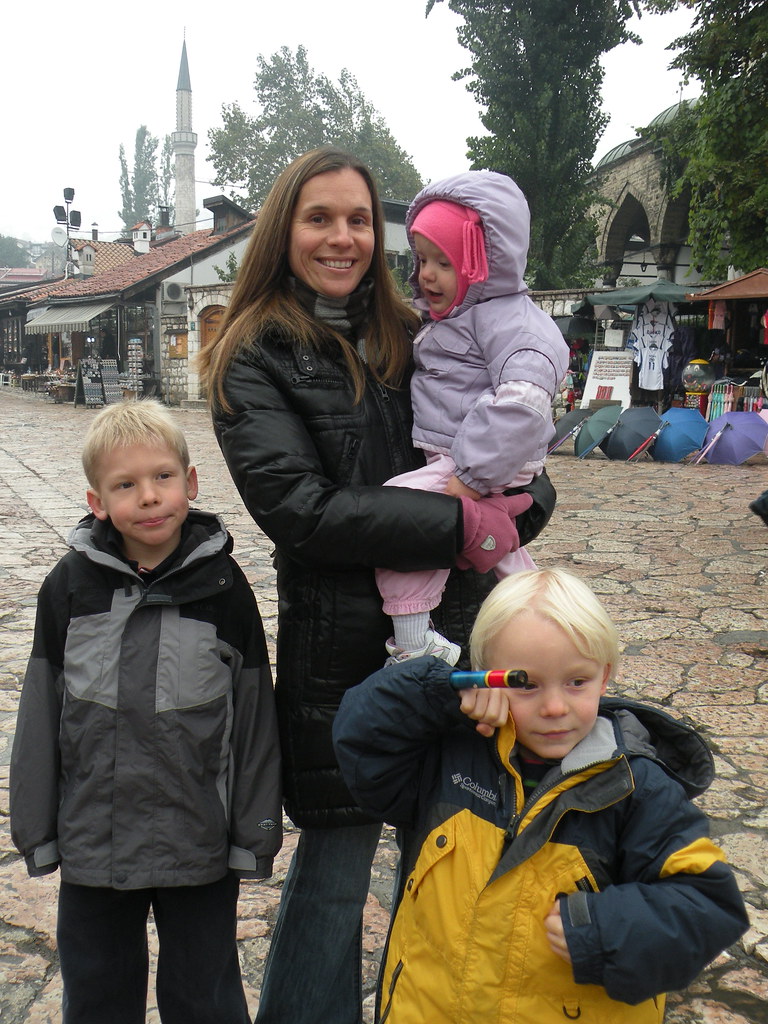
Ocean is shown looking up at the tower of Beg’s Mosque in the old part of Sarajevo. It is located in the center Bascarsija market and while we were shopping, we stopped to take a look at a fine example of Ottoman architecture. The towers of mosques can be seen throughout the city and in villages in Bosnia.
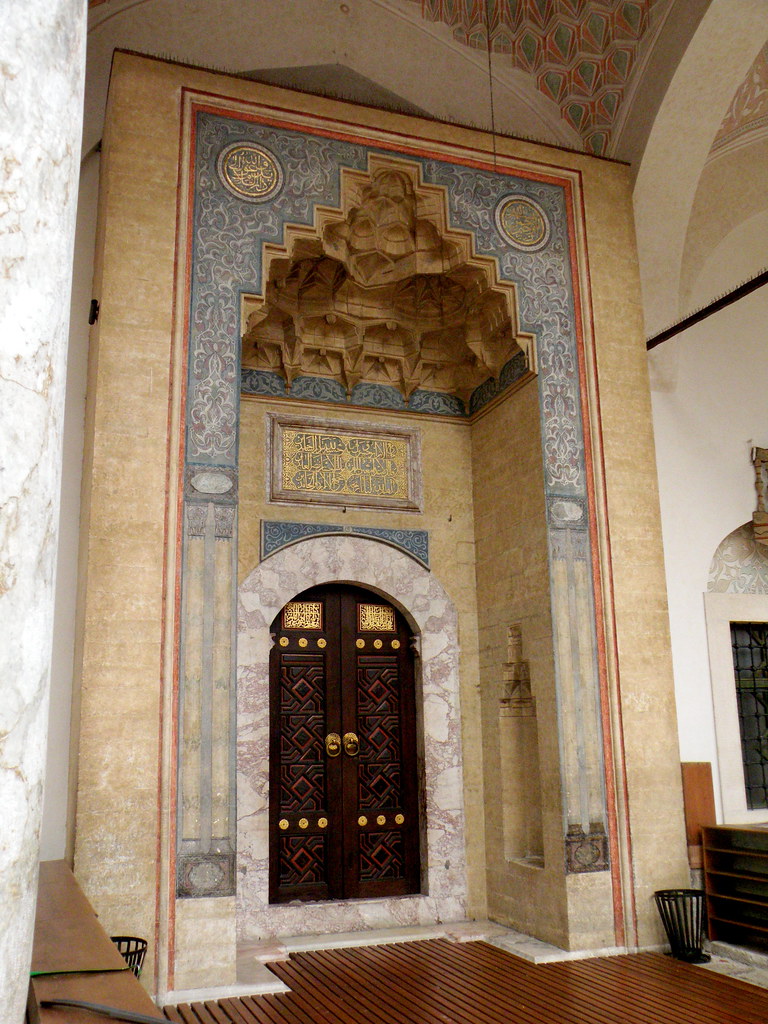
Beg’s mosque was financed by Gasi-Husrev Beg in 1531. He was the Bosnian governor for Sarajevo when the Ottomans ruled most of the Balkan peninsula. The Ottomans were here for over 500 years and it is in Sarajevo their influence can be felt the most in the ex-Yugoslavia. They also converted many of the Serbs and Croats to Islam, hence the Bosniaks of today. The mosques add a touch of the exotic to Sarajevo. The mosque was destroyed several times throughout its history, most recently during the siege on Sarajevo from 1992-1995. The Saudis financed rebuilding of the mosque. We even heard the call to prayer, the first time I ever heard it live. Very cool.
The family in the market
The market was great! Nadia enjoyed looking at all the shops. We bought a tea set, scarf, etc. and I even bought a fez. The people in the market loved the kids and they got free candy where ever we went. It was low tourist season and horrible weather, so there were no crowds and we got to meet many of the vendors. I also got a nice shave. The kids also enjoyed using umbrellas for the first time. We had to buy three of them of course and they walked around with them every day. Ocean dragged hers through puddles.
Ollie and Ocean are pictured above preparing snowballs to throw at our car. We were excited to see lots of snow on our trip to Sarajevo. We are on fall break and are exploring Serbia’s neighboring country.
We got off to a slow start yesterday with many errands to do around the house. I cleaned the car, fixed the rearview mirror, and helped Nadia pack. We made a delicious pancake breakfast as well as downloaded stories to listen to while driving. After exchanging some boots for Nadia, we were on our way.
Serbia has many single family farms still
We had a slight change in plans even before we got started. We had originally planned to stay near Visegrad, a town just across the Serbian border. The town was made famous by Nobel Prize laurate, Ivo Andric, a famous Yugolsavian author. He wrote “Bridge On the Drina”, a historical fictional account of the town. I blogged about the book here. We did not stay there because the best place in the area according to the guidebooks, was used in the 1990’s as a rape camp by paramilitary forces in the Yugoslavian civil war. The Bradt Guide to Bosnia didn’t mention this. Young and beautiful Bosniak women from the Visegrad area were kept there. Nadia felt queasy about staying the night in a such a place, 16 years after. I didn’t realize how much of the war happened in Visegrad. Many Bosniaks fled the area and what used to be a mixed area, is not predominately Serbian. That is consistent with the history of the place. Much violence happened there over the centuries, from the Ottoman Turks taking Serbian boys away from their families to be raised as Ottomans, to the Austro Hungarians subduing the Ottomans.
The Drina Bridge At Night
Perhaps it was a rainy, cold night, but the town felt a bit depressed. We stopped and I took some pictures of the bridge and walked out to the capia. There is no car traffic on the bridge. It is quite an impressive architectural feat, considering how wide the river is and how long ago the sultan ordered the bridge to be built. I used Serbian RSD to buy gas in the city.
The highlight of the day was the beautiful snow in the mountains. On the Serbian side in Zlatibor, there was lots of snow. We stopped at the Hotel Mecanik for a late dinner, just outside the village of Mokra Gora. We wanted to spend the night, as Ocean vomitted and the kids and I were tired. There was no rooms available, so we decided to go on to Sarajevo. It snowed the whole way and I was a bit disappointed not to be able to see the beautiful canyons and mountain views as we were approaching Sarajevo. Being from northern Michigan, USA, the snow brought back memories of my youth.
We finally arrived in Sarajevo around 10:00 PM. Distances are deceptive in Serbia and Bosnia as the narrow, twisting mountain roads make progress slow. It took about 200 hours to travel the roughly 100 kilometers. The hotel we booked was full so we found another nearby. Initial impressions are a lively, beautiful city. I can’t wait to explore it.
The Pleasures of Family Travel - Cleaning Vomit off a Car Seat
We are having a bit of car trouble. The temperature gauge is cold even though we drove through the mountains all day. I think it is a thermostat problem, we’ll have to get it checked out today or tomorrow before we leave on Tuesday.
 Schuman gives a brief recent history of each country and chooses an important political figure and businessman for each country to tell his story. Asia since WWII has passed other regions since then in standard of living. He goes into the many reasons. I understand the biggest reason was tapping into the global economy through encouraging foreign investment and increasing the quality of businesses in the country. He also writes that all of the countries put politics and history aside and concentrated on the generating of wealth. That is a good lesson for the Balkans!




 Bill's Blog