Raising Global Nomads

I am preparing for a panel discussion this Wednesday evening at our school. The topic will be Raising Global Nomads. Below are some notes for the panel of experts to review. These will be some of the discussion points.

We decided to raise our children internationally because we feel the experiences and lifestyle will make them better people. Over the holiday break, I am reading two books that discuss this. The first is the classic, “Third Culture Kids: The Experience of Growing Up Among Worlds” by David Pollack and Ruth Van Reken and the second is “Raising Global Nomads: Parenting Abroad in an On-Demand World” by Robin Pascoe.

First some definitions. The term Third Culture Kid comes from a study done in the 1950’s by a husband and wife team (Useem) that did research on Americans (culture #1) living in India (culture #2) in an expatriate enclave (culture #3), hence the name third culture. The term global nomad is defined as a child who has lived abroad during their identity formative years because of a parent’s occupational choice. Another term I use a lot is expatriate or in the shorter form, expat. This is someone that is living outside (ex) of their home (patria) country.

Those definitions apply to my three children perfectly. I am not a global nomad. I was born and raised in Michigan’s Upper Peninsula and lived in the same town and house from practically birth until I left for my first job at age 23. My wife is a bit different, as she was born in Australia (first culture) to Bolivian parents (second culture), but she did not live in an expat enclave. She also moved back to Bolivia at age 14. She doesn’t really “belong” in either Australia or Bolivia. This really doesn’t bother her, although some people discussed in the books are bothered by this. I have lived abroad for almost 20 years and don’t feel I belong to one place entirely. I enjoy everyplace I have lived and feel “at home” where ever I am. But the reason I am reading these books and thinking about this is not for me, but for my children. I wonder as they get older, what they will think about our choices of this global, nomadic, lifestyle.

The cases discussed in the book are mostly families that are employed as diplomats, multinational businesses, or missionaries. I haven’t found any parts yet about teachers in international schools. In Venezuela, all the families came because of the oil business. Here in Belgrade, they are mostly from the diplomatic missions, although we also have children of employees from Nokia, Kraft, Hotel Zira, US Steel, etc.

At the International School of Belgrade (ISB) I work mostly with global nomad teenagers. It reaffirms my decision as I really enjoy seeing the positive traits this lifestyle has given them. These traits as explained in the books are as follows:

  • More globally aware and worldly wise
  • they spend more time with adults than their domestic peers so they are more mature
  • they are generally high achieving and work harder at their studies than domestic children
  • they are exposed to the children of highly skilled professionals which is always good.
  • they are flexible and tolerant of different views and cultures
  • Drawn to careers with service to the community or to the world

The challenges or downside to overseas living is as follows:

  • they can feel special and privileged – depending on the country they can have maids, nannies, drivers, gardeners, etc.
  • they can be snobbish as they have traveled and experienced more than their domestic counterparts
  • they may experience grief in the loss of friends and teachers throughout their lives
  • adolescent rebellion may be delayed until they are gone to college, as they may not be as independent as domestic children
  • children are silent partners in relocation
  • they may feel rootless and restless, as if they don’t belong anywhere; a migratory instinct may takee hold
  • they may have issues of unresolved grief as they lose so many friends and teachers throughout their lives

The book, “Raising Global Nomads” gives advice for many of the challenges for families. There is a chapter on re-locations and how much to involve the children, timing, traveling tips, etc. Another chapter gives advice on culture shock, especially the difference between children’s sense of shock and adults. Some of the other issues are as follows:

  1. The work demands on parents and its effects on the family.
  2. Sensitive children
  3. First-timers overseas
  4. Loss of friends
  5. Dual career marriages – multicultural marriages – divorce
  6. Transferring worries and fears of parents to the children
  7. Choosing a school
  8. Health issues (finding a doctor – insurance – etc)
  9. Repatriation

Wings & Roots – by Gail Schoppert (long-time international schools director)

We thought we couldn’t give them roots

We gave them wings.

The things that nurture children

Can be named,

Although they are not the same in every home.

When you choose to roam outside your native land

And you have children

Be prepared to have them grow up special

And to grow up quick.

They learn the trick of being with adults,

And how to make friends fast,

But not to make fast friends.

When friendship ends,

Each time a parent is transferred

It is hard to trust.

Just nothing seems to last.

But overseas

The family grows close,

Depending on each other.

But where are

Grandparents, aunts and uncles, cousins?

They are cast in distant, part-time roles.

Some souls that should influence growing minds

Are far away.

And so the home

And so the school

Must fill the lives and set the rules.

It would be good

If we could slow our children down.

They move so fast,

Becoming mature so soon.

Here is a word of hope;

We have raised three children overseas.

And I am proud of all the many things

They’ve done because we gave them wings

And what I thought was a minus really was a plus:

They had to find their roots in us.


Australian Open

I am enjoying watching the Aussie Open in the early  mornings. Tennis is one of the things that Nadia and I share a passion for. With her 10 years younger than me and a good athlete, we can play together and it gives me a workout. It is an activity that we can do together. With the birth of Ocean (child number three) our tennis playing has been cut drastically, but now with Ocean able to walk, we will be looking to play more, especially as the weather improves.

Can Novak Defend his Aussie Open Title?

Sunday January 25 Update: #1 seed Jelena Jankovic lost to Frenchwoman Marion Bartoli the #16 seed. The only interest I have left in the women’s draw is Jelena Dokic. She is a fascinating story. Her family is Serbian and they fled Croatia during the war of the break up of Yugoslavia in the 1990’s. They first went to Serbia and eventually ended up settling in Australia. She became a top tennis player (peaked at #4 in the world) and renounced Australia to play for Serbia. Her father/coach was strange and battling alcohol problems and her career fizzled out. She is back now, and playing for Australia, sans father. She is making a comeback and defeated two seeded players to get into the third round. The only other names I recognize are Serena Williams and Marat Safin’s sister.

The men’s side is much more interesting for me. Andy Roddick just defeated Spaniard Tommy Robredo and will play the winner of the Baghdatis – Djokovic match. James Blake plays against Muhammed Ali look-alike Tsonga. An intriguing match! Federer is in the fifth set against Tomas Berdych. I also like Monfils, the wild hitting Frenchman.

The Australian Open is the first Grand Slam of the long tennis season. Our favorite player is Lleyton Hewitt because when we lived in Perth (2000-2001) he was number one in the world. I also fashion my game after his – run after every ball, never give up, fist pump, weak serve and no killer winner shot, etc.

Serbia is a tennis power with 2 of the big three still alive in the singles draws. Novak “Nole” Djokovic won his matches in the first three rounds quite easily, only dropping one set. He now has an interesting match against Cypriot Marco Bagdhatis. My other country I am following, the USA, both Roddick and Blake (won first two sets) made it to the fourth round. I don’t have much hope for those guys to win it however, becasue they often lose in the big matches. I feel that however, that Blake could break through and win a grand slam.

On the women’s side, the number one seed, Jelena Jankovic is through to the third round. Ana Ivanovic was knocked out in the second round.

Family Journal: Friday January 23, 2009


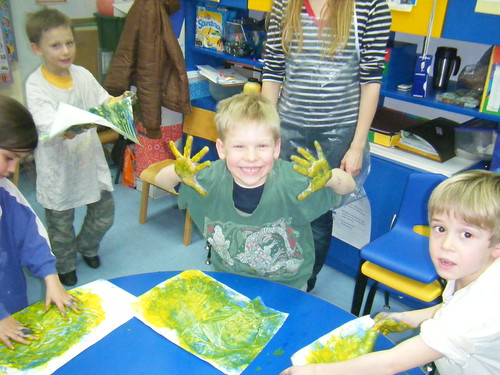
Owen is pictured above in his kinder classroom. I stopped by after my administration meeting to take a peak on the boys and how they were doing. Ollie was still sleeping from his nap time. Owen was in the midst of an art class. He was enjoying himself.

It was another busy week. I have a bit of a cold and earlier in the week, Ocean kept getting up many times during the night. She mercifully slept most of the night both last night and Thursday evening. She kept getting up screaming and the only thing that would get her back to sleep was more milk. Who knows what it was. We tried feeding her more before bedtime, but that really didn’t help.

The temperature got into the mid 50’s this week and all of the snow melted. The melting snow and light rain, combined to make things quite muddy. The forecast looks like it will stay warm until the middle of next week, when temps will finally go down close to the freezing mark.

I also sent this photo to Nadia yesterday. We visited the Ethnographic Museum last weekend and I spotted this photo. The museum in downtown Belgrade has some wonderful displays of costumes and artifacts of life in Serbia in the 1600’s to the early 1900’s. I teased Nadia with the photo below. The woman has collected is carrying back a load of firewood, has a pot of water on her head, knitting clothing, AND watching the child all at the same time. I wonder who took the photo and if it was staged? Anyway, we have come a long way since then with modern conveniences and technology that does away with three of the activities that she is doing. Where is her husband? Sitting on a bench in the village with his buddies? Hunting? Behind a plow? I think that spirit of the woman handling everything in the home and the man just worrying about his work is now gone. 


Photo of Serbian Peasant Woman

Visit to the Bajrakli Mosque


The minaret of the Bajrakli Mosque


Tuesday I tagged along with the grade 8 humanities class as they took a tour of the Bajrakli Mosque in downtown Belgrade. It was my first time to a mosque and I felt like the Ottomans were speaking to me. The name Bajrakli means banner or flagship. The name originates from when the Ottomans left Belgrade in the early 1800’s, this was their lasting monument of their presence.

The mosque was built in 1690 by Sultan Suleiman during the heydey of the Ottomans in Serbia. At the time, there were 22 mosques in the city, and this is the last one remaining today, although the iman told us several newer mosques are being built. The Austrians converted it to a Jesuit church for a short time, and then when they left, it was reopened as a mosque. The iman showed us the window that was walled up on one side of the mosque by the Austrians.

As you can see, the minaret is the classical Turkish style -thin, with a pointed cone peak. The mosque featured a huge dome, typical of the Ottomans and strongly influenced by the Byzantines. I also noted that St. Sava’s Cathedral has a large central dome. 


Ottoman Stonework
Ottoman Stonework

The authorities of the mosque were very kind to allow us access to the mosque. I understand in countries with a more strict interpretation of Islam, non-muslims may not be allowed as much access as we did. The iman explained the prayer service, and answered all of our questions regarding the building and the faith of Islam. I guess the Balkan form of Islam is more like the Turkish form than in Saudi Arabia. From his talk I learned the following:

  • Allah has 99 names which are related to His virtues. In a mosque, pictures of humans are not allowed and so the 99 names were written on plaques in Arabic script. 
  • Islam has prayer beads similar to a Catholic rosary. There are beads of 33 prayers or 99 prayers. 
  • The congregation worships in straight lines to emphasize their equality before god. 
  • They always face towards Mecca. 


The students align as worshippers would as the Iman explains the prayer service.

I would like to thank Mr. Vrbaski for allowing me to attend the trip with his class. I would also like to thank the mosque authorities for giving us the opportunity to experience a mosque. The students unit on Islam was really enhanced with this trip. It was also nice to see the students translating for us, the iman’s Serbian speech to English. 

The mosque trip also continued to perk my interest in learning more about the Ottoman empire. 


The girls wore headscarves upon entering the mosque.

Basketball Season Underway at ISB


It is basketball season here at ISB! Four teams (MS and HS Boys and Girls) are preparing for the upcoming games. ISB competes in the Central and Eastern European Athletic Association, which is composed of other international schools. We belong to the small school “blue” division. Each grade category has their own championships and they will be held throughout the month of March. Above are the high school boys in practice last Friday in our bubble gymnasium. They will compete in Helsinki, Finland on March 26-28. They are practicing 3 times a week and we are working on arranging games for the team with local schools in preparation for the championships.

24 Hour Theater at ISB

Laryanus, Zoran, Randa, Hannah, & Pan


This process–24-hour theater–condenses creativity to its essentials and boils the collaborative process down in a manner unlike any other in the realm of theater-making. Participants have only one full day to write and stage a play. It puts ‘experts’ and ‘newbies’ on the same playing field, providing nearly instant gratification for all. The anticipatory audience, drawn by curiosity, wonders–will these crazy kids be able to pull it together and keep it rolling? The result: energized (rather than exhausted!) students for the beginning of a new semester of theater. (U of Minnesota) 
The above is a description of the process of 24 Theater. The International School of Belgrade’s Thespian Society and the Grade 11 Theater Arts class put on a 24 hour theater this past weekend. The students arrived on Friday afternoon at 5:00 PM, and overnight, created plays which they performed on Saturday evening. With over 40 people in attendance in our black box performing arts theater, the student groups performed their plays. The photo above was taken from the question and answer period at the end of the evening. The students described their inspiration and the process behind the performance. The plays were excellent and most importantly, it was a great learning experience for the students. They went through the entire process of theater. Congratulations to all of the students and especially our performing arts teacher, Mrs. Patricia Sands! 
Vilmoš, Maša, Flavy, William


Family Journal: Saturday January 17, 2009

Friday evening after basketball practice I rushed home to get ready for an evening out. We hired a baby sitter for the night, and went out on a double date with the Moynihans. We had a nice dinner at Iguana (they recently changed the name to Na Costra or something similar). It is a small restaurant located downtown on Božidara Adžije Street. The owner lived many years in Melbourne and the food was excellent. Nadia had her favorite, sticky date pudding, an Aussie delicacy. We sat in a cozy table in the window and it was great. I chose a Serbian wine, a grape variety call Vranac, which was perfect. The restaurant is near the big Kalenić market so we did some shopping after wards. The absolutely best place to buy fruits and vegetables in the city, especially in the winter is the Tomato Company. It is located a block away from the Kalenic market, near a Hleb i Kifle bakery. They have rugula, lettuce, plums, etc. They also take care to present the produce well. Nadia and Janna are shown above in produce heaven.

Saturday we awoke to no electricity in the house and we had flashbacks to our time in Anaco, Venezuela. Goran from the school was all over the problem we got power back in the afternoon. Electrical crews were working on one of the poles near our house and last night we had no street lights near our house. In the afternoon we went grocery shopping for the week. We also watched a movie, “Bed Time Stories” with Adam Sandler. In the evening I was the administrator in charge of the 24 Hour Theater production by our school’s Thespian Society. I really enjoyed the show.

Below we took the wood that my future brother-in-law used with the boys. Owen woke up and wanted to hammer nails, so that is what we did. We built a stand for the shovel, rakes, etc. that I have in the yard. I also shoveled off all of the ice and snow from the side walk. My Dad would have been mortified to see a Kralovec family sidewalk in a slippery condition.

Ollie and Owen help me Build a Garden Tool Holder

The Bridge On The Drina – Ivo Andrić


 I just finished reading “The Bridge on the Drina” by Bosnian writer, and former long-time Belgrade resident, Ivo Andrić. He won the 1961 Nobel Prize for Literature.
UPDATE: I visited the bridge on October 17, 2009. My blog post on the experience is here

Andrić lived a full life and he is a great example of the idea of Yugoslavia. His parents were Croats from Sarajevo, Bosnia. He spent his childhood in Višegrad, a small town on the border of Serbia and Bosnia. He studied in Sarajevo and Zagreb, Croatia. He was imprisoned during WWI by the Austro-Hungarians as a revolutionary. After the Kingdom of Serbs, Croats, and Slovenes gained independence Andrić began a career as a diplomat for the new government. He held posts in Hungary, Austria, Italy, France, Belgium, Switzerland, and finally, in his peak position on the eve of WW II, to Berlin, Germany. All during this time, Andrić was writing and publishing poems, essays, and short stories. When Hitler occupied Poland, he tried to resign, but the Yugoslav government rejected it. When Germany bombed Belgrade in 1941, he retired from the foreign service and lived the rest of his life in Belgrade. During the war, he wrote three novels that would earn him the Nobel Prize. He donated the prize money to build libraries in Bosnia. You can read more about him at Ivo Andric Foundation web site.

I highly recommend the book, “The Bridge on the Drina.” The Drina is a river that separates Bosnia and Serbia. The bridge he refers to in located in the town of Višegrad, Bosnia. The novel is an epic historical fiction beginning in the 1500’s with the construction of the bridge by the Ottoman Turks and ending with its destruction during World War I. I love history and as all good historical fiction does, it brings alive the facts of history. It got me to think more about the legacy of the Ottomans. They had a large empire for many years, but are not that well known or studied in the US. Andrić tells of the Ottoman’s blood sacrifice, in which the Turks would raid Serbian villages and kidnap young Serbian boys to raise them as Turks in Istanbul. He also describes the public “staking” of a man caught vandalizing the bridge during its construction. The Turks were here in Serbia for a long time. As the novel progresses through time, it is good to have a bit of background of Balkan history. Besides the historical stuff, he tells good stories of people and families. My only criticism is he slides into a bit too much of “magic realism” and I got burned out on that by reading Garcia Marquez and other Latino writers.

The picture above is of the Hotel Moscow which I took in August of last year. Ollie is pictured in front of the fountain. A friend tells me it was one of Andric’s favorite hangouts here in Belgrade. I will go visit his museum soon. The apartment where he lived is now a museum and it will give me a better idea of the man and his works, and I will do another post on the visit. I will also most likely read some more by him. I am especially interested in reading his essay on Simon Bolivar. If any of my blog readers have a copy of that, preferably in English (I am now at the stage in my Serbian language development which I call “early caveman” – for example, Danas lepo toplo i kizovo (today very cold and slippery).

Ice Covers Belgrade: January 14, 2009

Icy Morning, originally uploaded by bill kralovec.

Nadia struggles to stay on her feet this morning with the boys. We awoke this morning to a layer ice on everything outside. The temperature was hovering around 0C, and it was a mix of rain and ice. We decided to walk to school this morning because of going down the hill to the school. Oliver getting out the door, fell on his butt. We heard many people with slips and falls, and there were many late arrivals to school this morning. Owen loved the slippery streets and skated to school.

I learned a new Serbian word: KLIZAV which means slippery. I’ll be using the word again in conversation tomorrow as the forecast is for the same. Today we discussed procedures for checking the conditions of the roads and contacting our school community. We’ll be testing these tomorrow.

We made it to school albeit a bit late. We held classes as normal. Tonight I am watching the Partizan vs. CSK Moscow EuroLeague basketball game. With a win, Partizan will qualify into the round of 16.

Update: Partizan Wins!!!