Not much time to write as teacher orientation has begun! School starts next Monday and it is full on work all week to get everything ready.
Sunday morning I took time out to run with Ocean and Owen on his bike. We rode down to the river and then took the bike elevator up on the bridge and crossed the Sava River. The kids are shown above with Old Belgrade shore in the background.
Saturday we hosted our first BBQ in our back yard. It was a success and everyone had a good time.
Tim and Owen Survive!
Sunday afternoon was spent at school fixing up my office. We moved in on Friday evening to the new school. Nadia is working in her classroom and I have to work on the schedule.
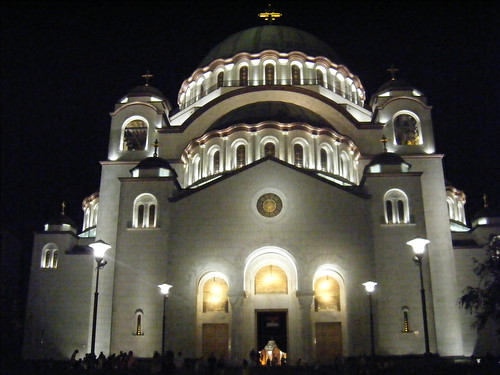
I took a photo Friday evening inside the giant St. Sava’s Church here in Belgrade. The church’s massive dome is 70 meters high and 10,000 people can attend mass. It can be seen from all over city. It is the third largest Orthodox church in the world and the largest neo-Byzantine building constructed in the 20th century. The Byzantine architecture style features a large, central, dome and thin windows to let in light. The inside is truly awe inspiring!
We walked down to the church from the main shopping area. I was surprised to see so many children and families near the church. It sits on a small hill surrounded by a park. There were roller bladers, kids playing tennis on the outside walls of the church, and teenagers riding mopeds up and down the side walks. No holy reverence here which is refreshing to experience. The church was open and a few people were taking photographs and looking around. Oliver and I went inside and were blown away.
As you can see in the photo, work is still being done on the church. Construction did not begin until 1935 and has been interrupted by the numerous wars Serbia has experienced. This is the first Orthodox Church I have been in and I was impressed by the mosaics on the walls, which are another feature of the Byzantine style. The Orthodox Church in Serbia is not under the direction of Greece and is independent and has its own pope (Patriarch) and hence the Serbian flag prominently displayed on the front entrance.
St. Sava's Church At Night
The grave of Serbian Saint Lazar is in the basement of the church. He is the Serbian Jesus. He was a Serbian noble who died at the famous Battle of Kosovo in 1389. According to legend, he was visited the night before the battle by the Prophet Elijah in the form of a gray falcon. Elijah offered Lazar an Earthly Kingdom or a Heavenly Kingdom. Lazar takes the Heavenly Kingdom, but to earn it, he has to die on the battlefield. He was canonized by the Serbian Orthodox Church and his feast day is the most holiest of all days in the Serbian calendar, June 28.
The church is named after the son of the founder of the Serbian medieval empire. Sava was originally Prince Rastko Nemanjić and he lived in the late 1100’s – early 1200’s. He was the founder of the Serbian Church. The location of the church was put here because Sava’s remains were believed to be burned here in the 1500’s by the Ottoman Turk leader Sinan Pasha.
I really felt I was at the heart of Serbdom! With the church being in the center of Belgrade, the capital of Serbia and with the remains of two of the founders of the Serbian nation and church here, you can’t get more Serbian than this. With the breakup of Yugoslavia over and a new era for Serbia, hopefully they can complete the church. The church represents the long history of the Serbs and the bright future ahead for the country.
Temperatures have been in the 90’s all week. We bought a small pool for the kids to play with and it is a big hit. Shown above is Ocean in her Dora The Explorer bathing suit. She loves the water.
At work the construction company moved out on Wednesday and late Friday I finally got into my office. The AC was not working so the days have been quite stifling. We completed the orientation packets for the new teachers. There is still much to do with the schedule, lockers, etc. still needing some attention. I received my school cell phone which will help greatly.
Vera our nanny is going to work out great! She is hard-working and wonderful with the kids. Ollie and Ocean particularly like her! She went with Nadia and the kids to the beach on Friday. Friday evening we went walking down town and ate at the nicest McDonald’s I have ever seen. We then walked down to the big cathedral in the city which I’ll do a blog post later.
Oliver On the Kneza Mihaila
On Saturday I ran with Ocean to the post office to pick up Nadia’s back pack that my parents sent and some lollies from Australia that Alejandra sent. We then had my colleague, Tim and his family over for a BBQ. He is the elementary principal and has two daughters that played and looked after the kids. Nadia and I actually had a chance to talk and enjoy ourselves. Tim’s wife Janna will be working with Nadia this year and he also had two friends from Montana/Seattle visiting. It was a nice afternoon.
We are still watching the Olympics and I discuss that more a bit later.
Today I will be going into school for a awhile to do some work and then the rest of the day will be spent with the family.
Nadia is working with Vera this week to see how she might be as our nanny for this year. Vera is from Belgrade and lives close to our house. She is 51 years old and so far is quite nice, hard-working, and most importantly, the kids like her. She is shown above serving breakfast to our charges. This is very important as Nadia begins work next Monday and we need someone we can trust to be at home with Ocean. We are using Skype to communicate with us at school and we’ll have a computer at home and both Nadia and I have lap tops at school so we will be in contact frequently.
I had a busy day at work yesterday as I am preparing for teacher and student orientation and working through the schedule. Nadia has been a champion being home with the kids all day. Owen loves his new spy watch, it has a special spy night light, message decoder, secret message capsule and shows the time around the world. Oliver got a new spiderman and he carries it around with him everywhere. Ocean is an eating machine and the best out of the three.
We are crazy for the Olympics here in the Kralovec family. Yesterday’s 4 x 100m relay swimming race had us on the edge of our seats. We hope Phelps reaches his quest for 8 golds. We also enjoyed the dunkfest of the USA Redeem Team against China in basketball. They will have tougher competition upcoming.
Serbia’s quest for their first medal as an independent nation has had it’s ups and downs. Their best hope is in tennis, but it suffered a set back yesterday when nagging injuries kept Ana Ivanovic out of the draw. The three other Serbs, Novak Djokovic, Janko Tipsarevic, and Jelena Jankovic all won their first round matches and now are into the round of 32. Janko upset seeded David Ferrer of Spain. Novak has Raphael Nadal on his half of the draw, while Janko has Roger Federer on his side. Both should move on to the round of 16. Jelena is the number two seed, but has Venus Williams and Marat Safin’s sister on her half of the draw.
Ana drops out of the women's singles tennis draw.
In water polo, the Serbian men defeated Germany in the first round and are scheduled to face arch rival Croatia today. The Serbian men’s soccer team looked outclassed against the Ivory Coast on Sunday in a 1-3 defeat. Their final group match against Argentina is a must win situation. Argentina has already qualified to the quarterfinals and might play with substitutes. The Serb men have one point from a first round draw with Australia. They need a decisive win against Argentina tomorrow and an Ivory Coast close loss.
The Serbian Women’s Volleyball team has two wins against two lesser opponents and plays powerhouse Brazil tomorrow which will be a good test. The men’s volleyball team is trying to bounce back against Brazil today after a narrow defeat to Russia in round one.
I have been pleasantly surprised with the great amount of bicycling paths and running routes one can have here in southern part of Belgrade. There are miles of bike paths along the Sava River and acres of parks near our home. It must be watching the Olympics and seeing all those great athletes competing that inspired me yesterday. In the morning I went with Ocean for a long run through the Košutnjak Hill (Doe Hill) park. This is a huge area of forest and open areas just south of our suburb of Senjak. It gets its name to the deer that once roamed there, as it was the Royal Hunting Grounds reserve until 1903. It is very nice except for the “hill” part. Our area of Senjak is all hills and they do take it out of you.
In the afternoon I went with Ollie and Ocean over to the school’s park. Owen and I then rode our bicycles once again to Ada Ciganlija island. It should be called “sport” island as it has facilities for almost every sport imaginable. There were lots of people biking and roller blading, as well as soccer, tennis, etc. There is even a baseball field.
We spent the evening in our backyard. We have a perfect little place for the kids to run around and it was great the Calzini’s (previous occupants) left a swing set for us!
I have a week of work ahead of me, as we are gearing up for the arrival of the new teachers and the orientation program which begins next Monday.
Yesterday morning Ollie, Owen, and I took our first trip downtown in public transport. We walked down the hill and first took a bus in to the main train and bus station in Belgrade (picture above). From there we took an electric trolley (tram) to Kalmegdan Park and the zoo. It was raining off and on quite hard so we had to wait out the rain several times. It costs 60 cents and about 20 minutes. The boys were thrilled with public transport and the zoo.
The zoo is big and has a varied selection of animals. I have mixed emotions about zoos. I think they are good in that people learn about and see the animals and perhaps this will lead to better protection of their habitat and population numbers. But on the other hand, it is still an “animal prison” and the amount of living space is limited. It was especially sad to see the chimpanzees in their cages.
Boys Play At Kalmegdan Park near the Belgrade Zoo
In the afternoon, the rains let up and the sun was shining. Owen and I were inspired after watching the Olympic Road Race, so we went for a long bike ride. Our neighbor, Radtko, brought a bike over for me to use. We went down to the Sava River bike trail and west to the Ada Ciganlija island. We rode on the river side of the island where Belgraders have small floating houses on the banks. It reminded me of the cottages on the lakes in my native Upper Peninsula. It was peaceful on that side of the island and many Belgraders potter about on weekends in their river shacks. We stopped for a Coke on the way home at Costa Coffee, the Starbucks of Serbia.
Saturday evening Nadia prepared a wonderful dinner of roast pork and vegetables. We watched an episode of the Spiderman cartoon, read a book, and went to bed. Ocean slept most of the night! We have been letting her cry it out the past couple of evenings. She was getting up 5-10 times a night, and now it is down to 2-3 and we don’t have to walk her until she falls back to sleep.
Ana Ivanovic is shown above during last night’s Opening Ceremony of the 2008 Olympic Games. I love the Olympics and the whole family is following it, especially the teams of our countries. We are especially focusing on Serbia this year, and Ana, Jelena, and Novak are some of the favorites to win medals for Serbia this year.
It is a historic year for Serbia in the Olympics. It is the first time since 1912 that they have competed as Serbia. Since that time, they have either been a part of Yugoslavia or with Montenegro. They have 92 athletes participating in 11 sports. They did not win any medals in those Stockholm games of 1912, so this could be the first medal for Serbia in history!
Other medal hopes for Serbia are in the team sports. The water polo team recently won the World League championship in Germany. The men’s volleyball team placed second in the World League warm up tourney in Brazil last month. Serbia also has men’s soccer and handball teams.
I’ll hopefully have time to post a follow up during the games on Serbia’s medal tally.
Earlier this week I attended the ISB Administrative Retreat. The admin team of the school is pictured above. From left to right are Bane (IT Coordinator), myself, Eric (Director), Tim (Elementary Principal) and Zhana (Business Manager). The goals of the retreat were to get to know one another and develop trust, give Tim and I information necessary to begin contributing to the school, and to decide what we were going to do in the 2008-2009 school year regarding the school’s strategic plan.
It was a good idea to get away from the distractions of school and home. We were able to focus our time on working and getting to know each other. ISB is a world-class international school and to manage the daily operations of a demanding community, the admin team needs to work closely together.
One of the things that I will take away from my time at ISB, is the idea of setting essential agreements of the group before we begin working together. For example, the first agreement that we made is the needs of students come first in our decision making. Others include treating each other with respect, being honest, etc.
The informational items that we went through were forms of communication at the school, the budget, the crisis response manual, calendar, etc. There is so much for me to absorb coming to a new school. I am feeling a bit overwhelmed, but every day I am a bit more comfortable in getting a grasp of the scope of my responsibilities.
The heart of our work was going through the strategic plan. This was an initiative completed during last school year. The school and Serbia are going through incredible growth and change! In response to these changes, the school set out a clear, long range (5 year) plan on the direction it wants to head. All stakeholders were heard and the Board pulled it all together and defined the school’s goals for the next five years. It is a comprehensive plan and is available for everyone to see on the school web site. It was our job to begin defining how we were going to implement some of the plan during this upcoming school year.
The venue for the retreat was the BG Sports Center located about 30 minutes outside of Belgrade in the area of Kovilova. It was a hotel with sports theme. There is a huge basketball/handball/volleyball arena on the grounds. They also hosted this past June, the world championships in the Shotgun Events of skeet, trap, and double trap, so we did hear the occasional gunshots during our work time. The Serbian under 21 national basketball team was also training there and we got to see the Serbian national coach. The hotel and grounds were very nice.
View of the grounds of the hotel and the view towards Belgrade.
I want to give a special thanks to my wife Nadia for watching our children during our two day retreat. She put in a couple of tough days and a night with three little ones.
I look forward to a great year of working with my colleagues and the school community!
We had a nice weekend, our first in Belgrade without jet lag. On Saturday we went to Ada Ciganlija which is a long, flat island in the middle of the Sava River. It is a few kilometers from our house and has an artificial 4 kilometer lake in the middle. As you can see, on a hot Saturday in August, it is quite popular with Belgraders! The island is great, with bike trails going for miles all around.
Despite the hordes of people, we had a really good time. The boys enjoyed all of ice cream vendors and swimming. Ocean loves the water and she was laughing and playing and would have stayed in there as long as I did. Nadia and I enjoyed the people watching. Old folks doing the European sleeping under a tree in the shade and women in bikinis sauntering down the path with purses and high heels.
We then went to the Delta City mall and Nadia and the boys watched a movie. I strolled around with Ocean and she fell asleep.
On Sunday we relaxed around the house. I did some yard work, took the kids to the park and went for a long walk with Ocean. We had a big lunch outside and ordered pizza for dinner. I will be back at work all day today.


 Bill's Blog