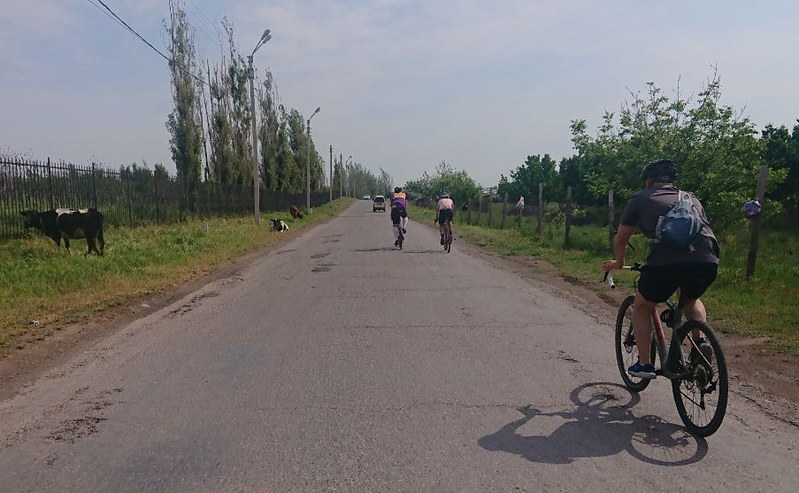
Matt, Jimmy, Simon and I yesterday went on a 60 kilometer bike ride north of Tashkent. We headed out from the Hotel Uzbekistan towards the Kazakhstan border. We then did a loop through agricultural areas and villages. Going with a group is much better for me than by myself. I had to push myself to keep up with them. We ended the ride with coffee and breakfast at a Turkish Cafe. My perfect Saturday morning!
Ramadan is coming to an end next Thursday with the breaking of the fast celebration called Eid al Fitr The weekend prior to this, the mosques at night are quite busy. People pray in the evenings at mosques throughout the city during Ramadan after the first evening meal. Last night Ocean and I were driving around to see how many people were coming out. She just took video from the car because it was hard to find parking and there were so many people. I am glad they were outside, but I wonder with what the impact will be on COVID numbers in a couple weeks’ time.
Ocean with Mom’s flowers
We also went shopping for Mother’s Day which takes place tomorrow, May 9 in the USA. Here in Uzbekistan May 9 is commemorated to honor the soldiers of World War II.
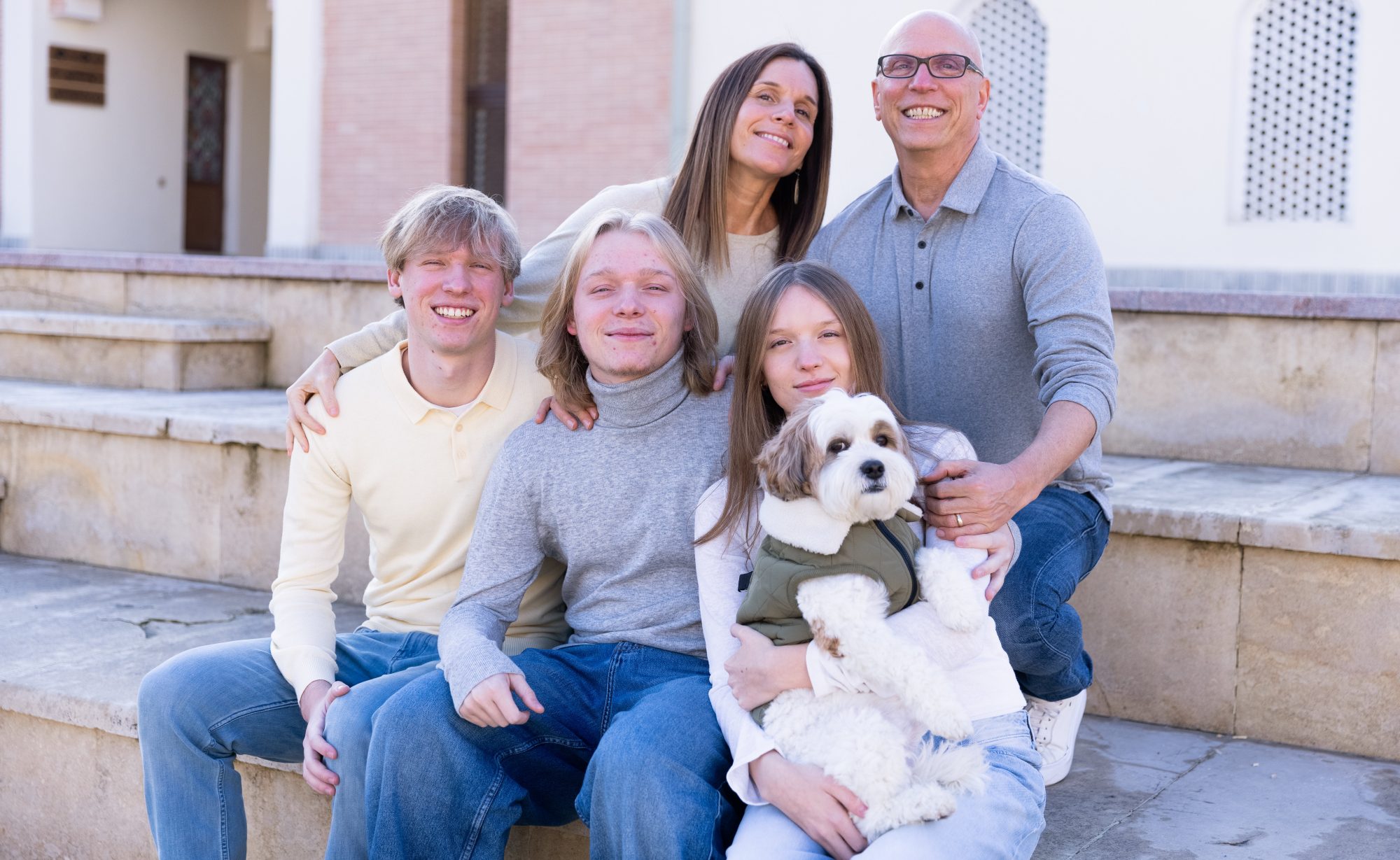
We celebrated my son Oliver’s 15th birthday Friday at his favorite restaurant, City 21 at the Hilton. It is on the 21st floor and overlooks the Tashkent City development. His girlfriend came with and we all enjoyed a delicious meal style. Afterward we came home and went for a swim. We ate so well that no one had an appetite for cake.
Oliver is completing grade 9 and passed me this year in height. He loves socializing with friends, Japanese anime/manga, gaming and playing volleyball. Happy birthday Oliver, we love you!
Vaccinated and happy at the Tashkent International Clinic – April 21, 2021
Nadia, Owen and I received our first dose of the vaccine against COVID. The World Health Organization helped Uzbekistan purchase 600,000 doses of the Oxford-Astra Zeneca vaccine last month. The COVAX program’s goal is to deliver vaccines to low income countries. The idea is that no one is safe unless all countries are vaccinated. Having the virus continue to thrive in large populations risks the rise of new mutations that may not be deterred by our current range of vaccines. Especially for our foreign faculty who are caught between being an expatriate here in Uzbekistan and not being a resident of their home countries, I was concerned we would not be able to access the vaccine. But thanks to the help of the World Health Organization Uzbekistan office and our clinic, we were able to secure enough doses for everyone. The Uzbek government is prioritizing the elderly, health care workers and now teachers. Our school was able to offer the vaccine to all employees and dependents this week, thanks to help from our sister organization, the Tashkent International Clinic. Authorities from the Sanitary Epidemiological Station (SSES), the Health Department of the former Soviet Republic world came to the clinic to deliver the first doses.
The SSES personnel felt great satisfaction to get such an ecstatic response from our foreign employees, including the Kralovec family. The vast majority of Uzbeks I know are skeptical of the AstraZeneca vaccine. They cite the very rare instances of blood clots and the pauses governments around the world have taken. There is also skepticism of government programs in general which is part of the Soviet legacy and autocratic government here. I fear that vaccine uptake will be slowed by this attitude. Hopefully, Uzbeks will be more accepting of other vaccines like Sputnik V or the Chinese vaccines.
I did not feel much fear or anxiety about getting COVID. I am in pretty good health and not over 65. However, after getting the first dose of the vaccine, I felt elated and relieved, more so than I thought I would. We will now get our second dose before we leave for summer vacation in June. We received the Oxford AstraZeneca manufactured in India and is called “Covishield”. We’ll be some of the few Americans with the AstraZeneca vaccine. Because of the upheaval the coronavirus has caused us, we were happy to start to see the end of this pandemic. However, it is going to probably be much like the flu vaccine, with us having to get a yearly booster against the different mutations from that particular year.
This rapid development of the vaccine also highlighted to me the progress of science. DNA technology has really changed the vaccine landscape, making it much easier for companies to design specific vaccines to counter a multitude of viruses. I can see this area of science only getting better which bodes well for a planet with an ever increasing population and the potential for new viruses to infect humans.
About 1/3 of people who took the vaccine, felt side effects bad enough to keep them at home from school. I didn’t really feel much which worries me a bit about my immune system. Why no strong reaction? 🙂 Nadia had fever and headache and Owen had a headache. Both are feeling better as I write this post in the evening of the day after the vaccines. I came home from school and took a nap and went for a bike ride along the Ankhor Canal. It was a beautiful Tashkent spring evening and the Minor Mosque and water reinvigorated me to finish the week at school on a positive note.
Ramadan started this week in the Islamic world and it is celebrated here in Tashkent.
Ramadan is the ninth month of the lunar-based Muslim calendar. This year it is from April 12 to May 11 and moves 10-12 days earlier every year because the Muslim calendar is shorter than the Gregorian calendar year. In Islamic tradition, this is the month Allah revealed the Qur’an to the Prophet Muhammad. The faithful followers of Islam use the month to fast (no food, drink, sex, etc.) in daylight hours and to reflect on the wisdom of the Qur’an and lots of prayer.
We received a Ramadan starter kit from our mahalla officials. Every house received a bottle of water, a guide to sunrise and sunset times and some dates. Traditionally, the evening meal iftar begins with dates, as Muhammad did 1400 years ago. It is challenging this year as Ramadan runs to mid-May, which is pretty close to the summer solstice.
Ramadan Starter Kit
I am not sure what the percentage of Tashkenters are observing the fasting rules. Outward signs of Islam are growing here since the government loosened restrictions. This seems to be a trend which over the years will continue. I don’t think it will be as popular as it is in the heartland of the Islamic world, the Gulf region because of the secular influences in Central Asia. I did notice less traffic and people in the supermarket the other evening, right before sunset. I took Obi for a walk over to the Teleshayakh Mosque or Zangi-Ota Mosque and (zangi-ota means black)Museum Complex. The large property has a beautiful mosque, madrassa, museum and shops/apartments. The museum displays some very old copies of the Qur’an. One copy uses the Kufic script, an ancient “font” from the city of Kufa in Iraq that feature in many early Qur’ans. I didn’t go into the mosque because I had Obi, but thought it would be appropriate during Ramadan to visit some of the mosques here in Tashkent on my nightly walks with my dog.
Obi is checking out the courtyard of the Zangi-Ota Mosque Complex
It was a big day for Nadia and I yesterday as our son Owen had his last day of classes. He is a senior this year and will be graduating next month. The day was marked with an assembly for the Class of 2021, a “clap-out” and a nice lunch at Loza Restaurant. Of course, Nadia was crying, “our baby is leaving us.” I am devastated as well! Next week they will be undergoing a whole-class quarantine in anticipation of the first IB exam on April 29. International Baccalaureate (IB) exams are conducted during the month of May. With the number of COVID cases rising in the city, we are being cautious to make sure everyone is healthy and ready for the in-person exam session. Many schools around the world are either on lockdown and not able to come together for exams or have had too much Virtual Learning over the two-year IB Diploma Progamme to make the exams valid. Our school is fortunate to be able to administer exams and the Owen’s class only had around 100 days of VL over the course of an approximately 320-year Diploma Programme.
I love traveling and seeing new places and after over 25 years of living abroad, it is rare that I go to a place I’ve never heard of. Over our Spring Break last week, we traveled to the far western part of Uzbekistan, to an autonomous region called the Republic of Karakalpakstan. It took our traveling party a couple of days to learn to say it. Kara-kalpak – stan means “black” “hats” “people” “land of”. The name derives from the Central Asian hat made of the Qaraqul breed of sheep. An “autonomous region” is analogous to a state or province so it is not a separate country. However, the Karakalpaks have their own flag, their own language and they do have the right to vote for secession. The Karakalpaks are a traditional Turkic nomadic ethnic group of fishermen, herders and farmers. The language is more similar to Kazakh and Uzbek and they look more Mongol/Kazakh than the Uzbeks. In the few words I learned, Karakalpak differs from Uzbek/Kazakh like Catalan is to Spanish, slight differences of spelling and pronunciation and spelling, but similar structure. Karakalpakstan was part of the Khanate of Khiva and became an autonomous republic under the Russians and Soviets. It is historically known as Khwarezm and was controlled by the Persians before Alexander the Great conquered it. For milennia, the Karakalpaks survived off irrigation and fishing from the Amu Dayra.
Stirring Sumalak, the Navruz Holiday Dish
The capital of Karakalpakstan is the city of Nukus. It felt rough-edged in the middle of a vast desert. The Uzbek government has put money into the infrastructure and in the city center, there are new apartment buildings with retail shops on the ground floor, new roads, a big mosque and nice promenade along one of the many canals leading off the Oxus River (Amu Dayra).
Fresh Bread
Our tour guide, Aydos, took us to the village of Shimbay for a day of experiencing Karakalpak culture. The tour company as with many businesses in Uzbekistan is new and is developing tourism in the region. The Shimbay villagers were excited for the novelty of foreigners and provided us a fascinating day. They were as curious about us as we were of them. No jaded locals, tired of the throngs of tourists in Karakalpakstan! I put together a video of our experiences. It really hit home for me the socio-economic levels in the region. All of the homes were clean and well-maintained, but every house had an outhouse (long-drop) and there were lots of livestock in the back yards of the homes. It reminded me of the stories my mother told me of her childhood in Michigan. Her grandparents came to America from Finland at the turn of the century and when she was born in 1940, the family still had a cow and outhouse.
Yurt Workshop
The highlights included listening to Karakalpak folksongs played on a traditional, two-stringed guitar, the colorful women’s dresses and building a yurt. We got to see how yurts are assembled from Black Poplar branches, one of the few trees that grows in this dry region in riverine habitats. I also loved the bread ovens and like many Central Asia peoples, they’ve had a long time cooking with wheat and know bread! The menu included a hearty turkey stew, hot bread, fresh off the sides of the adobe oven and mixed salads.
Rolling Dumplings
The people of Shimbay were obviously proud of their Karakalpak heritage and we were honored to spend the day with them. The village had a real community feel, something that is lost in more affluent, modern societies. Humans yearn for connection and that is something we can learn from.
I loved the past couple of days helping the boys learn how to tie their ties and dress in business attire. They participated in the Tashkent International School Model United Nations. The school usually travels to The Hague or other destination or hosts other schools, however, due to the pandemic, it was only our high school that participated. Oliver represented Argentina and Owen represented the former USSR in the historical UN sessions. It is a mock UN with delegates making proposals and working in committees.
The event is 100% student-led with experienced students acting as chairs. There is usually a global emergency on day two. Besides the general assembly, there are sessions on different areas like the environment, human rights, etc.
The students learn diplomacy and how the United Nations functions. They also hone their presentation skills through debate, persuasion, compromise, dialogue, etc. Basically, they are learning diplomacy and politics. It is such a valuable experience. Owen and Oliver are really enthusiastic about it!
I took my first flight in over one year! The last time I was in an airplane was early February 2020. Today, March 20, 2021 my family flew domestically from Tashkent to Nukus. We were so excited to go to the airport, go through security, board the plane, etc. I usually fly 5-8 times per year and the pandemic put a stop to that. It was strange to be on a plane again after so long. The flight was full with over 300 passengers so people are not afraid to fly in Uzbekistan. We are on our Spring Break and I really felt the need to get away from the city and school. It is a much needed respite.
It was a warm, rare rainy day in Tashkent Saturday. Spring is when we receive the most rain and as we start spring tomorrow, it is appropriate that it rained most of the day. In the morning I answered emails and completed a few items for school. I went for a short bike ride around the neighborhood and then packed and cleaned the house. We prepped Owen for a week alone. Our driver Ahat, delivered us to the national airport and we enjoyed the 1 hour, 25 minute flight across the country.
Nadia is excited to board a plane – first time 18 months!
We landed in the Nukus, the capital of the autonomous Republic of Karakalpakstan. This economically poor region the size of Oklahoma is located in the far west deserts of Uzbekistan. The Karakalpaks are a mixed ethnic Turkic group formerly living a nomadic lifestyle in these harsh lands. “Kara” means black and “kalpak” hat in their language. My initial impression is they look more Mongol or Kazakh than Uzbeks.
We are staying at the Jipek Joli which means “Silk Road” in the Karakalpakstan language. The letter j is pronounced like the Russian ж. Nukus has a population of around 350,000 people and reminded me of the outskirts of Guangzhou, China. The Soviets made this town with wide streets. Near our hotel, there are many new apartment blocks with businesses on the ground floor. We walked to Korzinka, one of the big national Uzbek chain grocery stores and bought some snacks. We had a delicious dinner at the hotel and went to sleep early.
Family brunch at Arrows and Sparrows Cafe in Tashkent City. (friend of the family to my right)
Cold weather has returned to Tashkent after a couple weeks of spring, almost summer-like weather. It snowed a bit on Saturday night and it continues with below freezing temperatures and a bit of sleet today. We are looking forward to Spring Break, one more week of school to go. There are still a low number of cases in Uzbekistan and Tashkent. The government announced they are stopping administration of rapid antigen testing at airports. People arriving still need to have had a negative PCR test before boarding the flight.
I was taxi driver again this weekend, shuttling teenagers to various places. Oliver is spending a lot of time with his girlfriend. Owen plays tennis on Saturday with his friends and is always going out on the town with his friends. Ocean’s good friend Asla slept over on Saturday. Nadia had a great time with her friends Friday night at the City 21 Restaurant at the Hilton. I played 2 and 1/2 hours of tennis this morning with the regular crew and got a lot of work done in the afternoon. I took Obi out for a walk along Nukus street and enjoyed the cold, fresh air.
We had many laughs about our protective whistles. I took the girls to Щеф Бургер
Before the cold weather hit I went for a bike ride along the canal on Saturday morning. Below is another example of the glorious Soviet architecture one sees around Tashkent. The Palace of Arts Turkistan hosts concerts, festivals and events.
A really nice Sunday in Tashkent today. I started with an intense two sets of doubles tennis with friends at the Olympic Tennis Club. I was the chauffeur today for the family. Nadia got a serious haircut, which I love! We drove Owen and his friends to Paul for lunch and Nadia and I stayed and had a late lunch ourselves. We had lots of fun harassing Owen, but they were OK with us picking up their tab.
Chevrolet Sport over the curb
Not many people had cars in Uzbekistan for the first 20 or so years of their independence. With the opening of the economy, more people are able to afford cars. However, they have not learned to drive! The first car of choice for new drivers is either a Chevrolet Sport or Matiz. These are the craziest drivers, racing at all costs between stoplights. They switch lanes all the time without using their directional lights and you see a lot of accidents like the scene above. I was walking my dog Saturday night and came upon this three-car accident. I hope they will eventually learn that the roads are not a formula 1 racetrack and it is better to obey the traffic laws and get to their destination safely. My strategy to avoid accidents is staying in my lane, driving slowly and having a big car (Chevrolet Captiva). I wish I had a button on the dashboard with a laser that when aimed at a reckless driver, would stop the car, raise it in the air 20 feet and stay like that for two hours. It would teach these irresponsible drivers. Do I sound like an old man? 🙂
“Roma” cart on my street
I am noticing more what I thought were Roma people. There was a big population in Belgrade but I have not seen the large settlements like there. In doing a bit of research, I found they are Lyuli or Luli people. Today there was a family begging in front of the supermarket. They are an ethnic group distantly related to the Roma of Eastern Europe. They settled mainly in Tadjikistan, arriving in the 1200s from the area of Multan, in the Indus Valley. They call themselves the Mughat, meaning “fireworshippers” or Ghurbat “exiled”. They do not have any of the Romany tradition and the only reason they are known as gypsies or cigani (in Russian) is because of their nomadic lifestyle. There is an estimated 12,000 Lyuli in Uzbekistan. They practice a form of Islam, but face discrimination in Central Asia. I will definitely try to find out more about their population here and their culture. You can read more about the Lyuli people of Uzbekistan here.
I have not been posting much lately because of being busy at school. We start a three-day weekend because of Women’s Day holiday (March 8) on Monday. Last night Nadia and I took Obi for a walk downtown. She posed in front of the Hotel Uzbekistan. The hotel’s facade is an LED billboard and it reads “reklama” in Russian which means advertisement. Our dog Obi received a long overdue haircut and he looks so different with less fur and being able to see his eyes.
We hopefully had our last snowfall of the year on February 24-25. Overnight about 3-5 inches fell. I love taking Obi for walks in the quiet snow. Our neighborhood is gentrifying quickly, but most of it still looks like a Central Asian village. The photo above is typical of what it looks like on a winter evening close to my house.
Spring in Tashkent is often rainy which gives us very clear skies. Last Sunday driving to play tennis, the Tien Shan mountains were visible throughout the city. They are about a 60-minute drive away.
To finish this post, I always appreciate the beauty of mosques. Below is a closeup of one of the minarets from the Minor Mosque. The mosque was completed in 2014 by the city government and is next to the Ankhor Canal, one of my favorite running/biking/walking routes. Last Sunday I walked around the mosque while waiting for a shop to open.


 Bill's Blog