Finding a Work-Life Balance


A few days ago I watched a Ted.com talk by author Nigel Marsh. He wrote a couple of books about finding a balance in our lives between work and family – “Fat, Forty, and Fired” and “Overworked & Underlaid.

His ideas resonated with me and I feel that when I get busy at work with consecutive 10+ hour days, I am missing something. He didn’t come up with any formulas, but his main message was to make small choices. He described a call from his wife asking him to leave work early to pick up his son from school. She was busy with the other three children and needed some help with the kids. Marsh went picked up his son and they hung out in the park and went for a bite to eat. He finished the night by reading his son a story and putting him to bed. His son said this was the best day of his life.

I try to keep in mind that my children and wife for that matter, are so precious that if I can make any small choices to find a bit more time with them, the better. I am not a business or bank executive like Mr. Marsh was, and I am blessed that education is a profession that is more family-friendly than most professions, but there are times when I feel out of balance. Work demands overtake time spent with my children, time spent renewing the relationship with my wife, and time spent taking care of my personal health and fitness and well-being.

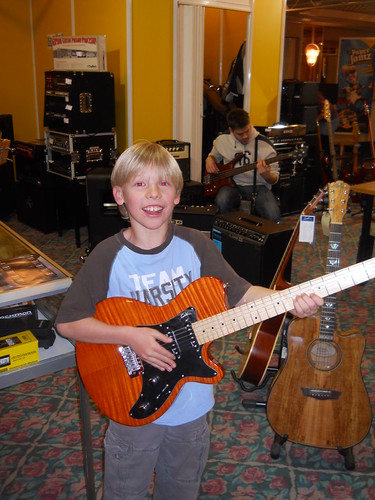
I spent an entire day yesterday with my three children. Nadia is out of city on a conference and I have all three. We survived day number 2 in fine style, although I did lose my patience a couple of times. Owen is shown above at the Guitar Art Festival Expo at the Continental Hotel. He plays the guitar and I wanted to encourage him and the other two to play music. Ollie loves the drums. Hopefully after the basketball season is over, I can learn the piano and my dream of a family band can be realized. I’m looking for stuff to do at home that doesn’t include a screen! Owen wants an electric guitar and Ollie wants a drum set, and I want a keyboard. We’ll see where this goes…

Ocean - Tata doesn't know how to brush girls' hair (sorry Nadia)

When I am in charge of the kids, I prefer doing stuff rather than just sitting at home. It makes it easier for me and the boys instead of me scrambling around trying to keep the house clean and nothing gets broken. In the morning we went to the school’s bubble and played tennis and basketball. In the late afternoon after a hike around our new neighborhood, we went and saw “Medved Yogi – Yogi Bear” and ate a pizza at Vapiano. The weather is cold and the melting snow makes everything wet and muddy, so the more we can do indoors, the better.

It was great to hang out with the kids all day and I have another one today. Our neighborhood, Dedinje, means “old man’s hill” and below is the view from top of the hill looking east into the suburbs of Belgrade.

Owen and Bill Go to the Belgrade Philharmonic

With Nadia at an Educational Conference in Dubai until Monday, I have a full weekend with the kids. We are starting the Ski Week Holiday also on Monday so I’ll have more time to blog.

We started the holiday last night by playing some pick up basketball at the school with the teachers. Owen and I then went to Kolorac Hall in downtown Belgrade to watch the Belgrade Philharmonic Orchestra. We have season tickets for the “New Years Cycle” which is a series of six concerts having the theme of New Year. Last night it was the theme was Chinese New Year, which the actual date happened earlier this month. It is the year of the Rabbit.

The concert last night featured a Chinese pianist named Haochen Zhang. The first piece was aptly a piano concerto and the big Steinway was in the center of the stage. Zhang came out and played Tchaikovsky’s Piano Concerto Number 1. Zhang made it look easy. The highlight for me was introducing Owen to the orchestra and the different instruments and Tchaikovsky. He did fall asleep in the second movement, but did get to get the feeling of it. The theater was warm (In Serbia in the winter, everyone cranks the heat because they are afraid of cold drafts causing sicknesses.) and cozy.

The video above is Zhang playing a Chinese folk song which I’ve heard before in some movie. I really like the song and if any reader of my blog knows the name of it, please send it my way.

Remembering the Holocaust in Belgrade


Last week we recognized Holocaust Memorial Day (January 27) at my school, the International School of Belgrade. The Israeli Ambassador to Serbia, Arthur Koll spoke to the student body about the Holocaust and mentioned the atrocities that occurred here in Belgrade. He refered to the first systematic use of a “gas van” to kill the Jews of Belgrade. I did a bit research and found a website put together by UK professor Jovan Byford and funded by the British Academy. Professor Byford, with the help of Serbian researchers, has put together an informative web site about the Nazi concentration camp in Belgrade.

The camp, called Semlin Judenlager (German for Zemun Camp for Jews), is located in New Belgrade, right on the banks of the Sava River. In the 1930’s, the Belgrade government drained a swampy area on the other side of the Sava, and established a fair and exhibition grounds. It was a popular place for theater, cinema, etc. and one of the first areas developed on the north side of the river. Today, much of New Belgrade, as the north side is referred to, is developed out to the airport, several kilometers away from the river.

The Nazis took over Yugoslavia in 1941 and occupied the city. Semlin was technically in the part of Yugoslavia administered by the fascist Croatian movement, the Ustase. Belgrade itself was officially in German-occupied Serbia. The fairgrounds were used to round-up all of the Jewish people of the city (around 15,000) as part of the genocide campaign of the Nazis. It was supposed to be a temporary camp, but when a permanent facility couldn’t be found, it became one. It differed from the more famous concentration camps like Auschwitz, in that it was very close to the city. A photo of the camp in 1941 is below. Yesterday, I stopped at the site and photographed the original tower as it looks today (above).  The camp is significant in that it marks an escalation of the systematic elimination of the Jewish people in Europe. Ustase officials were proud to report to Hitler that Serbia was the first area to be “Jewish-Free” in WW II. Today I am not aware of a Jewish community in Belgrade.

The Semlin Camp - Circa 1941

After the elimination of the Jews, the camp also processed Partisan and Chetnik prisoners, Communist sympathizers, political opponents, Romas, etc. Most were used as force labor and many died in the camp because of inhumane conditions and disease. The camp was kept open for several years, eventually being the target of Allied bombing in 1944 during the liberation of the city.

It is sad that it is not a protected landmark. Thousands of people perished at the site and the camp is a very important part of World War II history. I was surprised to see people living in the tower. It has been converted to apartments. The other former pavilions are also now apartment buildings. I wonder if the people living in them know about the atrocities and terror that occurred here. I recommend the web site about the camp. It is gripping reading, especially the letters from a Serbian-Jewish nurse who perished in the camp.

The Fairgrounds Today - February 2

There are a couple of monuments in the area, which I visited when we held an art exhibition in  a hall near former fairgrounds. If I had the resources, I would buy out the current tenants and restore the grounds to its original state and make a museum and educational center. Serbia and the rest of the Balkans would benefit from the tourist attraction in addition to being a center of tolerance, which will always be needed in the ex-Yugoslavia.

I can’t imagine the horror that took place here. Entire families murdered. Tragic. There are several other Holocaust sites in Serbia that I plan to visit before I leave the country. There is an excellent museum in Banjica about the prisoner camp there.

Ocean’s First Toboggan Run


Oceanćs First Tobaggan Run, originally uploaded by bill kralovec.

I promise not to do too many “kids in the snow” photo and video posts this year. I couldn’t resist however last weekend. We took the kids to Košutnjak Hill for some tobogganning. Ocean went down solo for the first time. She doesn’t like the snow as much as she does the water.

We really enjoyed the big snowfall and hopefully, more snow is on the way.

Latest Reading: “How Soccer Explains the World” by Franklin Foer

I am almost finished reading this entertaining book. The sub-title is “An (Unlikely) Theory of Globalization” and Foer looks at the two competing forces of globalization and tribalism. I am very interested in the tribalism aspect of soccer, especially when he begins the book here in Belgrade and looks at Red Star, my favorite team in the Serbian professional league.

Red Star Fans in the Background of last year's "Eternal Derby" Game

In every country I lived, I always pick a soccer team to support. In Colombia, it was Junior of Barranquilla, in Bolivia is is Oriente Petrolero of Santa Cruz, in Australia it was the now defunct Perth Glory, and in my last post in Venezuela, baseball took the role of soccer and I supported Caribes de Oriente. So it was natural for me to select a team upon arrival in Belgrade. I am not sure what determines the team, as I usually have a choice. Part of it is the tradition and history of the club, another are the uniforms, atmosphere at the stadium, etc.Many Serbs question why I would support Red Star when they are financially unstable and in recent years, have not been very successful.  I guess it is that I live in the part of Senjak neighborhood that is rabidly devoted to Red Star and the team was formed by Serbs who were against facism shortly after WWII.  The club is associated more with the police and the Serbian Chetniks, than the Communist era of Tito. They are the most popular club in Belgrade, with approximately 1/2 of all Serbs supporting them. I also like the red and white color scheme over the black and white of Partizan, the rival club and the second most popular team in Belgrade.

The book is a bit dated being published is 2004, and I would like the New York Times writer Frank Foer to update each chapter. The most poignant idea Foer presents in the book is the human need to associate with a group or tribe. Humans he states, have a natural urge to associate themselves with a group, and in today’s society, the family or tribe is not relevant. Soccer clubs in many instances, fill that role and it explains the rabid enthusiasm of fans at times, even when they are not really big soccer players and do not show this allegiance in other parts of their lives. I see the appeal of this and it might be the reason I always support a local club when posted overseas. It is something that is definitely missing for most Americans. My family is spread out over the world, the USA is very large and diverse and although it somewhat gives me an affiliation, a “tribe” based on the constitution and the ideal of the freedom of the individual, it doesn’t make me feel part of an intimate group.

Ultra Boys Graffiti In our Neighborhood of Senjak

Serbians, being part of a small ethnic group, naturally have that feeling. And with Red Star and other clubs, they also feel the comfort of the “tribe.” Foer goes into the uglier side of tribalism in the Red Star chapter. The Red Star fans are called Delije, which is a moniker given to them by the infamous Serbian soldier, Zeljko Raznatovic, “Arkan.” Historically, they called themselves Gypsies. The book details some of the fan clubs within the Delije, which can be translated as “heroes” or “warriors.” Above is a photo of one of the many fan club murals popular here in Senjak, the Ultra Boys. Around Red Star Stadium there are some interesting murals which I should do a blog post about someday. Anyway, the Red Star fans played a big part in the wars against Croatia and eventually the revolution against Milosevic, according to this book.

The book has chapters on Celtic-Ranger, Barcelona-Real Madrid, Brazilian professional soccer, etc. and they read as separate essays. I would recommend the book to any soccer fan and people interested in history and politics. On a separate note, nice to see Red Star on top of the table in the Serbian Professional League after five rounds. They defeated Javor yesterday, 1-0.

My Angel Princess

I snapped this photo a couple of weekends ago at the Knez Mihailova Street in downtown Belgrade, Serbia. It is the famous walking and shopping street that is only open to pedestrians. There is an old art gallery with high curb where street vendors sell souvenirs. Ocean sat down while Nadia and Alejandra were buying some ear rings. I took a series of photos showing the various emotions of her. She is very expressive and I absolutely love her. I call her my “Angel Princess” because she is so heavenly. It has been amazing to be a father to a daughter. I think I am learning as much from her as she is from me.

Sense of Community in Belgrade

Tuesday evening we took the kids to the Kalemegdan Park in Belgrade. The park is a huge public green space surrounding the ruins of a fortress. The city was originally only the fort as it commands a strategic, and more importantly for us today, a position with gorgeous views over the city and rivers. It is nice in Belgrade that most people live in apartments and do not have private gardens. They must use the public spaces, and this creates a real community feel. That is lacking in  many western nations as people tend to stay in private homes more. There is also not a lot of crime in the parks so families can enjoy them without worry. In developing nations, the parks are not very nice or safe from crime. I think this is one of the reasons expats like Belgrade so much, is this sense of community.

You can see Alejandra above (black dress) and my family, watching the old guys play chess. We had a nice evening, meeting several people and having the kids run around the fort walls and scramble on the collection of tanks they have on display.

We jha

Back in Belgrade

Owen Playing Chess Against His Cousin Sebey as Ocean Looks On

We are back in Belgrade and enjoying the beautiful weather and relatively empty city, with everyone on vacation. We are also hosting Nadia’s sister and my nephew for the week as they do not have to be back to school until September. I am working hard getting ready for the arrival of the new teachers. In the photo above, we had a pizza at “Brodic” one of our favorite splavovi (restaurant floating in the Sava River) and Sebey taught his cousin how to play chess.

We also are spending time at Belgrade’s “seaside” or Ada Ciganlija. The family is shown below on the rocky beach cooling off. It is an amazing place and the thing that most impressed Nadia and I was the fitness level of the Serbians. There are not many overweight people in Serbia as it is the US. We were discussing why that is so. I think it is a combination of more activity and less food intake.

Kralovecs Beat the Heat

Belgrade Marathon 2010 – We Really Did It This Time!


Yesterday we ran the half marathon in the 23rd annual Belgrade Marathon. Nadia and I had the goal of completing the half marathon (21 kilometers which is about 13 miles) and we did it. We ran together and finished the route in 2 hours, 4 minutes and 55 seconds. Above is the International School of Belgrade group and we are proud to say that we all finished the race. It was nice to have a group of students, parents, and teachers to support each other and along with the 3,000 other people running the half and full marathons, it was an exhilrating and exhausting morning. Once again, the Belgrade sun was shining brightly which made the sights all the more beautiful. We set the goal last year after we tried the 22 nd Belgrade Marathon. The last 5 kilometers were tough on both of us. For me personally, I find that now the limiting factor in my speed and distance is my legs and joints, it used to be my lungs. That is age starting to kick in.
I don’t think we are going to step it up again next year and do the full marathon, but you never know… Oh, and by the way, as we were finishing the half marathon, we watched the Kenyans finishing the full marathon. Wow.
An Exhausted Nadia Just After Finishing

The Eastern Gate of Belgrade

Yesterday errands took us over to the suburb of the famous “Eastern Gate” of Belgrade. The gate is an apartment complex that is a highly visible landmark as cars enter Belgrade on the main E-75 freeway from the east. The Genex Building, also on E-75 but on the other side of Belgrade is known as the “Western Gate.” The two communist era “Socialist Realism” architecture style buildings are the most highly visible of a city full of these monsters.

I personally love looking at them and have been reading some on their development. The Eastern Gate Apartments were built in 1976 and there are three buildings that form a circle and they house around 2000 people. They were built in 1976 and the complex is named after the town of Rudo, Bosnia. The idea behind communist architecture was to glorify the common worker and downplay individualism. They loved cement in those days as it is the main structural and decorative medium. Today’s apartments are made more of brick, wood, glass, and steel.

I am so curious to know what it is like to live in them. As I wrote, they are interesting to look at, but I am not sure what the residents think. I would imagine the hallways, stairwells, and elevators must be a disaster because they are not well-maintained. The majority of Belgraders live in apartments, but it seems that they do not devote much resources to communal upkeep of the buildings and grounds.

I guess the reason I like this architectural style so much is that it is so different from anything I have ever seen. They remind me of a science fiction movie of a Orwellian future, a type of “Blade Runner” post-apocalypse skyline.

I hope I get a chance to go into one. All of my current Serbian friends live in smaller apartment buildings. I’ll be blogging more about these Socialist Realism buildings in future posts.

Another View of the Rudo Apartment Complex