I had a nice day with the kids yesterday. We went to Kalemegdan Park while Nadia got her hair cut. We played a lot of hide and seek and in the parks. It has been a very rainy spring in Belgrade and the rains continued yesterday. It did clear up a bit to allow us to get outside.
In the morning I went for a run after making breakfast for the kids. Last night, Nadia and I went to the B.E.A.T., the Belgrade Expat Adult Theatre group’s performance. It was held at the school’s performing arts center and it was very entertaining.
Getting ready to go to soccer practice with the kids. Ocean is shown above running after the boys in the park. Below is the “Roma Recycling” program. The Roma collect old appliances by driving through the city streets on these tractors. Sometimes they collect them from directly from people and sometimes from the garbage receptacles. The Roma are very fascinating and I would like to post more about them.
Yes, I’ve joined them! Probably over half the men here in Serbia walk around with a “man purse” and when my secretary bought me one, I was skeptical. I first noticed this a few weeks ago at the Usce mall. In the mall, about 2/3 of men had them. I started to look around and saw that most clothing stores had a version of the man purse. After using it a couple of times, I found them very handy to carry my wallet, camera, keys, etc. I love it. Especially as a father, it seemed that my pockets were always full with toys, diapers, etc.
This particular brand is Diadora, the Italian Nike. I am comfortable with this one, it is not leather so I can beat it, and it is a sporting company so it is a bit more masculine. That is if you can call a man purse masculine. There is a wide range of sizes, from just enough to put in a passport and wallet, to expensive leather purses that really are the size of a woman’s purse, and may actually be, a woman’s purse.
My wife and I are afraid that I will forget it somewhere. Partly because I am not used to walking around with a purse. I’m sure this recent development of carrying a man purse will develop for me. I don’t think it will become a lifelong habit. At least I hope not. For now, I am enjoying the fact that my pockets are empty and I’m comfortable.
I figured an expat would have noticed this before me and when I typed in “Balkan Man Purse” sure enough, a post was done a couple of years ago on the B92 blog by Nicholas Cromie. A very funny post.
Last Saturday we were lucky to have the biggest recording artist in the history of Yugoslavia sing a tribute to our graduates. Lepa Brena has sold over 10 million records and sang at the 1984 Winter Olympics in Sarajevo. She sang after the ceremony in honor of our graduates, one of which was her son. She sang “Hajde Da Se Volimo” (Let’s Go Spread Some Love) and the crowd and I loved it.
She was very nice to do this and it lent a special touch to our commencement exercises. I found her to be a funny, generous person and want to thank her for making it a better day for all of us. I have to get more of her music. I love this song. Below is the original video.
Milan Stanković is this year’s Serbian representative to the Eurovision Song Contest. The competition is over 50 years old and is sponsored by the European Broadcasting Union. It is a bit like American Idol, with the artist singing the one song and being judged by television voters (50%) and international juries (50%) of music industry professionals. The artists selected are usually young and obscure and few go on to huge careers.
Stanković in the video above is bit of a sensation here in Serbia. His song and image are everywhere. He has a strange look, but the girls love him. The song is Ovo Je Balkans which means “This Is the Balkans” and it is a catchy song based loosely on the folk music of the region. One line in the song refers to the fact that Serbians kiss each other 3 times which distinguishes them from other countries. The 3-finger salute and this comes from the sign of the cross in the Serbian Orthodox Church, in which one uses three fingers to make it.
Eastern European countries take the contest much more seriously that Western European countries. When the song came on last night in the finals, we heard fireworks in the city. Milan was the eighth singer up out of 25 and we thought he had the best song we heard. There were a variety of styles, from the Mariah Careyish Azerbijzan singer to Bosnian Serb metal.
In the voting, fans cannot vote for their own country. Serbia came in 13th of 25. A German girl won the contest.
Yesterday we visited Sremski Karlovci, a small town just outside of Novi Sad. This is the heart of the Vojvodina, a region in northern Serbia that is a rich agricultural region and very Hungarian.
In the photograph you see the round yellow building to the right. This is the Chapel of Peace. On this spot in 1699, the Ottomans surrendered to the Austro-Hungarians on my wife’s birthday, January 26. The Turks controlled Belgrade and much of Vojvodina for years, but in 1697, a coalition of European armies came together to attack them. The Turks were hunkered down in the big fort in Novi Sad, Petrovardin, and had left to conquer another settlement north of the city. They ran into difficulties and attempted to flee to their winter headquarters in the Romanian city of Timisoara.
The Hapsburg Army was led by a Frenchman, Prince Eugene von Savoyen (below) was the hero. He had protected the Empire from the Turks in 1683, when they reached the farthest west they got, Vienna.
Prince Eugene - Defender of Vienna!!!!
The decisive battle that led to the Turks leaving Vojvodina and agreeing to peace terms at the spot above was on September 11 1697. Ironic that an Islamic army would have a serious defeat on this day. As I wrote, the Sultan was trying to get his army back to safety in Timisoara. They were crossing the river Tisa, near the modern Serbian city of Senta (then called Zenta) when Eugene’s army surprised them. It was a complete massacre of the Ottomans. They were trapped on a bridge and were totally unprepared. With a loss of only 500 men, the Hapsburg forces killed 30,000 Ottoman troops. There were many Serbs in the 70,000 strong force and they must have taken great pleasure in getting revenge on the Ottomans, who at the time, controlled Belgrade.
In the loot, were the Sultan’s royal treasure chest, the Ottoman state seal, and most interestingly, the Sultan’s Harem. I wonder what happened to those poor girls. This eventually led to two years later, Ottoman officials going to Sremski Karlovci and signing over huge parts of territory to the Austro-Hungarians. They gave up Transylvania, Hungary, and parts of Croatia.
On the day of the signing, there was no chapel but a round tent. Legend has there were four doors so the parties involved in the signing could come in at the same time, and perhaps, the term “round table” came into use in diplomacy circles. The Brits and Dutch were there as neutral guarantors of the treaty. The ambassadors of these countries still mark that day with a ceremony on the anniversary of the treaty signing.
Later, a Catholic church was built on the spot and recently restored. On the day we went, it was locked. A tour guide from the town was showing a group of American tourists the chapel and was complaining that the Catholic church would not allow town officials to turn it into a museum.
Front Facade of the Kapela Mira (Chapel of Peace)
It is a nice little town with a beautiful square, an excellent private high school, and a few wine cellars, so we’ll probably be back.
The city of Pljevlja, just across the border of Serbia in neighboring Montenegro, reminded me of the Višegrad of the Ivo Andric’ novel, “Bridge over the River Drina.” We visited the city over the Labor Day weekend attending a friend’s wedding. It is the third largest city in Montenegro and is located in a wild, beautiful region of canyons, rivers, and forests.
There was a relaxed, dusty feel to the city. Most impressive were the two Islamic minarets and the old Ottoman cemetery next to our hotel. The Ottoman Turks ruled Pljevlja for centuries and these are their legacy. There name for it Taslidža, which referred to the rocky landscape. Owen thought the country should be called Rock Negro, as they are everywhere. In Andric’s novel, the novel starts in the Ottoman times and ends with the arrival of the Austrians to the dusty river town of Višegrad. Pljevlja felt like that city after the Austrians had left. We visited the large Hussein Pasha’s mosque which dates back to 1569. It had been beautifully restored, but looked abandoned with uncut grass and a street dog sleeping on the front steps. The old Ottoman cemetery next to our hotel also had very long grass and looked like no one ever visited it.
The city today is mostly ethnically Serbian, politically Montenegrin, and it looks Bosnian. It sounds like it should be part of Yugoslavia with this mix.
The renovated but empty - Husein Pasha's Mosque
This is my favorite part of the Balkans, the region of Tara as I call it. It encompasses the Tara River and has snow-capped mountains, river canyons, pine forests, and lots of wildlife. So far we visited Mokra Gora in Serbia and now Durmitor and the Pljevlja municipality. I hope to explore Tara more.
Saturday we went on a hike to the beautiful Beljanica mountain. It is a 1,892 meter (6,200 feet) ridge located in the Resava region of Serbia. It is 152 kilometers (94 miles) south-east of Belgrade. A group of community members from the school made the 14 kilometer hike after touring the Resava Cava (Resavska Pećina). It was a fantastic day.
I was proud of both Owen and Oliver as they made it to the summit and back. It was a long day as we left the cave around 11:00 AM and didn’t return to the car until after 8:00 PM. We finished up the night at a country restaurant that had delicious, Resava River trout and homemade bread. I couldn’t have asked for a better day. The boys were tough, especially as we strained our way through a steep stand of Beech trees. The slope felt almost vertical, but they made it fun, playing with sticks and leaves on the way up and back down.
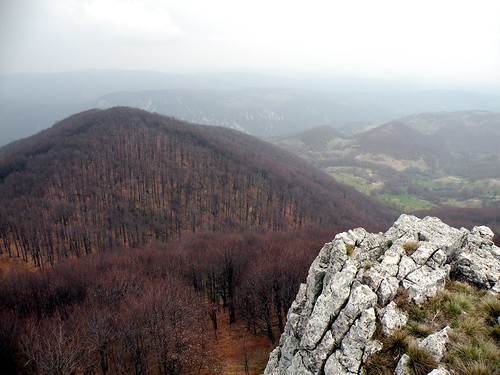
Looking Down At the Beech Forest From the Karst Peaks of Beljanica
Beljanica means “Little Whitey” in English and it refers to the limestone (karst) ridges you see in the photo above. Karst topography is formed with the dissolution of limestone rock. Many caves are formed in these areas and the large Resava cave is impressive. They have the cave well-lit for visitors and the kids loved it.
The Tour Guide Explains the Formation of the Cave in the Main Chamber
We didn’t see much wildlife. Only a small snake, some tadpoles, and plenty of wildflowers. The initial part of the hike went along by the river and through small farms with peasant sheep herders. I want to explore the region more. There is a nice waterfalls and monastery that we didn’t have time to see. It would also be good to spend a bit more time up at the top and walk along the ridges, as there were several to be explored. It was cold at the top and, we headed back without much time at the top. The boys slept soundly on the ride home.
Owen fills his water bottle from Martin in a well.
I would like to thank our fearless trip leader, Liberozo Sapundžić and his son Luka. They are two great men and had much patience with the group. Thanks for sharing your love of nature and expertise with the Serbian wilderness! I would love to return the favor in my beloved Upper Peninsula of Michigan someday.
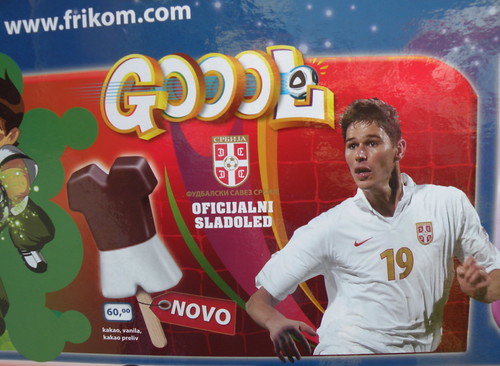
For those non-native English speakers, it sounds like “frickin'” which is a non-vulgar way of saying a vulgar word. Frikom, is pronounced in Serbian, “freekohm” but we say it a bit differently when we ask the kids, “Who wants a Frikam ice cream?” and they all shout, “me!!!!” Hilarious.
Owen is shown above holding the sign of all the different kinds of ice cream bars the company produces. They are from Croatia and besides ice cream, they also produce frozen berries which we eat all winter. Delicious. There colorful tents are seen in many places in Belgrade. There are lots of ice cream/refreshments/cigarette/newspaper stands on the sidewalks of busy intersections. The one below is next to a Maxi supermarket in Senjak. Owen and Ollie’s favorite is the Classic King. I bought the Frikom version of the “orange sherbet push-ups” for the kids over the weekend. They are not quite the soft ice cream I remember eating as a child, but they are a pretty good orange/pineapple mix.
The Pushup of My Childhood
Frikom is also getting into the World Cup spirit. They produced a set of cards and a special “soccer” ice cream bar. The advertisement below features Nikola Žigić, the big 6 foot 8 inches striker on the Serbian national team. He regularly plays for Valencia in the Spanish league. He is Ollie’s favorite player because he is so tall.
Ocean Samples the 2008 vintage Euphoria dessert wine
We visited the Aleksandrovic Winery last week in Vinca, a small village next to Topola in Serbia’s Šumadija region. I have not been to too many wineries here in Serbia yet, but the cellar had the nicest facilities I have seen yet. There is a beautiful wine bar on the ground floor connected to a huge restaurant, and in the basement, there are many large oak barrels. They obviously have invested lots of money into the place.
In their promotional video and website (link above), they tell the history of the winery. The name Vinca comes from the Latin (Roman) wine, as the area has been a place of wine production for a long time. The winery is located a the bottom of the Oplenac hill, the estate of King Petar I, that I blogged about yesterday. The Aleksandrovic family produced wine there for the Serbian royalty for over 100 years. The winery was abandoned after WWII during the communist era of Yugoslavia.
The family began developing the winery again about 10 years ago. The signature wine of the cellar is “Triumph” a mix of Sauvignon Blanc, Pinot Blanc, and Riesling grape varieties. The recipe for that wine was sent from Canada by the former royal cellar master who fled the country after WWII. The winery is unusual in that they only most of their wines are mixtures of grape varieties. Even the few pure (100%) wines with only one variety, they give a name to them like Harizma (Chardonnay), Varijanta (Black Muscat), etc. The wines we sampled were all pretty good and we bought 4 bottles. They also have home delivery service which is an excellent idea. It takes about an hour to drive from Belgrade to the cellar.
Grape Vines of the Aleksandrovic Winery at the bottom of Oplenac
On the sixth of April 1941, the Germans bombed Belgrade heavily for two days. Hitler called it “Operation Punishment” for the Serbs for not becoming an Axis satellite in World War II. The Germans wanted to use Yugoslavia as an area for industry and agriculture and setting up military bases. They controlled much of it, but the Serbs chose the high road and suffered greatly.
Above is a photo of the wreath and flowers placed at the site of the former National Library of Serbia. The bombing of Belgrade by the Nazis targetted not only military targets, but civilian as well. Tragically, thousands of civilians died in the carpet bombing. The library was also destroyed, taking with it valuable 900 year old documents and a treasure trove of the history of the Serbian people.
The bombing was made worse by the ex-Yugoslavian pilots in Croatia, an ally of Germany during the war. They knew where to strategically hit the Serbian part of the Yugoslavian military infrastructure.
I visited the site yesterday with Owen and Oliver and gave them a history lesson about Germany’s ambitions in World War II. The site contrasts well with the buildings left from the NATO bombing of 1999. It would be good for Belgrade to leave one of the sites like this as a physical memory. I wonder if the Yugoslav Defense Ministry building will look like this in 70 years.
Visiting the site also made me think of the long battle the Serbs have had with the German/Austrian people. One reads much about the 500 years of subjugation of the Ottomans, but throughout the years, the Austro-Hungarians and Germans have also inflicted much pain on the Serbs. Hitler could have eliminated the Serbs in World War II if they would have won the war.
I would like to see the site made more into a museum. On the site within the ruins, they could set up rooms with photos and memorabilia from World War II or perhaps a bit on the type of documents that were lost.






 Bill's Blog