Pig Roast

Goran With His Masterpiece

Yesterday it was a rainy day, and despite the wet weather, we still ended up having a great day. The highlight for me was going to a pig roast at the school hosted by our good friend, Goran. He is shown above with a fresh, Obrenovac-raised pig. I joked that it was a “prase” which means piglet in Serbian. That was my word for the day, svinja that means an adult pig and pork. The meat in the store would be referred to as svinjetina.

The Serbs are masters of preparing pork. For many centuries, they specialized in raising pigs and selling them to the Austro-Hungarians. The Royal Family of the Serbia, the Karadjordje dynasty started as pig dealers. I think they should have a pig sty in the White Palace grounds as homage to their past.

Goran served the svijetina with kupus (coleslaw), bread, and condiments of light green peppers or green onions. Delicious! A big thank you to Goran for letting us share in the feast.

Joseph holds Ocean After the Party

Artist Miloš Tutuš

Last night we visited the home of our friends, Vera and Miloš Tutuš. I didn’t have my camera, so  the photo above was taken September of 2008 at party we attended together. Miloš is a 28 year old artist and art teacher at the Chartwell School, a British private school here in Belgrade. He is a fine artist and we have a couple of his works hanging in our home. He is both a sculpture and painter and he has a wide range of works. He maintains an on line gallery of his work where you can view and purchase many of his pieces. The web site with his page is managed by a non-profit organization called ARTE that focuses on promoting artists and web entrepreneurs with emerging technologies.

Keyhole "Engrova" - A piece by Miloš in the Kralovec Home

The Eastern Gate of Belgrade

Yesterday errands took us over to the suburb of the famous “Eastern Gate” of Belgrade. The gate is an apartment complex that is a highly visible landmark as cars enter Belgrade on the main E-75 freeway from the east. The Genex Building, also on E-75 but on the other side of Belgrade is known as the “Western Gate.” The two communist era “Socialist Realism” architecture style buildings are the most highly visible of a city full of these monsters.

I personally love looking at them and have been reading some on their development. The Eastern Gate Apartments were built in 1976 and there are three buildings that form a circle and they house around 2000 people. They were built in 1976 and the complex is named after the town of Rudo, Bosnia. The idea behind communist architecture was to glorify the common worker and downplay individualism. They loved cement in those days as it is the main structural and decorative medium. Today’s apartments are made more of brick, wood, glass, and steel.

I am so curious to know what it is like to live in them. As I wrote, they are interesting to look at, but I am not sure what the residents think. I would imagine the hallways, stairwells, and elevators must be a disaster because they are not well-maintained. The majority of Belgraders live in apartments, but it seems that they do not devote much resources to communal upkeep of the buildings and grounds.

I guess the reason I like this architectural style so much is that it is so different from anything I have ever seen. They remind me of a science fiction movie of a Orwellian future, a type of “Blade Runner” post-apocalypse skyline.

I hope I get a chance to go into one. All of my current Serbian friends live in smaller apartment buildings. I’ll be blogging more about these Socialist Realism buildings in future posts.

Another View of the Rudo Apartment Complex

11th Anniversary of the NATO Bombing

Last week Belgrade commemorated the 11th anniversary of the 1999 NATO bombing that began in March of that year. Most of the buildings and bridges destroyed have been repaired or replaced. There are two large buildings left from the bombing, however, that have not been repaired. The building above is the one that is not often photographed by tourists. The other building, the former defense ministry headquarters, is often photographed and discussed because it is closer to the central, downtown area. I guess more tourists see it than this one.

The building was the federal police headquarters. It is a huge building and there are three large holes where obvious bombs were dropped. The building is located on the same street as the defense ministry, Knez Milosa, but further from the downtown. It is not far from our house in Senjak, just to the other side of the main freeway going through Belgrade. I think it is good that at least one of these buildings remains destroyed. It is a physical memory that is striking. It is similar to the ruins of the national library that was destroyed by the Germans in World War II. I’ll blog about that sight next month as the anniversary of that event is coming up in April.

Entrepreneurs Sell Advertising On the Building

Recently, two large billboards have been erected on the building. I wonder how long these sites will remain? Serbia marked the occasion with a minute of silence at noon followed by the sounding of the air raid sirens.

Visit to the Krušedol Monastery and Mother Angelina

Monasticism is an important part of the Orthodox religion. Serbia is full of monasteries and they are popular with tourists to visit. This is the first one I visited and I wanted to see the appeal of them. Monasteries usually are put in relatively remote places to protect them from outside invaders. I guess that is what makes them appealing to me.

This particular monastery is located just outside the Fruska Gora National Park. “Frankish Hill”, is a hilly region located just outside of Novi Sad, in the heart of Vojvodina. Vojvodina is the northern part of Serbia that once was the Pananonian Sea in geological times. It is a flat area except for Fruska Gora, which is a large area of hills. The Serbs put many monasteries in this area, I guess the hills offered protection. This monastery is for women and there are no orders in the Orthodox church like the Catholic Church. Above is a photo of the gate house.

On the wall of the gatehouse were two mosaic icons. The one below is of Mother Angelina Branković. She is a saint in the Serbian Orthodox Church and she is buried at the monastery. She died in 1520 and had a tough life due the times.

She was the daughter of Orthodox Christian Prince of Albania, Scanderberg. At this time, the Ottoman Turks invaded and took over Serbia. The leader of the Serbs, Stefan Brankovic, was blinded by the Turkish Sultan (ouch) for an alleged offense. Stefan sought refuge with the Prince Scanderberg and fell in love with Angelina. They eventually married and had two sons. The oppression of the Ottomans continued and they later fled to Italy for their safety. They lived peaceful lives there but not much is known. Angelina’s husband died and the family was in deep poverty.  She went to the Hungarian ruler for help and he set her up with her two sons back in Vojvodina, the Austro-Hungarian controlled part of Serbia. The eldest son, George, was the hereditary ruler of Serbia. He chose to become a monk and live a celibate life and took the name Maxim. He abdicated in favor of his younger brother John. The Hungarian Emperor gave John a calvary to manage to help protect the Austro-Hungarian Empire. John didn’t have much power. He had only a daughter who married into Croatian royalty. John died and thus ended the dynasty.  Mother Angelina outlived both of her sons. After the death of John, she devoted herself to the monastery and was buried there. Her son Maxim, is also pictured next to her on the gate house.

A few questions come of this. Why did Maxim not want marriage and heirs? Especially if he was the Serbian ruler? What crime was Stefan accused of to get the punishment of having his eyes gouged out? Why did John’s daughter marry outside the Serbs and not have anything to do with the dynasty? These are questions that are difficult to answer 500 years after the events happened. That is a bad thing about the lives of older saints, how much do we truly know about their lives?

Venerable Mother Angelina

Also note the cross in her hand has three bars across it. This is common in the Orthodox Church. The top crossbar signifies Pontius Pilate’s inscription, “King of the Jews” he put mockingly on the crucifix of Jesus. The bottom bar goes way back. When people were crucified, if they were only nailed to the cross by the hands and feet, it would not support the body. They therefore needed an extra support for the legs, hence the third crossbar. Early depictions of the crucifixion show this. Only later did the nail in the crossed feet of Jesus appear and the lower support disappear. I read on wikipedia that the lowest bar is usually slanted, but this one is not. The slant signifies the agony of suffering on the cross as well as the right side raised in allusion to the thief on Jesus’s right side seeking salvation at the end.

Another side note about the place, the Ustase, the Quisling Nazi regime during WWII Yugoslavia, converted the monastery into a concentration camp. Many Serbian and Yugoslavia Partisans were tortured and murdered there.

We were visiting the area to buy some wine. There are lots of wineries in Fruska Gora and the prices are much cheaper at the cellar. For example, a Kovacevic wine is 500 RSD cheaper than in Belgrade. I’ll give a review of some of the wines we purchased in a later blog post.

Serbian Christmas Traditions

Oliver is pictured above with the “badnjak” and the “žito” they were sell at our local market yesterday. They are both Serbian Christmas traditions. I blogged about the Christmas Eve tradition of the badnjak last year. We hope again to burn the badnjak (tied to our door) with a church on Wednesday night, Christmas Eve. Thursday, January 7th is the Serbian Orthodox Christmas. Can any of the readers give me background on the žito? The word means “grain” in Serbian. They were selling them in the market. It is a type of live grass. The one I bought is growing in the bottom of a 2-liter bottle. All had a candle put in and a Christmas wrapping. I think it must be something to do with the winter solstice and thanking the sun for its return and wishes for a good growing season and harvest in the upcoming summer.

We had a fire yesterday to roast peppers and egg plant. Nadia made a humus-like paste, I forget the name, with the egg plant. It was a cold day and see the comfort a family fire hearth would give to the ancient Slavic tribes. I could also see where they would be thankful that the days were getting longer. Thankfully with modern heating and electricity, we don’t have to worry about that anymore. I think it is good however, to pay homage to our ancestors and the tough life they lived.

We are enjoying the week in Belgrade before we have to go back to school next Monday. We are pictured below in our trusty Edelweiss at our last gasoline stop for the road trip. We drove through snow and ice on Sunday evening to return home. Traveling with young children is taxing and the kids were very happy to be home after a week on the road.

Happy in the Car

UPDATE: A reader sent me a link regarding the zito:

But the pebbles are grains of wheat that have broken open to release the shoots of new life — a biblical metaphor for Jesus’ death and resurrection taken from the Gospel of John. This tiny garden of wheat is a psenica (SHEN-it-za), a Christmas tradition in the Serbian Orthodox Church, which keeps to the Old Calendar date of Jan. 7

The seeds are planted in a bowl Dec. 19, St. Nicholas Day, and watered after a recitation of the Lord’s Prayer. Waiting for them to grow is a spiritual exercise.

“Isn’t it a fun way to pass the short, dark days waiting for the birth of Christ?” said Ms. Bizic, who retired five years ago as a librarian in the Quaker Valley School District. The green wheat is held tall and straight by a circlet of ribbon in the Serbian national colors of red, blue and white.

“When you first put the wheat in, you wonder if it will grow. But then you see it put out these little knots, and then the shoots. You can see it grow the next day and the next. It fills you with happiness,” she said.

Read more: http://www.post-gazette.com/pg/10007/1026404-323.stm#ixzz0d0MsC0ER

Christmas Joy


Ocean, originally uploaded by bill kralovec.

We had a nice day yesterday as a family. The kids were up early and so excited to open their gifts. Nadia and I have been using the “Santa Card” to get them to be calmer and to listen to us. Too bad that option is now over. it was so funny that Oliver even asked had he been good enough to receive gifts when he first awoke on Christmas morning.

Ocean really wasn’t sure what was going on, but she got into it when she saw her “Dazzling Dreams Castle” doll house. She also enjoyed her Princess car. We bought a monitor and key board to go with Nadia’s old Mac Mini for Owen so now he has his own computer. Ollie’s favorite gift was a car race track.

We ate a real Serbian turkey. I am used to those industrial factory raised turkeys from the US with the bland taste. This turkey tasted “meaty” and for example, had bones and cartilage on the drumsticks that I didn’t know existed. In the US, turkeys are not bred to walk and so the drumsticks have less connective tissue to get in the way. Nadia also made a raspberry dessert that was absolutely spectacular. I ate way too much and had a hard time jogging in the afternoon due to a full stomach.

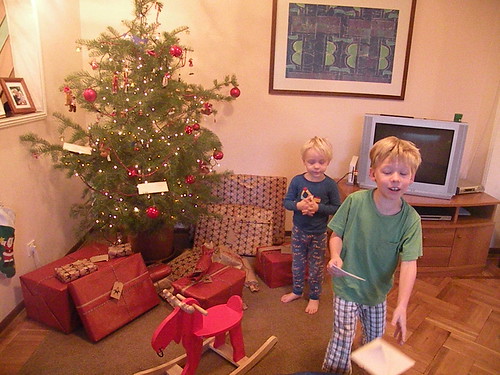
As you can see in the photo above, our Christmas tree is doing fine. We bought it from a tree farm, roots and all a few weeks ago. We intend to plant it in our yard after the holidays are done. We bought  a large pot and extra soil for it to stay alive. This is common with Serbs, as the culture appreciates trees and almost regards them as sacred. Belgrade is filled with trees on every street and there are strict laws which prevent people from cutting them down. I guess that trees helped the Serbs survive against the Turks. The hajduks hid in the forests while the Ottomans inhabited the fortresses in the cities and towns. I think it is a great tradition and our family will never again use a fake tree or cut a tree to use for a few weeks.

Big Mac Index In Serbia

Last night we took the kids to McDonald’s. I recently read a blog post about the Economist Magazine’s annual article on the Big Mac Index. The Big Mac Index is an informal method of predicting future currency exchange rates between the USA dollar and other currencies. The idea is the Big Mac, the world’s most popular sandwich should cost the same in every country. It there is a difference in prices, then the currency is overvalued or undervalued and should change in the future. 

The cost of a Big Mac in Serbia is 200 RSD (Republic of Serbia Dinar). This was at the McDonald’s on Slavija Circle in downtown Belgrade. The current price of a Big Mac in the US is $3.54. Today’s exchange rate is $1 = approximately 67 RSD. That would make the cost of a Big Mac in Belgrade to be $2.99, significantly cheaper than the US. In calculating a purchasing power parity percentage, the RSD is undervalued by 15.68%. The significance is that the power of the RSD should rise in the future and the exchange rate of 67 RSD/dollar should fall. 

Interior Dining Area of McDonald's near Terazije Fountain (Aug. 2008 photo)

Dining at McDonald’s in Serbia is not the same experience as the US. Generally speaking, McDonald’s is more of an upscale dining experience in Serbia than in the US. Lower income people in Serbia can’t afford to eat there often while in the US the poor go more often. McDonald’s in the US is viewed as a cheap meal or an eventful experience for families. We go about once every couple of weeks because the kids love it and it is an easy meal for us. 

I’ll be interested to see where the exchange rate goes in the first half of 2010. According to the Big Mac index, it should be dropping.

Budućnost Defeats Red Star


Pionir Hall View from our Seats, originally uploaded by bill kralovec.

Last night Owen, Ollie, and I attended the Adriatic Basketball Association game between our favorite Red Star and Budućnost of Montenegro. It was an important game for both teams as they are in 7th and 6th place in the league standings respectively.

The superior guard play of Montenegrins and the weak defense of Red Star contributed to the 88-77 win by Budućnost. I was very impressed with the backcourt tandem of Goran Jeretin (26 points) and Nikola Otasevic (a 6 foot guard who can reverse dunk). They really controlled the game. Red Star did make a run and tied the game with 4 minutes left in the third quarter at 56 apiece behind a couple of nice plays by Red Star import Mike Taylor.

Budućnost pulled away from that point outscoring Red Star 32-21 the rest of the way. Red Star has several problems. Number one is they don’t play defense with intensity. The two guards for the Montenegrins kept penetrating and passing effectively the whole game. Second, Red Star has no guards and play makers. The team is heavy on tall, stiffs with few ball skills. Our favorite player, Vladimir Štimac played little and was constantly being yelled at by the coach. I would find a new coach ASAP if I was Red Star management. I would also find a slasher/scorer at the 2 or 3 position as well as a solid point guard.

We got to stay for the whole game. Ollie most loved the popcorn and running around the stadium. It is a great night out for the kids. I bought a ticket for 200 RSD ($3) , the kids were free, and the boys had popcorn and pop for another 200 RSD. The crowd was enthusiastic, but not violent or rude. Serbians love basketball (košarka) and play it well. Serbs are a tall, athletic race in general, and it shows with the quality of basketball. There are many Serbs in the NBA and US universities. They also play all over Europe and Partizan, the defending champion of the NBL, went far in the Euroleague Basketball last season.

We also had a final day in the snow. The weather was above freezing yesterday and much of the snow melted. We took advantage of the snow again yesterday morning, and went to Banavo Brdo (Ban’s Hill) a suburb of Belgrade. They have a big sledding hill and boys loved it. I promised no more snow videos or pictures but I couldn’t resist. Here is Owen heading down Ban’s Hill. As I update this late on Wednesday evening, the snow is almost gone.
Big Snowfall in Belgrade


Owen, Ollie, Mom, originally uploaded by bill kralovec.

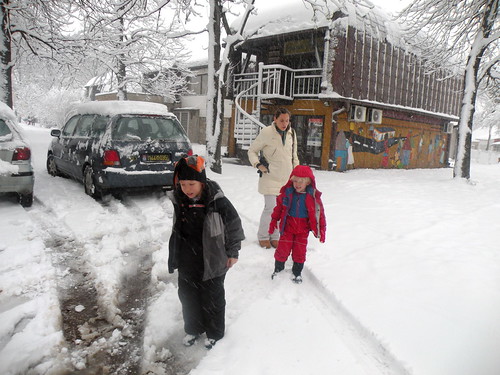
It started snowing Monday afternoon, and as I sit here and write this on Wednesday morning, the flurries are still lightly coming down. We probably have 8-12 inches of accumulated snow. The official weather service of Serbia measures 32 centimeters this morning with more to come in the next several days. This is the second snowfall of the year, first one in December. After so many years in the tropics, we are all excited for the change of seasons and we plan to take full advantage of the snow and winter. We can hopefully do some sledding this weekend! 

Above, the family is going to school yesterday morning. As you can see by the top of Eidelweiss, our trusted family car, it had snowed quite a bit Monday night. There is even more accumulated today.  It doesn’t snow here to often and the city does not plow the streets well. Only the main roads are clear and so near our house, it is tough going. Of course I don’t have our snow tires on yet! They are sitting in the trunk of the car and I hope to do this soon. I’ll take some more pictures today as it is absolutely beautiful, we snow on the trees and covering everything.