Zemun Quay

Dinner Along the Danube, originally uploaded by bill kralovec.

We went out to eat last night at the restaurant Šaran on the Zemun Quay. It was such a pleasant experience, I had to blog about it.

Zemun used to a separate city from Belgrade, but is now one of the 17 municipalities of Belgrade. It has a slightly different feel (architecture) than Belgrade, being under the Austrian-Hungarian Empire influence for a long time.

Zemun was founded on the banks of the Danube River, on three hills. There is a nice riverfront area of restaurants, that with a few modifications, could be made even nicer, and perhaps another attraction like Kalamegdan or St. Sava’s Church.

There are quaintly, slightly decrepit buildings, small fisherman’s boats, cobblestones, trees, and breeze coming off the river, with the view of a green opposite bank. One feels like it could be a Greek island waterfront, or a neighborhood of Venice. There were old men sitting on tables in front of dimly lit cafes, having a drink and some laughs. The restaurants in the summer have temporary dining areas along the river, outside of their main buildings. Many have live music. Besides diners and cafe-goers, there were families going for a walk along the quay, fishermen coming back from a day on the river, etc. It is perhaps a bit like San Francisco’s Fishermen’s Wharf before it became a tourist trap.

They can improve the area by stopping cars from entering the cobblestone street along side the quay. There are several areas nearby that could be developed as parking areas. We saw they were improving the walking paths along the quay and this would also help, especially if they can figure out a walking path up to the Gardoš Tower, which is a short two blocks from the river. There are also potential green areas further up the river bank that could be included in the quay area. Further down river there is the Grand Casino, more riverside parks, Great War Islands, with Lido Beach, and many great “splavs” – restaurants and night clubs on stillts on the river – also close by and with some creative development, could be connected to the Zemun Quay. It could be a good alternative to the downtown Bohemian Restaurant district of Skadarlija.

The food was good at Šaran and we had the best waiter I’ve encountered in Belgrade, Some of the dishes were a bit over-salted for our taste, but overall a fantastic meal.

Apricots – Kajsija


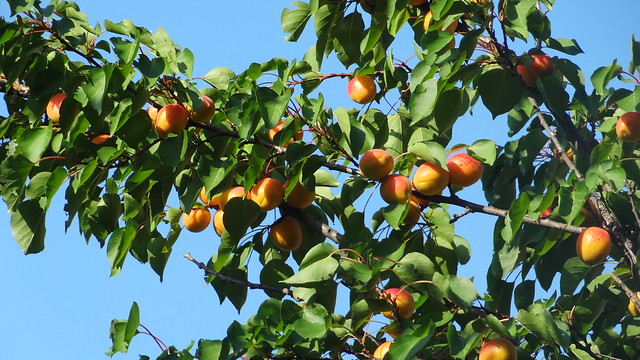
Another of Belgrade’s summer pleasures are apricots. Nadia is shown with several I picked from a tree in our yard. We’ve been eating a lot of them and Nadia made the best jam preserve with 12 kilos I bought from the Senjak market.

Apricots have been around a long time so the origin of the tree is a bit unclear. The scientific name (Prunus armeniaca) indicates they originated in Armenia, but there are experts who theorize India, and China as well. It is a member of the plum family and the common name, apricot, comes from Pliny The Elder, the Roman naturalist over 2000 years ago.

The apricot is high in antioxidants and fiber, so it is very healthy to eat. It is supposed to reduce bad cholesterol so I try to eat them daily while they are in season.

After my run yesterday, I stuck my head under the hose and looked up and saw the tree. I picked an apricot and it was absolutely delicious. It may have been a runner’s high, but I paused to acknowledge the refreshing taste of the apricot, or the Armenian plum!

In Serbian they are known as kasija, and of course, the Serbs distill an excellent brandy from the fruit, known as kajsijevača.

Aerial Spraying Against Mosquitos


Plane, originally uploaded by bill kralovec.

Earlier this week I snapped this photo from my balcony in Dedinje. Two planes were flying over the suburb spraying chemicals against mosquitoes. I’ve seen them do this in previous years over the Sava River and Ada Ciganlija, but never over my neighborhood. As you can see, they were quite close to the ground and were covering the area in a grid pattern.

I am wondering what chemicals are being sprayed and are there harmful side effects? There was an short news item in the Belgrade Insight this week stating that a full analysis of the spray will be done in 2013. Why so long?

In my research on line, I see that the Swedish Chemical Agency is working with the Serbian government on this to have Serbia comply with EU standards on mosquito control. Here is a powerpoint presentation done by Lilian Tornqvist regarding the Belgrade spraying. She points out that one of the chemicals, Lambda cyhalothrin, is a carcinogen. If any of my readers have more information, I would be interested. I’ll be following this story.

Photo from my balcony

Paraćin, Serbia

.

Above is a photo of the Hotel Petrus in Paraćin, Serbia. We stayed in the hotel during the shooting of the movie. What an architectural classic of Socialist Realism! Besides being an awesome monument to the communist era of Yugoslavia, it was a nice place to stay. It is located on the river and has a very pleasant restaurant overlooking the river. Another cool thing about the hotel are the hallways, that go in a complete circle on each floor. I will never stay in a hotel like that again. The stairs and elevators are in the center of the tower. I would have loved to explored the roof and basement of this hotel. I made a video (link here) of a bit of the inside of the hotel.

The city had a great vibe. There is a walking street nearby and lots of people were out and about. Across the river the hotel, there is a nice Serbian Orthodox Church (St. ) and another Socialist classic, this fine statue commemorating 30 years of “freedom” after World War II. The communist youth figures are holding up a bright red flame. They look more like Atlas than figures happy to be free. The concrete, box apartments in the background complete the scene.

A nice little town we hope to visit again.

Filming of Montevideo II

Last week I had the opportunity to act in Montevideo: Taste of a DreamThis is a project being done by the Intermedia Network and includes a book, documentary, television series and two feature films. It is the story of Jugoslavia’s participation in the inaugural soccer World Cup of 1930. It follows the formation of the team in Belgrade, to them eventually playing Brazil in their first game of the tournament. My role was the American Radio Commentator and with luck, a few bit parts will appear in the final edit of the movie. This is the sequel they are filming and it should come out in December or January.

The soccer scenes are taking place in Paraćin, Serbia, a small city (population 25,000) located in central, south, Serbia. The producers have renovated the local soccer stadium to look like Centennial Stadium of Montevideo, Uruguay in 1930, the host to the World Cup. I love sports and Serbia, so this project was a labor of love. The movie people treated me and my family very kindly and I had a great two days of filming. It was extremely hot and the make up people worked hard to keep me sweat-free for my parts. I realized how much goes into filming a movie, especially a period piece with hundreds of extras. A great amount of patience and attention to detail needs to go into it.

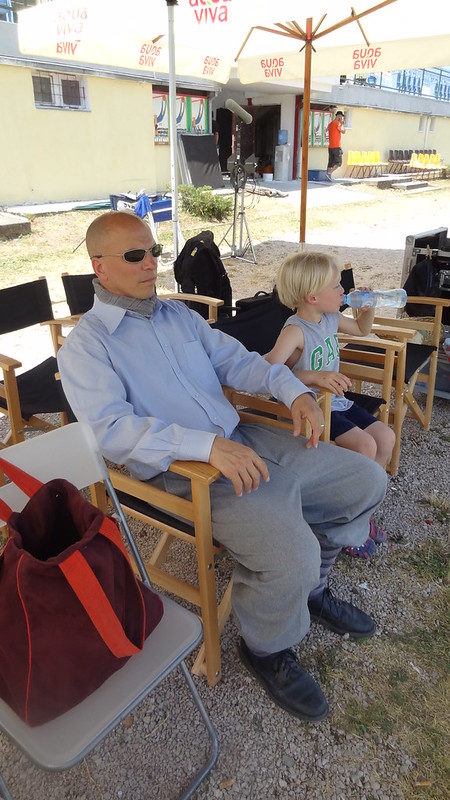
Owen, Ollie, and Ocean played a lot of soccer on the field during the filming in the bleachers.

I would like to thank Vlada, Dragan, and Srdjan for their patience with me and their hospitality. It is a worthy project and I am happy they are bringing this obscure story to modern audiences and so it does not become lost. I’ll be blogging a bit more about this project as it continues.

My Little Pioneer

My Little Pioneer, originally uploaded by bill kralovec.

Yesterday, May 25th, was a special day for me as it is my birthday and my adopted Slava. In Serbia, this date is the famous birthday of the ex Yugoslavian leader, Josip Broz, “Tito.” I’ve adopted him as my Slava patron. He was an athiest, as I am, so I guess it is appropriate to have him. I don’t agree with much of what Tito did and I don’t respect him as a hero, but it is a funny way to connect to Serbia and I love the idea of “the slava.” It is also funny that I have the same birthday as Sveti Tito.

For my birthday, I had Ocean wear the Pioneers of Yugoslavia uniform. This was a Communist propaganda movement that all children 7 and over participated. Ocean is wearing a “titovka” hat with the Yugoslav Communist Red Star and matching scarf.

My friend mentioned the pledge the kids took and it is underneath in English.

Today, as I become a Pioneer, I give my Pioneer’s word of honour -That I shall study and work diligently,respect parents and my seniors, and be a loyal and honest comrade and friend. That I shall love our homeland, self-managed socialist federal republic of Yugoslavia. That I shall spread brotherhood and unity and the principles for which comrade Tito fought.And that I shall value all peoples of the world who respect freedom and peace!

I had a great day with my family. We had a “brownie” birthday cake. Later on I attended our school’s prom, which was an elegant dinner at the Madera Restaurant downtown. It was a special day.

Srećan Rođendan and Happy Slava!

Book Review: “Constantine’s Crossing” by Dejan Stojiljković

The Serbian publishing company Geo Poetika with help from the Serbian government, has translated a series of novels of Serbia authors to English. This is the second one I have read, the first being Lake Como.

This book has a lot going for it, as it is right up my alley. It is a historical fiction novel, set in World War II, in the southern Serbian city of Niš. It has evil Nazis, Chetniks, Partizans, mixed in with a search for the Emperor Constantine-s weapon collection in the tunnels underneath the city. It also has vampires. With all of these elements that I love, I really enjoyed the book. It was a fast read and I could’t put it down.

I wish Stojiljković would have taken the story deeper, however. It is a great concept, but at 265 pages, it is hard to develop the characters fully and get into all of the cool history surrounding the early Christians, Germanic Tribes, and the life of Constantine. I don’t think the author is a scholar and perhaps this book would have been more to my liking if it was written by Umberto Eco or even Dan Brown. I could have used some more background on things like the runic alphabets, the Nazi’s work in the occult, and the life of Constantine. I could have used another 300-400 pages!

It was a great concept however and a perfect book for the airplane. Thanks again to Geo poetika for featuring these Serbian writers for the outside world to read. I highly recommend this book and it makes me want to explore some of the ruins around Niš. Also, the myth of the vampire started in Serbia and I just read of the course at the University of Wisconsin, by a Serbian professor, that explores this connection.


Elections Today

Update: From the B92 web site, the live results page from 1:00 AM. There will be another election between Tadic and Nikolic, both who got around 25% of the vote. I’ll be curious to see what percentage of eligible citizens voted. There were no surprises. In the parliament elections, Nikolic’s party has a slight advantage with 73 seats to Tadic’s 68. There will be a long negotiation to form coalitions to get a majority. I can’t remember what the “magic number” of seats is to form a government.

Predsednički izbori – Tadić i Nikolić u drugom krugu (82,9% pregledanih, 61,14% izlaznost): Stanković: 6.6%, Glišić: 2.7%, Tadić: 25.4%, Koštunica: 7.2%, Dragišić: 1.7%, J. Šešelj: 3.9%, Zukorlić: 1.3%, Grujičić: 0.7%, Dačić: 14.2%, Jovanović: 5.2%, Pastor: 1.7%, Nikolić: 25.2%,

Parlamentarni izbori – SNS ispred DS (78,8% obrađenih, 61,08% izlaznost): SNS: 73 (24.1%), DS: 68 (22.4%), SPS: 44 (14.4%), DSS: 21 (6.9%), LDP: 20 (6.6%), URS: 16 (5.3%), SVM: 5 (1.9%), SDA: 1 (0.6%), Sve zajedno: 1 (0.5%), NOPO: 1 (0.6%)

by B92 12:43 AM

Below is a nice article from The Economist about today’s elections. I am predicting that there will be no clear winner and the top two, Tadic and Nikolic will be running against each other. With my Serbian friends, as the article says, they are not happy with how things are going here, but they don’t think Nikolic is the answer. It should be interesting, especially if there is heavy voter turnout.

Serbia’s elections Cliffhangers The outcomes of Serbia’s many elections on May 6th are unpredictable

ON MAY 6th the French vote for a president and the Greeks and Armenians for parliaments. For Serbs it is the big bang: they will vote for a president, a parliament, in local elections and, in the province of Vojvodina, for a regional assembly. In Kosovo too, many Serbs may vote, but this is contentious and could lead to violence.

Kosovo aside, the Serbian elections are a cliffhanger. Polls give President Boris Tadic of the Democratic Party (DS) just under 36% and Tomislav Nikolic, leader of the Serbian Progressive Party (SNS), just over 36%. A run-off between the two a fortnight later is likely, and the result will be influenced by the parliamentary election. Mr Tadic sells himself as pro-European and pro-reform. But he looks tired and the economy is in dire straits. One poll finds 80% of Serbs are dissatisfied and angry, 77% feel helpless and hopeless and 60% are just depressed. The latest score for the SNS and its allies is 33.5%, with the DS and its allies trailing on 28.3%. Yet it may be easier for the DS than for the SNS to find other coalition partners.

The kingmaker is likely to be Ivica Dacic, leader of the Socialist Party, which with its allies is polling at 11.8%. Mr Dacic is the artful dodger of Serbian politics. In the war years he was a spokesman for Slobodan Milosevic. When Mr Milosevic fell in 2000 and was put on trial for war crimes, Mr Dacic stepped in to save the party. Now he is interior minister and a master of populist bluster. When Serbs were arrested in Kosovo, some with election materials, he arrested some Kosovo Albanians, boasting that this was a reciprocal measure. Mr Dacic is likely to stick with the DS, but he could choose to switch horses to the SNS if they make him a better offer (such as the premiership). The SNS was started in 2008 when Mr Nikolic and Aleksandar Vucic led their followers out of the extreme nationalist Radical Party, whose leader is also on trial for war crimes.

Any new government will have a hard time.Unemployment is 24% and as much as 40% of output is in the black economy. In February, because many workers went unpaid, more Serbs got pensions than salaries. Yet foreign companies are still investing in Serbia, not least Fiat, an Italian car maker that just opened a €1 billion ($1.3 billion) factory. With little time left, it is still uncertain what will happen in Kosovo. The Serbian authorities have stepped back from trying to organise local elections for Serbs there, though two municipalities in the Serb-controlled north may still hold them. If Serbia chooses to hold presidential and parliamentary elections in the north there is little the Kosovo government can do. But if it tries to hold them in the south, where most of Kosovo’s Serbs live, there could be bloodshed. One solution may be for both sides to accept a figleaf of cover for elections from the Organisation for Security and Co-operation in Europe. But NATO is taking no chances, deploying 700 more peacekeepers to deter violence. Until Serbia has a new government the European Union-sponsored dialogue between Kosovo and Serbia will remain in abeyance. Edita Tahiri, Kosovo’s chief negotiator, says she is not worried if there is a change in government in Belgrade. The talks will resume and Serbia will have to carry on making compromises, just as Kosovo does, because they have “no choice but to continue being pro-European.”
When There Were No Serbians in Serbia


Owen and Ollie at the Baths, originally uploaded by bill kralovec.

Earlier this month we visited the ancient ruins of the city of Viminacium. (Viminacijum in Serbian) The city was founded by the Romans around the birth of Jesus. Viminacium on the Danube River, close to the modern Serbian town of Kostolac, about an hour’s drive from Belgrade.

Viminacium in its peak had an estimated 40,000+ citizens. Many of the famous Roman Emperors visited or stayed in the city. Several battles in the many civil wars of the Roman Empire occurred there as well. The Romans established the city first as a military garrison while conquering the local Illyrians (Dacians) and later a market town grew up around the barracks.

We arrived late in the day and the site was closing. We still drove around to the excavated sites and got a sense of the place. Most of the city is not excavated, only 3 major sites, which are covered (see above). Researchers have found 35,000 graves, coins, vases, etc. The city was eventually overrun and destroyed by the man himself, Attila the Hun in 441 C.E. The Avars (ancient Turkish tribe) finished the job in 582, paving the way for the Slavs (Serbs) to come in an eventually settle the area.

It was amazing to think about all that went on there, such a long time ago! I hope they develop the project further, there is probably a lot that needs to be excavated and researched. The structures uncovered are not that impressive, no coliseums, statues of Caesar, etc, but I think they could make an excellent museum and educational center with the pieces they found. They had several books for sale in the visitor center with photos and information about the site, but no actual pieces displayed. We also so some chariots which would have been cool for the kids to ride in. I just don’t see the funds available to further carry on the work.

Perhaps the coal company operating next to the site can support excavation. There is a massive open pit coal mine there as well as a coal-burning electricity generation plant. It would be nice to tax those polluters and put the proceeds towards Viminacium. We will probably head back to the site and read some more about it.

Nadia in front of the Drmno Coal Mine

On a side note, the town of Stari Kostolac (Old Kostolac), close to the site, is a Roma or Gypsy village. We were driving back from the site through their and Nadia was freaking out when she saw the run-down settlement and only gypsies. I would also like to go back and explore the town a bit more. A friend told us the village used to be Serbian, but was abandoned and the Roma moved in.

It makes a good day trip from Belgrade.

Happy Easter – Srećan Uskrs


Egg Tapping, originally uploaded by bill kralovec.

We enjoyed the traditional Serbian Easter traditions last week during the long weekend. The Orthodox Easter is celebrated a week after the Catholic Easter. Above, is a video of the “egg-tapping” competition. This tradition started in Eastern Europe in the 1300’s and has now spread across the world. The egg is the pagan symbol of the renewal of spring and life. I never saw egg-tapping in Michigan. The champion in the video for this year was Ocean! Her egg didn’t crack. Late in the competition, Aca’s mother Mira gave Ocean a wooden egg, which is against the rules.

We had a second round of egg-tapping with our Romanian friends later in the day. Claudiu was explaining that while breaking the egg, they have the tradition phrase, “Christ Has Risen” which is answered by “Indeed, He has.”

We also liked coloring the eggs in the traditional Serbian method. We dyed the eggs in onion skins and it give it a deep red color. We bought some eggs with writing and Easter designs on them from the market, and when dyed, as you can see, they markings appear lighter. I don’t know what the acronym, XBBB means? It is in the Cyrillic script, and in Latin it would be HVVV. I know the “H” means Hristos (christ), but I don’t know what the three Vs mean. Any help from my Serbian readers? I also used some Easter Egg decorations from the company, http://www.jaje.rs. They have some great designs from based on ornaments from Serbian Medieval churches and monasteries. Very cool!