Košava Winds


Đerdap National Park, originally uploaded by bill kralovec.

The past two days here in the Belgrade the famous Košava winds have been blowing through the city. The winds are caused by a air pressure gradient between the Adriatic Sea (low air pressure) and southern Russia (high air pressure). Air moves from high pressure to the low pressure. In between Russia and the Adriatic are the beautiful Carpathian Mountains. Above is a photo of the southern Carpathians that form a steep gorge on the Danube River. It is the famous Đerdap National Park, or Iron Gates. It is about an hour’s drive from Belgrade. As the air moves from Russia westward towards the Adriatic, it is funneled through this gorge. On the other side of this gorge is Belgrade.

I can sure feel when the Košava is blowing! It is good that they clean out the city of pollution. They are bad in that they significantly lower the temperature in the non-summer months, especially winter.

When I took this photo in 2009, I was only admiring the beauty of the park. Now I realize that it causes a focus and acceleration of the cold northerly wind known as the Košava.

The locals claim it either blows for 1,3,5 days and they all believe it. It sounds like superstition as it doesn’t make sense for the cause of the winds, massive air pressure systems, to move out of the area in increments of an odd number of days. If a meteorologist can give me some background on this, I would appreciate it.

So far this time, it is the third day as I write this. The Košava is strongest in the morning, so I’ll see if this is the last day it blows.

Yugoslavia’s Alcatraz


Update February 3, 2014 – A list of 16,101 prisoners who were at Goli Otok from 1949-1956 was released on a Croatian website this week. It listed 413 people that died while serving time on the island from 1949 – 1956. 

The death of Momar Ghadafi last week has me thinking of dictators. His 42-year reign did not end well with “rebels” finding him in a storm sewer under a road and beating him and then executing him. This is much different than here in Serbia with the end of their Yugoslavian Dictator, Tito. His 37-year reign ended with a state funeral and honors. Many still regard him as hero, not only for his exploits in World War II, but also for keeping Yugoslavia together and more prosperous than its Warsaw Pact neighbors. Does he qualify as a dictator?

For anyone to keep power that long however you want to look at his time as Prime Minister/President. Tito did have his repressive measures to keep control. During my trip to the Adriatic last week, I read the book, “Goli Otok: Hell in the Adriatic” by Josip Zoretic. Goli Otok is an island off the coast of Croatia that for many years during the Communist period of Yugoslavia was a prison for political dissenters and for ordinary criminals. It is notorious for the harshness of the conditions for prisoners.The book is written by Zoretic, a Croatian born in Slovenija, who served 7 years on the island from 1962-1969. He was sent to “barren island” as it is translated to English for fleeing Yugoslavia. (note- Please help me Serbian readers, I learned that the word for island was “ostrvo”, why “otok?”

Zoretic was captured in Austria and sent back. He writes in the book that he fled the country because he could not find a job. According to him, his father refused to join the Partizan army during the World War II resistance. He also didn’t join the Chetniks, the other resistance group. Zoretic’s father was executed and tossed into an infamous deep cavern called “Jazovka” near the Slovenian and Croatian border. He was one of the lucky ones, because many Croatians taken there by the Partizans were tossed in alive, only to die slowly hundreds of meters below the earth on the remains of the dead. Zoretic didn’t know the full background of the story if his father was a collaborator with the Ustaše or just an ordinary civilian who didn’t want to participate on any side in the conflict. Recall that the Ustase were the Croatian Nazi collaborators in World War II.

Because of his father’s background, Zoretic couldn’t start a career and find jobs or enter training programs in the Partizan-controlled Yugoslavia. Talk about suffering for the sins of your father. He eventually got to leave Yugoslavia after serving out his sentence.  He wrote the book while in exile in Canada and I read where his son is raising money to produce a film based on the book.

The photo above is not the island of Goli Otok, but of Lokrum Island, located just off the coast of Dubrovnik, Croatia. It is a similar island and we visited Dubrovnik last year. It will give the reader a sense of what the place looked like.We didn’t get over to visit the island, which I don’t think is a tourist attraction. It would be good to restore the island. It is not as famous as the American island prison Alcatraz. Unlike Alcatraz, prisoners occasionally escaped but it was dangerous and difficult. I hope they do preserve the island as it has been left to ruin and an important part of history is being forgotten.

The book was an engaging read, as Zoretic described daily life in the prison. I was a bit put off by his “Greater Serbia” conspiracy theory. The Secret Police Chief under Tito at the time was a Serbian named Aleksander Ranković. He was the top Serb in Tito’s regime and was accused by the author of unfairly favoring Serbs when it came to sentencing.The guards were quite sadistic and cruel and I don’t understand how anyone could act that way towards another human being. Zoretic mentioned that some of them after leaving employment on the island were attacked on the mainland because people heard of the conditions on the island.

Goli Otok is a sad chapter in the history of Yugoslavia. It is a reminder to us all that humans can treat each other cruelly and the opression of the Tito-led communist Yugoslavia. I recommend the book anyone interested in learning more about Yugoslavia.

Vojvodina Retreat


Last weekend I went on a retreat with the High School Student Council. We stayed at the Majkin Salaš, which is similar to a country bed and breakfast. Salaš means ranch or farm in the Vojvodina dialect of Serbian. Vojvodina is the northern autonomous province of Serbia. In a geological timescale, it was a sea and today is called the Pannonian Plain. It looks like Iowa or Illinois or southern Michigan, being very flat and full of agricultural fields.

The Majkin Salaš has rooms, a conference center, a swimming pool and a working farm with a pond. They have a huge apple orchard and they were harvesting last weekend. The apples were delicious and I even harvested some. As you can see, we also rode the horses a bit. The Salaš is only about 12 miles from the Hungarian border.
We went to the famous Lake Palić, which is nearby. It is a shallow lake with very poor water quality. I wanted to go swimming in the lake but the water was so green with algae that it was not suitable for swimming. In researching about studies done on the lake, the algae growth is caused by high levels of nitrogen and phosphorus. These nutrients come from agricultural fertilizer run-off and treated wastewater being flushed into the lake. The lake is about 900 acres in area but only has a maximum depth of 2 meters. There is a lovely park on the shores and bike path. We rented bikes and had a good time on a perfect late summer day. The town of Palić on the shores of the lake has a Hungarian majority population and the architecture reflected that. If I was in the area, I would come back but I wouldn’t make a special trip, unless the kids wanted to ride their bikes around the lake.
Lake Palić

Koča Popović: Yugoslav Hero


My neighborhood in Dedinje is full of interesting stories. I wish I understood Serbian better because I would write a book on the fascinating history of this part of the city. Dedinje is the diplomatic enclave and richest part of the city and is full of beautiful villas with ample grounds and interesting stories that mirror the history of Serbia.

My neighbors were telling me the story of the house in this photograph. The home shares our driveway and his hidden by the trees around it. It is the former family home of Konstatin “Koča” Popović. He was a heroic officer in the Partizan Army and later served as the Foreign Minister for Yugoslavia. Popović was from a rich, “industrialist” family so I assume that this is the family home. He was not only a brave soldier that fought in the Spanish Civil War and World War II, but he was an intellectual. He was a writer, photographer, and artist.

The neighbor said that there is still a caretaker in the servant house and I do see an old lady from time to time as well as a dog, leaving via the front door. I would love to find out more about the house. Popovic is a Yugoslav hero who bravely fought the Germans and his archives are at the National Library.

I wonder what the house looks like inside? Did he leave any heirs? Why is the house look abandoned? Any of my readers have any answers for me? I will be asking my Serbian friends about him and will definitely post what I find out.

Historic Flag At Libyan Embassy


Rebel Flag , originally uploaded by bill kralovec.

I noticed that the rebels flag was raised this weekend at the Libyan Embassy here in Belgrade. I wonder who put it up? The “rebels” are moving in to the capital Tripoli, Gadhafi’s family is leaving the country, and it sounds like he is making a last stand in his home village. There still may be weeks or months of fighting in Libya, but it does look like there will be a change in government.

It is odd however that the official Libyan flag, which is all green, was taken down and the tri-color rebel flag put up. If Gadhafi approved the Ambassador and staff here, they quickly switched sides. I wonder who decided to raise this flag instead of the official one? Are all Libyan Embassies throughout the world changed the flag already?

Gadhafi was a terrible president for the country. I don’t have much hope for a good government coming from the rebels either however. Libya is cursed with oil reserves and as with most nations with oil, it doesn’t bring prosperity and a democratic society. I hope the rebels after they are done fighting, travel to Norway and see how they managed their oil money. Norway is one of the few countries that has been able to use its fossil fuel income to better its society. It has done so by basically putting most of the income in a trust fund and slowly selling its reserves. Having lived in Venezuela, another OPEC nation, I don’t have much hope for Libya…

Perfect Summer Day


Sunday we had a perfect summer day in the “dog days” of August. The weather has been very hot and so we began the day with a refreshing swim at the Kosutnjak Public Pool. We then drove out to the village of Beli Potok, located on the slopes of Mount Avala, just south of Belgrade. We ate at the Stari Majdan (Old Mine) restaurant. As you can see, they provided plenty of food. The restaurant is in an old quarry and is oddly shaped. The compound has two artificial turf tennis courts as a bonus. We played a set after lunch. The views overlooking Šumadija, the hilly, forested region were spectacular. I recommend a visit, especially if you are visiting Avala.
Stari Majdan Came Through with a Delicious Lunch
On the way home we bought a ripe watermelon (lubenica) and played volleyball with the kids in the back yard. Nothing better than a juicy watermelon on a plastic chair in the middle of the yard on a super hot day. It was the last day of summer holidays so we put the kids to bed a bit earlier than usual. It is soothing to listen to the crickets in the evening from the window of our balcony. Ah, the days of summer…
Ocean notices the plums

Also loved the huge vats of šliva (plums) they had on display at the restaurant. The plums are used to make the Serbian national drink, šlivavica, a distilled alcoholic beverage made from plums. Distilled beverages from a variety of fruits are very popular in the Balkans and are called rakijas in general. My favorites are the rakijas flavored with honey and walnuts. I wonder how many bottles they can get from one of these vats.

Belgrade: A River Town


I’ve come to appreciate the beauty of having two big rivers in Belgrade. I took the photo above with the panorama function of my camera. We took the new teachers on a boat cruise. This area is called “usce” and it means “confluence” in Serbian. This is where the Danube (Dunav) and Sava Rivers meet here in Belgrade. Near that spot, there is a large hill where the city was first settled. On the hill is the fort of Kalamegdan. From the fort to the right of the photo, the city spreads down the banks.It would be fun to have a boat to explore around a bit.
Oliver in Action at The Novak Tennis Centar

We played at the Novak Tennis Centar near the river. Nadia and I enjoyed playing despite having to control three kids. Oliver was running around with the clay court grooming equipment, etc. We need to find a tennis court that has a playground close by.

The river has many restaurants, bars, and clubs. Below is a typical example of a good fish restaurant near to where our boat docked.

We’ve been very busy getting ready for the first day of school tomorrow.

Sava River Bridge Opens to the Public


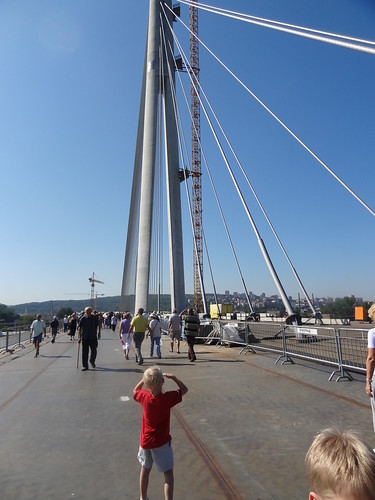
The Belgrade City government celebrated the completion of the part of the bridge across the Sava River by opening the bridge up to foot traffic this weekend. We were one of the first people across Saturday morning.

It was nice to see some different views of Belgrade. The column in the center with cable supports is the most impressive. As you can see, cars will be able to go directly underneath the column as it is split on the bottom. That is something you cannot see from the city. The cables also are a lot bigger than I thought. They are about the diameter of huge bowling ball.

A New View of the neighbor - The RailRoad Bridge

It is a massive construction site that also includes all of the entry and exit ramps and over passes. I hope this relieves traffic across the rivers in the city. This will be the fifth bridge in the city spanning the Sava. The bridge closest to us has been under repair all summer and there are delays because of closed lanes.

On spending time on the rivers this weekend, I realized that they play a big part in the city. It reminds me of the Swan River in Perth. Tonight perhaps I’ll take the family to the Belgrade Regatta and see all the boats on the river to finish the weekend.

News Team Were There

There has been some criticism about the cost of the bridge. I consider it worth it in the long run as perhaps, it will become a distinctive icon of the city. It is an engineering marvel and the column can be seen from just about anywhere in the city. I haven’t heard any phallic jokes about it yet, but those are sure to come.I wonder what the official name of the bridge will be. There is still much work to be done and they estimate a December 2011 completion date.


Lido Beach


Last night we visited Lido Beach in Zemun. It is located on the northern tip of “Great War Island” (Veliko – big Ratno – war Ostrvo – island). The island is situated at the spot where the Danube River (Dunav in Serbian) splits into its tributary, the Sava River. The island gets its name from the numerous armies that use the island as a launching pad for attacks on the city. The Turks, Serbs, and Austro-Hungarians all used it and the Serbian Army still has a presence on the island today.
In the summer, the city of Belgrade, with the help from the Serbian army, they make a pontoon bridge from the island to the suburb of Zemun. I wanted to check it out so we took the family over last night. There is a small beach on the northern point of the island, called “Lido Beach,” named after the Lido sandbar in Venice, Italy. Of course it was a body of water, so I had to jump in. The kids took off their shoes and splashed in the water a bit. Ocean loved the sand. We will probably head back there sometime. It is much like Ada Ciganlija, but the currents are a bit faster. The island is also a big bird sanctuary so I should try to do some birdwatching.
The View from Lido Beach at Sunset

There have been numerous attempts to develop the island. The Danube occasionally floods it in the spring, which is good for stopping people from putting hotels on it! It is a large green area in the city as you can see from the ariel view. It is supposed to be quite popular swimming beach and they do have a life guard, a couple of restaurants, and two volleyball nets.

Sava River Bridge on Discovery Channel

Very cool that the bridge under construction made the Discovery Channel. The single support column is massive and can be seen all around the city. According to the builders, it is 80% completed and should be done before the end of the year. It will certainly help traffic across the other bridges.