Picnicking is quite popular in Serbia. I think the fact that most Serbians live in apartments and don’t have much green space outside their homes, makes the locals want to get out a bit in nature. I love to go out with the family and spend an afternoon outdoors with a picnic lunch or a BBQ in the backyard.
Last Sunday we drove up to Vršac, a city of around 40,000 people located in the Banat region of the Vojvodina province. The Banat is a flat plain located in Hungary, Romania, and Serbia. Vršac is near the border of Serbia and Romania. We planned to picnic near a monastery but found it quite run down, so we found a spot in the vineyards outside the city. There are several good wineries in the region. It turned out to be really nice. We played a lot of baseball and Nadia made some delicious chicken sandwiches. Nadia and Ocean also caught some late summer sun, laying on the blanket.
After we were done eating, we went up to the famous tower of the city. As you can see in the photo below, the Banat is quite flat except for the vrh (summit in Serbian) in the city. Because of its strategic position, there was always a fortress on the top. We walked up to the fort to enjoy the beautiful views. The kids liked to climb on the crumbling walls of the ruins. The tower is being renovated and there was also a paragliding runway at the top.
It was a really nice day trip out of Belgrade. We didn’t visit any of the wineries, but might do it the next time we are in town. The city center is quite nice too, good for walking around.
ISB Students in the Courtyard of the Tronošo Monastery
I really enjoy hiking to the many Serbian Orthodox monasteries in the country. Most of them were built in wild, difficult access areas for protection from the Turks (Ottomans) and Austrians. Serbian rulers, instead of building castles and palaces, built monasteries and churches. The monasteries were bastions of Serbian religion, culture, and language. I am not religious, but the quiet, natural surroundings, and architecture have a calming effect on my soul. There are between 50 and 100 monasteries and I recommend a visit to any of them. They are great for hiking, holding a picnic, or admiring the architecture, mosaics, and history that these places hold.
The Tronošo Monastery is located in western Serbia near the Bosnian border. I was on a school trip this week and we took the students first to the home village of the Serbian language reformer, Vuk Karađić. I’ll blog more on him later. We then hiked from the ethno village through a steep ravine up to the monastery. The walk took about an hour.The church was completed in 1559 (over 400+ years ago) and it always amazes me, an American who is used to less ancient history. At the time, Serbian was dominated by the Turks, so the Serbs built the church with permission of the Ottoman authorities. Surrounding the church are the buildings and grounds of a cenobitic monastery. In the Eastern Orthodox Churches, this is similar to the Catholic Orders. Cenobitic means a focus on community. The “nuns” (what are they called in Orthodox????) were quite friendly to us and the community of 10 up keeps the grounds and they have a small gift shop. They served us Turkish coffee.
In reading a bit about the history of the place, during the Austro-Turkish War (1788-1791), the Tronošo Monastery, served as a center for organizing soldiers to fight with the Austrian army against the Turks. At that time as well, Vuk Karađić studied in the monastery school. During the Serbian uprisings in the 1800’s, once again it was a staging point for the Serbian army. The Turks set fire to the place in 1814 and it was rebuilt 3 years later. As you can see, the area has seen a lot of history.
Finally, I learned the story of Jug Bogdan. Jug was a heroic, medieval warrior featured in Serbian epic poetry. Just north of the Tronošo Monastery, a spring has a monument with the mosaic above. Legend has is that Jug (real name Vratko Nemanjić) and his nine sons were all killed at the Battle of Kosovo in 1389. Jug is pictured in the middle of the mosaic.
We have been taking advantage of the warm summer nights this week and trying to get out and do things outdoors. Owen is into distance running. After watching the events in the Olympics and watching Nadia and I run all the time, I guess it was inevitable. He is training for an 800 meter run at school.
There is a nice 1.2 kilometer running trail in the Košutnjak Park. The trail is dirt/wood chips and lined with wooden beams. This park is the huge, former hunting grounds of the King, and is located just on the next ridge from Dedinje. The trail is marked ever 100 meters and they even have a 12 minute run test chart to see how your fitness rates.
Besides the running track, there are tennis courts, volleyball, basketball, even a group was playing team handball on a specially marked court just for team handball. There were lots of people doing sport and exercising. The Serbs love sport!
Ocean Posing In the Park
One of the nicest things about Belgrade is the idea of the “third place.” The third place is defined as the place that is not your home and not your work. In Belgrade, most people live in small apartments and so the public places (third places) are vibrant and full of activity and people. It is a refreshing change from the USA, where people have such nice homes that they don’t go out and mingle. With big back yards, lots of tech gadgets, Americans generally spend more time at home. There is always something going on in Belgrade and the Košutnjak Park is a nice example. It is a great spot for families and I have some of my training running routes through the more remote sections.
This weekend my wife and I went out with friends to experience one of the famous “splavs” of Belgrade. A splav, which means raft in English, is a bar, restaurant, or dance club which is on the river. They are literally floating on the Sava River and one needs to walk out to them on a ramp. Above is a photo I took of a drinks table at the splav Sound, and the view is of the river and the Brankov Bridge.There are many splavs, ranging from the glitzy Freestyler, to the rickety, pizza and beer joint Brodić. They are the place to be in the summer.
The Belgrade nightlife is world famous and I can see why. We visited a club downtown (Brankow) and then went to Club Sound around midnight. It is one of the fancier clubs on the river. It was early as the place was half full. Around 1:30 AM or so, it began to fill up, and when we left after 3:00 AM, it was totally packed and in full swing. I was definitely one of the older people in the club, with most patrons in their mid-twenties to mid-thirties. The music was extremely loud, although I enjoy dance music, it was too loud to talk.
There were many very good looking people at Club Sound, both men and women. I also always feel very short here, as the Serbs are very tall. It is very surprising how many fit and handsome people there are in Serbia. There was not a lot of interaction and people were content to talk and flirt with their own table, people watch, and buy drinks. Mixed drinks were about 4.50 Euros, which is not cheap for Serbia, so I was surprised at how many people were drinking, considering most Serbians don’t make a lot of money.
Photo courtesy of the Belgrade Clubbing Blog
It was very interesting to people watch and get a glimpse of the nightlife here. I am definitely out of this scene, especially when I have three children, am happily married, and get tired around 10:00 PM anyway. It would be nicer if the music was turned down to a lower volume and clubs tried to get strangers to meet each other through activities designed by the establishment to get people talking to each other. Maybe I’m just getting old…
Club Brankow – On the Roof
I would like to thank my friend Nemanja for taking us out. I hope to explore a bit more of the Belgrade night life, although perhaps in the future, a not so late.
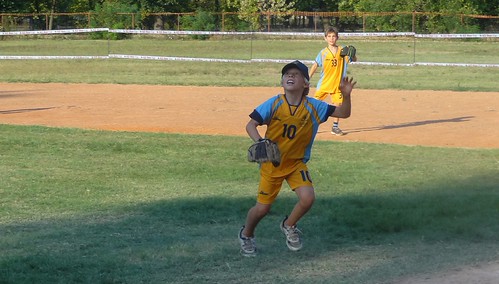
We played yesterday in the Tenth Belgrade Trophy Little League Baseball championship held at Ada Baseball Field. My friend Brian and I are coaching our sons and other international school students this summer. We got a team together to play some exhibition games in the tourney.
We played “The Alligators,” Novi Sad, and Bešereck, finishing with 1 win and 2 losses on the day. Owen made a couple of nice plays at first base and had a several hits, including a 2-RBI double to seal a victory against Bešereck.
I would like to thank Nikola Vučević, the organizer of the tourney and head of the Serbian Baseball Association for inviting us to play! He went out of his way to give our kids opportunities to play on the beautiful field and have some real games. Owen and his friends were so excited to wear uniforms (the old ISB MS volleyball uniforms) and compete. The day was funded by the city of Belgrade.
Despite the heat, it was a wonderful day. The first game we used a pitching machine against a much older team, and we soon found out we needed to switch to coaches pitching. In the second game we played against a team closer to our age, and in the third game, we played against a very good older club. Owen thought the highlight was Cody’s inside the park grand slam.
Owen’s first at bat!
With temperatures over 100F, after the game we cooled off in the river and had a nice BBQ meal at one of the restaurants at Ada.
We hope to play some more games before the cold weather sets in.
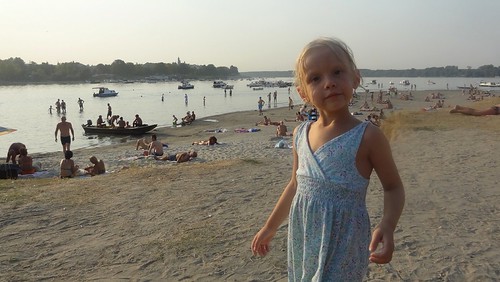
Last night after work, my daughter Ocean and I went to the Lido Beach on Great War Island. The island is in the middle of the Sava River, just upstream from Ada Ciganlija, near the Belgrade suburb of Zemun. During the summer months, the Serbian army erects a portable, pontoon bridge so people can cross and swim on the beach on the north tip of the island. During the other months, the small island is a Serbian military base and nature reserve for birds. It is called, Veliki Ratno Ostrva (Great War Island) because it was a strategic military point for the conquest or defense of Belgrade.
It is very shallow and no white sand, turquoise water of the Adriatic, but it does have a cool vibe and with temperatures over 100F, it was just as good as any Caribbean beach.
After a busy day at school with multiple meetings and the suffocating heat wave w are experiencing, it was nice to go to the beach, cool off, and just hang out with Ocean. She didn’t like the shells and rocky bits, but after awhile, got used to it. We bought some popcorn and then headed home. It was a brief respite from the busy school and family life I have.
Oliver is posing in the classic “Kralovec” family first day of school photo. My parents used to take a photo of us every year in front of our door my home with us leaning against the wall.
It was an historic day for our family as it was the first time all five of us went to the same school. My daughter Ocean was finally old enough to attend ISB and started Pre-Kindergarten today. The kids were all excited and Nadia and I were excited to get them all ready and out the door on time.
No matter how many years I am in education, the first day of school always holds a bit of nerves and excitement. It was a great day today.
A photo of a representation of the majority of the play in last night’s game. Short passing in the middle of the field, far away from the goal.
I have given up hope that soccer would be a pastime I can enjoy with my children. Once again, I sat through a 0-0 draw, with few chances from either team. Last Wednesday night, Serbia hosted Ireland in a friendly match as preparation for the upcoming World Cup Qualifying play starting next month.
Both Ireland and Serbia are those average small country European teams that usually don’t escape the first round of major tournaments and recently they have not performed all that great. Ireland lost three consecutive games in June’s Euro Cup and Serbia is 0-4 in their latest exhibition matches. The stadium was half full and the small contingent of Irish fans were making more noise than Serbian fans for most of the game. It was perfect however, for taking my boys.
Red Star stadium has a great atmosphere but they have a long way to go to make the experience a truly enjoyable one. The seats were hard plastic and many broken, the bathrooms are an absolute disaster, and there is no replays on the scoreboard screen. I don’t know how long it will take to get wireless internet.
I guess my main issue with soccer is it is too hard to score. No one on the field in the game could take the ball and manuever around a defender to take a shot at the goal. Instead it was the endless pass backwards to maintain possession and then as they try to set up a perfect shot in front of the goal, they got the ball stolen by a defender. This happened as the “attacker” play-acts and falls, desperate to get a penalty kick because it is so difficult to score in normal play. It has been 180 minutes plus of me watching this “ticky-tack” Spanish style possession play but without any real talent to drive and score. Don’t they understand that one needs to shoot the ball at the goal, regardless of the angle or distance if they want to score. The more shots that the goalkeeper has to stop, the greater the chance of scoring.
At least I got to spend time with my boys and ordering hot dogs and cokes kept them occupied through the whole game. I told myself I am swearing off going to the stadium as it is a waste of my time to be bored watch guys play keep-away. Will I change my mind for the World Cup Qualifiers?
Last weekend we went across the border to Timisoara, Romania to do some school shopping. It is only about a 1 and 1/2 hour or 2 hour drive away and has much better shopping than Belgrade. They have more products and many more deals. We went to the big Ilius Mall and we found many clothes for the kids and I also bought some work pants and shirts. I even found Moleskin® notebooks at a really cool book store. I think we liked the shopping so much because we dropped the kids off at the playland in the mall and had a relaxed time. We also did some grocery shopping at the Real supermarket and stocked up on high processed sugary breakfast cereals for the kids. The city is the fourth-largest city Romania with a population around 300,000 people. The 1989 revolution against the communist regime started in the city and it has more of an Austrian-Hungarian feel than the rest of Romania.
I strongly recommend Timisoara for Belgraders looking for a weekend get-away. Besides the shopping, we made a stop at the Banat Village Museum. The “Banat” is the region covering eastern Romania, western Hungary and northern Serbia. The museum is located in a park setting with examples of old homesteads from the different ethnic groups and time periods. It is nothing flashy, but is a nice spot for kids to run around. They had a great little pond, where the kids threw rocks and chased dragonflies.
Hanging out at the pond at the Banat Village Museum in Timisoara
Update (August 13, 2012) – In the return match, Red Star defeated Omonia 6-5 in penalty kicks to move on to the “playoff” round in the Europa League. I think it is a good strategy for Red Star, play for scoreless draws for 180 minutes plus extra time and then hope for the best in penalty kicks.
I attended the UEFA Europa League Third Round Qualifying Match between Red Star Belgrade and Omonia from Nicosia, Cyprus. It was a disappointing game with my scourge of soccer occurring, a scoreless 0-0 draw. Despite dominating the time of possession, Red Star must have had the ball around 80% of the time, they could not generate any real scoring threat with only one shot on target. Omonia, the most successful team in the history of the Cyprus league, was content to sit back and have the occasional counter attack. They were pleased with the draw in Belgrade and now await the return match in the Cypriot capital city of Nicosia.
It is nice to see Red Star in a European competition, even though the Europa League is not a prestigious as the Champions League, which Red Star won in that glorious season of 1991. They are a long way from that however, and it is a statement to how far the ex-Yugoslavian teams have fallen. They are now battling it out for the “scraps” of European glory, with the hundreds of minor clubs from the many small nations of Europe. Together, the ex-Yugoslavian teams were able to compete with the best teams, but today, with all separate nations, I don’t see any of them ever taking on the likes of Barcelona or Manchester United.
The match was basically meaningless because Red Star is still a long way from even getting to the group stage of the Europa League tourney. The qualifying rounds are quite complicated but I’ll try to explain them as best I can. For those of you who do not want the entire explanation, Red Star needs to win four rounds to get to the group stage of the Europa League.
First Qualifying Round – 54 teams play a home-and-away playoff to send 27 teams into the second qualifying round. Jagodina and Borac represented Serbia in this round with both teams losing.
Second Qualifying Round – The 27 teams from round one are joined by an new 53 teams from higher-ranked countries (UEFA ranks the quality of nation’s soccer association) or higher finishers in the lesser-ranked leagues. The 80 teams play a home-and-away round. Red Star and Omonia are 0-0 after the first leg of their series. The 40 winning teams move into the third qualifying round. All teams making it to the second round, get 90,000 Euros from UEFA plus the gate receipts from the game they host. In this second round, Red Star defeated Naftan Novopolotsk from Belarus 7-6 in aggregate goals, earning a 90,000 Euro bonus from UEFA.
Third Qualifying Round – An additional 30 teams from even higher-ranked leagues join at this stage the 40 qualified teams from the second round. Once again, a home-and-away leg is played and 35 teams move to the “Play-off” Round.Teams making the third round earn another 90,000 Euros. Red Star is currently in this round and will play at Omonia on August 9th.
Play-off Round – Another 41 or 43 teams join from even higher ranked league and teams that are knocked out early in the Champions League. The 74 or 76 teams once again play a home-and-away playoff and the 38 teams move to finally, the Group Stage of the Europa Tourney. This nets another 90,000 Euros from UEFA.
After playing a round-robin in the group stage, 32 teams go into a “knock-out” phase, and here teams start to earn bigger bonuses. Red Star last made it to the Group Stage in 2007-2008, but have not moved past the playoff round since then.
It all sounds to me a way for UEFA and the clubs to make money by all of these games. To make it through, Red Star would play an additional 20 games to win the whole thing. Serbia has a pretty good rank in UEFA’s system of coefficients. They are 16 of 53 associations, just behind the Ukraine and just ahead of Switzerland. Croatia is ranked 7 and the top ranking goes to of course Spain and the lowest ranking goes to San Marino. Cyprus is ranked 43.
It was pleasurable experience to watch the game last night, with a mostly full stadium and famous Red Star supporters Delije (heros) from the north section singing the entire game. Too bad the home team couldn’t give them a goal. It would be much more pleasurable if there was at least a regional league in the Balkans with the best players moving around to top clubs. More on that when the Serbian regular season begins shortly.





 Bill's Blog