Thoughts on Spain

Oliver Chases Ocean at Camp de Mer Beach

A few observations about Spain

  • The roads of the island have improved greatly since I was last here in 1997. Not only the roads, but the kilometers of bike and running paths. They are everywhere! This is great, but I wonder about the cost. For example, the pedestrian bridge over the highway must have been in the tens of thousands of dollars. I have also seen amazing municipal sports facilities. Near the suburb of Son Caliu where we are staying, there is a community swimming pool in Magaluf, an athletic track in Palma Nova, and an indoor pool and artificial turf soccer field in Santa Ponca. Who is paying for all this?
  • Last night about 9:30 PM, I went out looking to buy some milk, water, and bread. I could not find a single store open, only restaurants. The Latin American neighborhood “tienda” is not to be found in Spain. There is also a lack of outdoor markets.
  • Recycling seems to be very strong in Spain. I’ve seen glass, plastic, and metal bins conveniently located all over the island.
  • Spain consists of “Autonomous Communities” and it is not one legislative district. I thought it was only the Basque Country and Catalonia, but there are 17 “states” including the Balearic Islands. They had a graphic in the Mallorcan paper that showed the Spanish debt divided by autonomous region. The largest debtors are Cataluña and Comunidad Valenciana, that combined have 60% of total 36 billion euro debt.
  • One of the Spanish Royal family is under investigation for transferring funds to a Swiss bank account to avoid taxes. I feel royalty is an outdated concept. The idea that a family, and whoever marries into the family, is somehow special or made to rule by divine right is ridiculous. I don’t understand what benefits European countries get from having the tax payers support monarchies. Perhaps the English royal family brings in enough tourist dollars to justify their existence, but I can’t believe the rest are self-sufficient. I would strip them of all titles, make them get real jobs, and convert all assests into the public good.
Camp de Mer Beach – Mallorca, Spain


Latest Reading: R.A. Dickey

I just finished reading “Wherever I Wind Up: My Quest for Truth, Authenticity, and the Perfect Knuckleball” by New York Mets pitcher, R.A. Dickey and Wayne Coffey. I follow baseball and really enjoyed the book. Dickey made his first All Star Game this year at the improbable age of 37 and he is an interesting story.

One thing I got from the book is how hard it is to become a Major League Baseball professional player. Dickey was a highly recruited high school sports star, an All-American  pitcher at the University of Tennessee, played in the Olympics, but yet, was not quite good enough to be a consistent Major League pitcher. He was a “4A” pitcher, which meant that he was very good at the Minor League Baseball level (3A) but not quite good enough to stay as a player on a Major League club. He spent over 10 years on minor league baseball teams with some call ups to the big league, but always at the end of the season, he was back down in the minors. It was not until he changed to a knuckleball pitcher, that he become a solid professional and eventually an All Star pitcher. The book details his work in perfecting a difficult pitch over years of trying.

The book also describes his overcoming a poor, rough childhood, and maturing into husband and father. His honesty at his mistakes and overcoming sexual abuse, an alcoholic mother, absent father, and marrying young, are truly inspiring. The book made me want to be more patient and loving with my wife and children, and more open to the moment and enjoying every experience. He used counseling and his Christian faith to overcome his challenges. Although for most people, including myself, earning an athletic scholarship, participating in the Olympics, and even getting to play a single game in the Majors would be enough. But after reading about his struggles, it is good that he got the reward of a multi-million dollar contract. It is refreshing to have an athlete be smart and thoughtful and with help of Wayne Coffey, write an interesting book. I recommend it. 

Weekend In Mallorca

We spent the weekend exploring the remote beaches on the north coast of the island. We found the perfect wave beach for the kids near Alcudia. It was their first time in waves and they absolutely loved it. The waves were a perfect size for kids and the beach had a sandy bottom. It was a wind surf and parasail area with probably 50 people practicing the sport on the long beach. We then drove out to the end of the Cap de Formentor and soaked in the spectacular views of limestone cliffs, deep blue sea and green hillsides. The protected areas on the north coast are absolutely beautiful and I hope they can keep them wild.

On Sunday we visited Cala Torta. It was a windy day and the beach was closed to swimming when we arrived. The waves were immense. We hiked along the ridges, and when the lifeguard left, we got into the water a bit. The waves were so high, that I didn’t dare let the kids go out past their knees. We had a lot of laughs as the immense waves crashed on the beach and knocked us off our feet.


The kids are really improving their swimming. We have a pool next to the apartments where the kids could spend literally all day in. Owen learned to dive and Ollie can now jump into the deep part and swim to the side. Ocean can also jump in the deep end, but is a bit more cautious and only does it right next to the side. She does a front flip underwater.

The Son Caliu suburb of Palma where we are staying, has a lot of running/bike paths. As I wrote earlier, I am very impressed with the infrastructure of Mallorca.

I read an article yesterday in the Diaro de Mallorca (Mallorcan Daily) that discussed the economy of the island. In 2001 the Balearic Islands (Mallorca, Menorca, Ibiza) had 526 hotels that stayed open during the winter months (November to Easter) with an occupancy rate of around 50%. Last winter, 2011-2012, the number of hotels that were open year round had dropped to 126 with an occupancy rate of 32%. They are expecting even lower numbers for 2012-2013. This of course is not good for the islands as people have to make due on 7-8 months of salary. The reason less tourists are coming to the islands are the rising costs and competition from warmer places. Before switching from the peseta to the euro, it was cheaper for Germans and Brits to spend 15 days in Mallorca than in their home countries. Today, it is just as expensive. Also, places like Egypt, Tunisia, etc. are now less expensive than Spain. There was a another article with complaints from the golf industry, that the government is raising the IVA (sales tax) from 8 to 20% on a round of golf. In Europe, these government sales taxes of above 15% are ridiculous. I used to think the Canadian 13% was excessive (to give some perspective, in my home state of Michigan, the sales tax was raised from 4 to 6%) before I moved to Europe.

Spain fell into the same trap as the US did regarding the economic crisis. Many people thought they could become rich quickly through investing in real estate and many got in over their heads. The banks made bad loans and now Spain is receiving bailouts from the IMF and the Central Bank. I have noticed less people in downtown Mallorca and shops either closed or offering discounts. I think the island is adjusting to the lower number of tourists and there will be hotels and shops that go out of business.

Filming of Montevideo Continues


I had another day of filming yesterday on the set of the Serbian blockbuster, the sequel to the film Montevideo: Bog Te Video, a film directed by Dragan Bjelogrilić and produced by Intermedian Network. The film is about the 1930 Yugoslavian Soccer Team that participated in the first World Cup in Uruguay. I am above with my photo with some of the “Bolivian” extras. They were actually the darkest Serbian soccer players they could find. Yugoslavia defeated Bolivia 4-0 in that first World Cup.

Throw-In for Jugoslavia

It was an great experience to play a small role in the film as the American Radio Commentator. I learned a lot about the film industry. Roberto, a Spanish actor, said one of the virtues of a good actor is the ability to wait. I sat around most of the day as they were filming game sequences and it wasn’t until twilight that the directors got to the parts in the radio booth. Hopefully, some of my scenes will make the final cut!

I can’t get over the attention to detail and the big cost and logistics that goes into making a film, especially a period piece like this one. I have a new respect for film and understand why they need to charge money to see the picture.

I met some of the main actors and everyone, from the make-up and costumes, to the director and camera-crew were first-class and extremely helpful. I am sad I couldn’t stay to see Armand Assante tomorrow play his role in film.

Filming wraps up this week at the stadium and then moves to a few days at a hotel in Belgrade and then on to Trieste, Italy for another week. The picture will debut at the Sava Center in Belgrade in December or January.

Jakšić Goes Down

Family Journal: Bike Riding With the Boys

Oliver, originally uploaded by bill kralovec.

There are moments that you wish could last forever. The past few days I’ve been taking out Owen and Oliver for bike rides. At first they were complaining, but yesterday they asked me to take them out and we had a lot of fun. Belgrade has kilometers of bike paths around the city, either along the river, in New Belgrade, or in several forested parks. I would like to see even more, but compared to other international places I have lived, we are blessed to have so many kilometers to safely ride. The city could even put up more bike paths as evidenced by the many people riding.

Oliver is shown above at Ada Ciganlija after we took a swim to cool off from the ride. I would love to re-live these bike rides- as the kids are growing up fast and these opportunities will be fleeting as they get older.

We also spent the week improving our tennis games with coach Mili. He is teaching us the Split Method for forehands and backhands. I can’t recommend him enough and I’ll be blogging about it later. Below is a photo of Owen working with him yesterday.

Zemun Quay

Dinner Along the Danube, originally uploaded by bill kralovec.

We went out to eat last night at the restaurant Šaran on the Zemun Quay. It was such a pleasant experience, I had to blog about it.

Zemun used to a separate city from Belgrade, but is now one of the 17 municipalities of Belgrade. It has a slightly different feel (architecture) than Belgrade, being under the Austrian-Hungarian Empire influence for a long time.

Zemun was founded on the banks of the Danube River, on three hills. There is a nice riverfront area of restaurants, that with a few modifications, could be made even nicer, and perhaps another attraction like Kalamegdan or St. Sava’s Church.

There are quaintly, slightly decrepit buildings, small fisherman’s boats, cobblestones, trees, and breeze coming off the river, with the view of a green opposite bank. One feels like it could be a Greek island waterfront, or a neighborhood of Venice. There were old men sitting on tables in front of dimly lit cafes, having a drink and some laughs. The restaurants in the summer have temporary dining areas along the river, outside of their main buildings. Many have live music. Besides diners and cafe-goers, there were families going for a walk along the quay, fishermen coming back from a day on the river, etc. It is perhaps a bit like San Francisco’s Fishermen’s Wharf before it became a tourist trap.

They can improve the area by stopping cars from entering the cobblestone street along side the quay. There are several areas nearby that could be developed as parking areas. We saw they were improving the walking paths along the quay and this would also help, especially if they can figure out a walking path up to the Gardoš Tower, which is a short two blocks from the river. There are also potential green areas further up the river bank that could be included in the quay area. Further down river there is the Grand Casino, more riverside parks, Great War Islands, with Lido Beach, and many great “splavs” – restaurants and night clubs on stillts on the river – also close by and with some creative development, could be connected to the Zemun Quay. It could be a good alternative to the downtown Bohemian Restaurant district of Skadarlija.

The food was good at Šaran and we had the best waiter I’ve encountered in Belgrade, Some of the dishes were a bit over-salted for our taste, but overall a fantastic meal.

Beating The Heat


Since we got back from Greece earlier this month, Serbia has had very hot weather. Everyday it has been in the high 80’s and 90’s (F) topping 100 F on several occasions. There also has been a lack of rain and lawns not watered are yellow and the clay soils of Serbia are cracking.

We’ve been finding ways to cool off each day and these include swimming at Ada (above) or going to pools and eating plenty of ice cream.

We are trying to do all of the traditional summer activities like swimming, eating watermelon, playing baseball, etc. The family is enjoying time together and we are all looking forward to our next adventure of a couple of weeks in Mallorca, Spain.

The kids at the Kosutnjak Pool

Latest Reading: “Running With the Kenyans” by Adharanand Finn

Lining Up Behind the Kenyans in the 2009 Belgrade Marathon

I completed reading “Running With the Kenyans: Passion, Adventure, and the Secrets of the Fastest People on Earth” by the Guardian Editor and freelance journalist, Adharanand Finn. The 37 year old took his family to live six months in the Mecca of distance running, a village in the Rift Valley called Iten.

Finn was a pretty good runner in high school and wanted to find out why the Kenyans dominate distance running. For the past 20 years or so, almost every medal and marathon has been won by the Kenyans. They really took out everyone and truly dominate the sport.

The book was a quick read and I was interested to see what Finn found out and how much he improved himself. He formed a team while there and ran in the Lewa Marathon, a race through a National Park in eastern Kenya. I learned much about Kenya and I’ll be watching the distance running in this month’s Olympics with greater interest.

Why are the Kenyans the best distance runners in the world? Finn writes that there is no one secret practice or distance running genes, but a combination of things.

  • The country’s favorite sport is distance running and it would be like soccer in Brazil or cross-country skiing in Norway, they are fanatical about it. I didn’t realize Kenya was so big, with a population of 43 million. Cross-country races and track meets are huge events, widely followed in the country with television coverage and fans in makeshift stadiums.
  • Most of the runners come from poor villages where the children run barefoot to school, eat a spartan diet, and generally have a tough and active upbringing. They view running as a “way out” of poverty and if selected to compete in international events, the prize money from say the New York Marathon, can buy them a house and a herd of cows. They spend their days digging in the fields, herding goats, etc, while children in the west are playing Xbox, eating high-fat foods, and getting soft.
  • Once they are selected, they devote their lives to running. This means outside of running, they only rest, eat a restricted diet, and focus on getting better times. They do not work, go to school, etc. All of this running is done at altitude, which also helps them get more red blood cells.
  • There is a genetic component. As you can see in the photo below taken this year’s Belgrade Marathon, they are very thin and all arms and legs. My Slavic upper body bulk doesn’t look as sleek as the Kenyan running machine. Most of the Kenyan’s world class runners are from the ethnic group, Kalenjin and they live in the Rift Valley.

I don’t see how Europe or USA can take back distance running and overcome the Kenyans. I also see a bit of backlash, as people note who is the first non-Kenyan in the race and celebrate that finish. I wonder how long their world dominance can continue?

I recommend the book to others. I enjoy reading about sports, especially sports that I participate in. The book inspired me to run more and I have this summer.

Apricots – Kajsija


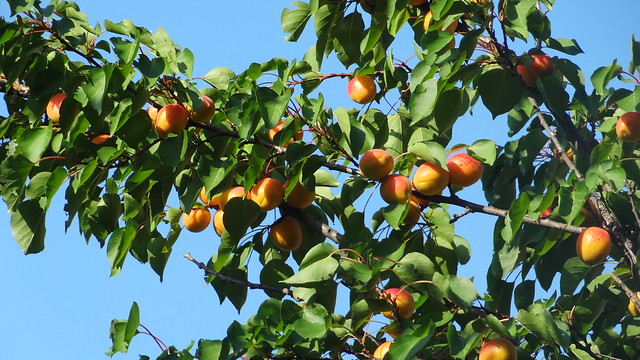
Another of Belgrade’s summer pleasures are apricots. Nadia is shown with several I picked from a tree in our yard. We’ve been eating a lot of them and Nadia made the best jam preserve with 12 kilos I bought from the Senjak market.

Apricots have been around a long time so the origin of the tree is a bit unclear. The scientific name (Prunus armeniaca) indicates they originated in Armenia, but there are experts who theorize India, and China as well. It is a member of the plum family and the common name, apricot, comes from Pliny The Elder, the Roman naturalist over 2000 years ago.

The apricot is high in antioxidants and fiber, so it is very healthy to eat. It is supposed to reduce bad cholesterol so I try to eat them daily while they are in season.

After my run yesterday, I stuck my head under the hose and looked up and saw the tree. I picked an apricot and it was absolutely delicious. It may have been a runner’s high, but I paused to acknowledge the refreshing taste of the apricot, or the Armenian plum!

In Serbian they are known as kasija, and of course, the Serbs distill an excellent brandy from the fruit, known as kajsijevača.

Tennis in Belgrade


We are loving the newly finished tennis courts at the school. Last month the courts were completed on the roof of the gymnasium and they are absolutely spectacular. The best thing about the courts is they are free to use, which is rare in Belgrade. All tennis courts in the city are privately owned and have rental fees ranging from 6 to 12 euros an hour, depending on quality and time of day. That is if you can find an available time.

With Novak Djokovic and the other Serbian professionals in the Top 20 of world tennis, the game has become very popular in Serbia. It is a shame that the city does not build public courts for citizens to use. Tennis is expensive as it is with equipment, coaching, etc. and to not have access to free courts, Serbia is not fully developing its potential. If I was mayor, I would start putting some courts in.

Owen Practices His Serve

Most of the courts in the city are clay and the school’s court is a hard court surface. They are perched on the roof, overlooking the valley towards Košutnjak Park and the view is breathtaking. They also have lights so we have been playing every night. I need to get Owen and Oliver into a club and some coaching as all three of my children love the game! Owen and I actually played our first set of tennis on the big courts, I won 6-1. I need to savor this victory as soon enough, the boys will be beating me on a regular basis.

We have been following closely the Wimbledon Championships. Too bad Nole lost to Federer in the semifinals. We are cheering for Andy Murray to be the first UK citizen to win since 1936 in today’s final.

Nemanja Serving