Since we got back from Greece earlier this month, Serbia has had very hot weather. Everyday it has been in the high 80’s and 90’s (F) topping 100 F on several occasions. There also has been a lack of rain and lawns not watered are yellow and the clay soils of Serbia are cracking.
We’ve been finding ways to cool off each day and these include swimming at Ada (above) or going to pools and eating plenty of ice cream.
We are trying to do all of the traditional summer activities like swimming, eating watermelon, playing baseball, etc. The family is enjoying time together and we are all looking forward to our next adventure of a couple of weeks in Mallorca, Spain.
Lining Up Behind the Kenyans in the 2009 Belgrade Marathon
I completed reading “Running With the Kenyans: Passion, Adventure, and the Secrets of the Fastest People on Earth” by the Guardian Editor and freelance journalist, Adharanand Finn. The 37 year old took his family to live six months in the Mecca of distance running, a village in the Rift Valley called Iten.
Finn was a pretty good runner in high school and wanted to find out why the Kenyans dominate distance running. For the past 20 years or so, almost every medal and marathon has been won by the Kenyans. They really took out everyone and truly dominate the sport.
The book was a quick read and I was interested to see what Finn found out and how much he improved himself. He formed a team while there and ran in the Lewa Marathon, a race through a National Park in eastern Kenya. I learned much about Kenya and I’ll be watching the distance running in this month’s Olympics with greater interest.
Why are the Kenyans the best distance runners in the world? Finn writes that there is no one secret practice or distance running genes, but a combination of things.
The country’s favorite sport is distance running and it would be like soccer in Brazil or cross-country skiing in Norway, they are fanatical about it. I didn’t realize Kenya was so big, with a population of 43 million. Cross-country races and track meets are huge events, widely followed in the country with television coverage and fans in makeshift stadiums.
Most of the runners come from poor villages where the children run barefoot to school, eat a spartan diet, and generally have a tough and active upbringing. They view running as a “way out” of poverty and if selected to compete in international events, the prize money from say the New York Marathon, can buy them a house and a herd of cows. They spend their days digging in the fields, herding goats, etc, while children in the west are playing Xbox, eating high-fat foods, and getting soft.
Once they are selected, they devote their lives to running. This means outside of running, they only rest, eat a restricted diet, and focus on getting better times. They do not work, go to school, etc. All of this running is done at altitude, which also helps them get more red blood cells.
There is a genetic component. As you can see in the photo below taken this year’s Belgrade Marathon, they are very thin and all arms and legs. My Slavic upper body bulk doesn’t look as sleek as the Kenyan running machine. Most of the Kenyan’s world class runners are from the ethnic group, Kalenjin and they live in the Rift Valley.
I don’t see how Europe or USA can take back distance running and overcome the Kenyans. I also see a bit of backlash, as people note who is the first non-Kenyan in the race and celebrate that finish. I wonder how long their world dominance can continue?
I recommend the book to others. I enjoy reading about sports, especially sports that I participate in. The book inspired me to run more and I have this summer.
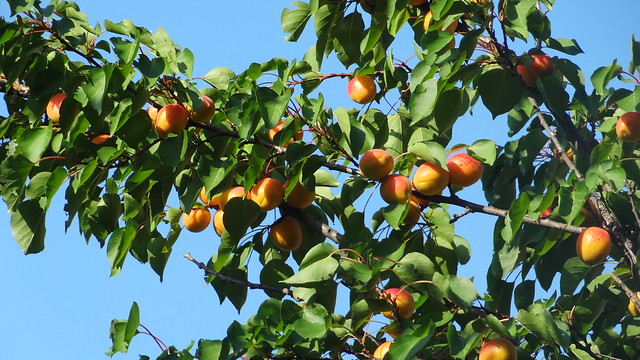
Another of Belgrade’s summer pleasures are apricots. Nadia is shown with several I picked from a tree in our yard. We’ve been eating a lot of them and Nadia made the best jam preserve with 12 kilos I bought from the Senjak market.
Apricots have been around a long time so the origin of the tree is a bit unclear. The scientific name (Prunus armeniaca) indicates they originated in Armenia, but there are experts who theorize India, and China as well. It is a member of the plum family and the common name, apricot, comes from Pliny The Elder, the Roman naturalist over 2000 years ago.
The apricot is high in antioxidants and fiber, so it is very healthy to eat. It is supposed to reduce bad cholesterol so I try to eat them daily while they are in season.
After my run yesterday, I stuck my head under the hose and looked up and saw the tree. I picked an apricot and it was absolutely delicious. It may have been a runner’s high, but I paused to acknowledge the refreshing taste of the apricot, or the Armenian plum!
In Serbian they are known as kasija, and of course, the Serbs distill an excellent brandy from the fruit, known as kajsijevača.
We are loving the newly finished tennis courts at the school. Last month the courts were completed on the roof of the gymnasium and they are absolutely spectacular. The best thing about the courts is they are free to use, which is rare in Belgrade. All tennis courts in the city are privately owned and have rental fees ranging from 6 to 12 euros an hour, depending on quality and time of day. That is if you can find an available time.
With Novak Djokovic and the other Serbian professionals in the Top 20 of world tennis, the game has become very popular in Serbia. It is a shame that the city does not build public courts for citizens to use. Tennis is expensive as it is with equipment, coaching, etc. and to not have access to free courts, Serbia is not fully developing its potential. If I was mayor, I would start putting some courts in.
Owen Practices His Serve
Most of the courts in the city are clay and the school’s court is a hard court surface. They are perched on the roof, overlooking the valley towards Košutnjak Park and the view is breathtaking. They also have lights so we have been playing every night. I need to get Owen and Oliver into a club and some coaching as all three of my children love the game! Owen and I actually played our first set of tennis on the big courts, I won 6-1. I need to savor this victory as soon enough, the boys will be beating me on a regular basis.
We have been following closely the Wimbledon Championships. Too bad Nole lost to Federer in the semifinals. We are cheering for Andy Murray to be the first UK citizen to win since 1936 in today’s final.
Earlier this week I snapped this photo from my balcony in Dedinje. Two planes were flying over the suburb spraying chemicals against mosquitoes. I’ve seen them do this in previous years over the Sava River and Ada Ciganlija, but never over my neighborhood. As you can see, they were quite close to the ground and were covering the area in a grid pattern.
I am wondering what chemicals are being sprayed and are there harmful side effects? There was an short news item in the Belgrade Insight this week stating that a full analysis of the spray will be done in 2013. Why so long?
In my research on line, I see that the Swedish Chemical Agency is working with the Serbian government on this to have Serbia comply with EU standards on mosquito control. Here is a powerpoint presentation done by Lilian Tornqvist regarding the Belgrade spraying. She points out that one of the chemicals, Lambda cyhalothrin, is a carcinogen. If any of my readers have more information, I would be interested. I’ll be following this story.
Above is a photo of the Hotel Petrus in Paraćin, Serbia. We stayed in the hotel during the shooting of the movie. What an architectural classic of Socialist Realism! Besides being an awesome monument to the communist era of Yugoslavia, it was a nice place to stay. It is located on the river and has a very pleasant restaurant overlooking the river. Another cool thing about the hotel are the hallways, that go in a complete circle on each floor. I will never stay in a hotel like that again. The stairs and elevators are in the center of the tower. I would have loved to explored the roof and basement of this hotel. I made a video (link here) of a bit of the inside of the hotel.
The city had a great vibe. There is a walking street nearby and lots of people were out and about. Across the river the hotel, there is a nice Serbian Orthodox Church (St. ) and another Socialist classic, this fine statue commemorating 30 years of “freedom” after World War II. The communist youth figures are holding up a bright red flame. They look more like Atlas than figures happy to be free. The concrete, box apartments in the background complete the scene.
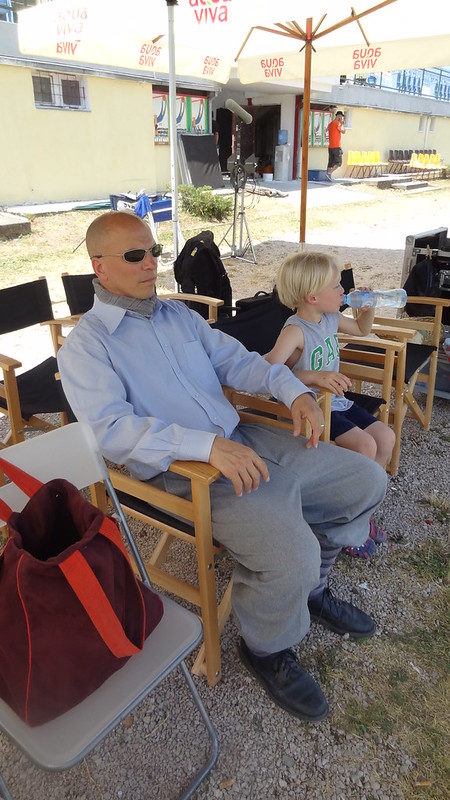
Last week I had the opportunity to act in Montevideo: Taste of a Dream. This is a project being done by the Intermedia Network and includes a book, documentary, television series and two feature films. It is the story of Jugoslavia’s participation in the inaugural soccer World Cup of 1930. It follows the formation of the team in Belgrade, to them eventually playing Brazil in their first game of the tournament. My role was the American Radio Commentator and with luck, a few bit parts will appear in the final edit of the movie. This is the sequel they are filming and it should come out in December or January.
The soccer scenes are taking place in Paraćin, Serbia, a small city (population 25,000) located in central, south, Serbia. The producers have renovated the local soccer stadium to look like Centennial Stadium of Montevideo, Uruguay in 1930, the host to the World Cup. I love sports and Serbia, so this project was a labor of love. The movie people treated me and my family very kindly and I had a great two days of filming. It was extremely hot and the make up people worked hard to keep me sweat-free for my parts. I realized how much goes into filming a movie, especially a period piece with hundreds of extras. A great amount of patience and attention to detail needs to go into it.
Owen, Ollie, and Ocean played a lot of soccer on the field during the filming in the bleachers.
I would like to thank Vlada, Dragan, and Srdjan for their patience with me and their hospitality. It is a worthy project and I am happy they are bringing this obscure story to modern audiences and so it does not become lost. I’ll be blogging a bit more about this project as it continues.
On our way home from Greece we spent the night in Greece’s second largest city, Thessaloniki. I wanted to learn a bit more about Greece outside of the resort areas.
We didn’t have a great first impression. The city was very crowded and I guess the best term that comes to mind is “seedy,” and it had a much different feel than Belgrade.
It reminded me a bit of my time on the north coast of Colombia and the cities of Cartagena and Barranquilla. The uneven sidewalks, the many apartments close to the street, and the hot, humid weather, brought me back to Colombia. We also stood out with blonde children and I really felt we were in a foreign land.
I was also taken aback by the aggressiveness of the people. For example, we stopped at a roadside fruit stand and I inquired about purchasing a watermelon. When I decided not to purchase one, saying it was too expensive, the vendor flipped out, gesticulating with much anger and shouting. His colleague also gave me a dirty look and a masturbation sign. All over a watermelon???
Negative impressions aside, I did see the appeal to the city. It had a sensual side, with many young people, a proliferation of bars and cafes, and I would guess for a young, single, man, that Thessaloniki would have its charms. Across the street from the hotel there was an impressive theater and contemporary art museum. I also would have loved to stay for the International Hellenic University’s symposium on the Jewish heritage of Salonica. So it does have its cultural and intellectual side.
The busy waterfront at sunset.
However, I don’t think it would be a good place for children. The crowded streets would be hazardous for running and there was not a lot of green space. I was also surprised at the lack of people who spoke English. I would guess that the education in the local area is not great, or maybe it is something with the Greek culture?
A typical street scene in Thessaloniki
In speaking with the locals about the economic crisis, they were concerned. An owner of toy store said that his business has been down for the past three years. He said with so many people out of work, toys are not one of the essentials. Several people predicted the government would drop the Euro and go back to the Drachma. Others mentioned they couldn’t do anything about it, and were more focused on their daily lives.
Thessaloniki is only seven hours’ drive from Belgrade, but a world apart.
We took a day trip to Diaporos Island, the largest of the nine islands off the coast near our hotel. The boys enjoyed snorkeling and exploring the island. It was very relaxing. The islands and the area remind me of the Mochima National Park in Venezuela. The blue waters and hot, dry climate are reminiscent of our times there. I was not impressed with the amount of garbage on the bottom of the sea and on the islands themselves. A cleanup and an environmental consciousness needs to be brought forth in this area.
We left Vourvourou for a day in Thessaloniki. We packed up and said goodbye to the Ekies Resort. I would highly recommend the hotel. It was perfect for kids with a pool, sandy beach in a protected cove, and other stuff for them to do like a trampoline, billiards, etc. The food was delicious and the design of the rooms, restaurant, and beach front was perfect! We would definitely go back.
It is nice to have beaches like this a day’s drive from Belgrade. I can see why so many Serbs travel to Greece for the summer holidays. It would be like driving from Michigan to Cancun, Mexico in one day.
As you can see, it is quite beautiful on the Aegean Sea. I’ve been reading about Greece’s economic problems and the recent elections recently in Slate and in the Wall Street Journal . I also read Robert Kaplan’s Greek chapters in his book, Balkan Ghosts: A Journey Through History. Below are my thoughts on the country and the things I have learned. Note that I’ve only been in the resort for a few days and have only spoken to employees, so this is no way an informed or experienced view. The purpose of this post is to crystallize my opinions of Greece.
I learned that the Greeks refer to themselves as Hellenes and the country Hellas. “Greek” is a corrupted form of the Turkish word for dog or slave.
I agree with Kaplan that Greece is more Balkan than Mediterranean. That is if you can define a place with those two “adjectives.” He means Balkan in that Greece is the mother Orthodox Church, from which the other Balkan Orthodox Churches were developed (Serbia, Macedonia, Bulgaria, Romania), the Byzantine Empire, which shaped the cultures of the Balkans, was basically a Greek Empire, with its capital being Constantinople, and also the Cyrillic Alphabets in the Balkans are also of Greek origin.
Salonika, or today known as Thessaloniki, used to be a predominately Jewish city. Jews found refuge in the city from 140BC to 1500 AD. 96.5 percent of them were wiped out by the Nazis at Auschwitz and other camps. With hundreds of thousands of Greek refugees fleeing Ataturk filling the city, any trace of the Jews in Salonika is gone.
I can see why the Greeks hate the Turks so much. I didn’t realize that Constantinople was a Greek city and the Hagia Sophia was built by the Byzantines in 500 AD. Ataturk wreaked havoc on the Greeks living in Asia Minor and the Greek city of Smyrna is today 100% Turk and named Izmir.
Most people do not know much about the recent history of Greece. The 20th century had lots of war and bad government. Kaplan had a good quote, “It had become just another Eastern European country: its population emerging, completely bewildered, into an unsentimental world where efficiency and hard work, rather than notions of past glory and philotimo were all that mattered.”
Like many nations, or states, or city governments, Greece needs to balance their budget. They spend wastefully and owe Germany and the European Union a lot of money, with a huge debt. This past quarter, unemployment in Greece was over 22%, which is twice as much as usual. It is however, a quite developed nation and I’ve seen good infrastructure and definitely not Third World. Greece has come a long way since the days of terrorist bombings in the 70’s and 80’s. I don’t envy the new Prime Minister, Antonis Samaras’s job. He and his colleagues need to make the government more efficient, protect the poor, find jobs for young people, and negotiate with the IMF and European Central Bank about the bailout and balancing the budget over time. Yikes!






 Bill's Blog